
A longer ingredient list can look more scientific, but it often makes a protocol harder to evaluate. Sleep, exercise, nutrition, and blood-pressure management may seem less exciting than a peptide stack, yet the central question is the same for every choice: what human outcome supports it, what oversight does it need, and what can’t it prove?
A useful longevity protocol is a written plan, not a shopping list. It names the behaviors or products, when they’re used, when to pause, and which health measures will help judge what happened. A training plan makes the distinction clear: completing every session demonstrates adherence, not that the plan lengthens life.
Table of Contents
- What a Longevity Protocol Can and Cannot Claim
- Evidence Levels for Common Longevity Interventions
- Calerie and Public Protocols as Worked Examples
- Measures That Show Change Better Than One Clock
- Schedule Parts Every Protocol Should Name
- Safety Limits When Interventions Get Stacked
- Write the Record Before the Next Change
What a Longevity Protocol Can and Cannot Claim
A polished multi-compound routine isn’t automatically more scientific than consistent sleep, training, and blood-pressure control. A longevity protocol is best understood as a structured way to manage behaviors, exposures, and health indicators, while recognizing that many interventions remain investigational.
The field has moved from studying longer life expectancy at the population level to geroscience, which examines whether aging biology and multiple chronic diseases can be delayed together. The review of the development of longevity science describes how the hallmarks of aging framework, published in 2013, and the pillars of aging concept, published in 2014, helped give researchers a shared way to organize questions about aging. That’s a research framework, not proof that any single regimen adds years to a person’s life.
Researchers also use biomarkers to estimate biological age or the pace of aging. These measures can help assess whether an intervention is associated with a change in a biological trajectory. But a change in a biomarker isn’t equivalent to a demonstrated increase in lifespan.
The useful distinction: A protocol can show what someone did and what changed alongside it. It can’t, by itself, prove that the protocol caused the change or extended life.
No routine here is a proven human lifespan treatment. That doesn’t make every intervention equally speculative: some have established clinical uses or measurable health outcomes, while others rely on early research, proposed mechanisms, or anecdotes. Before copying a public routine, sort each ingredient by its human evidence, regulatory status, required oversight, and the specific claim it can support.
Evidence Levels for Common Longevity Interventions
Read each row from left to right: what the intervention is, what human evidence can signal, who should oversee it, and what it doesn’t prove. That final column matters. A real clinical benefit for one condition doesn’t automatically establish that a product slows aging.
| Intervention | Type | Human evidence signal | Oversight | Don’t treat it as |
|---|---|---|---|---|
| About 12% calorie reduction | Lifestyle | CALERIE found changes in aging-related measures; lifespan data are absent | Self-directed food change; clinician if underweight or ill | A proven way to live longer |
| Aerobic and resistance exercise | Lifestyle | Fitness, strength, waist, and cardiometabolic endpoints | Coaching, plus clinician if there’s cardiac risk | A drug substitute |
| Mediterranean or plant-forward eating | Lifestyle | Diet-pattern trials, not lifespan proof | Usual nutrition care | A supplement stack |
| Sleep, blood pressure, lipids, glucose, no smoking | Clinical foundations | Standard preventive medicine | Primary clinician | An optional biohack |
| Metformin | Prescription | Prevention benefit without diabetes or prediabetes remains uncertain | Prescriber and lab monitoring | An over-the-counter anti-aging pill |
| Semaglutide or tirzepatide | Prescription peptide drugs | Weight and glycemic outcomes when indicated | Prescriber; avoid unapproved copies | Proof that aging slowed |
| Rapamycin | Prescription, often off-label | Limited human aging-outcome data | Specialist supervision | A casual add-on |
| NAD+ boosters | Supplement | Weak evidence for hard outcomes | Buyer caution; tell the clinician | A validated protocol |
| Experimental or research peptides | Often unapproved | Mostly anecdote or preclinical evidence | Don’t self-prescribe | Safe because a schedule exists online |
Lifestyle foundations are a sensible place to begin because they focus on health measures that clinicians can assess directly. For sleep, a practical guide to prioritize sleep for a healthier life can help turn a vague intention into routines around sleep timing and the sleep environment. Keep the goal concrete: better sleep habits, improved fitness, or management of a known risk factor, rather than a promise of a longer lifespan.
Prescription medicines belong in a different category from supplements and online products. Metformin isn’t a general anti-aging supplement, and its expected prevention benefit is uncertain in people without diabetes or prediabetes. Semaglutide and tirzepatide have clinical roles when prescribed for appropriate indications, but an approved medicine and a product sold online under a similar name aren’t interchangeable.
In February 2025, the U.S. FDA’s warning to a peptide seller said unapproved semaglutide and tirzepatide products may be contaminated, counterfeit, contain inconsistent amounts of active ingredients, or contain entirely different ingredients. “Not approved for human use” doesn’t mean “probably safe.” Rapamycin, NAD+ boosters, and experimental peptides require still more caution because interest in a mechanism or a proposed benefit isn’t the same as strong human-outcome evidence.
If two changes could explain a result, don’t add a third compound to find out. Keep the plan simple enough that you and your clinician can interpret what happens.
Calerie and Public Protocols as Worked Examples
Public longevity examples usually get judged by fame when they should be judged by design. CALERIE earns attention because it states a target, records what participants achieved, and keeps the conclusion inside the evidence.

The National Institute on Aging’s account of CALERIE describes a randomized trial of 218 healthy, non-obese adults followed for two years. Participants were assigned to a calorie-restriction program or a usual-diet control group. The program aimed for a 25% reduction in calorie intake; participants achieved an average reduction of approximately 12% and sustained about a 10% reduction in body weight.
That design works closer to a single-variable experiment than a kitchen-sink routine. Reports from the trial describe improvements in several aging-related physiological measures and no clear worsening of psychological or behavioral outcomes. A later biological-age estimate pointed to a slower estimated pace of aging in the restriction group than in controls. Those are changes in measures, not proof that calorie restriction lengthens human life. The NIA summary says direct human data linking calorie restriction to longer survival remain unavailable.
The public routines associated with figures such as David Sinclair and Bryan Johnson show how celebrity protocols attract attention. Their ingredient lists should not be treated as prescriptions: one person’s routine cannot establish that each component is safe or effective for someone else. Before scheduling matters, every component needs two labels: the human outcome evidence behind it, and its regulatory status. A 2024 survey of longevity clinicians found that 65% believed Bryan Johnson adds value to the longevity field, according to Longevity.Technology’s coverage. That reflects clinicians’ views of his contribution to the field, not clinical evidence that a particular routine improves health outcomes.
A long list of compounds can blur cause and effect: which change moved a measurement, which one caused a side effect, whether a pause mattered. CALERIE offers the more useful model to borrow: define one intervention, measure what happens, and state what the result cannot show.
For a visual introduction to the trial, this video offers another way to explore the example:
Measures That Show Change Better Than One Clock
Think of an aging biomarker like a bathroom scale. One scale might help estimate who could face health problems later; another needs to move when diet or activity changes. A measure that predicts future risk can be useful, but that doesn’t mean it reliably shows whether a particular intervention worked.
A 2026 Nature Medicine analysis summarized by Yale evaluated 111 DNA-methylation biomarkers, including 16 commonly used epigenetic clocks, across 51 longitudinal human intervention studies. The interventions included calorie restriction, fasting, exercise, diet patterns, medicines, bariatric surgery, and smoking cessation. Many biomarkers could predict future outcomes but didn’t consistently respond to interventions. Measures designed to estimate the pace of aging or mortality risk showed more consistent responsiveness.
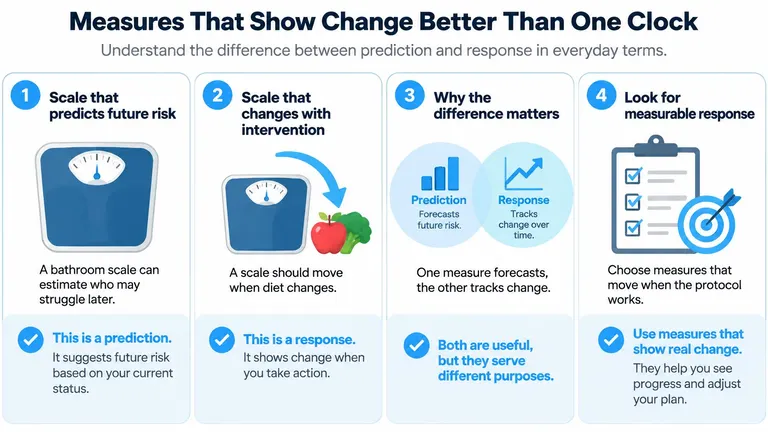
That’s why a protocol dashboard should give priority to repeatable clinical and functional endpoints, not a single biological-age score.
| Measure | Evidence as a change signal | Role in protocol |
|---|---|---|
| Common epigenetic clocks | Often don’t move reliably with interventions | Context only, not proof of benefit |
| Pace-of-aging and mortality-risk measures | Responded more consistently | Secondary trend signal beside clinical labs |
| Blood pressure, lipid profile, glycemic status | Established clinical endpoints | Primary dashboard items |
| Cardiorespiratory fitness, strength, waist | Established training and body endpoints | Repeat on the same dates as pauses and changes |
| Sleep and adverse effects | Practical markers of routine and tolerance | Log with every change |
For a clinician visit, a dated list of questions and measurements can make it easier to discuss what to repeat and when. If you’re planning that conversation, getting a clear health check quote may help you think through the practical side of arranging a checkup. Prescription medicines still need clinician-selected monitoring; a generic dashboard can’t determine which tests are appropriate for a specific person.
An epigenetic-age printout is a conversation starter, not a verdict. Recording an intervention’s start, pauses, adherence, and contemporaneous measurements preserves the timeline, but it can’t prove that a peptide or medicine caused a change. A peptide cycle before-and-after record can help organize that sequence, but the record is documentation, not evidence of benefit.
Choose two or three clinical endpoints before paying for an aging test. No single intervention has been proven to broadly slow human aging, so start with outcomes that matter to your health and can be assessed repeatedly.
Schedule Parts Every Protocol Should Name
A protocol schedule should work like a recipe card, not a vague intention. Before starting, write down seven details:
- Objective: State the aim in plain language, such as improving fitness, lowering waist circumference, or protecting muscle.
- Exact dose or training stimulus: Specify the medicine dose or the type and amount of exercise.
- Frequency and time: Record when each part happens and how often it repeats.
- Duration and planned stop: Set a review date and say when the plan ends.
- Pause rules: Note what happens during illness, travel, or side effects.
- Missed-dose action: For a medicine, use the prescriber’s written instruction. Don’t guess or double a dose.
- Agreement date: Record when the plan was agreed with the clinician or, for a lifestyle change, when you chose to begin.
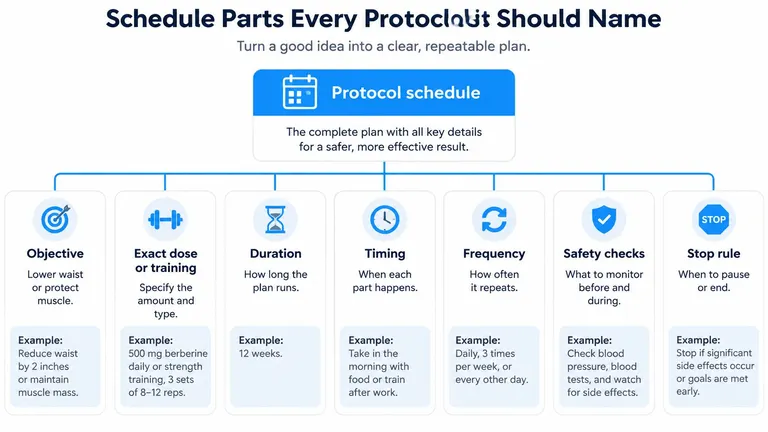
A lifestyle card could read: “Improve strength and aerobic fitness. Schedule three resistance sessions and 150 minutes of aerobic work each week. Review after 12 weeks. Pause training during a fever; don’t try to make up missed sessions by doubling the volume.” The example states the objective, workload, timing, review point, and a safety rule, so it’s easier to follow and discuss.
An incomplete drug card might say: “Peptide, Monday and Thursday.” That leaves out the product’s concentration, the prescribed dose, source or lot details, what to do after a missed dose, and when to pause. For medicines, the prescriber should write the dose and missed-dose instruction. Online anecdotes aren’t a substitute for those instructions.
The 2026 review of digital adherence research found improved adherence in 17 of 35 studies, with certainty ranging from very low to moderate. Results were more often favorable when support used customized reminders, interactive features, or multiple kinds of help, rather than education alone. A simple alarm may help with timing, but it doesn’t replace a complete schedule or clear instructions.
For a minimum safe record, log the product name, concentration, dose, date and time, lot or source information when available, symptoms, missed-dose action, and clinician instructions. A schedule log can keep those details accessible, including adherence to a schedule, but taking every scheduled dose proves adherence, not that the protocol slows aging.
Safety Limits When Interventions Get Stacked
Exercise and metformin sit on a different biological lane from agents aimed further downstream. Exercise, and metformin in selected patients, can create moderate metabolic or mitochondrial stress that may trigger adaptive responses. NAD+ boosters, rapamycin, and RNA-polymerase-I inhibitors are intended to act more directly on pathways involving nutrient sensing, growth signals, or molecular damage.
A review in Nature explains why combining interventions without a clear rationale can create monitoring and safety problems. If several compounds start together, you may have no practical way to tell which one changed a lab result, caused a symptom, or interacted with another part of the routine.
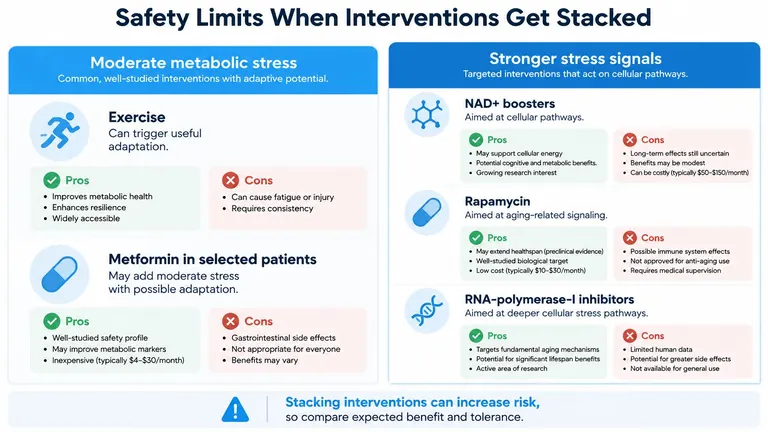
Set safety rules before adding anything new:
- Change one variable at a time. Keep the reason, expected outcome, and review date in writing.
- Use a clinician for prescriptions. Monitoring should match the specific medicine, rather than a generic anti-aging panel.
- Write a stop rule. Stop and seek medical advice for concerning symptoms such as fainting, severe gastrointestinal symptoms, mood changes, infection, or unexpected weight loss.
- Check the product category. An approved medicine, a compounded product, and a research-labeled item don’t have the same regulatory status or assurance of quality.
- Prevent record errors. Keep lot or source details when available, and don’t repeat an injection because you can’t remember whether you logged it.
Metformin deserves particular caution as a supposed anti-aging addition for people without diabetes or prediabetes. Evidence for prevention benefits in that group remains uncertain, and major clinical trials haven’t consistently shown the expected effects. Copying a milligram schedule from a forum doesn’t make it a medically appropriate plan. Compounded or research-labeled peptides can differ from approved medicines in dose and purity, so a schedule found online can’t establish that a product is safe.
Before a supplement routine grows, checking vitamin labels for overlapping ingredients can help reveal when multiple products contain the same ingredient. That’s a useful inventory step, not a substitute for reviewing medicines and supplements with a clinician. For concerns about peptide-related symptoms, understanding side effects of peptides can support a conversation, but it can’t determine what’s causing a symptom or what treatment is appropriate.
Pregnancy, a history of an eating disorder, frailty, or unexplained symptoms are reasons to avoid self-experimentation and speak with a clinician before starting a restrictive or pharmacological plan. A tracker can record a decision; it can’t decide whether that decision is medically suitable.
Write the Record Before the Next Change
Before adding another product, pause new additions for one review cycle. Prepare a one-page note for your clinician with your current lifestyle routine, each product’s name and concentration, its source, start date, frequency, cycle and pause rules, missed-dose plan, and the two or three endpoints you chose to follow.
Use the seven schedule details to make the note actionable, not merely complete. If an item is unapproved or supported mainly by anecdotes, the next step is to question its purpose and risks, not to optimize its timing. If you already have a clinician-set peptide schedule, a tracker can help keep the recorded plan and dose history accessible for a visit. It doesn’t choose compounds or doses, and it can’t verify that a routine is appropriate for you.
Calculating a dose, tracking a protocol, or describing a personal routine all call for appropriate caution and professional medical advice. A detailed log can show what you recorded and when. It can’t establish that a treatment works or make an unsafe product safe.
Keep the simplest plan whose endpoints you can remeasure.
PepFlow offers tools to organize an established peptide routine, record doses, and manage schedules, along with a Peptide Calculator, Knowledge Base, Cheat Sheet, and Reconstitution Guidelines. If you need a clearer record of a clinician-directed plan, visit PepFlow and use it for organization, not medical decision-making.