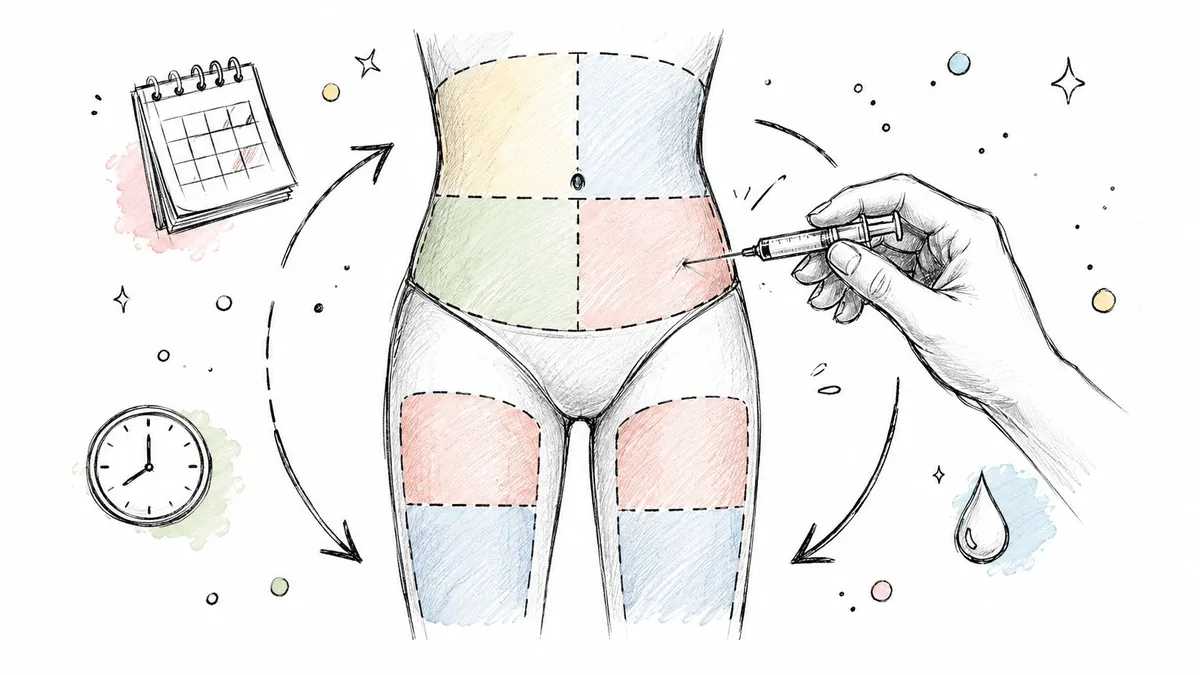
If you’re using peptides on a schedule, you’ve probably had this moment. You prep the dose, swab the skin, then pause and think, “Where did I inject last time?” You might start with a rough mental note like right abdomen, left thigh, or somewhere that felt easy. That works for a week or two. Then the pattern gets fuzzy, comfort starts driving the decision, and you end up returning to the same few spots.
That shortcut is where problems begin. Good injection site rotation isn’t busywork. It’s one of the few parts of a peptide protocol you fully control day to day, and it has a direct effect on tissue health, comfort, and dosing consistency. The challenge is that most advice online is written for insulin users with simple site diagrams and generic reminders to “rotate.” Peptide users often dose on different schedules, use different volumes, and need a system that holds up under repeated use.
A practical rotation plan solves that. You need a body map, a repeatable route, and a way to track what happened rather than what you think happened.
Table of Contents
- Why Consistent Rotation Is Non-Negotiable for Peptides
- Mapping Your Personal Injection Anatomy
- Designing Your Personal Rotation Schedule
- Perfecting Your Injection Technique for Site Health
- How to Spot and Prevent Common Complications
- Automate Your Rotation Plan with PepFlow
Why Consistent Rotation Is Non-Negotiable for Peptides
You feel fine running the same protocol for two weeks, then one injection hits differently. Appetite shifts more than expected. Recovery feels flat. Side effects show up on a day that should have been routine. Before blaming the peptide, check the pattern of where you’ve been injecting.
A lot of peptide users treat rotation like basic site care. In practice, it is part of dose consistency, especially when injections are frequent and the same easy spots keep getting reused.
The impact goes beyond surface-level irritation
Repeated injections into one area can leave tissue irritated, thickened, or less predictable to inject into. Once that happens, absorption may become less consistent, which makes your results harder to interpret.
That problem shows up fast with peptides because many users are dosing more often than the average once-weekly medication user. If training, sleep, food intake, and dose stay fairly steady, but site quality changes week to week, you have added noise to the protocol. The compound may be the same. The delivery conditions are not.
Practical rule: If you want cleaner feedback from a peptide protocol, rotate with intent and protect tissue quality the same way you protect dose accuracy.
Generic injection advice also tends to lean on insulin examples, which only gets peptide users part of the way there. The practical question is not just where subcutaneous injections can go. It is whether switching between body areas changes day-to-day feel, onset, or consistency enough to matter for compounds used multiple times per week.
URMC’s injection site guidance notes that insulin injected into the abdomen is absorbed faster than insulin injected into the thigh. That does not give us a clean peptide-specific rule for every compound, but it does support a disciplined approach. If site selection can influence absorption in one common subcutaneous context, peptide users should not assume body area is irrelevant.
Peptide users deal with more uncertainty
That uncertainty is exactly why a repeatable system matters. In peptide use, the literature often lags behind real-world questions, and online advice is full of vague diagrams, recycled insulin tips, and zero tracking. Guesswork is not a strategy.
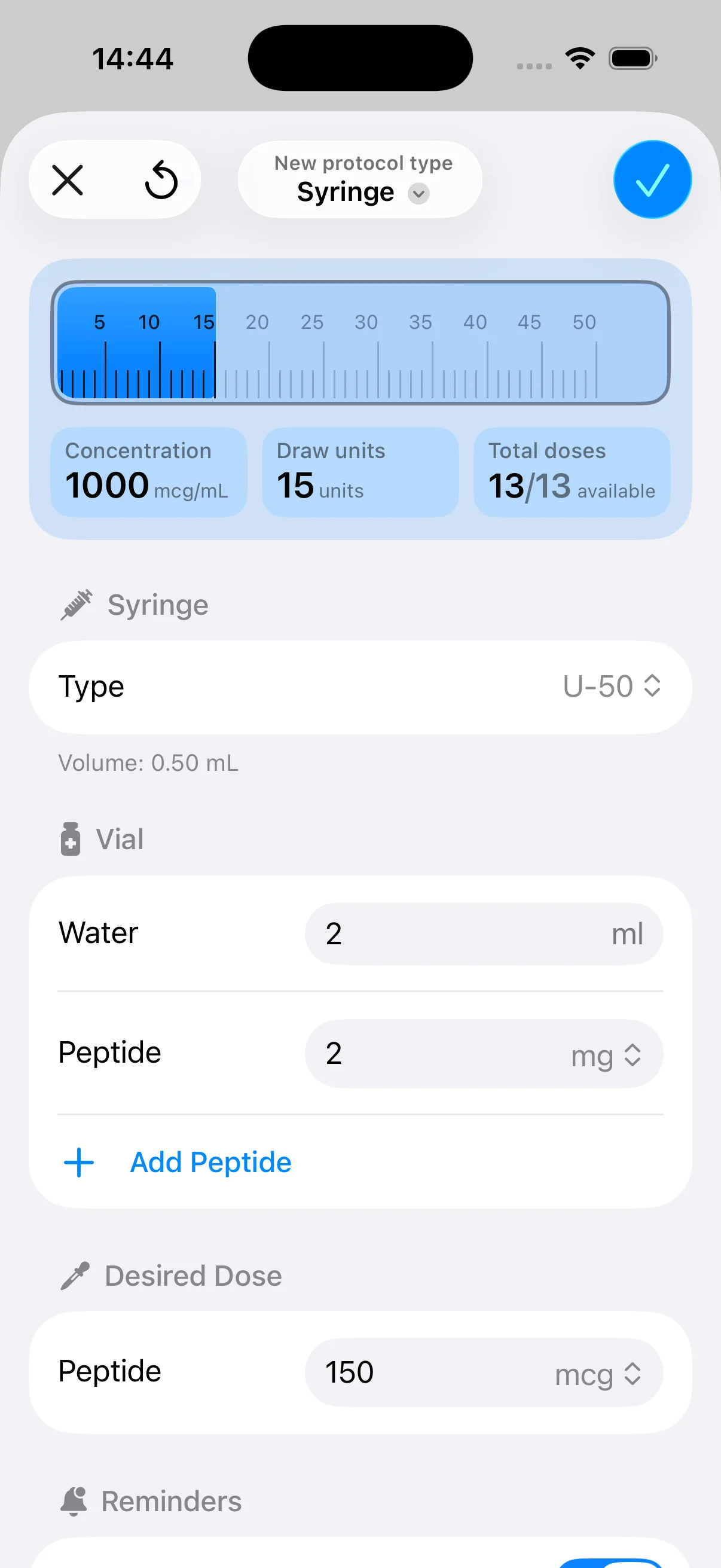
The fix is straightforward. Use a set rotation pattern, keep notes on response, and stop relying on memory. If you are already paying attention to dose volume and syringe markings, it helps to tighten up the rest of the process too. A quick refresher on how to read insulin syringes accurately pairs well with site rotation because both reduce avoidable inconsistency.
I have seen the same mistake over and over. Users get comfortable with one painless area, return to it too soon, then assume the peptide became unreliable. Usually the protocol did not suddenly fail. The routine got sloppy.
For people weighing broader treatment options, it also helps to separate self-directed peptide use from regulated care. If you’re looking at medically supervised weight-loss options rather than self-directed peptide experimentation, it’s worth taking time to explore approved treatments via XO. That distinction is important because approved therapies usually come with clear site-rotation instructions, while many peptide discussions online do not.
A good rotation system will not answer every pharmacokinetic question. It does something more useful. It removes one preventable source of inconsistency.
Mapping Your Personal Injection Anatomy
Before you can rotate well, you need a map that’s specific to your body. Not a stock diagram. Not “somewhere on the abdomen.” A map you can identify by touch in a few seconds.
Build a usable map, not a vague idea
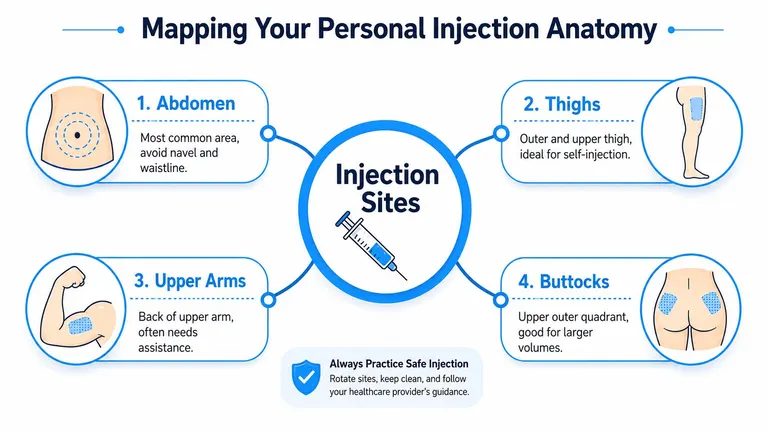
The four common self-injection areas are abdomen, thighs, upper arms, and buttocks. Not every site is equally practical for every user. The best site is usually the one you can access cleanly, repeat consistently, and rotate across without guessing.
The abdomen is often the easiest starting point because it gives you a broad, visible surface. The thighs are next because they’re easy to reach while seated. Upper arms can work, but self-placement is less reliable for many users. Buttocks are useful when you want another large area in the mix, though they can be awkward without a mirror or assistance.
If you want another practical visual breakdown focused on semaglutide-friendly locations, the Blue Haven RX semaglutide guide is a helpful companion reference.
Use your hands as measuring tools. If you can’t clearly define the borders of a usable area with your own fingers, the map is still too vague.
How to mark each area on your own body
Use simple landmarks you can repeat every time.
- Abdomen: Stay clear of the navel and avoid the waistband line where clothing rubs. Think of the usable space as the softer area around the midsection rather than the center point.
- Thighs: Use the outer and upper portion rather than the inner thigh. You want a stable, pinchable area that isn’t close to the knee or groin.
- Upper arms: The back of the upper arm is the usual target. This area is workable, but many people struggle to place the needle cleanly without twisting.
- Buttocks: Use the upper outer area. Avoid bony points and any place where you’re estimating blindly.
A simple way to make this practical is to divide each large area into smaller mental zones. For example, right abdomen upper, right abdomen lower, left abdomen upper, left abdomen lower. You don’t need to overcomplicate it. You need enough detail that “abdomen” doesn’t mean the same patch of skin every time.
For users still working out volumes and syringe markings, this matters alongside measurement accuracy. PepFlow’s guide on how to read insulin syringes is useful because poor site mapping and poor dose reading often show up together in beginners.
When your map is clear, rotation becomes mechanical. That’s what you want.
Designing Your Personal Rotation Schedule
You finish a morning injection, then realize you cannot remember whether yesterday was left lower abdomen or right lower abdomen. That is how repeated site use starts. Not because the plan was bad, but because the plan lived in your head.
A usable rotation schedule gives every dose a place before you open the alcohol swab. Peptide users need that more than occasional injectable users do. Daily and twice-daily protocols can overwork a favorite patch of tissue fast, especially when dose timing changes, travel happens, or you add a second compound.
Two methods that hold up in real use
Use the quadrant method for larger areas such as the abdomen and thighs. Use the clock method for smaller, clearly defined windows where you want a simple sequence you can repeat without guessing.
With the quadrant method, split one anatomical area into four sub-zones and rotate through them in order. Manufacturer guidance for weekly GLP-1 injections consistently instructs users to rotate injection sites with each dose rather than returning to the same spot repeatedly, which makes a four-part pattern a practical default for many users, as reflected in patient guidance summarizing FDA-labeled use for Zepbound and Wegovy. For higher-frequency peptide use, keep the same structure but add finer sub-zones inside each quadrant so you are not revisiting the same patch too soon.
With the clock method, assign positions around a site the way you would mark points on a dial. This works well for people who strongly prefer one region and need a repeatable route inside that region. It is less useful if your usable area is vague or if you tend to lose track after missed doses.
The trade-off is simple. Quadrants are easier to scale across multiple body areas. Clock patterns are easier to remember inside one area, but they can become sloppy if you do not log the exact point.
If you need help setting up the full process, PepFlow’s step-by-step peptide injection guide pairs well with a written rotation plan.
Build the schedule before you need it
Use a sequence you could follow half-awake.
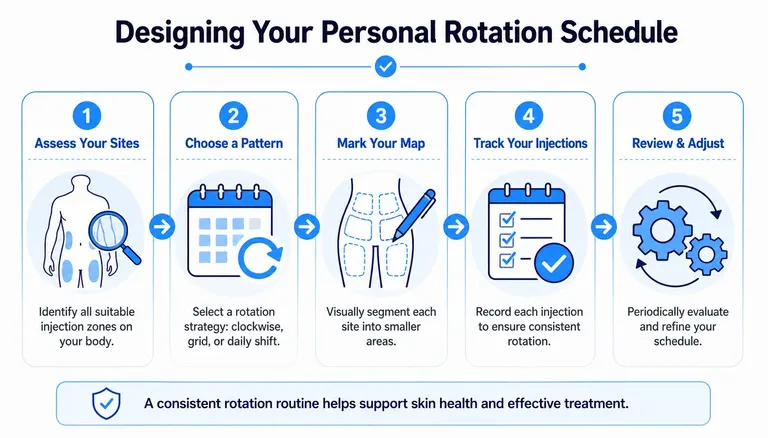
- Choose your primary sites. Pick the areas you can reach cleanly and repeat reliably.
- Assign a method to each site. Abdomen might use quadrants. Upper arm might use a clock pattern.
- Write the order down. Do not rely on memory once dosing gets frequent.
- Log the exact sub-zone used. “Left thigh” is too broad to be useful.
- Review the pattern weekly. If one area keeps getting picked because it is easier, your system needs more options.
PepFlow is useful here because peptide schedules are rarely as simple as one injection every seven days. Users often stack compounds, change timing, or run short cycles with different frequencies. App-based tracking addresses the problem, which is not knowing the theory of rotation. It is remembering what happened on Tuesday night.
A quick visual walkthrough can help if you’re more of a visual learner:
Sample Rotation Patterns by Dosing Frequency
| Dosing Frequency | Recommended Rotation Method | Example 4-Day Sequence |
|---|---|---|
| Weekly | Quadrant method across major areas | Right abdomen, left thigh, left abdomen, right thigh |
| Every other day | Quadrant method within two major areas | Right abdomen upper, left abdomen upper, right thigh upper, left thigh upper |
| Daily | Expanded quadrant method with sub-zones | Right abdomen upper, right abdomen lower, left abdomen upper, left abdomen lower |
| Twice daily | Clock method or dense grid across multiple areas | Abdomen 1 o’clock, abdomen 4 o’clock, thigh 1 o’clock, thigh 4 o’clock |
What weekly users should do differently
Weekly users usually do best with a simple repeating route. Four major locations are enough for many people, and the pattern is easy to audit later if a site becomes irritated.
Daily peptide users need more detail. “Abdomen this week” is too loose. A better plan looks like a route map with named sub-zones across multiple regions, including backup sites for travel days, gym days, or times when one area feels sore.
I also see a practical mistake here. People copy rotation advice built for insulin users on stable routines, then try to force it onto peptide protocols that involve more variation. The schedule has to match the protocol you are running.
That same planning mindset shows up in other categories of injectable treatment. Clinics offering advanced facial injectables also rely on precise site selection, documentation, and repeatable placement rather than casual guesswork.
The best rotation schedule is the one you can follow without debating it at dose time.
Perfecting Your Injection Technique for Site Health
You can have a clean rotation map and still irritate the same area if your mechanics get sloppy. I see this a lot with peptide users who inject more often than the average insulin patient. The schedule is fine. The execution is what breaks down.
Small technique details that matter
Start with repeatable basics. Wash your hands. Clean the site. Let the skin dry fully before the needle goes in. Picking a point while the alcohol is still wet increases skin irritation and turns a simple shot into a rushed one.
For subcutaneous peptide use, keep the setup simple and consistent. Short pen needles are usually easier to control, and a straight 90 degree insertion works well for many users. If you are very lean, injection depth deserves more attention because the margin for accidentally going too deep gets smaller. That matters more with peptides than many people realize, especially on high-frequency protocols where a minor technique flaw gets repeated again and again.
Use a fresh needle every time. Reused needles drag more, feel worse, and push people toward overused sites because those spots seem easier to inject. In practice, that one shortcut often starts the whole cycle of site overuse.
Clinical teams already work this way in other injectable settings. advanced facial injectables depend on precise placement, clean technique, and close attention to tissue response. The same discipline improves outcomes here.
What good spacing looks like in practice
Spacing needs to be deliberate. Within one body area, leave at least a finger-width between the last injection and the next one. For peptide users doing daily or twice-daily shots, that space disappears fast unless each point is chosen on purpose.
I coach people to pause for five seconds before uncapping. Identify the exact spot first. Then inject. That habit sounds small, but it stops the common pattern of hovering over the same comfortable patch and drifting back into it.
A quick pre-shot check keeps tissue healthier over time:
- Inspect the skin: Skip areas that look red, swollen, bruised, or irritated.
- Feel the tissue: Avoid patches that seem firmer, thicker, numb, or unusually easy to penetrate.
- Confirm your spacing: Stay at least a finger-width from the last point in that zone.
- Keep angle and depth consistent: Do not improvise from one injection to the next.
- Log it right away: Record the exact site while it is still fresh.
If you want a broader walkthrough on setup, handling, and self-administration, PepFlow’s practical peptide injection guide covers the fundamentals clearly.
Good site health comes from boring consistency. Peptide users who dose often do best when every injection follows the same clean process, with no guessing at the moment of use.
How to Spot and Prevent Common Complications
Most injection-site problems don’t arrive dramatically. They build because a user keeps choosing what feels easiest.
What lipohypertrophy feels like
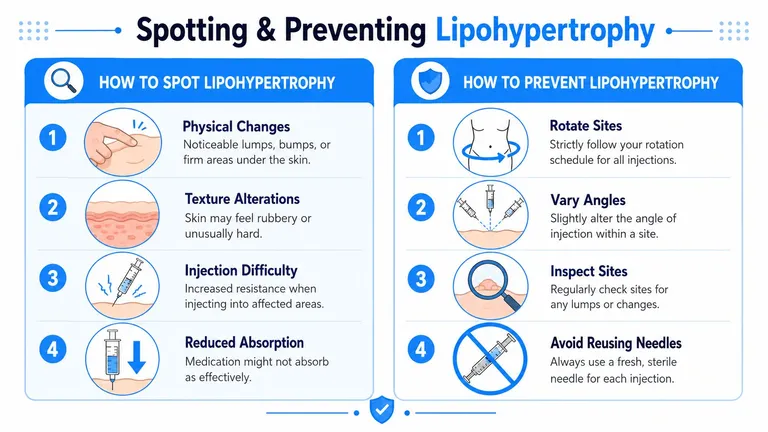
Lipohypertrophy is the complication peptide users need to understand early. In plain terms, it shows up as thickened or altered tissue from repeated injections into overused areas. Users often describe lumps, firmer patches, rubbery sections, or spots that feel strangely easy to inject because sensation is reduced.
That last part is what traps people. The damaged area may feel convenient, so they keep using it. Then the tissue quality worsens.
A quick self-check works better than waiting for obvious change:
- Run your fingertips across the zone: Healthy tissue feels consistent. Problem areas often feel raised, dense, or oddly smooth.
- Compare left to right: Asymmetry can reveal overused areas.
- Notice resistance: If one patch feels different during insertion, pay attention.
- Stop using suspicious areas: Don’t “test” a lump by injecting into it again.
If a site feels off, retire it first and analyze later.
Short-lived irritation after an injection isn’t the same thing. Mild tenderness or a small temporary mark can happen. What matters is persistence, texture change, or a pattern that keeps showing up in the same place.
Why rigid zone plans fail some peptide users
The old advice of “one zone per week” sounds neat, but it doesn’t fit everyone. For high-frequency peptide users, especially those dosing daily or twice daily, a single zone can get exhausted quickly. Recent guidance highlighted by Sweet Life’s discussion of site rotation points toward dynamic spacing of at least 1 cm rather than treating fixed weekly zones as a rigid rule.
That shift matters because high-frequency users need flexibility without losing structure. A dynamic approach still uses mapped regions, but the priority becomes spacing and tissue condition instead of blindly forcing the same weekly box.
Prevention comes down to habits:
- Expand the map: More usable zones mean less crowding.
- Inspect often: Catch texture changes early, not after repeated use.
- Avoid used-up favorites: Comfort isn’t a sign the site is healthy.
- Stay systematic: Random switching doesn’t equal rotation.
The users who avoid most site issues aren’t the ones with the highest pain tolerance. They’re the ones who notice small changes and adjust before those changes become a problem.
Automate Your Rotation Plan with PepFlow
Manual rotation systems usually fail for one reason. Memory isn’t reliable enough for repeated protocols.
Memory is the weak point
You may remember the last injection. You probably won’t remember the last six with enough precision to protect your tissue over time. That’s especially true when your schedule changes, you travel, or you’re running more than one protocol.
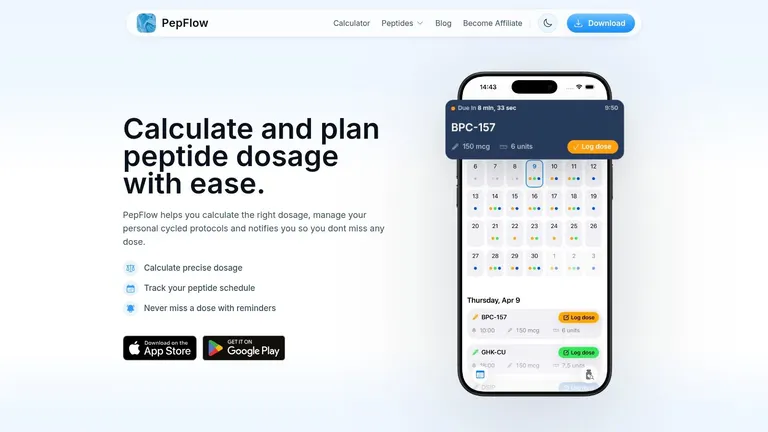
A tracking app solves a problem paper charts never solved well. It keeps the schedule, the injection history, and the exact site notes in the same place. Instead of trying to reconstruct where you injected three days ago, you check the log and move on.
Turn a protocol into a trackable routine
PepFlow is useful here because it isn’t just a generic reminder app. It lets you build peptide protocols around actual dosing schedules, then attach practical notes to each dose event. That means you can log entries like “right abdomen, upper outer quadrant” or “left thigh, clock position 4” instead of relying on memory.
That history becomes your rotation record. Reminders help you stay on schedule, and the log helps you avoid accidental overlap. If your protocol includes pauses, rest periods, or multiple compounds, the organization matters even more.
A few habits make the app more valuable:
- Name your zones consistently: Use the same wording every time.
- Log immediately after injection: Delayed logging turns into missing data.
- Review recent history before each dose: A quick glance prevents overlap.
- Keep site notes simple: Short, repeatable labels work best.
If you’re trying to build a routine that holds up beyond the first enthusiastic week, PepFlow’s article on choosing a routine schedule app is a good place to think through what consistent adherence requires.
A strong injection site rotation plan doesn’t need to live in your head. It works better when it doesn’t.
If you want a cleaner way to manage peptide timing, dose planning, reminders, and site-tracking notes in one place, try PepFlow. It helps turn a messy protocol into a repeatable routine you can follow.