You’ve reconstituted a peptide, calculated the intended dose, and drawn it into a syringe. Then you notice the volume looks uncomfortable for the deltoid, or you’re unsure whether the same amount would be acceptable in the thigh or hip. That moment matters because an intramuscular injection is limited by anatomy, not by what the syringe can hold.
The practical answer isn’t one universal maximum. Muscle size, injection site, age, body composition, formulation, and total fluid volume all affect the appropriate choice. For many average adults, 3 mL is the commonly used upper benchmark for one IM site, while smaller sites and smaller patients require less. If your planned volume doesn’t fit the selected muscle, the safer response is to change the site, adjust the concentration under appropriate clinical guidance, or divide the dose.
Table of Contents
- Why Muscle Capacity Matters for Peptide Dosing
- Anatomical Factors That Dictate Safe Volumes
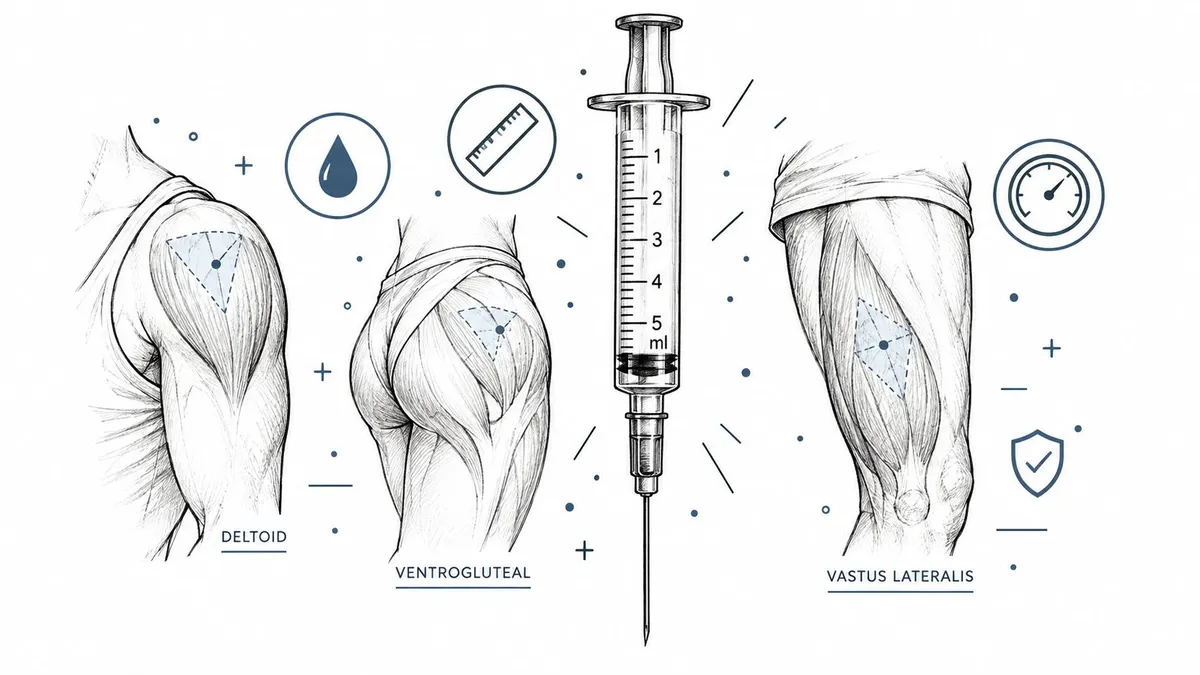
- Recommended Volume Limits by Injection Site
- Managing Peptide Concentration and Reconstitution
- Calculation Walkthroughs for Common Protocols
- Common Mistakes and Misconceptions in Biohacking
- Streamlining Your Protocol with Digital Tools
Why Muscle Capacity Matters for Peptide Dosing
You’ve mixed a vial with more diluent than expected, and the calculated dose now fills a substantial part of the syringe. The first question shouldn’t be whether you can physically push the plunger. It should be whether the chosen muscle can accept that fluid volume without excessive pressure, leakage, or avoidable injury.
Muscle tissue isn’t an empty reservoir. A properly placed IM injection deposits fluid within a defined muscle mass, where the formulation can disperse and enter surrounding tissue. When the volume is too large for the site, the muscle and surrounding tissues experience greater distension. That can increase soreness and pressure, and some of the medication may track back along the needle path instead of remaining where intended.
The Canadian Immunization Guide’s guidance on vaccine administration treats 3 mL as the practical upper limit for a single injection in an average adult in everyday practice. It also describes splitting larger volumes between sites, while recognizing that selected adults receiving large-volume immune globulin may require individualized decisions based on muscle mass.
Volume affects both comfort and delivery
A volume limit protects more than comfort. Excessive fluid can create local tissue pressure, contribute to leakage, and make delivery less predictable. A painful injection may also cause the person to move, withdraw the needle early, or alter technique, creating additional problems.
That’s why “the medication is only a small dose” can be misleading. The relevant measurement is the final liquid volume, not only the amount of active peptide. A dilute preparation may require more fluid than the chosen muscle can reasonably accommodate.
Practical rule: Choose the injection site only after you know the final volume, not before.
Peptide users often focus on sterile preparation, syringe markings, and dose conversion. Those steps matter, but anatomical planning belongs in the same safety workflow. If a preparation requires more volume than the site can tolerate, forcing it into that site doesn’t make the protocol more precise. It can make administration less reliable.
Anatomical Factors That Dictate Safe Volumes
The same liquid volume can be reasonable in one muscle and inappropriate in another. A deep, substantial muscle has more tissue available for dispersion than a small, superficial muscle. Body size also changes the practical ceiling, so an adult with limited muscle mass shouldn’t automatically use the highest figure cited for a larger adult.
Historical guidance has always reflected this variability. The CDC overview of vaccine administration practices describes IM volume limits as evolving from muscle-specific recommendations rather than one fixed standard, with anatomy, age, and muscle mass shaping the decision.
The factors that change the ceiling
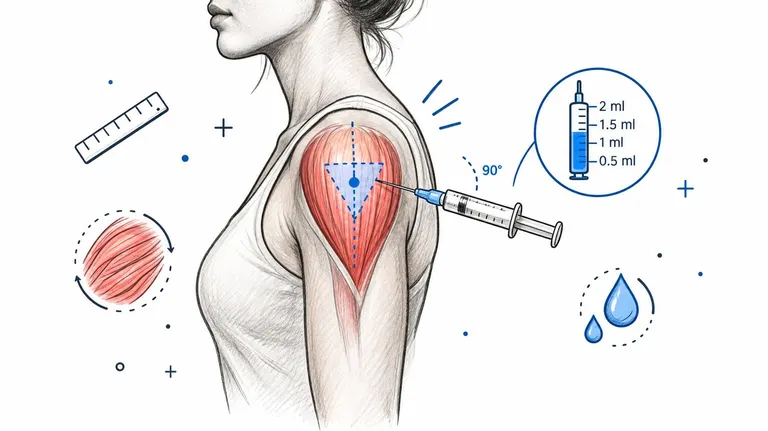
Muscle mass is the first consideration. The deltoid is accessible and commonly used, but it has less tissue than the thigh or hip. The vastus lateralis and ventrogluteal region can provide more room when the formulation requires a larger final volume.
Depth and placement matter just as much. A technically correct IM injection must reach the muscle rather than remain in subcutaneous tissue. Needle selection and technique should be assessed by a qualified clinician, especially when body composition makes the muscle depth difficult to judge. A volume that might be tolerated intramuscularly can behave differently if deposited too superficially.
Solution concentration determines how much liquid carries the intended dose. A higher concentration can reduce the volume needed for a given dose, while a lower concentration increases it. That doesn’t mean “more concentrated” is automatically better. The formulation’s instructions, stability, sterility, tolerability, and prescribed dosing plan remain decisive.
Viscosity and local irritation also affect the experience. A thick or irritating preparation may be harder to inject and more uncomfortable, even when the volume is within a typical range. Users shouldn’t treat volume as the only variable.
For readers comparing injection-based procedures with other techniques, a resource such as what is dry needling for pain can help clarify that needle-based treatments differ in purpose, tissue target, and technique. Dry needling isn’t a substitute for understanding IM anatomy, but the comparison reinforces an important point: the tissue being accessed determines the appropriate method.
Recommended Volume Limits by Injection Site
Use site-specific guidance rather than a single number copied from a syringe label. Adult bedside references commonly place ordinary IM injections around 2 to 3 mL per site, while some site-specific clinical guidelines allow a larger volume in substantial muscles. The Canadian Immunization Guide supports treating 3 mL as the everyday adult benchmark, with larger volumes divided when appropriate.
The table below summarizes figures described in the provided clinical guidance. These are not permission to self-inject a maximum volume. They’re reference points that must be adjusted for body size, muscle development, formulation, and professional instructions.
| Injection Site | Muscle Group | Max Volume (mL) | Best For |
|---|---|---|---|
| Deltoid | Shoulder | About 0.5 to 2 | Smaller-volume injections |
| Ventrogluteal | Hip | Commonly about 2.5 to 4 in cited guidance | Larger adult-muscle volumes when clinically appropriate |
| Vastus lateralis | Thigh | Up to 5 in adults in specific guidance | Larger volumes and substantial thigh muscle |
| Dorsogluteal | Buttock | Around 4 in historical guidance | Site-specific clinical use, subject to current practice and assessment |
The Royal Children’s Hospital intramuscular injection guideline describes the deltoid as accepting about 0.5 to 2 mL, while the adult vastus lateralis may accept up to 5 mL because the thigh has greater muscle mass and dispersion capacity. Those figures explain why a volume that feels excessive for the shoulder may be considered in a larger site, but they don’t remove the need for correct placement and individualized assessment.
Match the site to the final volume
If your volume is small, the deltoid may be considered when it’s appropriate for the medication and the person’s anatomy. If the volume is higher, a clinician may select the ventrogluteal or vastus lateralis site, or divide the dose between sites.
Smaller-framed adults and younger patients need lower limits. Pediatric guidance uses substantially smaller volumes than adult guidance, so adult figures must never be transferred to children. For any injection, follow the medication’s labeling and the technique taught by a qualified healthcare professional.
Needle length and gauge also affect delivery, but they don’t increase the muscle’s capacity. A site-selection decision should come before drawing the dose, and a practical injection needle size chart can support that preparation without replacing clinical instruction.
Some readers also explore injection-based regenerative or aesthetic treatments, such as Ideal Face & Body stem cell therapy. Those procedures have their own clinical protocols and shouldn’t be used as a template for peptide administration.
Managing Peptide Concentration and Reconstitution
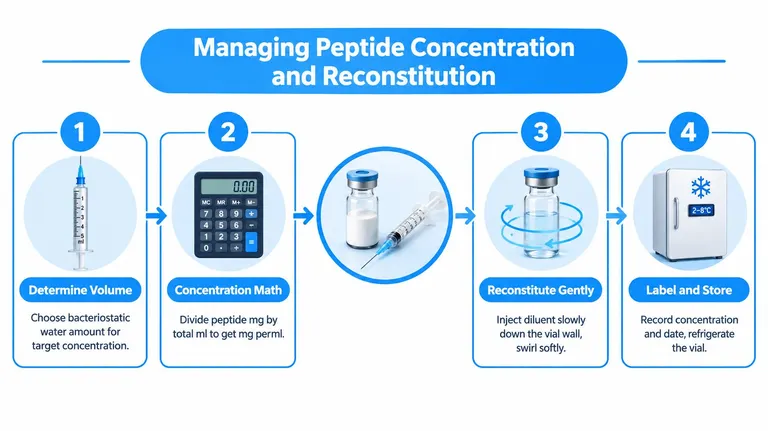
Peptide reconstitution changes the relationship between dose and injection volume. The active amount may stay the same while the liquid volume changes, depending on how much diluent is added. That makes concentration planning important before the vial is mixed.
The basic relationship is straightforward:
Concentration = total peptide amount ÷ total liquid volume
Then:
Injection volume = desired dose ÷ concentration
For example, if a vial contains a stated peptide amount and you add a chosen volume of bacteriostatic water, the resulting concentration determines how much liquid contains the intended dose. The calculation should be completed before administration, checked against the chosen site, and verified against the product’s instructions.
Concentration is a planning variable, not a safety shortcut
A more concentrated solution may keep the injection volume within a smaller site’s practical range. However, concentration can affect local tolerability, measurement precision, and formulation behavior. A more dilute solution may be easier to measure or better tolerated for a particular preparation, but it creates a larger final volume and may require a larger muscle or divided administration.
Don’t add diluent just because a larger volume seems easier to measure. Don’t reduce diluent arbitrarily to force a large dose into the deltoid. The reconstitution liquid, storage conditions, stability, and mixing method should follow the product documentation or a clinician’s instructions.
Use a written record that includes:
- Vial strength: Record the total peptide amount in the vial.
- Diluent volume: Record the exact amount added.
- Final concentration: Calculate the amount per milliliter.
- Target dose: Express the intended dose in the same units used by the calculation.
- Injection volume: Confirm that the result fits the selected site.
- Storage information: Follow the applicable product and pharmacy instructions.
A calculator or worksheet can reduce arithmetic errors, but it can’t validate an unapproved preparation. For people reviewing medically supervised hormone-related treatment options, Cost Plus TRT for transfers may provide broader context about prescribed therapy and clinical oversight. It isn’t a substitute for peptide-specific instructions.
The following video can be used as an additional visual learning aid, but technique should come from a qualified professional familiar with the product and injection route.
Calculation Walkthroughs for Common Protocols
Consider a hypothetical adult protocol that produces 4 mL for one intended IM dose. The number itself doesn’t answer whether the injection is acceptable. The selected muscle matters. A 4 mL volume would exceed the commonly used deltoid range, so the person shouldn’t inject it into the shoulder just because the full dose is already drawn.
Start with the concentration. Suppose the reconstituted vial contains a total peptide amount represented as P, dissolved in 4 mL. The concentration is:
P ÷ 4 mL
If the target dose is P, the calculated injection volume is 4 mL. That confirms the problem, but it doesn’t determine the solution.
Option one involves changing the site
A clinician may decide that a larger adult muscle, such as the vastus lateralis or ventrogluteal site, is more appropriate for the final volume. The decision must account for the person’s muscle mass, the formulation, injection technique, and current clinical guidance.
Another approach is dividing the volume between separate sites. The nursing guidance on administering intramuscular medications describes switching to a larger muscle or splitting a dose when the required volume exceeds the selected site’s tolerance.
Neither option means a user should independently choose a site or divide a prescription. A divided dose may require specific instructions about timing, sterility, and whether the medication is suitable for separate administration.
Option two involves changing concentration
If a clinician determines that a smaller final volume is appropriate for the selected site, the concentration can be recalculated. To produce a target volume of 1.5 mL for the same total peptide amount P, the required concentration becomes:
P ÷ 1.5 mL
The user would then need to follow the approved reconstitution instructions that produce that concentration. The key is that the final dose remains P, while the carrier volume changes from 4 mL to 1.5 mL.
This math is easy to reverse accidentally. If you change the diluent volume, the amount drawn for the target dose also changes. Review how to calculate final concentration before relying on syringe units, and have a pharmacist or clinician verify the calculation when the preparation isn’t commercially standardized.
Write every step down. Don’t calculate from memory, and don’t convert between milligrams, micrograms, milliliters, and syringe units until the concentration is confirmed.
Common Mistakes and Misconceptions in Biohacking
A frequent misconception is that adding more water automatically makes an injection safer or less painful. More diluent can make a solution less concentrated, but it also increases the final volume. In a small muscle, that may create a new problem by exceeding the site’s practical capacity.
The opposite mistake is assuming that a person can “push through” any pressure if the dose is important. Pain is not a reliable indicator that the medication is being delivered well. Excessive pressure, tissue distension, leakage, and poor dispersion can all undermine the intended administration.
Four assumptions that need correction
- “The syringe holds it, so the muscle can hold it.” Syringe capacity is a manufacturing feature, not an anatomical recommendation.
- “A larger adult limit applies to everyone.” Muscle mass and body size vary, and smaller adults may need a lower volume.
- “The deltoid is convenient, so it’s suitable for every dose.” The deltoid generally suits smaller volumes than the larger thigh or hip muscles.
- “One painful injection proves the dose is working.” Pain doesn’t confirm absorption, placement, or efficacy.
Repeatedly exceeding a site’s tolerance may contribute to persistent local problems, including inflammation, tissue thickening, or impaired comfort with future injections. Pooling or leakage can also make delivery less predictable. Seek medical evaluation for worsening pain, spreading redness, marked swelling, drainage, fever, or other concerning symptoms.
Rotate sites only according to a clinically appropriate plan. A structured injection site rotation guide can help organize rotation, but it shouldn’t override medication-specific instructions or professional assessment.
Streamlining Your Protocol with Digital Tools
Manual calculations become fragile when a protocol involves vial strength, reconstitution volume, target dose, concentration changes, and syringe-unit conversions. One transposed digit can change the final liquid volume, and a correct dose calculation can still produce an unsuitable injection plan if the site’s capacity isn’t checked.
A useful digital workflow separates the decisions:
- Enter the vial strength and reconstitution volume.
- Calculate the resulting concentration.
- Enter the intended dose in the correct units.
- Review the calculated milliliter volume.
- Compare that volume with the clinically selected site.
- Record the dose and follow the prescribed schedule.
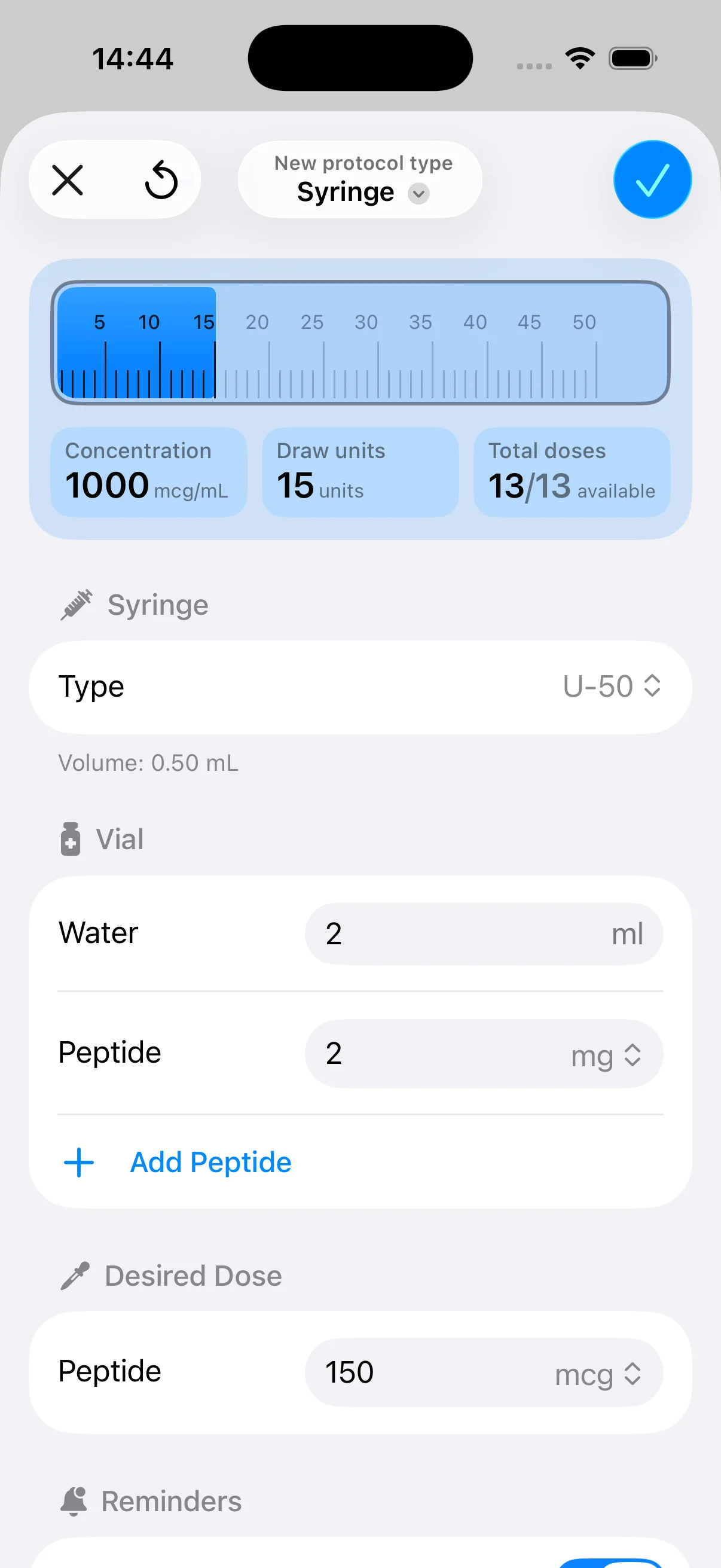
PepFlow is one option for organizing this process. Its dosage calculator accepts vial strength, reconstitution volume, and target dose, then calculates the resulting injection volume and practical syringe units. The app also supports cycled protocols, reminders, dose logs, and history tracking, which can reduce reliance on mental arithmetic and scattered notes.
A calculator can flag that a planned volume is larger than expected. It can’t decide whether a specific peptide is appropriate for IM use, confirm sterility, select a needle, or replace medical advice. Treat the digital result as a verification tool, then confirm the clinical plan with a qualified professional.
The central habit is simple: calculate first, choose the site second, and inject only after the final volume has been checked. That approach keeps concentration math connected to anatomical reality instead of treating them as separate tasks.
PepFlow helps you calculate peptide injection volumes from vial strength, reconstitution volume, and target dose while keeping protocol schedules and dose logs organized. Visit PepFlow to check your calculations, monitor your planned routine, and reduce avoidable errors before preparing an injection.