Why do so many discussions about IGF-1 LR3 begin with muscle growth, yet skip the question that determines almost everything else: what happens when a growth factor is deliberately engineered to evade its normal transport system?
That question matters because IGF-1 LR3 isn’t native IGF-1 with a longer label. It was designed to remain less tightly captured by IGF-binding proteins, which changes how researchers think about its availability, activity, and handling. At the same time, online interest often runs ahead of the evidence. Readers may encounter confident claims about muscle, recovery, or longevity even though the direct evidence remains overwhelmingly preclinical.
This guide is for anyone trying to understand what IGF 1 LR 3 is, why scientists created it, what its receptor biology suggests, and where the evidence stops. It also addresses practical issues that receive less attention, including stability, storage, batch quality, and the difference between organizing a research protocol and treating an unapproved compound as a medicine.
Table of Contents
- Introduction to IGF 1 LR3 and Why It Matters Today
- What IGF 1 LR3 Is and How It Differs From Native IGF-1
- How IGF 1 LR3 Works Inside the Body
- Potential Benefits Risks and Safety Considerations
- What Current Research Shows
- Practical Handling Dosing Schedules Storage and Monitoring
- Legal Status FAQs and How PepFlow Supports Your Routine
Introduction to IGF 1 LR3 and Why It Matters Today
Why does IGF-1 LR3 attract so much attention while its human evidence remains limited? The answer begins with its design. Training forums often describe it as a long-acting growth-factor analog for muscle or recovery, while safety discussions focus on glucose concerns, uncertain long-term effects, product quality, and the lack of established human therapeutic approval.
Both views identify real questions. Neither provides enough context by itself.
IGF-1 LR3 is a synthetic analog of native IGF-1, so researchers modified a natural signaling molecule rather than creating an unrelated compound. The design work dates to the early 1990s, and published work from 1992 is described as an early characterization point in the research history summarized by the IGF-1 LR3 pharmacology overview. One purpose of the design was to reduce how strongly native IGF-1 is held by binding proteins in circulation.
That creates the central distinction: greater freely available signaling does not establish a proven benefit. Receptor activity in a cell or animal model is like a key turning in a laboratory lock. It shows that the mechanism can operate under those conditions, not that the same result is safe, reliable, or clinically useful in people.
The key distinction: IGF-1 LR3 has an interesting binding-protein evasion design and a meaningful preclinical research history, but it isn’t an approved human therapy.
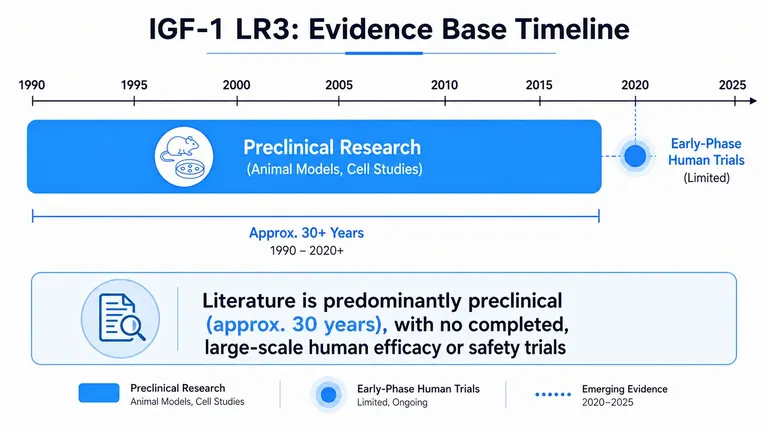
The evidence gap matters for claims about muscle growth, recovery, and longevity. Available summaries describe identified studies as predominantly preclinical, with no completed randomized controlled human trials identified for IGF-1 LR3 as a broad therapy. A small human exploration involving 20 participants over 7 months examined intranasal long R3 IGF-1 research related to Alzheimer’s disease. That finding should not be treated as a broad clinical evidence base or regulatory approval, as explained in this evidence review.
Practical interpretation also requires attention to stability, storage, and batch quality. A promising molecular design can still be undermined by poor handling or an inadequately characterized product. The sound starting point is therefore the molecule’s structure, its binding-protein strategy, and the limits of current evidence.
What IGF 1 LR3 Is and How It Differs From Native IGF-1
What makes IGF-1 LR3 different from native IGF-1? The answer begins with its structure and with how that structure changes interactions with binding proteins.
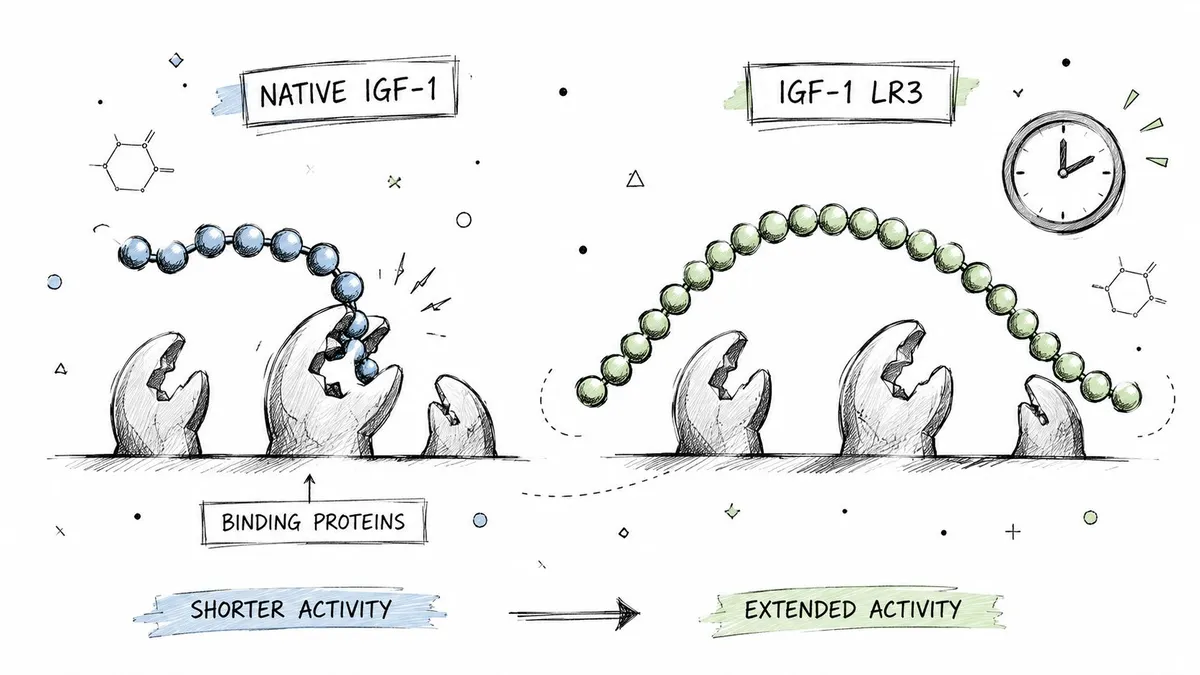
Native IGF-1 is a naturally occurring growth-factor signal. It binds the IGF-1 receptor and participates in pathways associated with growth, metabolism, cell survival, and repair. In circulation, however, much of it is held by IGF-binding proteins, or IGFBPs. That binding helps regulate exposure, while reducing the fraction that remains freely available.
IGF-1 LR3 is an 83-amino-acid synthetic analog designed to alter that balance. Its defining changes are a 13-amino-acid N-terminal extension and an arginine-to-glutamic-acid substitution at position 3. The structural design is described in the pharmacology reference for IGF-1 LR3, and receptor and binding-protein differences are examined in this peer-reviewed review.
| Feature | Native IGF-1 | IGF-1 LR3 |
|---|---|---|
| Basic role | Natural growth-factor signal | Synthetic analog used in research |
| Structure | Native IGF-1 sequence | 83 amino acids, with an N-terminal extension and position 3 substitution |
| IGFBP interaction | Stronger sequestration | Much lower reported affinity |
| Research purpose | Study natural IGF-1 biology | Study more sustained, less sequestered IGF-1 receptor signaling |
| Human therapeutic status | Native IGF-1 medicines exist in specific regulated contexts | Not approved for human medical use |
The key structural distinction is reduced binding-protein capture. Native IGF-1 is more readily sequestered by IGFBPs, whereas LR3 was designed to remain less affected by that interaction. More of the analog may therefore remain available to engage the receptor in experimental settings. Availability still does not establish that a tissue receives a useful or safe amount.
Research summaries describe LR3 as having far lower IGFBP affinity and substantially longer functional activity than native IGF-1. These properties help explain its use in laboratory models, but they do not provide a confirmed human dosing or safety schedule. The molecule’s behavior also depends on practical factors that are easy to overlook, including stability, storage conditions, and batch characterization.
IGF-1 LR3’s research value comes from the combination of preserved IGF-1 receptor agonism and reduced binding-protein capture. Its lack of approval matters equally. Researchers can examine more sustained receptor signaling without treating laboratory findings as proof of a safe human intervention.
A visual explanation can connect the molecular changes with receptor biology. This mechanism-focused IGF-1 LR3 video follows the path from receptor engagement to downstream signaling, but clear visuals remain educational, not clinical evidence.
How IGF 1 LR3 Works Inside the Body
The simplest way to understand IGF-1 LR3 signaling is to separate availability from activity.
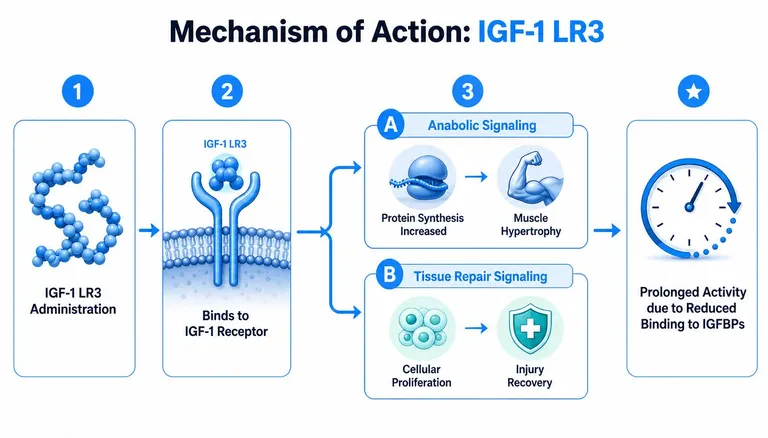
First, the analog remains available in the surrounding fluid for longer than native IGF-1 is expected to remain freely active. The important mechanism isn’t merely that LR3 is “long acting.” Independent review literature says no published human pharmacokinetic study exists for LR3, while animal and secondary estimates place its functional half-life around 20 to 30 hours. Native IGF-1’s free half-life is described as about 10 to 12 minutes in this pharmacokinetic discussion.
Second, the available molecule can interact with the IGF-1 receptor, a receptor on the cell surface that functions like a lock. IGF-1 LR3 acts as a key that fits that lock and initiates intracellular signals. The receptor doesn’t know whether the molecule came from a training-related discussion, a research vial, or a laboratory experiment. It responds to receptor engagement.
Third, receptor activation can recruit signaling networks associated with protein synthesis, cell survival, proliferation, metabolism, and repair. In a simplified model, the receptor is the doorbell, and pathways inside the cell are the wiring. Pressing the bell for longer or making more keys available can change the strength and duration of the signal, but the final biological result still depends on the tissue, cellular environment, exposure pattern, and other signals present.
Why reduced sequestration matters
The reported roughly 1,000-fold reduction in IGFBP affinity is central to the molecule’s research rationale. Instead of treating binding proteins as a minor detail, think of them as traffic controllers that determine how much signal remains free to circulate. LR3 was built to reduce that control.
The same peer-reviewed source describes about a 3-fold potency increase versus native IGF-1 in monitored clinical or monitoring literature, but that comparison must be handled carefully. A potency result under a defined experimental condition doesn’t establish a safe or effective human protocol. It tells researchers that the analog can produce a stronger measured response under the conditions tested.
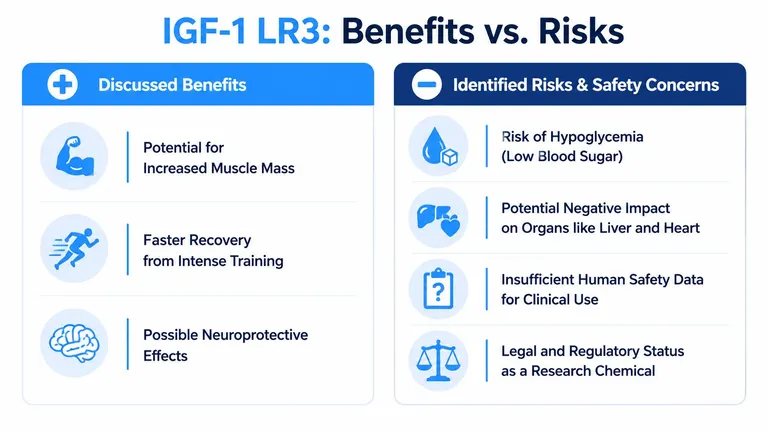
That distinction becomes especially important when discussing glucose. IGF signaling overlaps with metabolic systems, so a compound designed to produce more freely available receptor activity may also create effects that require careful monitoring. Hypoglycemia is not a theoretical footnote in the way people discuss this compound. It is one reason self-experimentation without qualified medical oversight can become dangerous.
The strongest interpretation is modest but useful: LR3 is engineered to make IGF-1 receptor signaling more sustained and less constrained by IGFBP binding. The weakest interpretation is that this engineering guarantees muscle growth, faster recovery, or longevity benefits in humans. The evidence doesn’t support that leap.
Potential Benefits Risks and Safety Considerations
People usually ask about IGF-1 LR3 because they want an outcome, not a molecular explanation. The outcomes most often discussed are increased muscle mass, improved recovery, tissue repair, and possible neurological effects. These interests have a biological basis in preclinical work, but the word “possible” matters because the direct human evidence remains limited.
In cell and animal research, IGF-1 receptor signaling can influence pathways related to protein synthesis, cellular survival, proliferation, and tissue remodeling. That makes LR3 relevant to studies of muscle and repair. It doesn’t prove that a person will gain useful muscle, recover faster, or experience a longevity effect from unsupervised exposure.
The upside needs an evidence label
A practical way to evaluate claims is to assign each one an evidence label:
- Mechanistic: IGF-1 LR3 can engage the IGF-1 receptor and alter downstream signaling in research settings.
- Preclinical: Cell, rodent, livestock, and disease-model work can reveal biological possibilities.
- Clinical: Human trials would need to establish whether those possibilities produce meaningful outcomes.
- Regulatory: Approval would require an authorized assessment of quality, efficacy, and safety.
Most online performance claims stop at the first two labels. The direct evidence doesn’t yet justify treating them as clinical conclusions. Readers looking for broader context on adverse reactions can also review this overview of peptide side effects, while remembering that general peptide information isn’t a substitute for compound-specific medical evaluation.
The risks deserve equal attention. Low blood sugar is a central concern because IGF-1 activity can overlap with insulin-like metabolic effects. Symptoms can include shakiness, sweating, dizziness, confusion, weakness, or loss of consciousness. Anyone experiencing symptoms that could indicate hypoglycemia should seek urgent medical guidance rather than trying to correct a research protocol alone.
Growth signaling isn’t tissue-selective
A second concern follows directly from the biology. IGF-1 receptor signaling supports growth and proliferation, but the receptor doesn’t selectively distinguish “desired muscle” from every other responsive tissue. This creates legitimate questions about organ effects, abnormal tissue growth, and long-term consequences, especially when controlled human exposure data is absent.
Unregulated supply adds another layer. A label can be wrong, a concentration can be inaccurate, and a vial can contain contaminants. The 2026 stability and quality coverage reports FDA observations involving endotoxin contamination in unregulated batches, as well as receptor-binding loss during poor handling, in this practical report on IGF-1 LR3 quality. These concerns affect the research material itself, not just the user’s intended outcome.
A balanced decision therefore has to include four questions:
- What outcome is being claimed? Muscle, recovery, tissue repair, or longevity may involve different biology.
- What evidence supports it? A receptor mechanism isn’t the same as a controlled human outcome.
- What could go wrong quickly? Glucose disturbances can become urgent.
- What remains unknown over time? The absence of long-term human data prevents confident reassurance.
The right conclusion isn’t that every research finding is meaningless. It’s that enthusiasm should remain proportional to the evidence, and safety decisions should involve a qualified clinician who can assess personal risk factors.
What Current Research Shows
A useful evidence review separates three questions: what happens in cells, what appears in animal models, and whether people experience a meaningful, repeatable benefit. Regulatory review adds a further test, whether the full evidence package supports medical use. These categories connect, but one cannot substitute for another.
For IGF-1 LR3, the record remains concentrated in laboratory and animal research. Published work has examined cell responses, rodent anabolic models, livestock exposure, nerve-regeneration experiments, and disease models involving amyloid-plaque remodeling. The broader review also reflects a design feature that shapes interpretation: LR3 was developed to reduce binding by IGF-binding proteins, which may support more sustained receptor activity in experimental settings. That mechanism explains why researchers study it. It does not establish a clinical benefit.
The preclinical emphasis also creates an evidence gap. Findings from a receptor assay can suggest a biological direction, while an animal result can show effects across tissues and exposure levels. Neither one answers whether the same analog, route, dose, population, and outcome would produce a safe and useful result in humans.
Why small human research doesn’t settle the question
A small human investigation of intranasal long R3 IGF-1 in an Alzheimer’s disease context does not establish a treatment for muscle growth, recovery, or longevity. Its setting, route, participants, outcome measures, and follow-up cannot be transferred automatically to unrelated goals. Human relevance requires a direct match between the research design and the claim being made.
Native IGF-1 also requires careful comparison. It has medical applications in specific circumstances, while adjacent studies may involve related growth-factor biology. Those facts can support a hypothesis about LR3, but they cannot validate LR3 itself. The compound’s modified binding behavior, handling requirements, and unapproved status remain separate questions.
Evidence rule: Similar biology can generate a useful hypothesis, but it can’t replace direct clinical evidence.
Fitness content can blur these distinctions. Readers reviewing peptides discussed for muscle growth may see LR3 listed beside compounds with different mechanisms, evidence levels, and quality concerns. Such lists can provide orientation, provided a cell signal, an animal finding, and a human treatment outcome are not presented as equivalent.
Current regulatory summaries continue to classify IGF-1 LR3 as a research compound without FDA, EMA, or comparable approval for human therapeutic use. That classification signals unresolved questions about dosing, product quality, effectiveness, contraindications, and long-term safety. It also makes batch handling relevant to interpretation: unstable or inaccurately characterized material can weaken the reliability of an experiment before its biological results are assessed.
The narrow conclusion is the most defensible one: LR3 is a useful preclinical tool for studying sustained IGF-1 receptor signaling, but its direct evidence doesn’t support broad therapeutic promises.
Practical Handling Dosing Schedules Storage and Monitoring
Practical stewardship starts with a boundary. This article doesn’t provide a human dosing regimen, injection instructions, or a schedule for self-administration because IGF-1 LR3 hasn’t been approved for human therapeutic use and no validated clinical dosing framework has been established.
That doesn’t make handling questions irrelevant. Researchers and readers still need to understand why timing, storage, documentation, and batch verification matter. A planning checklist can help someone ask better questions of a qualified professional without turning an organizational tool into a medical prescriber.
Handling begins before the vial is opened
Product identity is the first checkpoint. A responsible laboratory process should connect the vial to a documented lot, a credible certificate of analysis, and testing that addresses identity and purity. A label alone can’t confirm that the material contains the stated analog or that it is free from contamination.
Reconstitution is another point where technique affects reliability. Readers seeking general background can consult this peptide reconstitution guide, but compound-specific instructions should come from an appropriate laboratory or healthcare professional. Avoid treating generic online instructions as proof that a product is sterile or suitable for human use.
Storage deserves more attention than it usually receives. A 2026 report cites peer-reviewed stability data indicating about 18% loss of receptor-binding affinity after 72 hours at 25°C, according to the IGF-1 LR3 stability report. That finding doesn’t create a universal expiry rule, but it demonstrates why temperature exposure and time outside controlled storage should be recorded rather than guessed.
A monitoring and documentation framework
A useful record can include:
- Material details: Product name, lot identifier, supplier documentation, and date received.
- Handling events: Reconstitution date, storage conditions, temperature excursions, and visible changes.
- Health observations: Symptoms that might indicate glucose disturbance or another adverse response.
- Professional review: Questions, laboratory results, and instructions provided by a qualified clinician.
- Decision points: Clear criteria for pausing and seeking medical advice if symptoms or quality concerns arise.
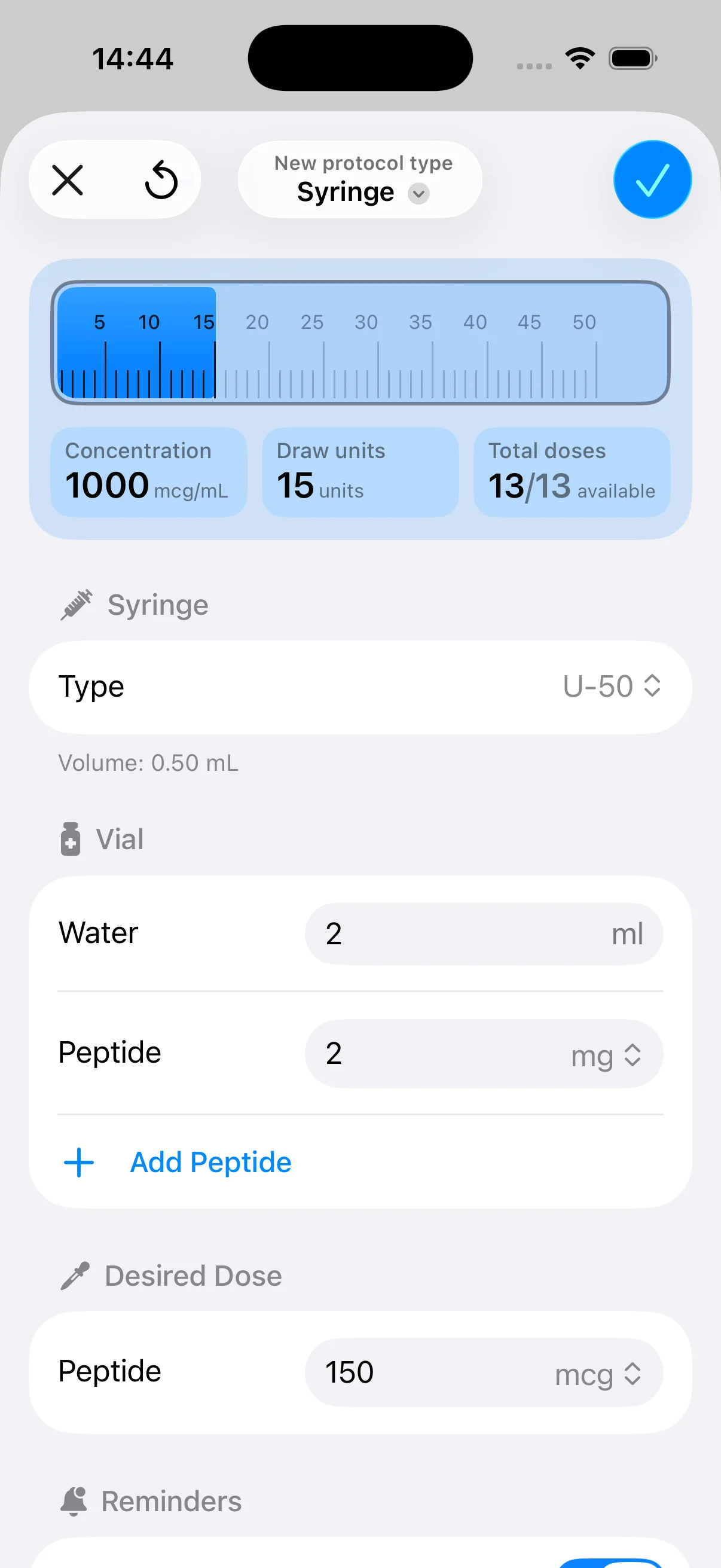
Dosing math also deserves separation from dosing judgment. A calculator can convert a clinician-provided amount into a volume based on vial concentration, but it can’t determine whether that amount is appropriate, safe, or medically indicated. If a professional has already supplied a documented plan, an organizational app such as PepFlow can help configure vial concentration and injection-volume calculations, manage scheduled pauses, and record reminders. It remains a planning aid, not medical advice.
The practical lesson is simple: a stable, correctly identified sample is a prerequisite for interpretable research. Even perfect arithmetic can’t rescue degraded, contaminated, or mislabelled material.
Legal Status FAQs and How PepFlow Supports Your Routine
IGF-1 LR3’s legal position should be checked locally, but the central regulatory fact is consistent across the cited summaries: it remains a research compound without FDA, EMA, or comparable approval for human therapeutic use. Research-use labeling doesn’t convert a compound into an approved medicine, and it doesn’t remove the need to follow local rules governing purchase, possession, importation, administration, and sport participation.
For readers interested in how technology is changing product discovery and purchasing workflows more broadly, Zinc’s overview of AI for commerce offers useful context. That topic is separate from peptide safety, but it reinforces a practical point: convenient digital systems don’t replace verification or professional judgment.
Frequently asked questions
Can IGF-1 LR3 be treated like prescribed IGF-1?
No. Related biology doesn’t establish identical safety, quality, or approved use. The exact analog and intended purpose matter.
Does “research use only” mean personal use is medically acceptable?
No. That label describes the stated supply context. It isn’t evidence of human approval, sterility, or a clinically validated protocol.
Is sports participation affected?
Athletes should check the current rules of their governing body and sport. Growth-factor-related substances may raise anti-doping questions, and a lack of routine detection doesn’t establish permission.
What should someone do after possible hypoglycemia symptoms?
Stop treating the situation as a scheduling problem. Seek urgent medical guidance, especially if symptoms are severe, persistent, recurrent, or associated with confusion or loss of consciousness.
For people following a clinician-directed plan, PepFlow can organize dose calculations, cycle dates, pause periods, reminders, and adherence logs in one place. That kind of structure can reduce manual math and missed entries, but it doesn’t determine whether IGF-1 LR3 belongs in a person’s routine or make an unapproved compound safe.
PepFlow offers a dosage calculator and scheduling tools for organizing clinician-provided peptide plans, including concentration math, pause periods, reminders, and history tracking. Visit PepFlow to keep the administrative side of a research-peptide routine clear and documented, while leaving medical decisions to a qualified professional.