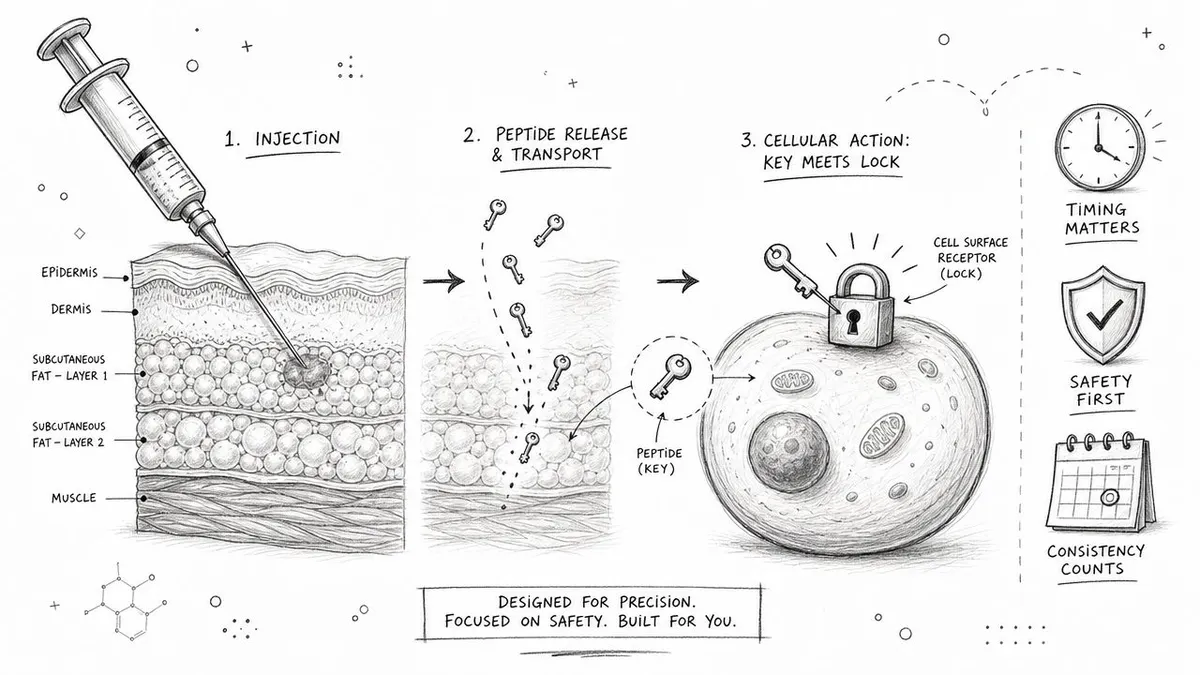
Many wonder, how do peptide injections work as if the answer were a straightforward ‘you inject a compound and it does something useful.’ That framing misses the most important part. A peptide usually isn’t replacing a missing substance the way many drugs do. It’s sending instructions.
That difference matters because it changes how you think about everything else: why injections are used instead of pills, why timing can matter as much as dose, why one injection site may behave differently from another, and why safety isn’t just about “possible side effects” but also about sterility, sourcing, and whether the product is even appropriate for human use.
Table of Contents
- What Really Happens When You Inject a Peptide
- From Syringe to Bloodstream The Injection Process
- Peptides as Cellular Messengers The Dimmer Switch Effect
- A Tour of Common Peptide Classes and Their Functions
- Understanding Peptide Pharmacokinetics and Dosing Schedules
- Navigating Peptide Safety Sterility and Sourcing
What Really Happens When You Inject a Peptide
A peptide injection starts a chain of events that’s easy to underestimate. At the surface, it looks simple: liquid goes under the skin or into muscle. Underneath that, the body begins reading a biological signal.
Peptides are short chains of amino acids, typically in the range of 2 to 100 amino acids. Their main job is signaling. They bind to specific receptors and tell cells to turn certain processes up or down. That could involve repair, metabolism, tissue response, or hormone-related signaling depending on the peptide.
The route matters because peptides don’t do well in the digestive tract. Oral bioavailability can be as low as 1 to 2% when peptides are broken down during digestion, while injection bypasses that breakdown and lets the peptide reach the bloodstream and tissues more directly. That’s one reason injectable peptides are treated differently from ordinary supplements.
Key idea: A peptide injection is less like pouring fuel into a tank and more like delivering a message to a control panel.
That message doesn’t float around randomly. The peptide interacts with receptors in tissues such as muscle, fat, and liver, where it can influence processes like collagen production, fat breakdown, or recovery signaling. In many cases, the peptide isn’t forcing the body into an unnatural state. It’s nudging an existing pathway.
One detail people often miss is that many injectable peptides arrive as a powder and must be reconstituted with bacteriostatic water before use. Handling matters here. Shaking the vial is typically avoided because it can degrade the peptide.
If you keep that simple mental model in view, messenger, receptor, response, most of the rest of peptide science becomes easier to understand.
From Syringe to Bloodstream The Injection Process
Why injections are used at all
The first practical question isn’t what the peptide does. It’s how to get it into the body intact.
Because peptides are fragile in the digestive tract, injection is often used to bypass that degradation and deliver the molecule more directly into circulation and nearby tissues. That’s why many peptide protocols rely on subcutaneous or intramuscular administration instead of swallowing a capsule.
If you want a practical overview of preparation basics, this peptide injection guide is useful for understanding the mechanics before thinking about protocol design.
Subcutaneous and intramuscular are not the same
These two methods are often lumped together, but they behave differently.
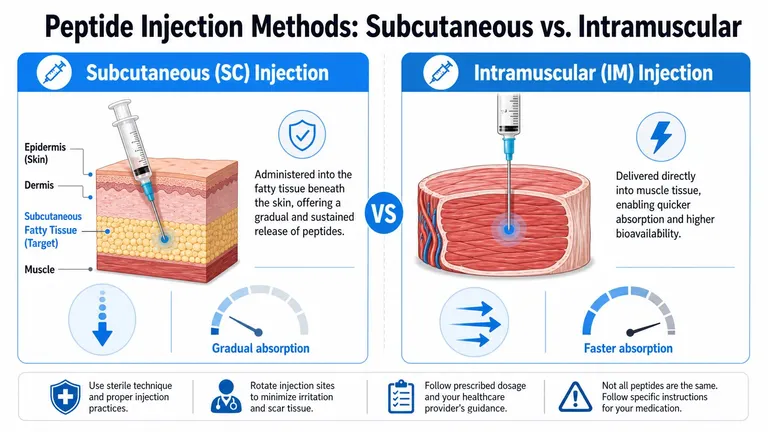
Think of subcutaneous injection as placing the peptide into a reservoir. The peptide sits in fatty tissue beneath the skin and enters circulation gradually. This route is common when a steadier release pattern is preferred.
Think of intramuscular injection as merging onto a faster roadway. Muscle tissue generally has a different blood supply environment, so absorption can feel quicker in practice. The exact effect depends on the peptide and the person, but the route changes the early part of the molecule’s journey.
A simple comparison helps:
| Method | Where it goes | Typical absorption pattern | Why someone might choose it |
|---|---|---|---|
| Subcutaneous | Fatty tissue beneath the skin | More gradual | Common for routine self-administration |
| Intramuscular | Muscle tissue | Often quicker | Used when faster uptake is desired |
Why injection site can change the outcome
Even within subcutaneous injections, location isn’t trivial. Research on subcutaneous peptide delivery found that site-dependent pharmacokinetic variability is influenced by local blood flow and pre-systemic catabolism, and that peptides with rapid absorption are more sensitive to injection site choice. The same analysis found that higher-flow sites such as the abdomen can accelerate absorption and reduce variability compared with lower-flow sites such as the thigh, according to this analysis of subcutaneous peptide absorption variability.
That’s why two injections of the same peptide can feel different if they’re given in different places.
Injection technique is only half the story. The body region you choose can affect how consistently the peptide gets from tissue to bloodstream.
For people using peptides around training, recovery, or tightly timed routines, that variability matters. It doesn’t mean one site is always “best.” It means consistency in site selection can make a protocol more predictable.
Peptides as Cellular Messengers The Dimmer Switch Effect
A peptide is a message not a replacement
This is the concept most articles skip. Peptides often act more like cellular messengers than blunt-force drugs.
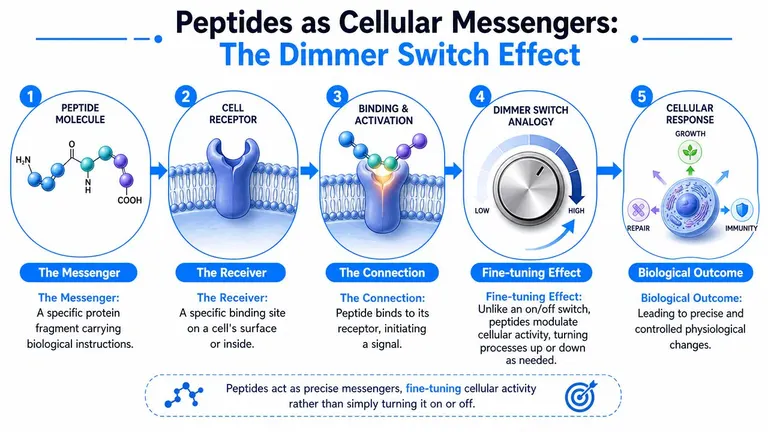
A useful way to think about them is the dimmer switch analogy. Instead of replacing a hormone outright or forcing a system fully on or fully off, a peptide can help upregulate or downregulate a natural process. In that sense, it fine-tunes biology rather than taking the controls away from it.
That framing matches the explanation in this discussion of peptide signaling and the dimmer switch model, which describes peptide injections as short amino acid chains that bind to specific cell receptors and optimize natural pulsatile processes rather than merely replacing them.
The lock and key idea is only the beginning
You’ll often hear that peptides bind to receptors using a lock-and-key model. That’s helpful, but incomplete.
The “key” part explains specificity. A peptide doesn’t interact with every cell in the same way. It binds to a receptor that matches it. Once that connection happens, the cell starts a signaling cascade. That cascade can alter what the cell does next, including repair behavior, metabolic signaling, or hormone-related activity.
For growth hormone-releasing peptides, one example is that they can coax the body to produce more growth hormone in its natural rhythm by inhibiting somatostatin, which removes a brake on growth hormone release. That’s very different from replacing growth hormone from the outside.
Here’s the practical distinction:
- On off drug model: Replace, block, or force a system directly.
- Dimmer switch peptide model: Signal the body to adjust an existing pathway.
- Physiologic implication: Rhythm, timing, and receptor response matter more than many beginners assume.
Later on, this is why rigid “more is better” thinking often causes problems. If the peptide is meant to work with a pulsatile rhythm, treating it like a constant flood can work against the biology you’re trying to support.
A closely related example for metabolism is GLP-1 therapy. If you want a plain-language explanation of one clinically used peptide pathway, this guide on semaglutide for weight loss helps show how a peptide can mimic and amplify a natural signaling system rather than behave like a generic stimulant.
Why this matters in real life
The dimmer switch model changes expectations.
People sometimes expect an injection to act like flipping a switch and producing an immediate, linear effect. But receptor signaling is rarely that simple. The body interprets the message, responds through downstream pathways, and then regulates itself in context.
Here’s a short video that pairs well with that idea:
A peptide doesn’t just “enter the body.” It enters a conversation already happening between cells, receptors, and feedback loops.
That’s the lens that makes the rest of the topic make sense.
A Tour of Common Peptide Classes and Their Functions
The peptide world gets confusing fast because people talk about “peptides” as though they’re one thing. They’re not. Different classes aim at different signaling pathways.
A better way to organize them is by primary biological goal.
Comparison of Common Peptide Classes
| Peptide Class | Primary Function | Mechanism Example | Common Examples |
|---|---|---|---|
| Growth hormone releasers | Support natural growth hormone signaling | Encourage the body’s own pulsatile release rather than replacing the hormone directly | Ipamorelin, CJC-1295 |
| Metabolic peptides | Influence appetite, glucose handling, or metabolic signaling | Act on receptors involved in satiety and metabolic regulation | Semaglutide, tirzepatide |
| Tissue and recovery peptides | Support repair-related signaling | Interact with pathways associated with healing and tissue response | BPC-157 |
| Cosmetic and regenerative peptides | Support skin or hair related signaling | Influence collagen-related or regenerative pathways | GHK-Cu |
| Insulin-based peptides | Affect glucose regulation | Directly influence blood sugar handling | Insulin |
This table is a simplification, but it gives you a map. The point isn’t memorizing names. The point is seeing that each class speaks to a different part of physiology.
What readers often get wrong
A common mistake is assuming all peptide protocols should be built like standard drug schedules. That misses the core educational gap noted earlier: many people hear that peptides “bind to receptors,” but never learn the difference between upregulating a natural process and hijacking a system outright.
That’s why growth hormone releasers are a useful example. Their role is often described in terms of encouraging the body’s own pulse patterns. If someone approaches that as a static input problem, they may misunderstand how frequency should be approached.
A second mistake is treating approved medical peptides and experimental wellness-market peptides as if they belong in the same evidence category. They don’t. Some, such as insulin or semaglutide, have established medical use. Others circulating in online communities are discussed much more aggressively than they’re studied.
Practical rule: Don’t ask, “What do peptides do?” Ask, “Which peptide class is this, what receptor pathway is involved, and is it meant to signal, mimic, or replace?”
One more source of confusion is labels. People say “peptide” and may mean a prescription GLP-1, a cosmetic peptide, a research-market injectable, or a growth hormone secretagogue. The shared word makes them sound interchangeable when they’re not.
That’s why the smartest starting point is category first, claims second.
Understanding Peptide Pharmacokinetics and Dosing Schedules
Pharmacokinetics and pharmacodynamics in plain English
At this point, peptide use becomes more subtle than many people expect.
Pharmacokinetics asks what the body does to the peptide. How fast does it absorb? How long does it remain measurable? How is it cleared?
Pharmacodynamics asks what the peptide does to the body. Which receptor does it activate? What downstream signal does it trigger? How long does that signal matter?
For peptides, those two timelines often don’t match. According to this overview of peptide pharmacology and signaling persistence, receptor activation can trigger intracellular signaling cascades that continue after measurable peptide concentrations decline. In plain terms, the peptide may be hard to detect while the message it started is still unfolding.

That’s why half-life alone can be misleading. If you dose only by asking, “How long is the molecule present?” you can miss the more important question: “How long is the biological effect developing?”
Why timing is not just a calendar problem
If a peptide is working through signaling and downstream amplification, the dimmer switch idea becomes practical, as frequency should support that pattern instead of trying to keep plasma levels perfectly flat at all times.
People using structured regimens often need help translating vial math into a schedule they can follow. Tools that calculate units, track cycling, and manage reminders can reduce simple adherence mistakes. For example, this explanation of DAC vs no DAC peptides helps users understand why release profile and timing logic can differ between peptide formats.
A simple way to think about scheduling:
- Absorption matters first. The injection route and site influence how the peptide enters circulation.
- Signal duration matters next. The body may keep responding after the peptide itself falls.
- Rhythm matters after that. Some protocols aim to align with natural pulses rather than overwhelm them.
That’s why two bad dosing strategies show up often:
- Chasing constant presence: Treating the peptide like it must always stay high in the bloodstream.
- Stacking without logic: Adding injections because the previous dose is no longer measurable, even if the signaling effect is still active.
Both mistakes come from treating peptide timing as a simple refill problem.
Navigating Peptide Safety Sterility and Sourcing
Basic handling mistakes can change the risk
Safety starts before the injection.
Many peptides arrive as a powder and need reconstitution with bacteriostatic water. That step sounds routine, but small mistakes can matter. Rough handling, poor technique, reused supplies, or sloppy storage can change both peptide integrity and injection safety.
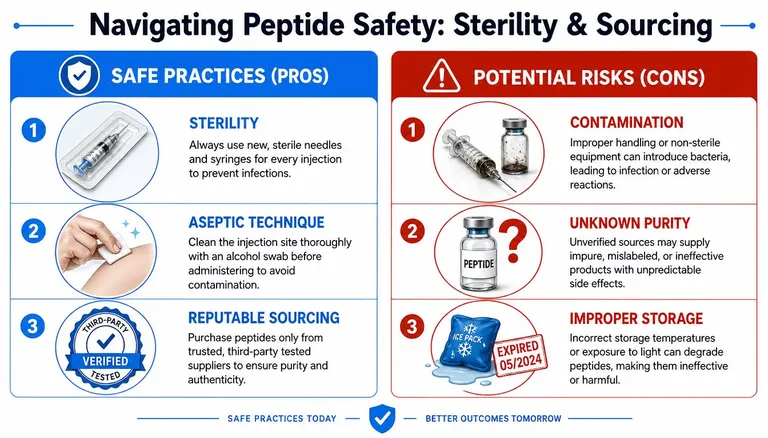
A few baseline practices are essential:
- Use sterile equipment: New needles and syringes reduce contamination risk.
- Clean the site: Alcohol prep matters because you’re bypassing the skin barrier.
- Handle gently: Avoid shaking reconstituted peptide solutions.
- Store correctly: Follow product-specific storage instructions to avoid degradation.
If you want a general parallel from another injectable category, this guide on B12 shot side effects explained is helpful because it shows how many injection-related issues come from technique and context, not just the substance itself.
The biggest safety split is approved versus grey market
The most important safety distinction isn’t “natural versus synthetic.” It’s regulated versus unregulated.
This AP coverage of peptide injection risks and side effects notes that peptide injections are often associated with mild side effects such as injection-site reactions, but the grey market for non-FDA-approved peptides adds major concerns around contamination and unregulated dosing. It also identifies immunogenicity as a primary risk for synthetic compounds, meaning the immune system may produce antibodies against the peptide.
That matters because a vial bought online may not be “the same thing but cheaper.” It may differ in purity, labeling, sterility, or even identity.
A practical safety framework
When evaluating a peptide product or protocol, ask:
- Is this approved for human use? Approved peptides and experimental peptides shouldn’t be treated as interchangeable.
- Who prepared it? Compounding and sourcing quality affect what ends up in the vial.
- Is the protocol medically appropriate for you? Peptide class matters. So do allergies, existing conditions, and medication interactions.
- Can you verify safe handling? Sterility and storage are part of safety, not afterthoughts.
For day-to-day administration, educational tools can help reduce avoidable handling errors. This article on how to prevent contamination is one example of the kind of operational guidance that matters when people self-administer injectables.
The short version is simple. Peptides can be biologically elegant, but the process around them can still be messy if you cut corners. Understanding receptor signaling is useful. Using a contaminated or mislabeled product erases that advantage fast.
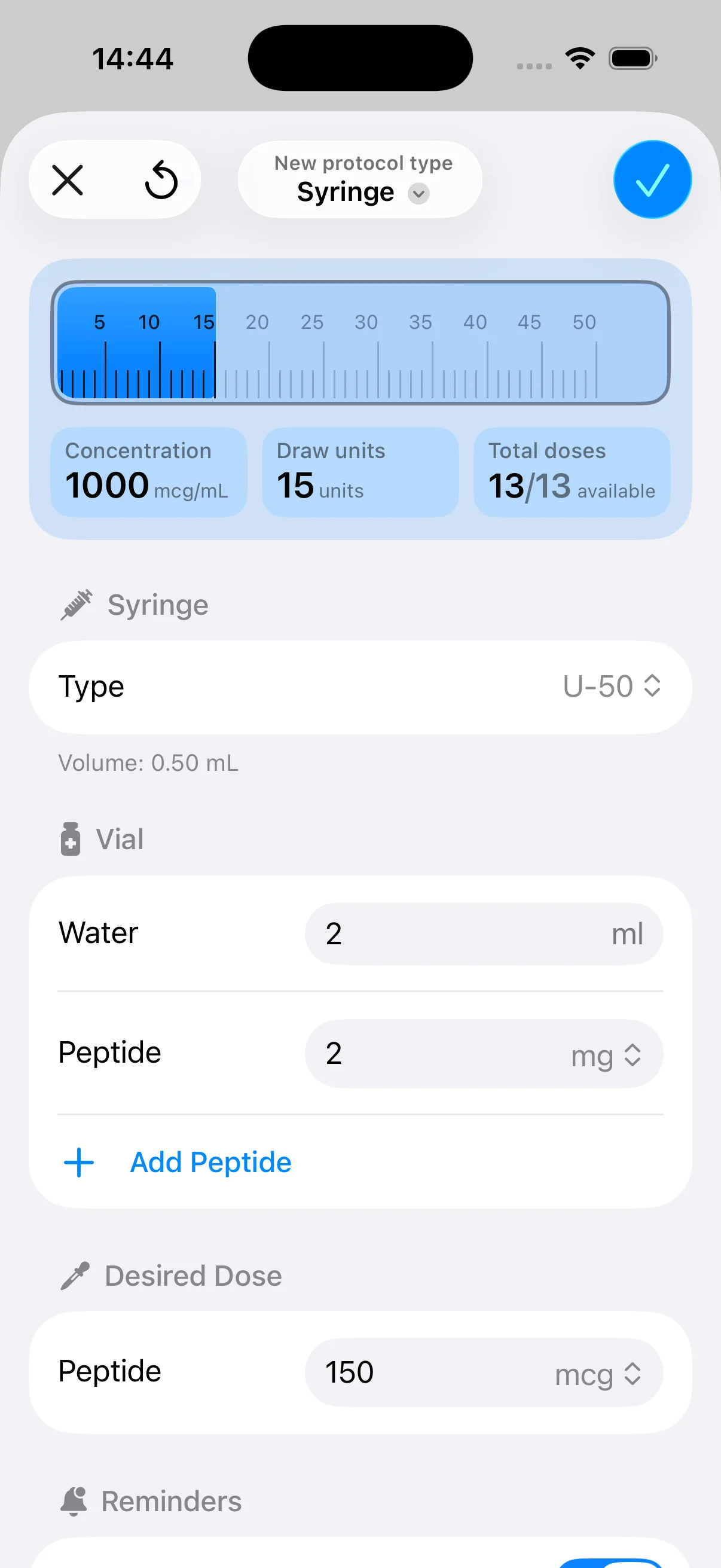
If you’re following a structured peptide routine, PepFlow can help with the logistical side: calculating practical unit amounts from your target dose, organizing cycled protocols, tracking schedules, and sending reminders so timing stays consistent. It’s a planning tool, not medical advice, but it can reduce the manual math and calendar friction that often lead to avoidable mistakes.