You’ve got a vial in front of you, maybe a new shipment just arrived, and the first question is simple on the surface: how long do peptides last?
That question trips people up because it sounds like one thing, but it usually means three different things. You might be asking how long the powder stays good in the vial. You might mean how long the peptide stays in your bloodstream after a dose. Or you might mean how long the actual effects seem to last.
Those are not the same timeline. Mixing them together leads to bad storage, sloppy scheduling, and a lot of confusion about whether a peptide is “still working.” If you’ve ever heard one person talk about a peptide lasting years and another say it only lasts hours, both might be right. They’re just talking about different stages of the peptide’s life.
Table of Contents
- Answering the Question How Long Do Peptides Last
- The Three Timelines of a Peptide’s Life
- Peptide Shelf Life From Vial to Syringe
- Half-Life and Effect Duration Inside the Body
- Key Factors That Alter Peptide Duration
- How to Manage Your Protocol with Precision and Consistency
- Frequently Asked Questions About Peptide Longevity
Answering the Question How Long Do Peptides Last
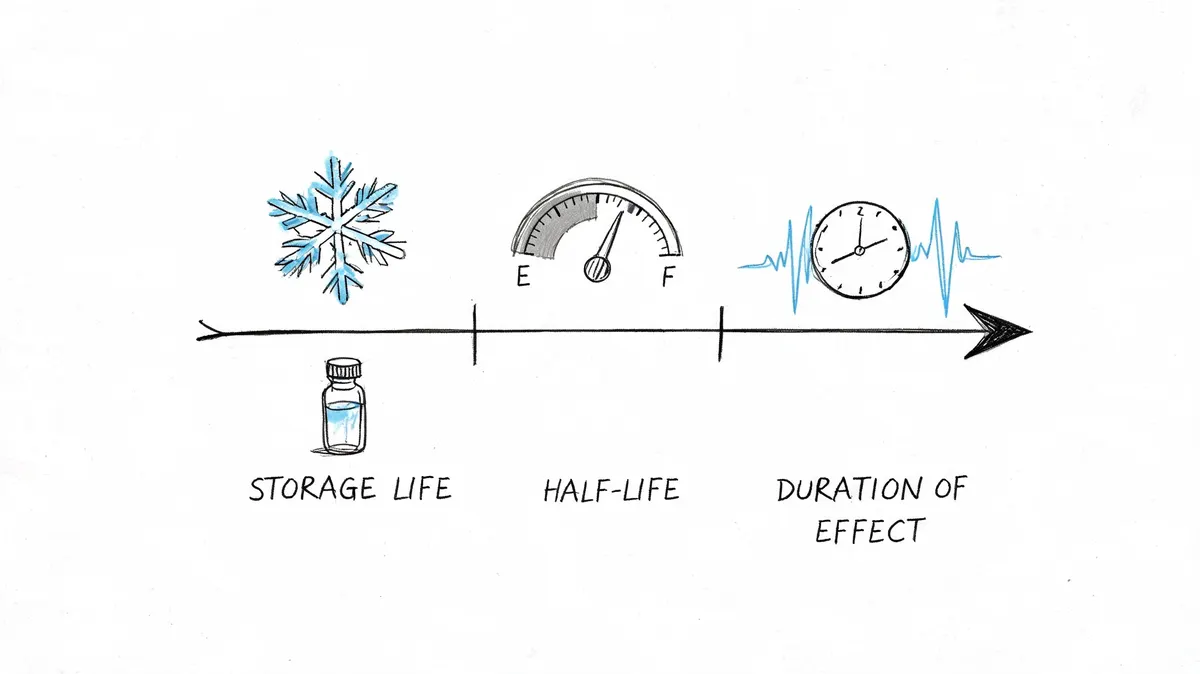
A peptide can “last” on three separate clocks.
First, there’s shelf life. That’s the chemical stability of the product while it’s sitting in a vial, either as a dry lyophilized powder or after it’s been mixed into a liquid. This is the timeline that matters when you’re deciding whether to freeze it, refrigerate it, or discard it.
Second, there’s half-life. That’s a pharmacokinetic term. It describes how quickly the body clears the peptide from circulation. If half the amount is gone after a certain span of time, that span is its half-life.
Third, there’s duration of effect. That’s the part that is often prioritized in day-to-day use. A peptide may leave the bloodstream relatively quickly but still trigger downstream signaling that continues after blood levels fall.
Practical rule: If you don’t separate these three meanings, you’ll almost always get the wrong answer to how long peptides last.
Here’s a simple example. A peptide powder in a sealed cold vial might remain stable for a long time. The same peptide, once mixed with liquid, may have a much shorter usable window. After administration, it may remain in the body for a shorter period still. Yet the biological effect could continue beyond that.
That’s why storage advice, dosing frequency, and expected results often sound disconnected. They’re attached to different clocks.
Keep this framework in mind whenever someone gives a peptide timeline:
- In the vial means shelf life.
- In the bloodstream means half-life.
- In real-world response means duration of effect.
Once you sort the question that way, the rest gets much easier to manage.
The Three Timelines of a Peptide’s Life
Shelf life means stability in the container
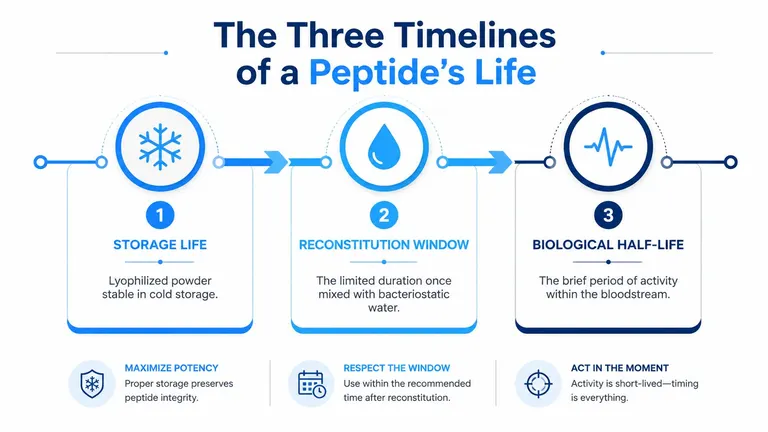
Think of a lyophilized peptide like a dry pantry item. It’s not immortal, but it’s far less reactive because the water has been removed. Water is a major driver of breakdown. Once you remove it, you slow hydrolysis and make microbial growth much less of a concern.
Now compare that with a reconstituted peptide solution. That’s closer to fresh food in the fridge. It may still be usable, but the clock is moving much faster. The peptide is exposed to a liquid environment where chemical reactions happen more easily, and contamination risk goes up if handling is sloppy.
People often hear “my peptide lasts a long time” and assume that applies equally to both forms. It doesn’t. Powder and liquid live on completely different storage timelines.
Half-life means clearance inside the body
Half-life is the bloodstream clock. A good mental model is a fuel tank.
You administer a peptide. Your body starts absorbing, distributing, breaking down, and clearing it. Half-life tells you how long it takes for roughly half of that available amount to be removed from circulation. It doesn’t tell you whether the peptide is “working well,” only how quickly the body is reducing its concentration.
That matters for protocol design. If a peptide clears quickly, people may schedule it differently than one that lingers longer. But half-life still isn’t the whole story.
Half-life answers “how long is it in circulation?” It does not answer “how long does the outcome continue?”
Duration of effect means what you actually feel or observe
This is the journey, not the fuel tank.
A peptide may bind to a receptor, trigger a cascade, or nudge a biological process that keeps going after blood levels have already dropped. That’s why someone can report an effect that seems to last longer than the peptide’s actual measurable presence.
The reverse can happen too. A peptide may remain present, yet the noticeable effect feels modest or fades because the biological response depends on dose timing, receptor sensitivity, tissue targeting, and the user’s own physiology.
A simple way to organize it is this:
| Timeline | What it describes | What you use it for |
|---|---|---|
| Shelf life | Stability before use | Storage and handling |
| Half-life | Time in circulation | Scheduling and dosing rhythm |
| Duration of effect | Biological impact over time | Expectations and protocol observation |
When people ask how long peptides last, they usually need all three answers, not one.
Peptide Shelf Life From Vial to Syringe
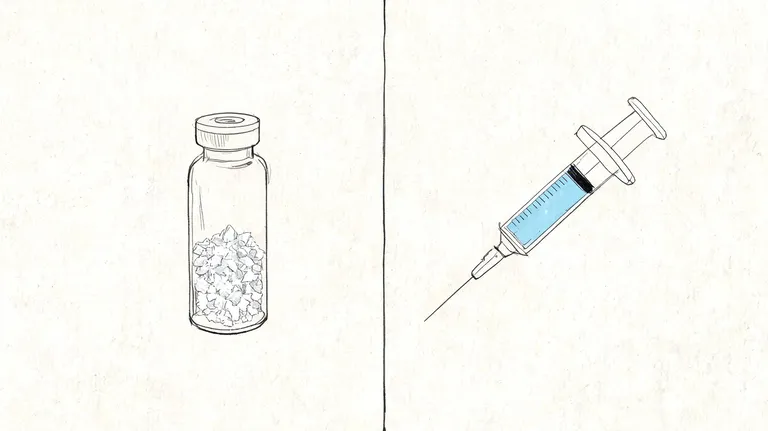
The biggest shelf-life mistake is treating dry peptide powder and mixed peptide solution like they age at the same speed. They don’t.
Lyophilized peptides kept at -20°C remain stable for 3 to 5 years, while storage at -80°C results in minimal degradation even after a decade according to this review of lyophilized peptide stability and storage ranges. That same source notes some evidence of certain lyophilized mixtures remaining stable even longer under specific conditions.
Once reconstituted, the timeline contracts sharply. Reconstituted peptides in solution are typically stable for 2 to 8 weeks under refrigerated conditions of 2 to 8°C according to GenScript’s peptide storage and handling guidance.
Why powder lasts longer than liquid
Dry powder is stable because water is gone. That matters because water helps drive hydrolysis, one of the main ways peptide bonds and side chains degrade. A dry, sealed vial also reduces the chance of microbial growth.
In solution, several problems show up at once:
- Hydrolysis becomes easier because the peptide is now surrounded by water.
- Oxidation risk increases for sensitive residues.
- Contamination becomes possible through handling, nonsterile technique, or repeated access to the vial.
- Freeze-thaw damage adds stress when the same solution is repeatedly warmed and re-frozen.
NIBSC and related supplier guidance consistently point toward the same practical rule: long-term storage belongs in the dry state, kept cold, dark, and tightly sealed. If you want a broader operational checklist, this peptide storage guide temperature light and humidity is a useful companion because it organizes those environmental variables clearly.
A practical storage routine
Most storage problems come from repeated little exposures, not one dramatic mistake. The vial warms up on the counter. The cap comes off for too long. The same solution gets thawed over and over. Each step chips away at stability.
A cleaner routine looks like this:
- Keep unused material dry: If you won’t use it soon, leave it lyophilized instead of mixing it early.
- Store it cold and dark: Cold slows degradation, and light protection matters for sensitive residues.
- Reduce moisture exposure: Open the vial briefly and reseal it well.
- Aliquot when practical: Smaller portions reduce repeated freeze-thaw cycles on the main stock.
- Use appropriate sterile liquid and technique: Poor mixing habits shorten usable life fast.
- Label clearly: Write the reconstitution date and solvent used so you’re not guessing later.
If you need a focused walkthrough for liquid handling, this guide on how to store reconstituted peptides is worth bookmarking.
Here’s a quick visual refresher on handling and storage basics:
Keep the long clock and the short clock separate in your mind. The powder may be stable for years in proper frozen storage. The mixed vial usually isn’t.
One more point people miss. Shelf life is sequence-dependent. Some peptides are naturally more fragile than others, especially once dissolved. That’s why one person’s storage routine works fine for one compound and fails badly for another.
Half-Life and Effect Duration Inside the Body
Storage answers what happens before use. Half-life and effect duration answer what happens after administration.
Half-life is a pharmacokinetic clock
Half-life is the time it takes for the amount of peptide in circulation to fall by about half. That decline reflects absorption, distribution, metabolism, and clearance. In practical terms, it helps explain why some peptides are taken more often and others less often.
People commonly confuse half-life with “how long I can notice it.” That’s not precise. Half-life is a concentration concept, not a feeling.
You can think of a peptide as a short chain built from amino acids, then shaped by chemistry that affects how quickly enzymes break it down, how well it resists degradation, and how long it remains available to tissues. Small structural changes can alter that timing a lot.
Some peptides are modified specifically to extend their in-body persistence. If you’ve seen longer-acting versions and wondered why they behave differently, this explainer on what is DAC in peptides gives a practical overview of one common strategy for extending circulation time.
Here’s the important limitation. A general educational article can explain what half-life means, but it shouldn’t invent values for individual peptides when verified numbers aren’t available in the source set. So rather than guess at named compounds, use this principle-based table:
| Peptide | Approximate Half-Life | Typical Dosing Frequency |
|---|---|---|
| Short-acting peptide | Short, often requiring closer timing | Often scheduled more frequently |
| Modified long-acting peptide | Longer due to stabilization or carrier features | Often scheduled less frequently |
| Fragile unmodified peptide | Variable and sequence-dependent | Depends on protocol design and clinical context |
Why effect duration can outlast half-life
A peptide can leave the blood before its consequences fully fade.
If receptor binding starts a healing, signaling, appetite, endocrine, or recovery process, that process may continue after circulating levels decline. This is why users sometimes say, “I know it’s not in my blood very long, but I still feel the result later.”
That doesn’t mean half-life is irrelevant. It still shapes timing, accumulation, and spacing between doses. But duration of effect depends on what biological pathway got turned on, how strongly it was activated, and how your body responds afterward.
A few practical examples help:
- A short half-life peptide may still have a lasting downstream effect if it triggers signaling that keeps running.
- A longer half-life peptide may feel smoother because levels remain more stable over time.
- Two people can experience different effect duration from the same schedule because response is biological, not just mathematical.
Don’t build your whole protocol around “how long I felt it.” That’s useful personal feedback, but it isn’t the same as pharmacokinetics.
The clean way to think about it is this. Half-life guides timing. Effect duration guides observation. They overlap, but they are not interchangeable.
Key Factors That Alter Peptide Duration
No peptide exists in a vacuum. Its real-world duration changes with chemistry, handling, delivery method, and the person using it.
Sequence chemistry changes fragility
Some peptides are just harder to preserve.
A peptide’s longevity is strongly sequence-dependent. Peptides containing Asparagine (N), Glutamine (Q), Methionine (M), Cysteine (C), or Tryptophan (W) have shorter shelf lives in solution because they are more vulnerable to chemical degradation through processes like deamidation or oxidation according to Bachem’s handling and storage guidelines for peptides.
That matters in two ways. First, it changes how carefully you need to manage storage after reconstitution. Second, it helps explain why one peptide tolerates routine handling while another seems to lose integrity quickly.
If a peptide contains oxidation-prone residues, extra exposure to air, warmth, light, or repeated opening becomes more costly. The same “bad habit” doesn’t hit every sequence equally.
Delivery, dose, and individual biology matter
A peptide’s timeline also shifts after administration. Route changes absorption speed. Dose changes concentration and sometimes changes how long effects are noticeable. Individual metabolism changes clearance.
Here are the variables that most often move the needle:
- Route of administration: A peptide delivered by one route may absorb and clear differently than the same peptide delivered another way.
- Dose size and spacing: A larger or more frequent dose can change how long a user perceives the effect, even when the half-life itself doesn’t change.
- Age and metabolic rate: Some people clear compounds faster than others.
- Health status: Liver function, kidney function, inflammation, and concurrent medications can affect the in-body timeline.
- Protocol consistency: Irregular timing makes it harder to tell whether a peptide is short-acting, underdosed, or being used inconsistently.
The number on paper is only part of the story. The peptide’s chemistry sets the boundaries, but your handling and your biology decide where you land inside them.
This is why protocol conversations can get messy online. One person is describing chemical fragility. Another is describing absorption. Another is reporting perceived effect length. They sound like they disagree, but often they’re each talking about a different factor.
How to Manage Your Protocol with Precision and Consistency
The science gets complicated fast. The management side is where most avoidable problems happen.
Where people make avoidable mistakes
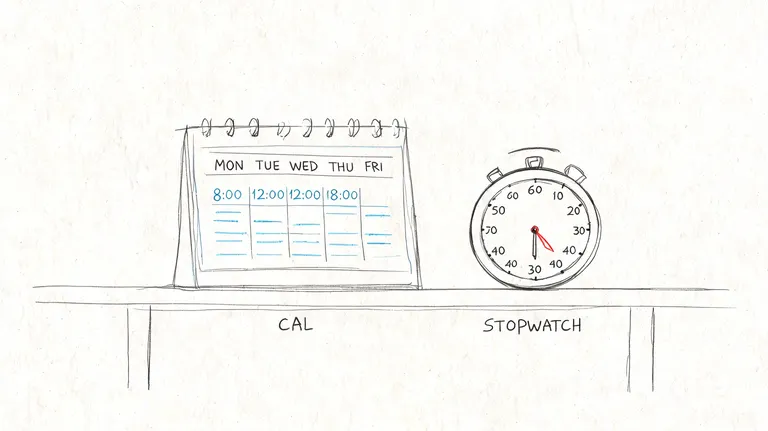
A typical peptide routine asks you to juggle several moving parts at once. You need to remember when a vial was mixed, how it was diluted, what concentration that created, how often the protocol calls for dosing, and when the usable window closes.
That’s exactly where errors creep in:
- Math slips: Wrong unit conversion, wrong dilution, wrong draw amount.
- Timing drift: “I’ll remember later” turns into missed or doubled doses.
- Vial confusion: Two similar vials in the fridge, unclear labels, uncertain mix dates.
- Storage mismatch: Reconstituting too much too early, then trying to stretch the liquid longer than you should.
NIBSC-based guidance makes the practical implication pretty clear. For anything not being used immediately, keep it lyophilized and minimize air, moisture, and repeated warm-up cycles because those exposures can shorten shelf life. If you need a refresher on preparation itself, this guide on how to mix peptides with bacteriostatic water covers the basics in plain language.
A simple system beats memory
A more advanced protocol is unnecessary for many. They need a more reliable system.
Use a checklist that lives with the peptide, not in your head:
- Record the mix date as soon as you reconstitute.
- Write the concentration clearly on the vial or storage card.
- Track the intended dosing rhythm on a calendar, not from memory.
- Note the discard point for the reconstituted solution.
- Log each dose immediately so you don’t second-guess whether you already took it.
A routine like that protects both accuracy and consistency. It also makes troubleshooting easier. If a peptide seems ineffective, you can review storage, reconstitution timing, and adherence before assuming the compound itself is the problem.
Frequently Asked Questions About Peptide Longevity
How can I tell if a peptide may have degraded?
Use caution with any solution that looks cloudy, discolored, contaminated, or different from its usual appearance. Degradation isn’t always visible, so a clear liquid is not a guarantee. If storage conditions were poor or the timeline is uncertain, don’t rely on guesswork.
If I miss a dose, should I double the next one?
That depends on the specific peptide and protocol. In general, doubling because you “missed time” can create more problems than it solves. A better move is to return to the planned schedule unless your prescriber or protocol instructions say otherwise.
Does keeping a peptide in the freezer always solve the problem?
No. Freezing helps, but repeated thawing, opening, moisture exposure, and poor handling can still shorten usable life. Temperature is one piece of stability, not the whole picture.
Does half-life tell me exactly how long effects last?
No. Half-life tracks clearance from circulation. Effects can end sooner, match closely, or continue longer depending on what biological signaling the peptide triggers.
Will peptides show up on a drug test?
Standard workplace drug panels usually aren’t designed to look for peptides. Specialized sports or anti-doping testing is a different situation. Testing rules vary, so athletes should check the standards that apply to their organization.
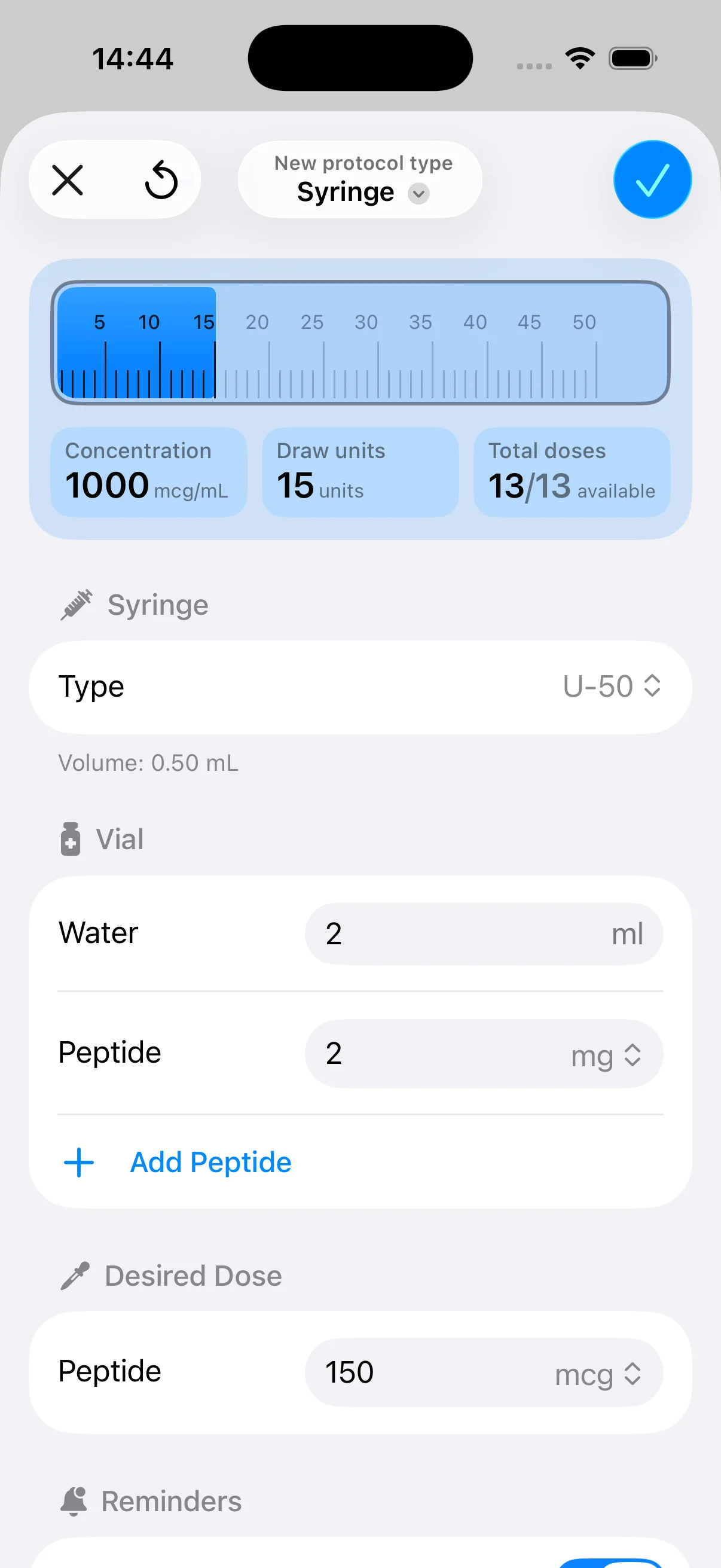
If you want a simpler way to stay organized with reconstitution math, dosing schedules, reminders, and protocol tracking, PepFlow is built for that job. It helps you plan accurately, reduce manual mistakes, and keep your peptide routine consistent without turning your notes app into a lab notebook.