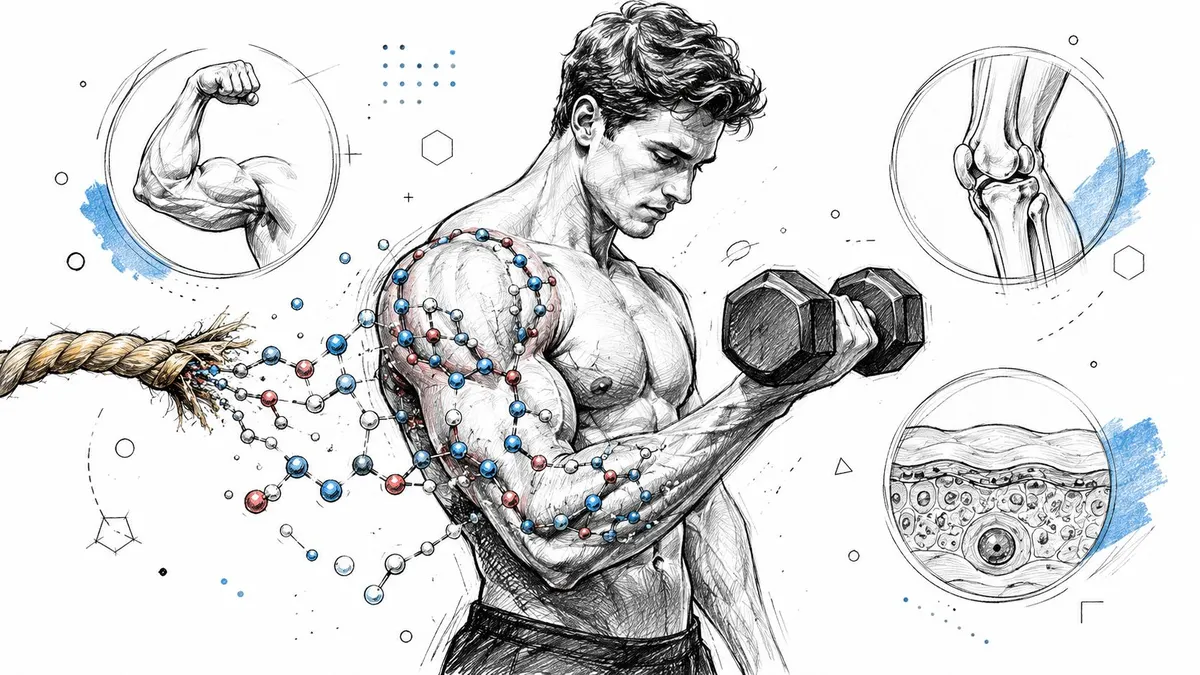
You’re probably looking at collagen because something changed. Your training is still consistent, but your elbows feel beat up after pressing. Your knees complain on stairs the day after squats. Recovery isn’t terrible, but it’s slower than it used to be. Or maybe you don’t care about “beauty supplements” at all, yet you’ve noticed that skin, joints, and connective tissue age on the same timeline as strength.
That’s where most collagen content loses people. It throws every possible benefit into one bucket and never answers the useful question. What’s worth trying for your goal, and what kind of collagen makes sense for that goal? A review discussing this gap noted that most “collagen for men” content rarely addresses which protocol is worth trying for a specific target, or how much the result depends on age, training status, and adherence in the first place (PMC review on collagen protocols and context).
If you’ve already looked into peptides for men, collagen sits in a different lane. It isn’t a shortcut to rapid muscle gain. It’s a support supplement. Used well, it can fit a plan built around training, recovery, joint comfort, and aging well. Used badly, it becomes another scoop of expensive powder with a broad label and no clear purpose.
Table of Contents
- Beyond the Hype Why Collagen for Men is Gaining Traction
- What Are Hydrolyzed Collagen Peptides
- Evidence-Based Benefits for Mens Health and Performance
- Bovine vs Marine vs Multi-Collagen Sources
- How to Choose a High-Quality Collagen Supplement
- Practical Dosing and Sample Protocols
- Frequently Asked Questions About Collagen for Men
Beyond the Hype Why Collagen for Men is Gaining Traction
Men usually don’t start with collagen because they want “glowing skin.” They start because a practical problem shows up. Lifting feels good, but tendons feel less forgiving. Running still clears your head, but your knees need longer to settle down. You’re trying to stay strong without feeling like every session adds more wear than benefit.
That’s why hydrolyzed collagen peptides for men have gained traction. Not because they replace good programming, sleep, or protein. Because they speak to the things many active men care about: joint comfort, connective tissue support, recovery, and maintaining usable muscle as they age.
Why the interest keeps growing
A lot of the demand comes from frustration with standard supplement categories. Whey helps total protein intake. Creatine helps strength and power. Fish oil gets pulled in for general support. But there’s still a gap around tendons, ligaments, cartilage, and whole-body structural support.
Collagen fits that gap better than most products marketed as “recovery” formulas.
Practical rule: If your main issue is that training stress feels harder on your joints and soft tissue than it used to, collagen makes more sense than another pre-workout.
There’s also a marketing problem in this category. Many products lump skin, hair, joints, gut, and muscle into one promise. That sounds great on a label, but it’s not how useful supplementation works in real life. Men need a filter.
A better way to think about it is this:
- For training support: collagen is usually best treated as an adjunct to resistance work, not a muscle-building replacement for complete protein.
- For joints: the form matters, and “collagen” is not one interchangeable thing.
- For skin: oral collagen has real support, but it’s usually a secondary win for men who started taking it for other reasons.
What actually matters
The most useful question isn’t “does collagen work?” It’s “what am I trying to improve, and which version gives me the best chance of seeing a result?”
That changes the buying decision completely. A lifter chasing better recovery should think differently than a man dealing with osteoarthritis symptoms. A guy who wants broad connective tissue support doesn’t need the same product logic as someone shopping for wrinkle reduction.
This is why collagen has moved from fringe to mainstream in men’s wellness. It’s not magic. It’s specificity.
What Are Hydrolyzed Collagen Peptides
A common scenario looks like this. A guy adds collagen to his coffee because he heard it helps recovery, but he has no idea what the label means or whether the form matters.
It does.
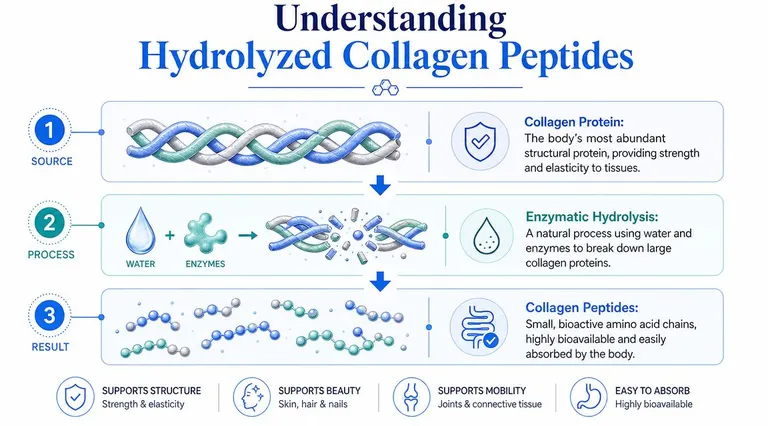
Hydrolyzed collagen peptides are collagen proteins that have been broken down into smaller chains of amino acids. That processing makes them easier to dissolve, easier to use in a daily routine, and more practical than raw collagen for supplementation.
What “hydrolyzed” means
Collagen in whole form is a large structural protein. Hydrolysis cuts that larger protein into smaller peptide fragments.
That is the main reason collagen peptides dominate the supplement category. You are buying a form designed for regular oral use, not a bulky protein structure that is harder to work with.
Smaller peptides also help explain why powders labeled “collagen peptides” usually mix well and sit fairly lightly compared with less processed collagen forms. For men who will only take a supplement if it fits into coffee, a shake, or yogurt without much friction, that matters more than marketing language.
Why the form matters in practice
For most men, “hydrolyzed” is not a technical detail. It affects compliance.
A supplement only helps if you take it consistently enough to judge whether it is doing anything. Hydrolyzed collagen powders tend to be the easiest format for that. They dissolve fast, work in hot or cold liquids, and usually have less texture than gelatin-style products.
There is still a trade-off. Better mixability and convenience do not automatically mean better results for every goal. The result you care about depends more on the collagen source, collagen type, total dose, and how you use it around training or daily joint support. That is why the useful question is not just “is it hydrolyzed?” It is “hydrolyzed from what source, for which goal, and at what dose?”
If you want a broad market view of how brands position different formulas, this overview of Canadian collagen supplements is a decent reference point.
What hydrolyzed collagen peptides are not
Hydrolyzed collagen is a targeted protein supplement. It is not a replacement for complete protein.
That matters for active men. Collagen is rich in glycine, proline, and hydroxyproline, which makes it useful for connective tissue support. It is relatively low in some amino acids that matter more for maximizing muscle protein synthesis, especially compared with whey, eggs, meat, or a well-formulated protein blend.
I usually frame it this way for clients. If the main goal is adding muscle, fix total daily protein first. If protein intake is already solid and the goal is joint support, tendon loading, skin support, or a more specific connective-tissue protocol, hydrolyzed collagen can earn a spot.
Some men also buy collagen for digestion. That topic deserves its own filter, so a separate guide on collagen peptides for gut health is the better place to sort useful claims from weak ones.
The practical takeaway is simple. “Hydrolyzed collagen peptides” tells you the delivery form. It does not tell you the best use case by itself. For men, the smart move is matching the form, source, and dose to the actual target, whether that target is joint support, training support, or skin.
Evidence-Based Benefits for Mens Health and Performance
A common scenario looks like this. A guy is training hard, his elbows or knees are starting to complain, and he buys collagen expecting better lifts, pain-free joints, better skin, and maybe even easier fat loss from one scoop a day. That is where collagen marketing gets ahead of the evidence.
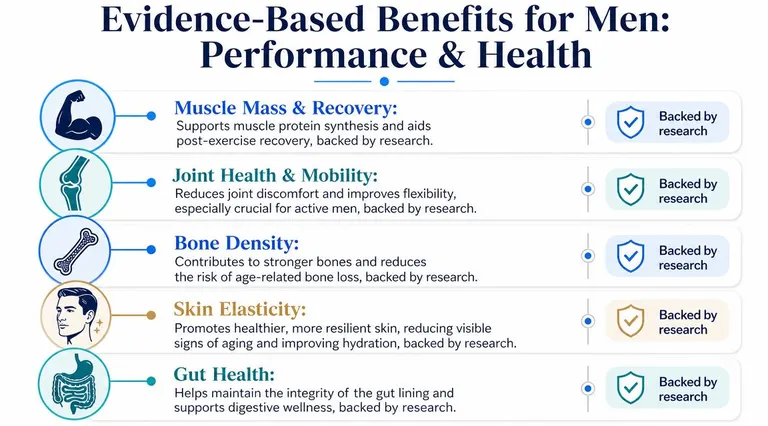
For men, the practical use cases are narrower and more useful than the label usually suggests. The best-supported categories are joint function, connective-tissue support around training, and skin quality. A key benefit is matching the goal to the right protocol instead of treating every collagen product like it does the same job.
Muscle support and recovery
Collagen peptides make more sense as a training-support supplement than as a muscle-building protein.
A meta-analysis on long-term collagen supplementation combined with resistance or concurrent training reported significant improvements in fat-free mass, maximal strength, tendon morphology, and 48-hour recovery after exercise-induced muscle damage (PMC meta-analysis on training outcomes with collagen peptides).
The trade-off is simple. Collagen can support connective tissue and recovery, but it is still a poor substitute for a complete protein if the main goal is maximizing muscle protein synthesis. For men who lift, sprint, jump, or do combat sports, that distinction matters. Use collagen to support tendons, ligaments, and recovery demands. Use whey, eggs, meat, or another complete protein to cover the muscle-building side.
I usually reserve collagen for active men in two situations. First, total daily protein is already in a good place and joint or tendon stress is becoming the limiting factor. Second, training volume is high enough that recovery quality matters as much as raw strength work.
To keep expectations realistic around body composition, these Tecton Ketones collagen insights are useful because they separate supportive effects from exaggerated weight-loss claims.
Joint comfort and functionality
This is often the strongest reason to use collagen.
A 2021 systematic review found strong evidence that 5 to 15 g/day of collagen peptides improves joint pain and functionality. The review also noted that 15 g/day combined with resistance training produced stronger body-composition and strength changes in elderly sarcopenic men than in younger recreationally active participants (systematic review on collagen peptide dosing and joint outcomes).
That matters because it helps set expectations by goal and population. A 25-year-old lifter with mild knee irritation may notice modest support over time. A man with more obvious joint wear, higher training age, or declining connective-tissue tolerance may have a stronger reason to stay consistent with it.
For joint-focused use, collagen type and form matter more than flashy branding. Hydrolyzed collagen peptides are commonly used for broad connective-tissue support. If the main complaint is cartilage-related joint discomfort, some men may also want to compare that with undenatured type II collagen rather than assuming all collagen products are interchangeable.
Skin benefits are real, but usually a secondary goal for men
Skin is not the headline reason most men buy collagen, but the evidence is good enough to count as a legitimate benefit.
A placebo-controlled human study summarized on PubMed Central reported statistically significant improvements after 28 and 56 days of hydrolyzed collagen use. Participants saw improvements in softness, smoothness, firmness, and wrinkle visibility, and the product was well tolerated with no adverse effects recorded (PMC placebo-controlled study on hydrolyzed collagen and skin outcomes).
For most men, this sits in the bonus category. If skin is the primary goal, collagen can fit. If the main goal is training support or joint comfort, better skin is a possible extra benefit rather than the main reason to buy.
Claims that need more skepticism
Collagen gets stretched too far in marketing.
Hair, nails, gut health, brain health, and broad “anti-aging” claims often get grouped together as if the support is equally strong across the board. It is not. If digestive support is the specific target, this review of collagen peptides for gut health claims is a better place to sort stronger points from weak ones.
The practical takeaway is straightforward. Match the protocol to the actual goal. For muscle support around training, collagen works best as an add-on to adequate total protein. For joints, it has one of the better evidence bases in the category. For skin, the benefit is real, but usually secondary for men.
Bovine vs Marine vs Multi-Collagen Sources
Most men get stuck on the wrong debate. They compare bovine to marine, or look for a “five-type multi-collagen” blend, and assume more types must mean a better product.
Sometimes source matters. Often, the bigger distinction is product form and intended use.
Bovine and marine in real-world terms
Bovine collagen is common, easy to find, and usually more budget-friendly per serving. Marine collagen appeals to men who prefer fish-derived products or want to avoid bovine sources. Multi-collagen blends try to sound complete by combining several sources.
That doesn’t automatically make one category superior.
Use source as a practical filter:
| Option | Usually makes sense when | Possible drawback |
|---|---|---|
| Bovine | You want broad use, easy availability, and lower cost | Not suitable if you avoid bovine products |
| Marine | You prefer fish-derived collagen | Often costs more and may be a poor fit with fish allergies |
| Multi-collagen | You like source variety and don’t mind blends | Can distract from the more important issue, which is whether the form matches your goal |
If the label says hydrolyzed peptides and the product is from a reputable brand, source is often a secondary decision compared with dose, consistency, and fit for purpose.
The distinction that matters more
The bigger decision is hydrolyzed collagen peptides versus undenatured type II collagen.
A practical review noted that hydrolyzed forms are commonly used at 2.5 to 15 g/day for broad skin and joint benefits, whereas undenatured type II collagen is discussed at around 40 mg/day specifically for osteoarthritis symptoms. The same source makes the key point clearly: they are not interchangeable (Ubie Health doctor’s note on collagen types and dosing differences).
That changes how men should shop.
Which one fits which goal
If your goal is broad support across training, connective tissue, skin, and general joint comfort, hydrolyzed collagen peptides are usually the better fit.
If your goal is narrower and more symptom-focused, especially around osteoarthritis-related joint discomfort, undenatured type II collagen deserves a look.
- Choose hydrolyzed peptides if you want a daily powder you can mix into drinks and use as part of a general recovery or joint-support routine.
- Choose undenatured type II if you’re looking at a targeted joint strategy and understand that it works differently.
- Don’t assume “multi-collagen” is automatically better if the label never clarifies dose, form, or intended use.
Men with joint pain often ask the wrong question. It’s not “cow or fish?” first. It’s “hydrolyzed peptide support or type II joint-specific support?”
That’s the decision that usually matters more than the source debate.
How to Choose a High-Quality Collagen Supplement
A man walks into a supplement store looking for joint support and leaves with a vanilla “beauty collagen” creamer loaded with sweeteners, vague branding, and no clear dose. That happens all the time.
Good collagen products are usually plain. The label tells you the form, source, serving size, and what the product is built to do.
Start with your goal, not the marketing
The smartest buy depends on the job. If the goal is training support, tendon and ligament stress, or general joint comfort, a simple hydrolyzed collagen peptide powder usually makes more sense than a “multi-benefit” blend. If the goal is skin appearance, the same product may still fit, but only if the dose is clear and the formula is not padded with extras that raise the price without improving the outcome.
Consumer-facing clinical summaries note that the strongest support is around skin hydration, elasticity, and some joint-related uses. Claims around hair, nails, and gut health are less convincing in current research (GoodRx summary of collagen benefits and limits).
That matters because many labels sell fantasy coverage. Men usually do better with a targeted product matched to a specific result.
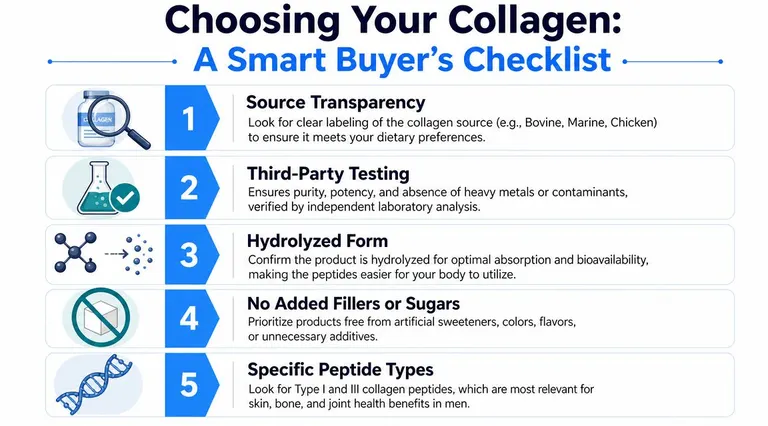
What I would check before buying
Start with these five filters:
- Form on the label: Look for hydrolyzed collagen or collagen peptides stated clearly on the front or supplement facts panel.
- Dose per serving: Make sure the serving gives a meaningful amount of collagen, not a tiny scoop hidden inside a bigger “wellness blend.”
- Type and intended use: The product should make it clear whether it is built for broad structural support or a narrower joint-focused use.
- Third-party testing: NSF Certified for Sport, Informed-Sport, or clear batch testing adds confidence, especially for competitive athletes.
- Ingredient discipline: Less clutter is usually better. Skip formulas overloaded with sugar, proprietary blends, or trendy add-ons that distract from the main ingredient.
This is also where price per serving matters. A premium tub is not automatically a better tub. I would rather see a straightforward peptide powder with transparent testing than an expensive formula built around branding language.
Red flags that usually signal a weak buy
A few label habits tend to show up in mediocre products:
| What to check | What you want to see |
|---|---|
| Form | Hydrolyzed collagen peptides clearly stated |
| Purpose | Broad support or joint-specific support clearly described |
| Additives | Minimal sugar, filler, and unnecessary extras |
| Quality signals | Third-party testing or transparent sourcing |
Be cautious with phrases like “full-spectrum matrix,” “beauty complex,” or “multi-source collagen” if the company never tells you how much of each type you are getting. That is hard to use in a real protocol. It also makes it harder to compare one product against another.
For men who already track recovery and nutrition, collagen should fit into the plan cleanly. It should not replace complete protein. If you need to determine optimal protein intake first, do that before spending extra on specialty supplements.
One more practical point. Powders usually give better value and easier dosing than gummies, creamers, or ready-to-drink products. If you want a broader reference for building supplement routines and serving sizes, this peptide dosage guide for practical protocol planning is a useful comparison point.
The best collagen supplement is rarely the flashiest one. It is the product that makes the intended use obvious, gives you a workable dose, and does not bury the formula under hype.
Practical Dosing and Sample Protocols
A common scenario is the guy who trains hard, hits his whey and creatine, then adds collagen and expects it to work like another muscle-building protein. That is usually the wrong setup. Collagen works best when the protocol matches the goal, whether that goal is joint support, tendon-heavy training, or skin-focused use.
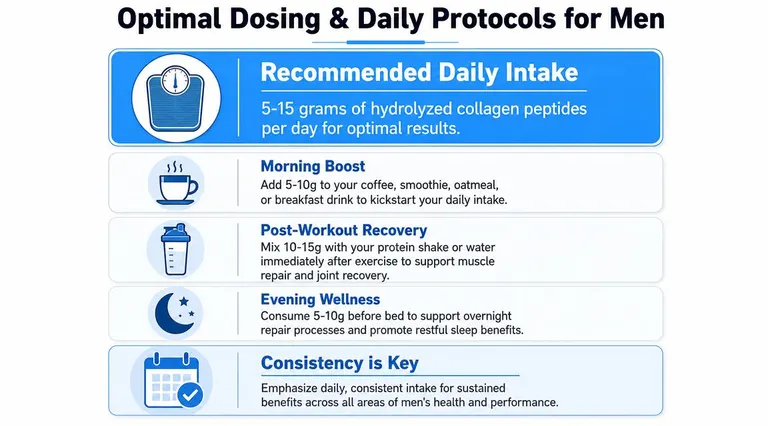
As noted earlier, the commonly studied intake range is 5 to 15 grams per day. For practical use, I keep it even simpler. Use the lower end when the goal is basic daily support. Use the higher end when the goal is training-related connective-tissue support and you want a protocol that fits around lifting.
The practical dose range
For most men, 5 to 15 grams per day is enough.
Dose matters more than fancy timing. Consistency matters more than chasing a perfect window. If you still need to determine optimal protein intake, sort that out first so collagen stays in the support category instead of replacing complete protein.
Sample protocol for muscle support and recovery
This protocol fits an active man who lifts regularly and wants extra support for tendons, ligaments, and overall training durability.
-
Dose
Take 15 g/day of hydrolyzed collagen peptides. -
Timing
Take it at a time you will repeat daily. Post-workout is fine. Breakfast works too. -
Best use case
This setup makes the most sense when heavy lifting, sprint work, combat sports, or high-volume training are already stressing connective tissue. -
Duration
Run it for at least 8 weeks before judging it. Connective tissue usually responds slower than muscle soreness or gym pump, so early impressions are often misleading.
Sample protocol for daily joint support
For men whose main goal is getting through the week with less joint irritation, simpler usually works better.
- Use 5 to 10 g/day
- Take it with a routine meal or coffee
- Track function, not just discomfort
- Stick with one protocol long enough to notice a trend
That last point is the one many men miss. The useful question is not whether your knees feel different by tonight. The better question is whether squats, stairs, long walks, or back-to-back training days feel easier to handle after a few steady weeks.
Match the protocol to the goal
If the goal is muscle gain, collagen is an add-on, not the foundation. Keep whey, eggs, meat, dairy, or another complete protein doing the heavy lifting for total protein quality.
If the goal is joints or tendons, a plain hydrolyzed collagen powder is usually enough. If the goal is skin support, type I dominant products, often from bovine or marine sources, are the cleaner fit. Men get better results from this goal-first approach than from buying a random multi-collagen blend and hoping it covers everything.
Keep the plan boring enough to follow. Fixed dose, fixed time, and enough patience to assess it properly. If you like structured supplement planning, this practical peptide dosage guide for organizing daily protocols is a useful reference for building consistency, even though collagen itself is much simpler than most peptide setups.
Frequently Asked Questions About Collagen for Men
Is hydrolyzed collagen safe for most men
For healthy adult men, hydrolyzed collagen is usually easy to tolerate. The main issues I see in practice are minor digestive complaints, a bad taste in some powders, or using it despite a fish or bovine allergy tied to the source material.
The bigger mistake is expecting fast results. Collagen works slowly. If the goal is tendons, joints, or skin, assess it over steady weeks and months, not a few workouts.
Dose still depends on the job. Lower daily amounts can make sense for skin support. Higher daily amounts are more often used for joint or connective tissue goals. Match the dose to the outcome you care about.
Will collagen raise testosterone or libido
No. Collagen is not a hormone support supplement.
It provides specific amino acids that may help connective tissue and skin, but it is not a meaningful tool for raising testosterone, improving libido, or fixing symptoms of low hormones. Men with those goals need a different workup and a different plan.
Can I take collagen with whey, creatine, or other basics
Yes, and that is usually the best way to use it.
Whey or another complete protein should cover muscle protein synthesis and total daily protein quality. Creatine supports strength, power, and training output. Collagen fills a narrower role. It is better used as a targeted add-on for joints, tendons, skin, or recovery support around high-impact training.
That distinction matters. Men who buy collagen for muscle gain and treat it like a replacement for whey usually get the protocol wrong from day one.
Should I buy collagen for hair or gut health
Use some caution here. Those claims often outrun the evidence and the marketing gets broad fast.
If your main goal is better skin quality, a type I dominant collagen product is the cleaner fit. If your main goal is nagging joints or tendon load from lifting, running, or court sports, a plain hydrolyzed collagen product is usually enough. If your main goal is muscle, prioritize complete protein first and treat collagen as optional.
That goal-first approach is what keeps this supplement useful instead of random.
If you like structured protocols and don’t want to rely on memory, notes apps, or spreadsheet math, PepFlow helps organize dosing and scheduling with far less friction. It’s built for people who care about precision, reminders, and staying consistent with supplement or peptide routines without turning daily adherence into a chore.