
Most of the popular advice on MOTS-c pretends there’s an official playbook. There isn’t. How to take MOTS-c starts with accepting that this is an experimental peptide, with no FDA-approved human dosing standard and no official dosing guideline, so any serious protocol has to be built from research-practice ranges, careful timing, and clean tracking rather than myth (Nature Communications study, current peptide protocol summary, Rite Aid overview of MOTS-c).
That framing matters because MOTS-c isn’t a random wellness add-on. It’s a mitochondrial-derived peptide first described as an exercise-responsive regulator of metabolic homeostasis, linked to AMPK signaling and age-dependent physical decline in the scientific literature (Nature Communications study). Earlier mouse work summarized in an NIH/PMC review found improved glucose uptake in skeletal muscle and better insulin sensitivity in aging-related metabolic dysfunction, and another review reported endogenous MOTS-c levels rise by 1.6-fold during exercise and 1.5-fold after exercise, then return to baseline within 4 hours (Nature Communications study).
Table of Contents
- Why MOTS-c Protocols Remain Experimental
- Reconstituting MOTS-c Without Damaging the Peptide
- Understanding Common Dosing Ranges and Schedules
- Subcutaneous Injection Technique and Site Rotation
- Building a Reliable Scheduling and Tracking System
- Safety Considerations and When to Seek Professional Guidance
Why MOTS-c Protocols Remain Experimental
The first mistake is treating MOTS-c like a finished compound with a settled dose. The evidence is not there yet. MOTS-c has no FDA-approved product, no official dosing guideline, and therapeutic dosing is still not established, so any claim of a universal protocol is overstating the current state of the field (Rite Aid overview of MOTS-c).
What the peptide is
MOTS-c is not a generic supplement, and it is not a standard hormone either. It is an encoded mitochondrial peptide, derived from the mitochondrial 12S rRNA region, and its significance comes from how it behaves under metabolic stress rather than from any approved treatment status (Nature Communications study). That is why dose discussions usually cluster around exercise timing, glucose handling, and recovery instead of around a conventional clinical prescription.
The practical implication is straightforward. If a compound is still being discussed through preclinical work, practitioner-reported use, and evolving protocol summaries, then the defensible approach is to treat every cycle as a monitored experiment. You are not following a fixed standard. You are managing variables, recording inputs, and watching for patterns that hold up over time.
Practical rule: if a protocol sounds certain, but the peptide still lacks an approved human dosing standard, assume the certainty is coming from marketing, not medicine.
What the research-practice gap means
Current guidance fills the gap with patterns that recur across sources, not with formal approval data. That is why you will see repeated references to subcutaneous use, dosing ranges, and cyclical schedules, even while those same sources admit the human evidence base is incomplete (current peptide protocol summary). The dose patterns are useful, but they remain conventions rather than settled clinical rules.
A defensible protocol starts by asking three questions. What can be justified from the literature, what comes from practitioner convention, and what can be tracked in your own body? That difference matters. It separates a plan from a guess.
Reconstituting MOTS-c Without Damaging the Peptide
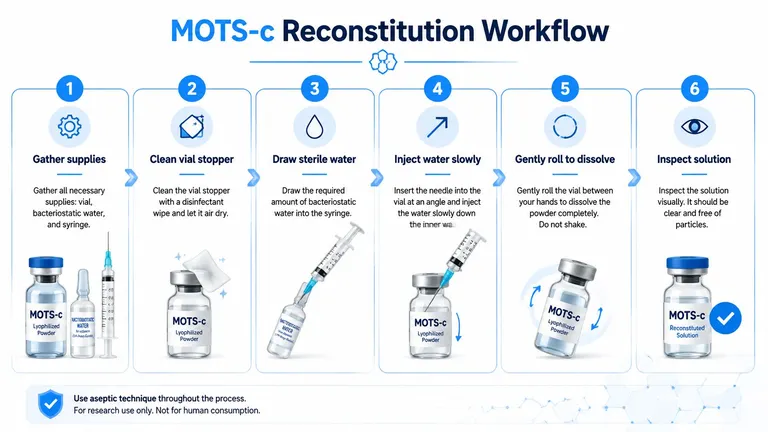
The vial stage is where people create problems they later blame on the peptide. Reconstitution is mechanical work, and it rewards patience. Bring the MOTS-c vial and bacteriostatic water to room temperature first, then wipe both stoppers with alcohol before you touch anything else.
The cleanest workflow
Use a slow, controlled reconstitution workflow to protect the powder and make the final solution easier to read. Add the diluent slowly down the inside wall of the vial, not straight onto the lyophilized cake, then gently swirl or roll the vial until the solution clears. Shaking introduces foam and can stress the peptide structure. For a freeze-dried peptide handling guide, the same low-turbulence principle applies across this class of compounds.
A common benchmark is 2 mL bacteriostatic water into a 10 mg vial, which yields a 5 mg/mL solution.
- 10 mg total peptide divided by 2 mL equals 5 mg per mL.
- At that concentration, 1 mL contains 5 mg.
- 0.5 mL contains 2.5 mg.
If your vial size or diluent volume changes, the same logic still applies. Divide the total milligrams in the vial by the total milliliters added, and you’ll know your concentration. That math is what keeps the protocol defensible instead of approximate.
What not to do
Don’t blast the diluent directly onto the powder cake. Don’t shake the vial hard. Don’t rush the process because the peptide is sitting on the counter. These are the mistakes that create foam, make the solution harder to inspect, and turn a simple prep into a mess.
If you want the full step-by-step sequence used in practice, the reconstitution workflow lays out the order clearly without pretending there is an official FDA-approved standard for this peptide.
Understanding Common Dosing Ranges and Schedules
Once the vial is ready, the question is where to begin without pretending there is an official answer. MOTS-c has no FDA-approved dosing standard, so the practical starting point comes from research-practice ranges and the way experienced users document response, tolerance, and timing. A defensible protocol is the one you can explain clearly and track consistently, not the one that sounds the most authoritative.
Across contemporary peptide guidance, the most commonly reported research-practice dosing range is 5 to 10 mg per injection, usually given subcutaneously and often 2 to 3 times per week or on a morning/pre-exercise schedule (current peptide protocol summary). Some protocol summaries extend that range to 5 to 15 mg per injection, but the practical center of gravity still sits in the narrower band (protocol guidance).
How to read the range
That range does not mean every user should begin in the middle. It means the available protocol culture clusters there because the evidence is still early and no completed human clinical trial dosing standard exists. The safer read is straightforward. Choose the lowest dose that matches your goal, run it long enough to see a pattern, then decide whether the response justifies moving upward.
The schedule matters as much as the amount. Some guides describe 4 to 8 week active phases followed by 2 to 4 week washouts, while others summarize 8 to 12 weeks on followed by a break (current peptide protocol summary). Those differences are not a contradiction. They reflect how people build norms before formal standards exist, and they leave room for conservative users who prefer shorter runs as well as more experienced users who want longer observation windows.
The protocol is part dose, part timing, and part restraint. If you cannot explain why you chose each one, you probably have not built a protocol yet.
Table
| MOTS-c Dosing Variables at a Glance | Common Range | Notes |
|---|---|---|
| Per-injection amount | 5 to 10 mg | Most common research-practice range |
| Broader protocol summaries | 5 to 15 mg | Appears in some guides, but not as a universal standard |
| Injection frequency | 2 to 3 times weekly | Often used in subcutaneous protocols |
| Cycle style | 4 to 8 weeks on, 2 to 4 weeks off | Common washout pattern in informal guidance |
| Timing | Morning or pre-exercise | Chosen to align with metabolic activity |
For a familiar comparison point, the logic is closer to a creatine monohydrate dosing guide than how people approach a prescription medication. You are still matching a protocol to a goal, not waiting for one universal dose to exist.
Subcutaneous Injection Technique and Site Rotation
Technique matters, but it does not need to be fancy. Subcutaneous administration is the standard approach described in protocol guidance, and the practical steps are simple once you stop improvising them. Wash your hands, clean the site, pinch about an inch of skin, then insert the needle at a 45 to 90 degree angle based on body fat. Inject slowly, then wait about 5 seconds before withdrawing.

Where to inject
The usual sites are the abdomen, thigh, and upper arm. Rotation helps reduce local irritation, and a practical site rotation guide can make that pattern easier to keep consistent. In day-to-day use, the abdomen is often the easiest place to standardize because access and visibility are simple. Thigh and upper arm work too, especially if you are spreading injections across a multi-week run.
Angle choice is about tissue depth. Leaner users often do better closer to 90 degrees with a proper skin pinch, while users with more subcutaneous tissue may stay comfortable at a shallower angle within the same range. The goal stays the same, get the peptide into subcutaneous fat, not muscle.
After the injection
Inject slowly. Do not jab. Do not drive the plunger fast. When the dose is in, wait a few seconds before withdrawing the needle, then avoid rubbing the site afterward. Rubbing can add irritation you do not need.
Practical rule: if the same site feels tender, stop forcing it. Rotate earlier, not later.
A simple rotation pattern works better than an elaborate one you cannot maintain. Alternate abdomen quadrants, then move to thigh or upper arm as needed so the tissue is not taking the same stress every time.
Building a Reliable Scheduling and Tracking System
The hardest part of how to take MOTS-c isn’t the injection itself. It’s keeping the protocol accurate week after week when your schedule changes, travel happens, and the math gets annoying. That’s why a tracking system matters more than clever stacking or heroic discipline.
Make the schedule visible
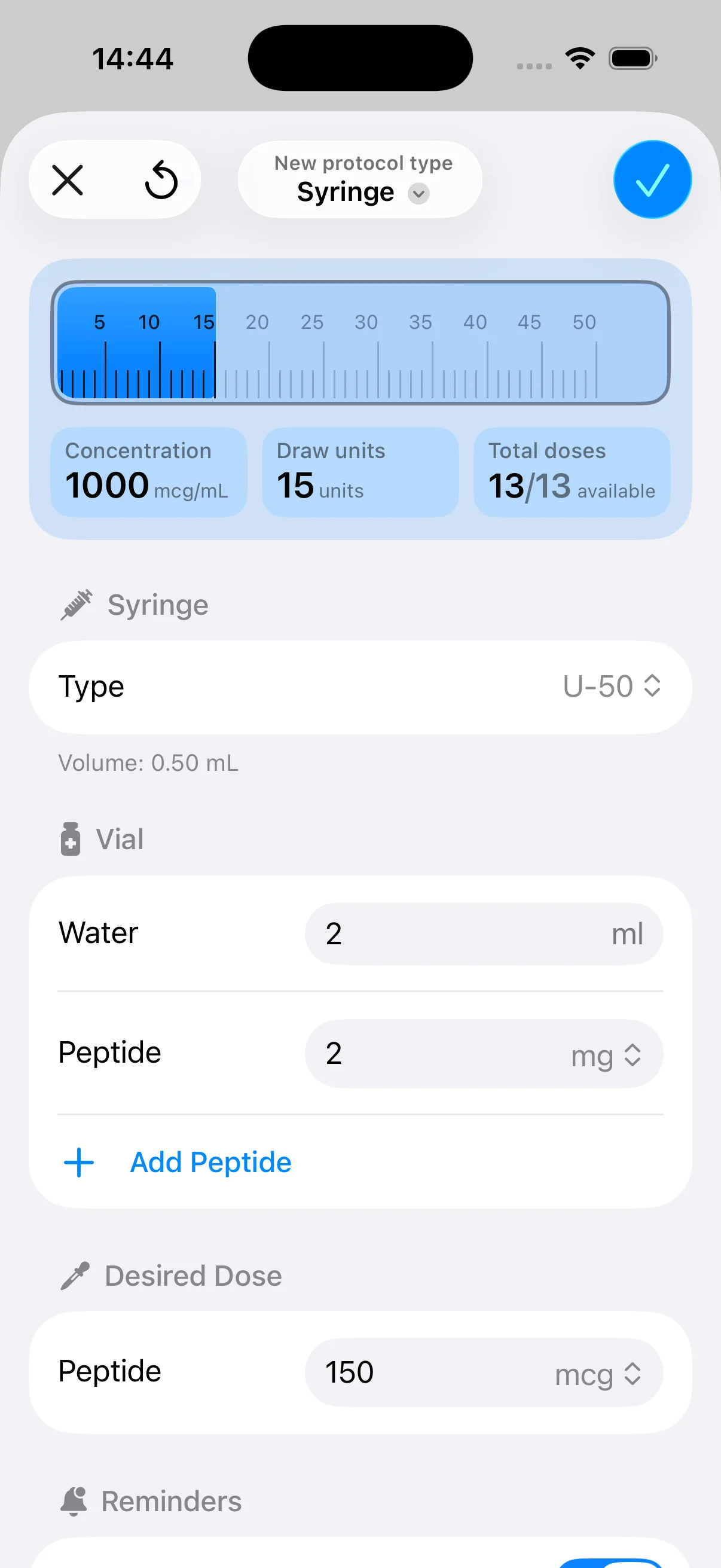
A good system turns a vague plan into something you can follow. That can mean a calendar, a paper log, or a dedicated app, as long as it stores dose history, cycle timing, and reminder triggers in one place. PepFlow is one option for that kind of organization, since it converts desired amounts into practical unit measurements and supports cycled protocols with reminders and logging.

The value is not novelty. It’s reducing the chance that you misread a concentration, forget a dose, or lose track of where you are in a cycle. A protocol only stays defensible if you can reconstruct what you did.
Track what you can verify
A clean log should record the date, dose, site, and any unusual response. If you want to compare timing strategies, note whether a dose was taken in the morning, pre-exercise, or on a different schedule. That’s enough to spot patterns without drowning yourself in metrics.
Backup matters too. If your phone dies, a paper note in the vial bag can keep the cycle intact. A routine schedule app can help, and a simple routine schedule app makes more sense than relying on memory alone, but a low-tech fallback still saves the day when technology fails.
A protocol you can’t track accurately will feel inconsistent even when the dose is fine.
Safety Considerations and When to Seek Professional Guidance
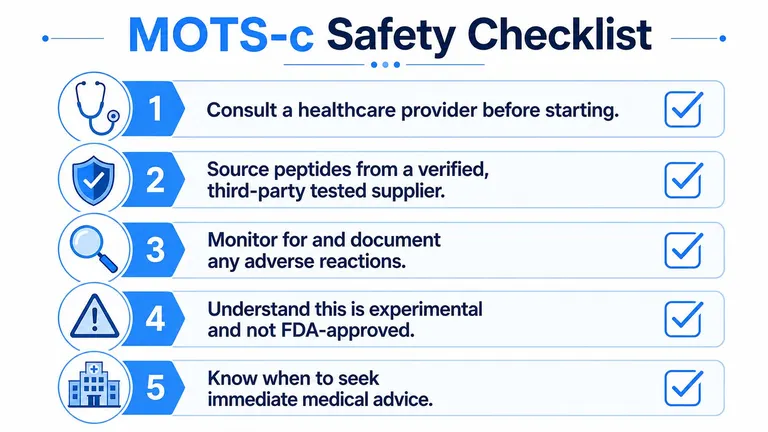
MOTS-c safety starts with humility. This remains an experimental peptide, not an FDA-approved therapy, so any dosing plan should be treated as provisional until a qualified clinician helps weigh the trade-offs. The issue is not finding a mythical official guideline, it is building a defensible protocol from the limited research-practice range available, while staying honest about what is still uncertain.
What responsible use looks like
Start with the basics. Verify the source, document what you take, and watch for adverse reactions instead of assuming the protocol is working just because it feels organized. The point from why more pills may backfire applies here too, more inputs do not automatically produce better outcomes.
That matters even more with peptides, because it is easy to stack compounds and blur the picture. Keep one variable at a time whenever possible. That gives you something real to evaluate. Multiple changes at once turn the log into noise and make it hard to know what helped or harmed.
When to pause and ask for help
Pause the cycle if you notice local irritation that keeps getting worse, reactions that do not settle, or anything systemic that feels off and does not make sense. Seek medical guidance if you are unsure how MOTS-c fits with your health status, medications, or existing metabolic issues. The goal is not to dramatize every symptom. The goal is to keep an experimental protocol from becoming a blind one.
A more conservative approach is easier to defend. Keep the plan restrained, keep the records honest, and let someone qualified review the picture when your own notes are not enough to make the next decision clear.