
You’re likely at the common point of inquiry concerning DAC vs no DAC peptides. You already know both versions sit in the same family, you already know the names, and you already know the simple summary: DAC lasts longer, no-DAC is shorter acting.
That’s not enough to choose a protocol.
The core decision is whether you want a sustained signal that stays with you in the background, or a brief pulse that comes and goes quickly. That difference affects scheduling, flexibility, monitoring, and the kind of tradeoffs you’re willing to accept when you build a routine around compounds like CJC-1295.
Table of Contents
- Understanding the DAC vs No DAC Decision
- How DAC Technology Changes Peptide Behavior
- Pharmacokinetics A Direct Comparison
- Practical Implications for Dosing and Scheduling
- Comparing Efficacy and Safety Profiles
- Use Cases When to Choose DAC vs No DAC
- Planning Your Protocol Safely and Effectively
Understanding the DAC vs No DAC Decision
Most comparisons of DAC vs no DAC peptides stop at duration. That’s useful, but it misses the actual protocol question: what kind of exposure are you trying to create?
A peptide with DAC includes a Drug Affinity Complex designed to keep the compound active longer. A no-DAC version removes that long-acting feature, which changes the pattern of exposure from extended coverage to shorter bursts. In practice, that means the choice isn’t just about convenience. It’s also about how tightly you want to control timing, how comfortable you are with lingering effects, and how much structure your schedule can realistically support.
For people sorting through different peptide therapies, this is usually where confusion starts. Two protocols can involve a closely related compound and still behave very differently once dosing frequency, response tracking, and tolerance for side effects enter the picture.
The strategic question behind the label
The cleaner way to think about it is this:
- DAC protocols favor continuity. They suit people who want less frequent administration and are comfortable with a longer tail after each dose.
- No-DAC protocols favor control. They suit people who want a shorter window of activity and more room to adjust timing or stop quickly if the protocol isn’t a good fit.
That distinction matters more than marketing language like “stronger” or “more natural,” because neither label tells you how the protocol will feel to manage over time.
Practical rule: Choose the exposure pattern first. Then choose the compound version that matches it.
What usually works in real protocol design
When someone struggles with a peptide plan, the problem usually isn’t the peptide itself. It’s mismatch.
A long-acting protocol fails when the user wants rapid feedback and precise control. A short-acting protocol fails when the user can’t stay consistent with frequent dosing. The better choice is the one you can follow, monitor, and adjust without turning your week into a scheduling problem.
How DAC Technology Changes Peptide Behavior
A weekly injection can look convenient on paper, then become a problem if the response is too strong, sleep worsens, or water retention shows up and lingers. That is the core effect of DAC technology. It changes the peptide from a short signal you can shape around timing into a long signal that keeps working after the injection is done.
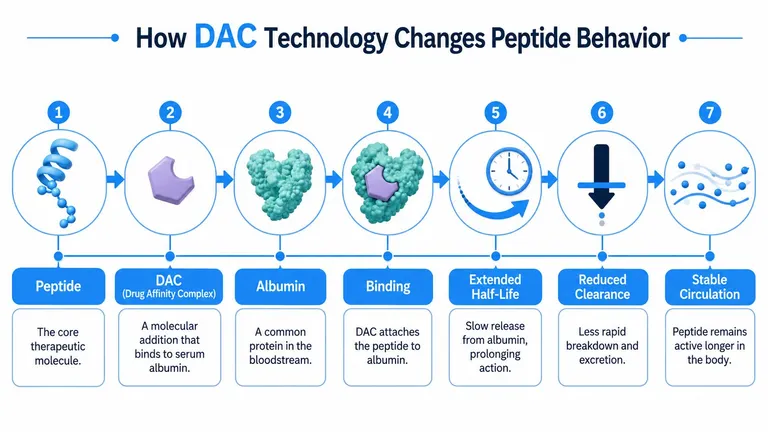
Mechanistically, the DAC add-on is designed to increase albumin binding. That slows clearance and keeps more of the peptide circulating over time. If you want a quick primer on the mechanism itself, PepFlow has a useful explainer on what DAC means in peptides.
Sustained exposure changes the kind of stimulus
The practical difference is not just “longer half-life.” It is the type of stimulation you create.
A no-DAC peptide produces a brief exposure window. That is closer to a pulsatile pattern, which matters if the goal is to keep tighter control over timing, stack it with other compounds, or stop quickly if the protocol is not going well. A DAC peptide creates a more chronic, sustained signal. In practice, that can reduce dosing burden, but it also reduces your ability to make clean adjustments once the dose is in.
That trade-off is where protocol design starts to change.
Why the same peptide family can behave so differently
DAC does not change the peptide’s broad target class. It changes exposure kinetics, and exposure kinetics often determine how a protocol feels in practice.
With sustained albumin-assisted circulation, receptor signaling is stretched over days instead of hours. That can be useful when consistency matters more than precision. It can also create a flatter, less biomimetic pattern than many users expect from a growth-hormone-related protocol. In coaching or research planning, this is usually the point people miss. They compare ingredient names and overlook that one version behaves like an always-on nudge, while the other behaves like a timed pulse.
The safety angle follows the same logic. A short-acting compound gives you more chances to correct course. A long-acting compound gives you fewer injections, but each dosing decision carries a longer tail.
That is why DAC should be viewed as a strategic modification, not just a convenience feature. It changes efficacy patterns, side-effect management, and how much control you keep once the protocol begins.
Pharmacokinetics A Direct Comparison
A protocol can look clean on paper and still be the wrong choice once timing enters the equation. The primary split between DAC and no-DAC is not the peptide family name. It is the exposure pattern you are choosing to live with.
For CJC-1295, the no-DAC version is the short-acting form based on modified GHRH(1-29), while the DAC version stays in circulation far longer. Earlier in the article, we covered how DAC extends circulation time. The practical consequence matters more than the label. One option creates ongoing receptor stimulation across days. The other creates shorter, more biomimetic pulses that rise and clear fast enough to give you tighter control.
DAC vs No-DAC Peptides At a Glance
| Attribute | DAC Peptides | No-DAC Peptides |
|---|---|---|
| Core behavior | Long-acting | Short-acting |
| Time in circulation | Extended exposure over days | Brief exposure after each administration |
| Release pattern | Sustained background coverage | Distinct pulse after dosing |
| Signal style | More continuous stimulation | More pulsatile stimulation |
| Typical scheduling style | Weekly-style | Daily or twice-daily style |
| Flexibility | Lower once administered | Higher because effects clear faster |
| Best fit for | Simplicity and fewer injections | Precision and tight timing control |
Why half-life changes protocol behavior
Long half-life changes more than injection frequency. It changes how fast you can interpret a response, adjust dose selection, and recover from a protocol that is too aggressive.
With DAC, side effects or unexpected responses tend to linger because the signal does not shut off quickly. That makes dose selection more important at the front end. Small mistakes can stay relevant for days. With no-DAC, the shorter action gives faster feedback. That usually makes troubleshooting cleaner, especially in early protocol setup or in users who are sensitive to GH-related effects.
For broader context on peptide timing and clearance, PepFlow’s guide on how long peptides last adds useful background.
Sustained stimulation versus pulsatile stimulation
This is the distinction many comparison guides miss. Longer-lasting exposure is not only a convenience feature. It changes the kind of biological signal you are creating.
No-DAC better matches a pulse-driven approach. You administer it, get a shorter window of activity, then the signal fades. DAC shifts the protocol toward chronic, sustained stimulation. That can suit users who prioritize consistency and fewer injection events, but it also reduces precision. If the goal is to mimic a more natural rise-and-fall pattern, no-DAC usually fits that logic better.
In practice, the choice comes down to what you need most.
- Use DAC logic if fewer administrations matter more than fine control and you can tolerate slower adjustments.
- Use no-DAC logic if timing, responsiveness, and easier course correction matter more than convenience.
- Do not judge them by the same standard. DAC is better at maintaining exposure. No-DAC is better at preserving maneuverability.
That is the core pharmacokinetic trade-off. DAC gives persistence. No-DAC gives steering control.
Practical Implications for Dosing and Scheduling
Protocol design gets real when the calendar gets involved. At this point, the difference between DAC and no-DAC stops being academic.
A weekly-style compound creates one kind of adherence problem. A daily or twice-daily compound creates a completely different one. Neither problem is trivial. One asks for patience. The other asks for discipline.
What a DAC schedule tends to demand
DAC usually fits people who want fewer administration points and less day-to-day interruption. If your workdays are chaotic, travel is common, or your schedule changes often, that can matter more than any abstract discussion of peptide theory.
The tradeoff is that a longer-acting protocol is less forgiving. Once you commit to a dose, you don’t get much same-day flexibility. That means sloppy planning shows up later, not immediately.
What a no-DAC schedule tends to demand
No-DAC protocols usually suit people who don’t mind routine and want closer control over timing. The burden is consistency. If your injections need to happen on a tighter cadence, the protocol only works when your behavior is equally tight.
That’s where a lot of otherwise good plans fall apart. The compound may be right, but the user misses windows, compresses doses into inconvenient times, or gradually turns a structured plan into an improvised one.

Scheduling mistakes that cause preventable problems
Some patterns come up repeatedly:
- Overvaluing convenience: A user picks DAC because fewer injections sound easier, then dislikes having less control once the dose is in.
- Underestimating routine burden: A user picks no-DAC for the pulsatile logic, then can’t maintain the frequency required.
- Ignoring tracking needs: Short-acting protocols produce more decision points. If those aren’t logged, patterns get blurry fast.
- Changing too many variables at once: When timing, dose, and stacking all shift together, it becomes hard to interpret what’s happening.
The best protocol isn’t the one that looks ideal on paper. It’s the one you can execute accurately for long enough to evaluate honestly.
Matching the protocol to the person
I usually frame it this way. If someone needs minimal disruption, DAC often makes more sense. If someone needs maximum control, no-DAC often makes more sense.
That sounds simple, but it’s the right filter. Long-acting compounds reduce scheduling friction but increase commitment per dose. Short-acting compounds increase scheduling friction but reduce commitment per dose.
Choose based on the part you’re better at handling.
Comparing Efficacy and Safety Profiles
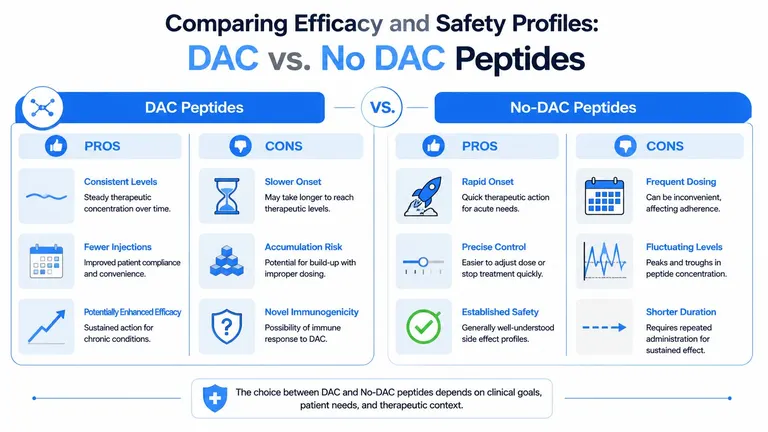
This is the part most guides skip. They tell you DAC lasts longer and no-DAC is more biomimetic, then stop before the question matters.
The more useful question is this: what are you buying with prolonged exposure, and what are you giving up compared with pulsed exposure?
Existing sources already note the safety tradeoff. DAC binds albumin and extends activity to about 6 to 8 days, while no-DAC clears in roughly 30 minutes and produces brief GH pulses. The important gap is that these sources do not quantify how that pharmacokinetic difference affects side effects, tolerance, or monitoring thresholds across different populations, as noted by Women’s Health of MD in its discussion of CJC peptide therapy.
Where DAC may help and where it may complicate things
Sustained exposure can be attractive when the goal favors consistency over precision. A stable background signal is easier to live with for some users, especially if they value low-frequency administration.
The tradeoff is straightforward. If a user doesn’t tolerate the protocol well, that effect may not fade quickly. A long-acting compound is harder to steer because the exposure persists.
Where no-DAC may help and where it may complicate things
Pulsatile exposure tends to appeal to people who want a pattern that feels closer to a brief signal instead of an ongoing one. The major practical benefit is reversibility. If something about the protocol feels off, there’s less lingering activity to work through.
The downside is workload. More frequent administration means more opportunities to miss doses, mistime them, or create inconsistent protocol conditions that muddy interpretation.
A risk framework that’s actually useful
Instead of asking which one is safer in the abstract, ask three narrower questions:
- How sensitive are you to lingering effects? If that matters a lot, shorter exposure usually gives you cleaner control.
- How good are you at execution? If adherence is weak, a frequent protocol can become messy quickly.
- How much monitoring discipline do you have? Long-acting protocols need patience. Short-acting protocols need detail.
If you want maximum control over side-effect management, shorter-acting exposure usually gives you more room to respond.
That doesn’t make no-DAC universally better. It means control is one of its strongest practical advantages.
Efficacy isn’t just chemistry
A protocol only becomes effective when the user can carry it out consistently enough to produce a stable pattern.
That’s why the efficacy conversation can’t be separated from scheduling and tolerance. A theoretically excellent no-DAC plan can underperform if the user misses timing windows. A theoretically convenient DAC plan can become a poor fit if the user dislikes the persistence of the signal and can’t adjust quickly.
In practice, efficacy and safety are linked by one thing: how manageable the protocol feels once real life starts interfering.
Use Cases When to Choose DAC vs No DAC
Decision-making gets easier when you stop asking which one is better and start asking which one matches the job.
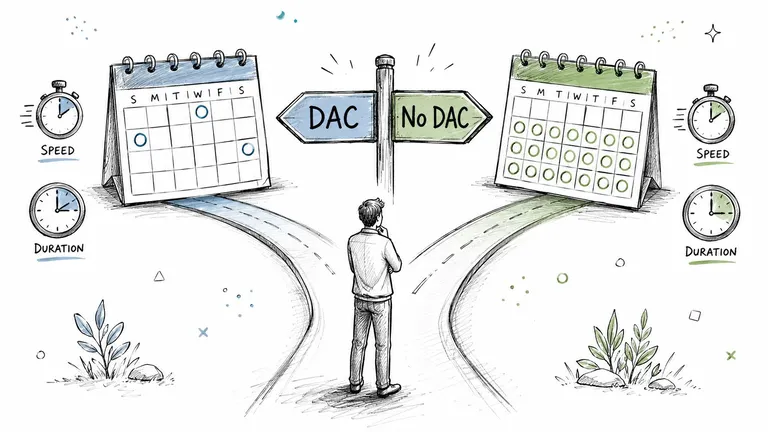
Choose DAC when consistency matters more than precision
DAC usually makes more sense in cases like these:
- Busy schedule: You want fewer intervention points during the week.
- Low injection tolerance: You’re more likely to stay compliant if administration is infrequent.
- Steady protocol preference: You’d rather run a simple, stable routine than manage repeated timing windows.
Choose DAC if your main problem is adherence fatigue, not lack of control.
For a focused breakdown of that exact comparison, PepFlow has a dedicated guide on CJC-1295 DAC vs no DAC.
Choose no-DAC when control matters more than convenience
No-DAC is usually the better fit when the user wants to shape the protocol more tightly around timing and feedback.
That often includes people who are side-effect cautious, people who prefer shorter exposure windows, and people who don’t mind the structure of daily routine. It also tends to fit users who want a more clearly pulsed pattern rather than an extended background signal.
A good way to think about it is operational. If you want to make small protocol decisions with more immediate feedback, no-DAC gives you a better steering wheel.
Here’s a useful visual explainer that helps frame the choice:
Two profiles that make the decision easier
The DAC user is often someone who says, “I need this to be simple enough to keep doing.”
The no-DAC user is often someone who says, “I need this to be adjustable enough to trust.”
Both are valid. Problems start when someone picks one for the wrong reason. If you choose DAC because it sounds stronger, or choose no-DAC because it sounds more advanced, you’re probably using the wrong filter.
Planning Your Protocol Safely and Effectively
The cleanest way to plan DAC vs no DAC peptides is to work backward from three things: your tolerance for frequent dosing, your need for control, and your willingness to track the protocol carefully.
If you want fewer touchpoints and can accept a longer window of activity, DAC usually fits better. If you want tighter timing control and faster reversibility, no-DAC usually fits better. Neither choice removes the need for caution, consistency, and informed oversight.
This is informational content, not medical advice. If you’re evaluating sourcing, preparation, and formulation questions, it helps to understand how specialized peptide compounding services are typically discussed in clinical practice, especially when protocol precision matters.
The main implementation challenge is simple: people make mistakes when they eyeball doses, drift off schedule, or rely on memory instead of a system. The more structured the protocol, the less room there is for casual tracking.
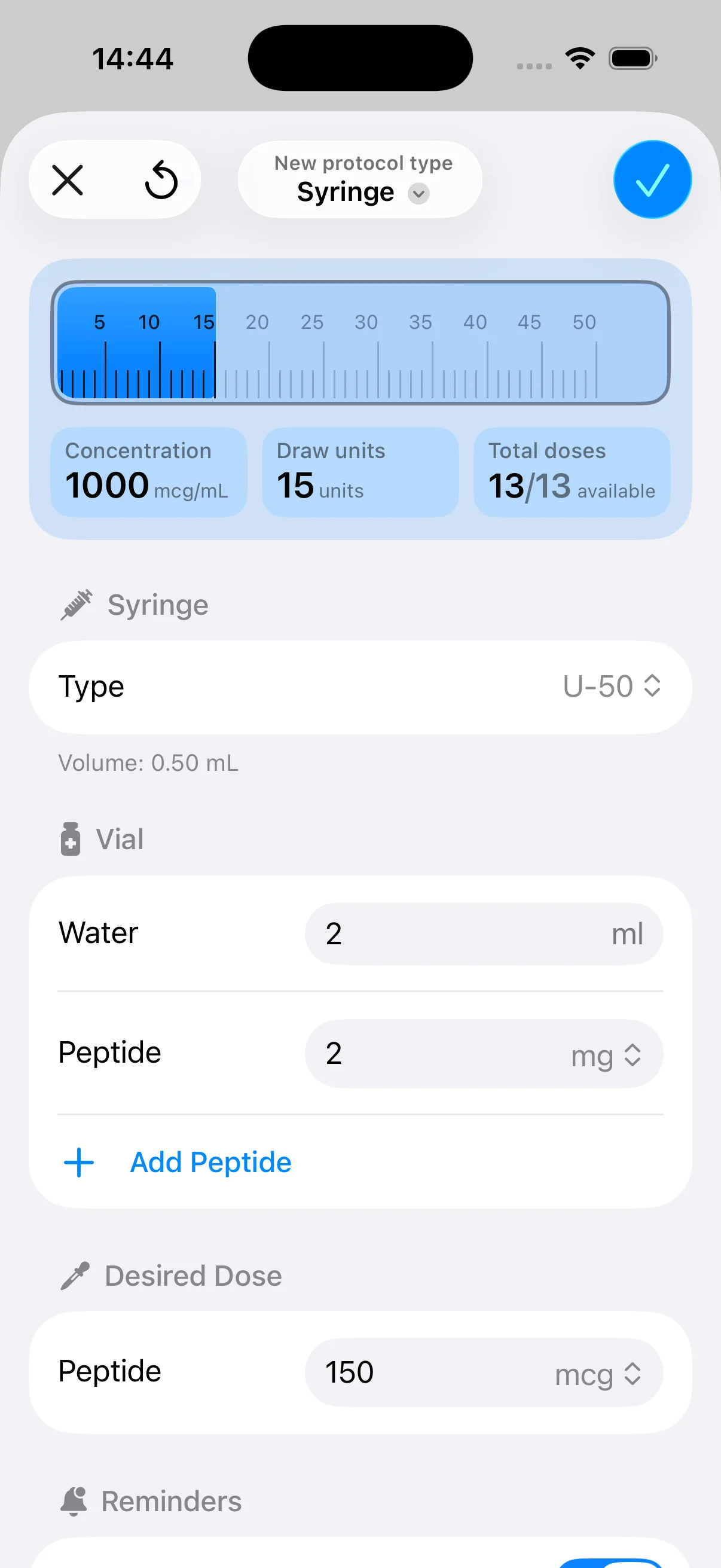
If you want a simpler way to manage the logistics, PepFlow helps you calculate peptide doses, organize complex schedules, track cycles, and stay consistent with reminders so your protocol is easier to follow accurately.