You’ve measured the diluent, opened the vial, and added the exact volume on your worksheet. The solution looks blue-green, so it seems ready. Then the vial sits in the refrigerator without a date, gets warmed repeatedly during daily draws, or changes color after an acidic ingredient is added. The volume was correct, but the preparation wasn’t controlled.
Learning how to mix GHK-Cu requires more than water and arithmetic. GHK-Cu is a copper-binding tripeptide, so the process must protect the peptide-copper complex from contamination, unsuitable pH, light, temperature cycling, and aggressive agitation. The sections below focus on those failure points, while separating topical formulation questions from preparation intended for injection.
Table of Contents
- Why GHK-Cu Mixing Demands More Than Just Water
- Choosing the Right Solvent for Your Protocol
- Calculating Concentration and Executing the Mix
- Storing and Managing Your Reconstituted Solution
- Using Technology to Track Peptide Cycles
- Addressing Safety Risks and Evidence Gaps
Why GHK-Cu Mixing Demands More Than Just Water
GHK-Cu was first isolated in 1973 by Loren Pickart, who identified the copper-binding tripeptide glycyl-L-histidyl-L-lysine from human plasma albumin. That history matters because GHK-Cu isn’t just a powder that becomes useful after dilution. It’s a biologically active peptide-copper complex, and preparation should preserve that structure. The foundational discovery and later review of its biological context are discussed in this medical review of GHK-Cu.
A common failure looks deceptively ordinary. Someone calculates the volume correctly, injects diluent directly onto the lyophilized cake, shakes until the foam settles, and leaves the vial exposed to light while deciding what to do next. The final liquid may still look acceptable, but rough handling can stress the peptide-metal coordination, while contamination and unsuitable storage can compromise the solution after mixing.
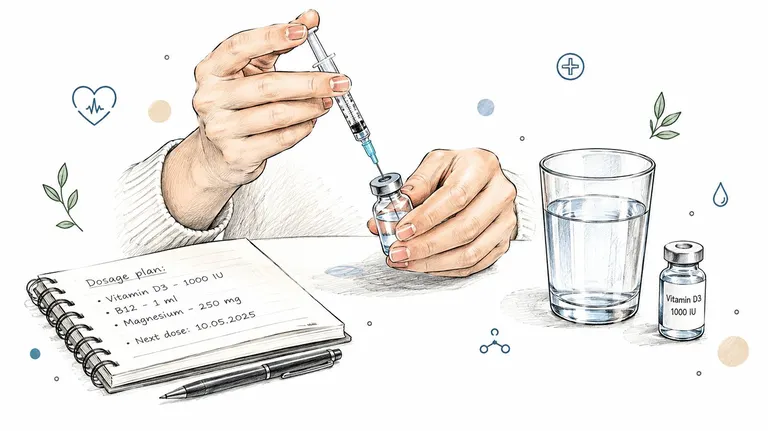
The preparation sequence that holds up
Treat reconstitution as a controlled workflow, not an improvised dilution.
- Confirm the vial contents. Record the peptide amount and decide what final concentration your clinician or protocol requires.
- Choose a compatible sterile diluent. Bacteriostatic water is commonly selected for preserved multi-dose handling. Sterile water without preservative has a much shorter practical window after piercing.
- Clean the working area and vial stoppers. Every needle entry is a contamination vector, so use new sterile equipment and let alcohol on the stopper evaporate before piercing.
- Add liquid slowly down the vial wall. Avoid striking the powder directly.
- Gently swirl. Don’t shake, foam, or force dissolution.
- Inspect, label, and refrigerate. Record the mix date, concentration, and storage requirements immediately.
Independent medical literature describes GHK-Cu activity at very low nanomolar concentrations, which helps explain why small preparation inconsistencies can matter when users seek repeatable dosing. If you’re considering supervised treatment rather than cosmetic formulation, a clinical resource such as OneTwenty’s GHK-Cu treatment information can help frame the discussion with a qualified professional.
Practical rule: Correct volume is only one quality check. A usable protocol also controls the solvent, pH, handling force, exposure, and time.
Choosing the Right Solvent for Your Protocol
The diluent determines more than how quickly the powder dissolves. It affects contamination control, storage expectations, and the chemical environment surrounding the copper complex.
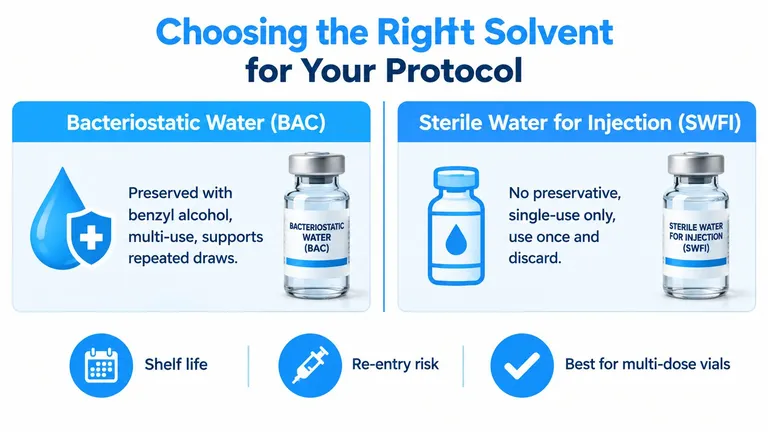
Bacteriostatic water contains a preservative, commonly benzyl alcohol, that helps inhibit bacterial proliferation in a multi-dose container. Handling guidance commonly pairs it with refrigeration at 2–8°C and a conservative post-reconstitution window of about 28–30 days, provided the solution remains protected from light and is handled aseptically. That window isn’t a guarantee. Each puncture, warming event, and lapse in technique can shorten the useful life.
Sterile water without preservative can be appropriate when the prepared solution is intended for immediate, single-use handling. It doesn’t provide the same protection against microbial growth after repeated vial entry, so it’s a poor choice for a stock solution that will be opened over an extended period. The distinction between preserved and unpreserved water is also reflected in broader peptide-handling guidance from this medical review on peptide stability and use.
A solvent decision based on the protocol
| Choice | What it supports | Main limitation |
|---|---|---|
| Bacteriostatic water | Preserved, multi-dose handling when refrigeration and aseptic technique are maintained | The preservative doesn’t make poor technique safe |
| Sterile water | Immediate or single-use preparation | No preservative protection after repeated entry |
| Tap, bottled, or improvised water | Nothing suitable for a controlled peptide preparation | Sterility and compatibility aren’t assured |
Don’t substitute saline, acidic liquids, alcohol, or cosmetic water without a formulation rationale. Solubility alone doesn’t establish stability. GHK-Cu guidance generally places the preferred environment in a near-neutral to mildly acidic range, about pH 5.0–6.5, with some compatibility guidance extending the tolerable range more broadly. Strongly acidic conditions can increase copper dissociation, while higher pH may contribute to instability or color loss. For readers working with acid-sensitive materials, this guide to acetic-acid peptides offers useful context on why the reconstitution vehicle must match the peptide.
Use pharmaceutical-grade products intended for the route and purpose under consideration. A preservative can reduce one risk, but it doesn’t correct an incompatible pH, prevent oxidation from light, or validate self-administration.
Calculating Concentration and Executing the Mix
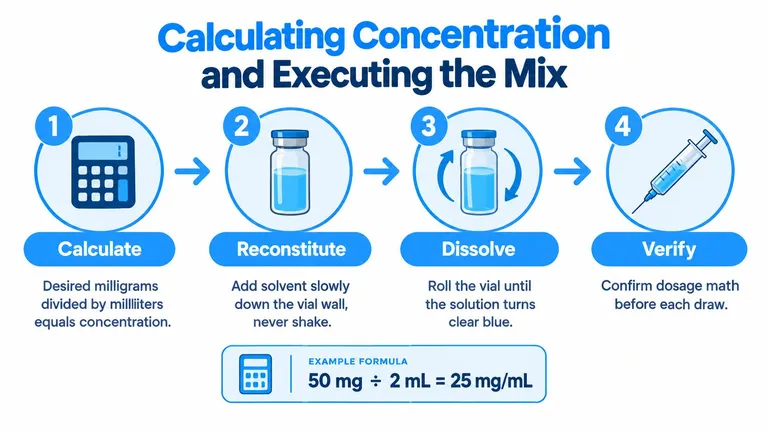
Do the calculation before opening the vial. The basic relationship is:
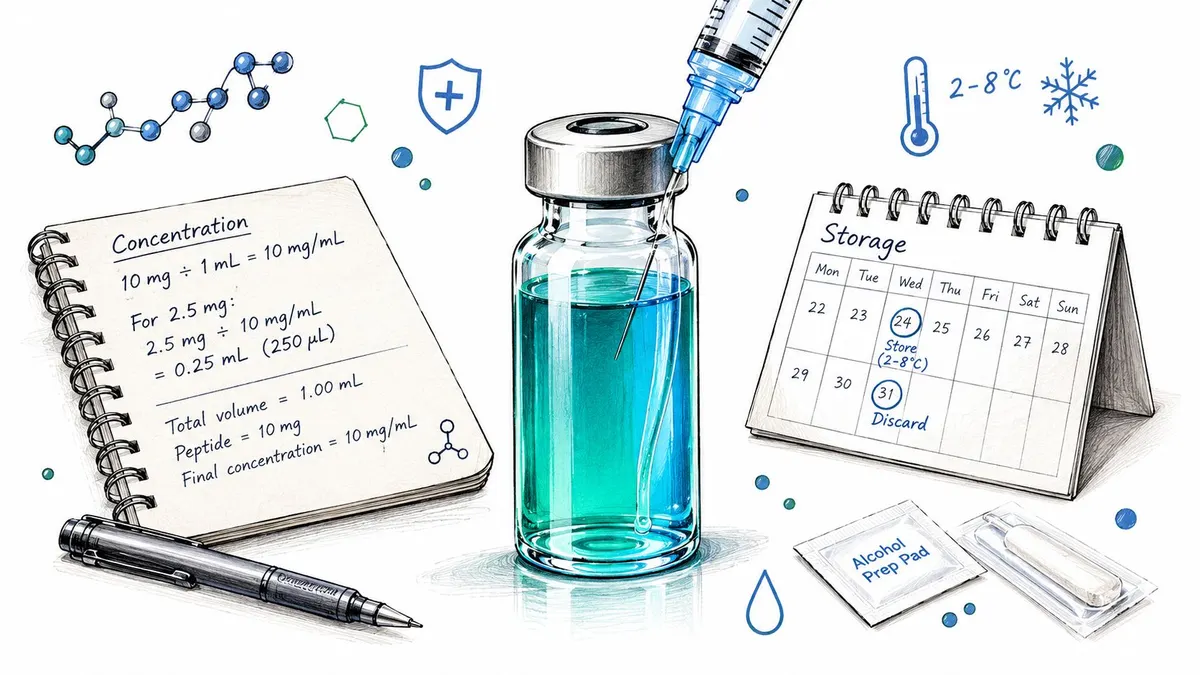
Concentration = peptide amount in milligrams ÷ final diluent volume in milliliters
For example, a 50 mg vial mixed with 2 mL of diluent produces 25 mg/mL. That example is a concentration calculation, not a recommended dose. The appropriate target depends on the intended use, dose volume, equipment, and professional instructions.
A different handling guide uses 2 mg/mL for a 10 mg vial mixed with 5 mL of diluent. These examples show why copying someone else’s volume can create the wrong concentration for your protocol. Calculate from your own vial label and final volume, then verify the result before drawing.
Use a gentle transfer technique
Once the arithmetic is checked, the physical process matters.
- Prepare sterile equipment. Use a new sterile syringe and needle for the transfer. Clean the stoppers and allow the disinfectant to dry.
- Draw the calculated diluent volume. Remove visible air bubbles and confirm the volume at eye level.
- Position the needle inside the peptide vial. Aim the tip toward the inner glass wall, not at the powder cake.
- Run the diluent slowly down the wall. This reduces direct impact, foaming, and unnecessary mechanical stress.
- Remove the needle and gently swirl. Roll the vial in a controlled circular motion. Don’t shake it.
- Allow time for hydration. If the powder doesn’t dissolve immediately, set the vial down and let the liquid hydrate it before attempting another gentle swirl.
The aim is a clear, uniformly blue-green solution without visible particles. Color is a useful observation, not a substitute for validated testing. A marked change toward a paler color can signal copper dissociation or instability, particularly when it appears alongside unsuitable pH, heat, light exposure, or contamination.
Check the dose math separately
Mixing concentration and dose conversion are related, but they’re not the same calculation. Once concentration is known, calculate the volume required for the prescribed amount, and write that conversion on the vial label or protocol sheet. A dedicated GHK-Cu dosage calculator guide can reduce manual conversion mistakes, but it can’t determine whether a route of administration is medically appropriate.
The safest point to catch a concentration error is before the vial is opened.
Storing and Managing Your Reconstituted Solution
The mixed vial is more vulnerable than the dry powder. Refrigerate the reconstituted solution at 2–8°C, keep it protected from light, and return it to storage promptly after each draw. Don’t place it in a refrigerator door if that location causes frequent temperature changes, and don’t use a freezer as a shortcut for extending the life of a liquid stock.
The conservative benchmark for a bacteriostatic-water preparation under refrigerated, light-protected conditions is about 28–30 days after reconstitution. That estimate assumes controlled handling. Sterile water without preservative should be treated as a short-window, single-use option rather than as an equivalent multi-dose stock.
Prevent temperature cycling
Repeated warming and cooling creates two problems. First, it increases opportunities for condensation and contamination during handling. Second, repeated temperature changes can disturb solution stability. The same concern applies to freeze-thaw cycles, which should be avoided for reconstituted GHK-Cu.
Aliquoting can reduce the need to warm the entire stock, especially in laboratory workflows where single-use portions are appropriate. It must be performed with validated sterile technique, suitable containers, and a clear labeling system. For practical storage principles, see this guide to storing reconstituted peptides.
Inspect before every use
A typical intact GHK-Cu preparation is blue-green. A shift toward a paler color may indicate copper dissociation or instability, while particles, cloudiness, or unexpected discoloration should be treated as failure signals rather than corrected with more swirling or additional water.
- Check the label: Confirm the reconstitution date and concentration.
- Check the container: Look for cracks, damaged stoppers, or leakage.
- Check the liquid: Look for unexpected particles, precipitation, cloudiness, or color change.
- Check the history: Discard a preparation with uncertain storage or contamination exposure.
When the solution’s identity or handling history is uncertain, don’t try to rescue it. A discarded vial is preferable to using a preparation that may be degraded or contaminated.
Using Technology to Track Peptide Cycles
A vial can be chemically prepared correctly and still be used incorrectly. People forget the reconstitution date, confuse concentrations between vials, misread a syringe, or continue using a stock after its planned window. The administrative layer is part of the safety process.

Build a record that follows the vial
At minimum, record:
- Vial identity: Peptide name and amount stated on the label.
- Mix date: The date the diluent entered the vial.
- Final concentration: The calculated amount per milliliter.
- Storage condition: Refrigerated, protected from light.
- Use history: Each draw, missed dose, pause, or disposal decision.
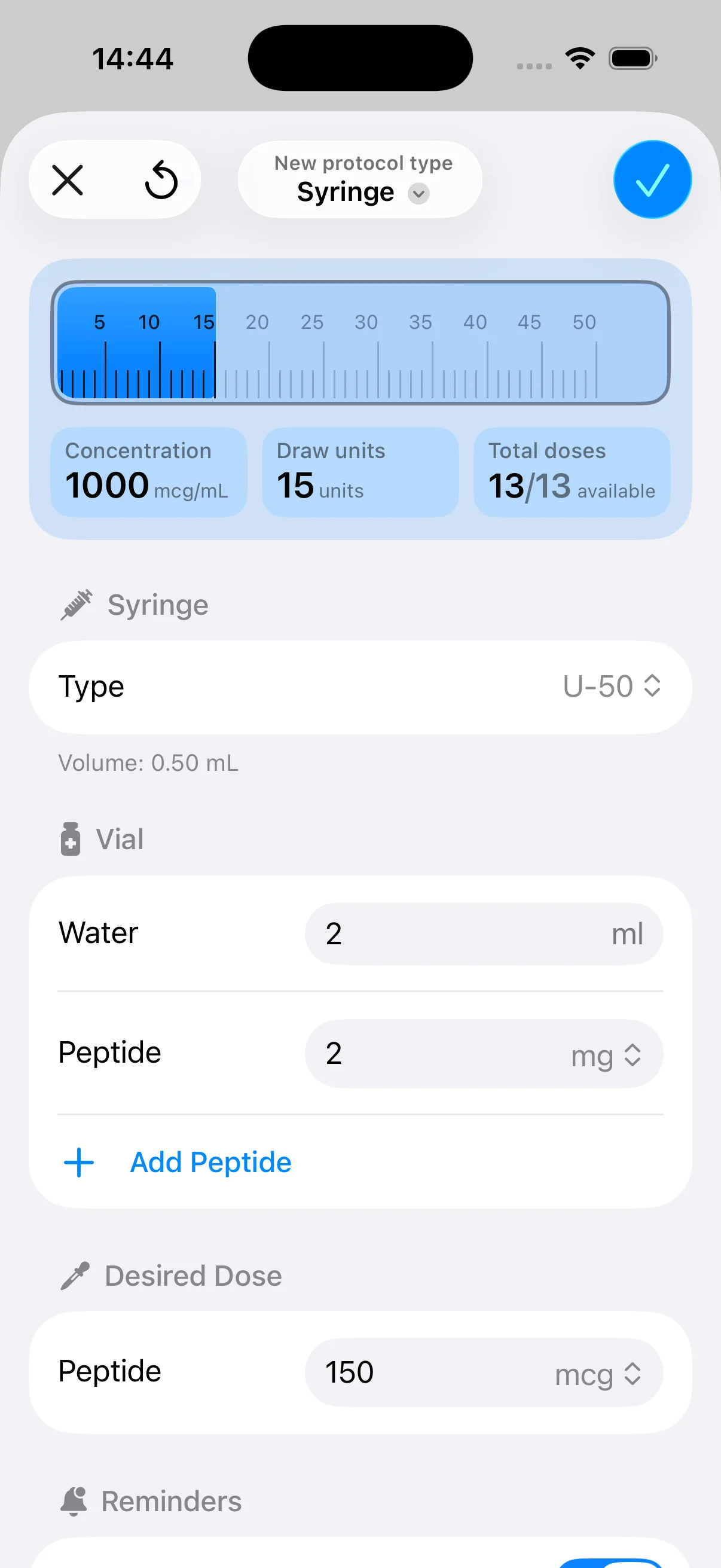
PepFlow is one organizational option for this workflow. Its calculator can convert a target amount into a practical draw volume after the vial amount and reconstitution volume are entered, while its protocol features support start dates, dosing frequencies, pause periods, reminders, countdowns, and dose history. The app helps organize the numbers and schedule, but it doesn’t replace sterile technique, product quality controls, or medical advice.
A resource such as The Sleep Consultant’s peptides guide may also be useful when you’re thinking about how peptide routines fit alongside broader wellness habits. Keep that planning separate from decisions about route, dose, and preparation safety.
Use a digital record or a paper label, but make the record unambiguous. Don’t rely on memory for a multi-dose vial, particularly when more than one concentration is stored in the same refrigerator.
A visual walkthrough can help users understand how a tracking workflow fits around preparation and routine logging.
Addressing Safety Risks and Evidence Gaps
A correctly mixed solution isn’t automatically safe to use. The route of administration changes the risk profile, and topical cosmetic use shouldn’t be treated as evidence for injection.
GHK-Cu is commonly discussed as a cosmetic ingredient, with some product materials framing topical formulations around 0.5% and describing low toxicity. Those statements don’t establish safety or effectiveness for injection. Recent reporting emphasizes that people are injecting copper peptides ahead of the science, with no published human evidence showing that practice is safe and effective. The distinction is important because a sterile technique can reduce contamination risk without proving that the product, dose, route, or formulation is clinically appropriate.
Separate topical formulation from injection preparation
Topical products are designed for application to the skin and may contain stabilizers, preservatives, penetration aids, or other ingredients that aren’t suitable for injection. A water-reconstituted research product isn’t automatically a finished cosmetic serum, and a cosmetic ingredient isn’t automatically an injectable medicine.
Copper exposure also deserves medical attention. Reported systemic symptoms associated with copper toxicity can include abdominal pain, vomiting, weakness, and tremor, as summarized in recent coverage of copper peptide use. If symptoms occur after exposure, seek urgent medical advice rather than trying to adjust the mixture independently.
Preparation safety is necessary, but it isn’t a clinical safety assessment.
Before using GHK-Cu beyond a professionally formulated topical product, discuss the product, route, concentration, medical history, and other substances with a qualified clinician. Don’t inject a preparation just because an online mixing guide provides volume math, and don’t combine ingredients in the same vial unless compatibility, sterility, and intended use have been professionally established.
PepFlow helps organize vial concentrations, draw-volume calculations, cycle dates, reminders, and dose history so your protocol doesn’t depend on memory or handwritten math. Visit PepFlow to see how its tracking tools can support a more consistent record while you handle the medical and sterility decisions with a qualified professional.