
You’ve got a vial in front of you, a sterile syringe, and a peptide that looked simple on paper. Then the moment you add bacteriostatic water, the powder doesn’t turn clear. It turns cloudy, or strings into a faint haze, or just sits there like wet dust that refuses to disappear.
That’s the point where a lot of people assume the peptide is bad.
Usually, that’s the wrong conclusion. Many peptide handling mistakes start because people treat every lyophilized peptide as if it behaves the same way in water. It doesn’t. Some dissolve readily. Some need a different chemical environment before they’ll go into solution cleanly. That’s where acetic acid peptides become relevant. The phrase is a little sloppy, but in practice people use it to mean peptides that require dilute acetic acid for proper reconstitution.
The important detail isn’t just “use acid.” It’s understanding why acid helps, which peptides need it, and why the specific 0.6% concentration threshold matters for certain use cases. That last point gets missed all the time. Generic advice often turns a precise chemistry problem into a vague internet rule, and that’s how people end up with cloudiness, wasted material, or structural damage.
Table of Contents
- Introduction to Acetic Acid in Peptide Research
- The Chemical Reason for Using Acetic Acid
- A Step-by-Step Guide to Peptide Reconstitution
- Dosing and Protocol Planning with Acetic Acid Peptides
- Storage Handling and Stability
- Safety Precautions and Injection Tolerability
- Frequently Asked Questions
- Can I use vinegar instead of sterile acetic acid solution
- What does it mean if the peptide stays cloudy
- Are all hydrophobic peptides supposed to be mixed with acetic acid
- Is a mild sting normal with acetic acid peptides
- Should I shake the vial if it won’t dissolve
- What should the final solution look like
Introduction to Acetic Acid in Peptide Research
A researcher opens a fresh vial of a long-chain peptide, adds bacteriostatic water carefully, and waits for the familiar clear finish. Instead, the vial turns opalescent. The solution looks milky. Gentle swirling doesn’t fix it. More time doesn’t fix it. The peptide still won’t dissolve.
That scenario is common with peptides that aren’t comfortable in neutral water.
The issue usually isn’t poor manufacturing. It’s chemistry. Some peptide sequences contain residues that make them reluctant to stay separated in plain aqueous solution. They fold onto themselves, clump, or aggregate enough that the solution never becomes clear. If you force the issue by shaking hard or adding the wrong solvent, you can make things worse instead of better.
Practical rule: If a peptide stays cloudy after careful handling, don’t assume more agitation will solve it. Cloudiness is often a chemistry signal, not a mixing problem.
Acetic acid matters because it can create the environment those peptides need to dissolve. Used correctly, it isn’t a random substitute for water. It’s the right tool for a narrow, important class of reconstitution problems.
That’s why broad advice like “hydrophobic peptide equals use acetic acid” is too crude. Some peptides need it. Some don’t. Some can be harmed by using acid unnecessarily. The distinction matters because reconstitution isn’t just about getting powder to disappear. It’s about preserving the peptide’s structure while producing a usable, stable solution.
People also get tripped up by terminology. “Acetic acid peptides” doesn’t mean the peptide itself contains acetic acid as a structural feature. Most of the time, it means the peptide is being reconstituted in a dilute acetic acid solution because that solvent helps it dissolve and stay workable.
A good mental model is this: the vial is not a simple mixing problem. It’s a compatibility problem. Your job isn’t to overpower the peptide into solution. Your job is to give it the solvent conditions that let its chemistry cooperate.
The Chemical Reason for Using Acetic Acid
A peptide can look simple on paper and still behave badly in a vial. You add sterile water, swirl gently, and instead of a clear solution you get haze, threads, or fine particles that refuse to disappear. That is usually a charge problem before it is a mixing problem.
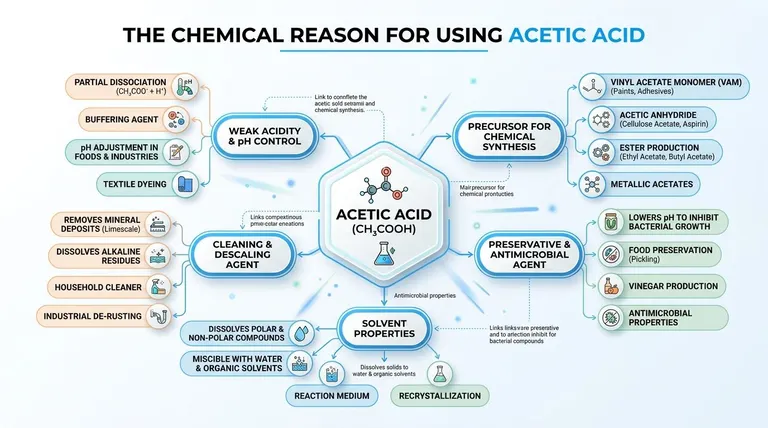
The key chemistry starts with side chains that can gain or lose protons. Residues such as arginine, lysine, and histidine carry basic groups, and their charge state changes with pH. In a neutral solvent, some peptides expose enough sticky hydrophobic surface and enough interactive charged sites that neighboring molecules attract each other more than they interact with water. Once that starts, the peptide tends to cluster rather than disperse.
Acetic acid shifts that balance by donating protons in a controlled way. For certain peptides, that extra protonation changes the surface chemistry enough to reduce peptide-peptide attraction and improve peptide-solvent interaction. A crowded parking lot is a useful comparison here. At neutral pH, several cars can still angle into each other and block movement. After mild acidification, the same cars are aligned differently and can pull into separate spaces. The peptide is still the same molecule, but its behavior in solution changes.
This matters most for peptides that are known to require an acidic reconstitution environment rather than plain bacteriostatic water alone. If you want a practical overview of solvent selection, this guide to peptide reconstitution solutions explains how solvent choice affects dissolution and handling.
Why the concentration matters
Acid strength and acid concentration are not interchangeable. That distinction causes a lot of confusion.
A dilute acetic acid solution can help certain peptides dissolve because it nudges the pH into a range where protonation improves solubility. But there is a narrow operating window. The often-missed detail is the 0.6% acetic acid threshold used for specific acid-requiring peptides in research settings. Below that level, you may not get enough of the charge-state change needed to keep the peptide dispersed. Above what is appropriate for the peptide and route of use, you increase the risk of irritation and can expose the molecule to conditions it does not tolerate well.
That is why acid should be selected by peptide type, not by frustration level.
For some long-chain or aggregation-prone peptides, mild acetic acid is the solvent condition that keeps the powder from assembling into insoluble clusters. For peptides that do not need acid, unnecessary exposure can create cloudiness or structural problems instead of solving them. Good critical lab protocols start with that compatibility question first.
A few practical conclusions follow from the chemistry:
- Acetic acid is selective: It helps peptides whose solubility improves after mild protonation.
- The 0.6% figure is not trivia: For peptides that require acetic acid, concentration control can be the difference between clean dissolution and avoidable damage.
- Visual appearance is informative: A clear solution suggests the peptide is in solution. Persistent haze, floating strands, or fine particulate matter suggest incompatibility, incomplete dissolution, or structural change.
- More force does not fix wrong chemistry: Aggressive shaking cannot substitute for the correct solvent environment.
A peptide that resists water is often signaling that its charge distribution and exposed surfaces are poorly matched to that solvent. Acetic acid works because it changes that chemical relationship. Used correctly, it creates a mildly acidic environment that helps certain peptides enter solution while staying suitable for careful human-focused handling.
A Step-by-Step Guide to Peptide Reconstitution

The biggest mistake in peptide reconstitution is treating every vial the same. The second biggest mistake is applying acetic acid to every “hard to dissolve” peptide without asking whether that peptide requires it.
A product page discussing acetic acid water highlights a point many guides miss: the advice to use acetic acid for all hydrophobic peptides is oversimplified. It also states that 0.6% acetic acid is the relevant threshold for specific peptide types such as IGF-LR3, and that while 0.6% acetic acid stabilizes IGF-LR3 and prevents aggregation, using it on peptides that don’t require acid can lead to cloudiness and irreversible structural alteration. You can read that claim in the Peptides Lab UK acetic acid water reference.
Before you add anything to the vial
Set up the workspace first. Don’t start improvising once the stopper is punctured.
You want a clean surface, sterile syringes, the peptide vial, and a sterile 0.6% acetic acid solution if the peptide you are handling is one of the acid-requiring types. Household substitutes are not acceptable. Neither are guesswork dilutions made without sterile technique and proper control.
For anyone building repeatable handling habits, it helps to review broader critical lab protocols so the mechanical parts of sterile prep become automatic rather than rushed.
How to reconstitute without damaging the peptide
The mechanics are simple, but the details matter.
-
Confirm the peptide’s solvent requirement. Don’t use acetic acid because a forum post said all long-chain peptides need it. Verify that the specific peptide is one of the types that benefits from acid reconstitution.
-
Decide the final concentration you want. The amount of solvent you add determines how concentrated the final solution will be. Write that target down before drawing anything into the syringe.
-
Inject slowly along the vial wall. Don’t blast solvent directly onto the lyophilized puck. Let the liquid run down the glass so the cake wets gradually. That reduces local stress and avoids mechanical disruption.
-
Swirl gently. Roll the vial softly between your fingers or make small circles. Don’t shake it. Don’t vortex it. Vigorous agitation can encourage foaming and aggregation.
-
Wait for visual confirmation. Some peptides dissolve quickly. Others need patience. Give the vial time before deciding you have a problem.
If you want a separate walkthrough focused on solvent choice and reconstitution mechanics, this guide on peptide reconstitution solution is a useful companion reference.
Lab habit worth keeping: Write the solvent, date, and intended concentration on the vial immediately after reconstitution. Memory is not a reliable system.
What success and failure look like
A successful result is usually boring. The solution becomes clear and uniform. Nothing floats. No fine haze hangs in the liquid. The vial doesn’t show stringy fragments or tiny persistent particles.
Signs that should make you stop and reassess:
- Persistent cloudiness: The peptide may not require acid, the solvent may be inappropriate, or the structure may already be compromised.
- Visible floaters: This can indicate incomplete dissolution or damaged material.
- Foam after aggressive mixing: Mechanical stress may have introduced a new problem.
The key idea is restraint. When a peptide resists dissolution, people tend to add more force. Better practice is to add more reasoning.
Dosing and Protocol Planning with Acetic Acid Peptides
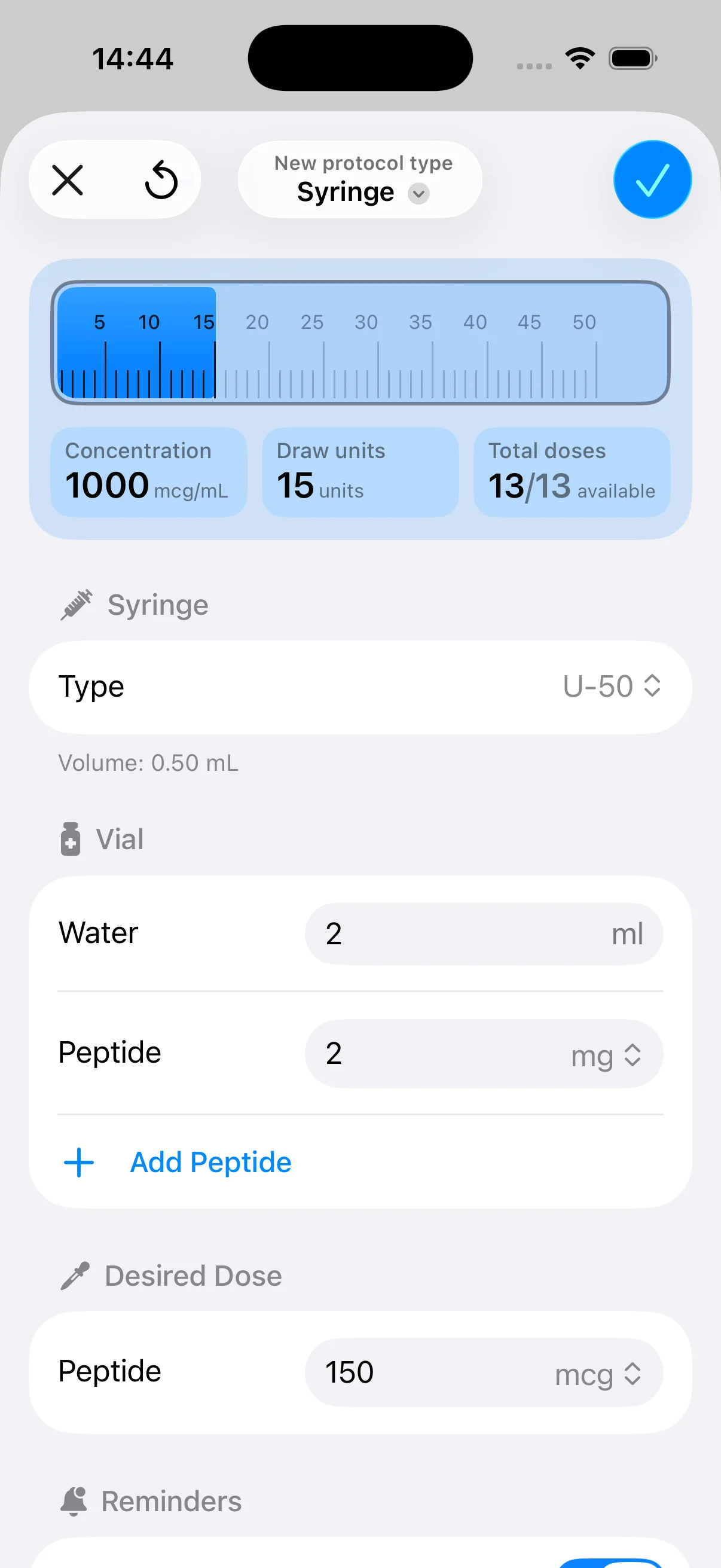
You reconstitute a vial carefully, the powder disappears, and the solution looks clear. The next mistake usually happens on paper. A correct solvent choice can still lead to a wrong dose if the concentration math is sloppy.
With acetic acid peptides, dosing starts from chemistry, not syringe markings. The acid helped create a usable solution, but it also fixed the concentration environment of that vial. If the acetic acid was prepared incorrectly, especially above the 0.6% level discussed earlier, the problem is not just comfort at administration. You may also be planning doses from a solution that does not represent the peptide’s intended handling conditions.
Start with concentration, then calculate volume
The core relationship is simple:
concentration = total peptide amount / total reconstitution volume
Everything else comes from that number.
A vial is like a beaker of evenly mixed dye. Once the peptide is fully dissolved, each microliter contains a proportional fraction of the total peptide mass. That is why the first calculation belongs at the vial level. The syringe is only a measuring tool used afterward.
For example, if the full peptide content is dissolved into a known final volume, any drawn portion contains the matching fraction of the total amount. If you double the draw volume, you double the peptide delivered. If you misstate the reconstitution volume, every dose based on that number will be wrong in the same direction.
Why acetic acid changes planning
Some readers assume acetic acid matters only during dissolution. That is incomplete. It also affects how you document and interpret the vial.
A peptide that needed acetic acid often had poor water solubility to begin with. That means casual reconstitution errors carry more risk. If someone adds an uncertain volume, tops off later, or forgets whether the vial was prepared with dilute acetic acid or another solvent, the protocol becomes hard to trust. For repeated use, the record of solvent type, final concentration, and target dose matters as much as the draw itself.
This is also the point where human-use caution separates from general lab handling. In research settings, people may focus only on getting material into solution. For human administration planning, concentration accuracy and the commonly cited 0.6% acetic acid ceiling both matter because they affect peptide handling and injection tolerability at the same time.
A practical dosing workflow
Use one written record for each vial and fill it out before the first dose:
- Write the peptide amount exactly as labeled.
- Write the final reconstitution volume exactly as prepared.
- Note that the solvent was 0.6% acetic acid if that was used.
- Calculate the vial concentration once, in a single unit system.
- Define the intended dose in the same unit system before converting to syringe volume.
- Record each planned draw volume from that concentration, not from memory.
Small transcription errors are more common than difficult math. A missing decimal point, a remembered volume that was never verified, or a switch between mg and mcg can shift the whole protocol.
If the vial will be used across multiple days, pair your dose plan with a clear handling timeline. This guide on how long reconstituted peptides last in storage helps put those scheduling decisions in context.
One habit that prevents many errors
Do the full calculation once. Then keep that result as the master reference for the vial.
Repeated back-of-the-envelope conversions create drift. One person rounds. Another person converts from a syringe mark instead of from concentration. By the third administration, the protocol may still look tidy while the arithmetic underneath has changed. In peptide work, consistency is a form of safety.
Storage Handling and Stability
A peptide can be reconstituted perfectly and still be mishandled afterward. Once water-based solvent enters the vial, you’ve moved from a dry storage problem to a solution stability problem.
That changes the priorities. Sterility matters more. Light exposure matters more. Repeated warming and cooling matter more. So does the number of times you puncture the stopper and draw from the same vial.
What changes after reconstitution
The simplest rule is to refrigerate the solution promptly and handle it gently each time you use it. Keep the vial clean, wipe the stopper before access, and avoid unnecessary agitation. If you need repeated use over time, careful labeling becomes part of stability management, not just organization.
Many people assume acetic acid and bacteriostatic water are interchangeable once the peptide is dissolved. They aren’t. They create different solution environments and may suit different peptides differently. That’s why storage advice should always be tied to the peptide type and the solvent used at reconstitution.
For a broader discussion of handling timelines and practical peptide storage decisions, this article on how long peptides last adds useful context.
Reconstitution solvent comparison
| Characteristic | Bacteriostatic Water | Acetic Acid Solution (0.6%) |
|---|---|---|
| Typical use case | Common choice for peptides that dissolve readily in neutral aqueous conditions | Better suited to peptides that specifically require acidic reconstitution for clean solubility |
| Initial appearance after mixing | Often clear when the peptide is water-compatible | Often clearer for acid-requiring peptides that stay cloudy in plain water |
| Handling priority | Maintain sterility and minimize contamination | Maintain sterility and also respect peptide-specific compatibility |
| Risk if used in the wrong context | Incomplete dissolution for some long-chain peptides | Cloudiness or structural alteration if used on peptides that don’t require acid |
| Best practice | Use when the peptide is known to tolerate and dissolve in it | Use only when the peptide is known to benefit from acid reconstitution |
Storage doesn’t rescue a poor reconstitution choice. If the solvent was wrong on day one, refrigeration won’t fix that chemistry later.
The practical takeaway is simple. Match the solvent to the peptide first. Then store the finished solution with discipline.
Safety Precautions and Injection Tolerability
People get into trouble with acetic acid peptides when they treat “acid” as a casual ingredient instead of a controlled solvent condition. The term sounds familiar because acetic acid is associated with vinegar, but that familiarity is misleading.
What never belongs in the vial
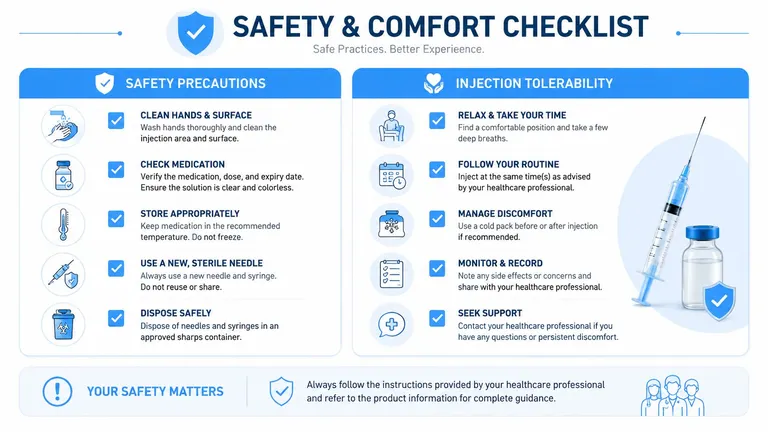
Never use kitchen vinegar. Never use a non-sterile household liquid because it “contains acetic acid.” The issue isn’t just concentration. It’s sterility, purity, and consistency. A peptide vial is not the place for approximation.
The same caution applies to homemade mixing without proper controls. If you don’t know the exact concentration, sterility status, and suitability of the solution, you don’t know what you’re putting into the vial.
For readers trying to distinguish expected local effects from broader tolerance concerns, this overview of peptide side effects is worth reviewing alongside sound technique.
What mild irritation can mean
A dilute acidic solution can produce a mild temporary sting or slight redness at the injection site. That doesn’t automatically mean something has gone wrong. Slight acidity can irritate tissue briefly even when the preparation is otherwise appropriate.
What matters is the pattern.
- Short-lived mild sting: Often consistent with the acidic nature of the solution.
- Minor redness that settles: Can occur with local irritation.
- Escalating pain, marked swelling, heat, or spreading redness: These are not things to dismiss as normal acid sensation.
- Any sign of contamination or infection: Stop using the vial and seek qualified medical guidance.
The smart posture is neither panic nor bravado. Don’t overreact to a brief sting. Don’t underreact to worsening local symptoms.
If your body’s response grows stronger instead of fading, treat that as a warning signal, not as proof you need to “push through.”
Good peptide practice is conservative practice. Clean materials, correct solvent, gentle handling, and attention to local tissue response do more for safety than any trick people trade online.
Frequently Asked Questions
Can I use vinegar instead of sterile acetic acid solution
No. Vinegar is not an acceptable substitute. It isn’t formulated for sterile peptide reconstitution, and “contains acetic acid” is not the same thing as “appropriate for controlled peptide handling.”
What does it mean if the peptide stays cloudy
Cloudiness usually means something is off. The peptide may not be compatible with the solvent used, it may not have dissolved fully, or it may have undergone structural disruption. Don’t respond by shaking harder. Recheck whether that peptide requires acid, and whether the solvent choice was appropriate.
Are all hydrophobic peptides supposed to be mixed with acetic acid
No. That blanket rule is exactly where many problems begin. Some peptides benefit from acidic reconstitution. Others can become cloudy or damaged if acid is used unnecessarily.
Is a mild sting normal with acetic acid peptides
It can be. A brief mild sting or slight redness may reflect the acidic solution contacting tissue. What shouldn’t be brushed off is severe pain, progressive swelling, heat, or signs that suggest contamination or infection.
Should I shake the vial if it won’t dissolve
No. Gentle swirling is the safer move. Hard shaking can create foam, stress the peptide, and make interpretation harder.
What should the final solution look like
For a properly reconstituted peptide, the goal is a clear, uniform solution. Persistent haze, visible particles, or stringy material are reasons to stop and reassess rather than proceed casually.
If you want a simpler way to manage vial setup, concentration math, and day-to-day scheduling, PepFlow is a practical companion. It helps you calculate doses from your actual reconstitution volume, organize protocols, and stay consistent without relying on handwritten notes or mental math.