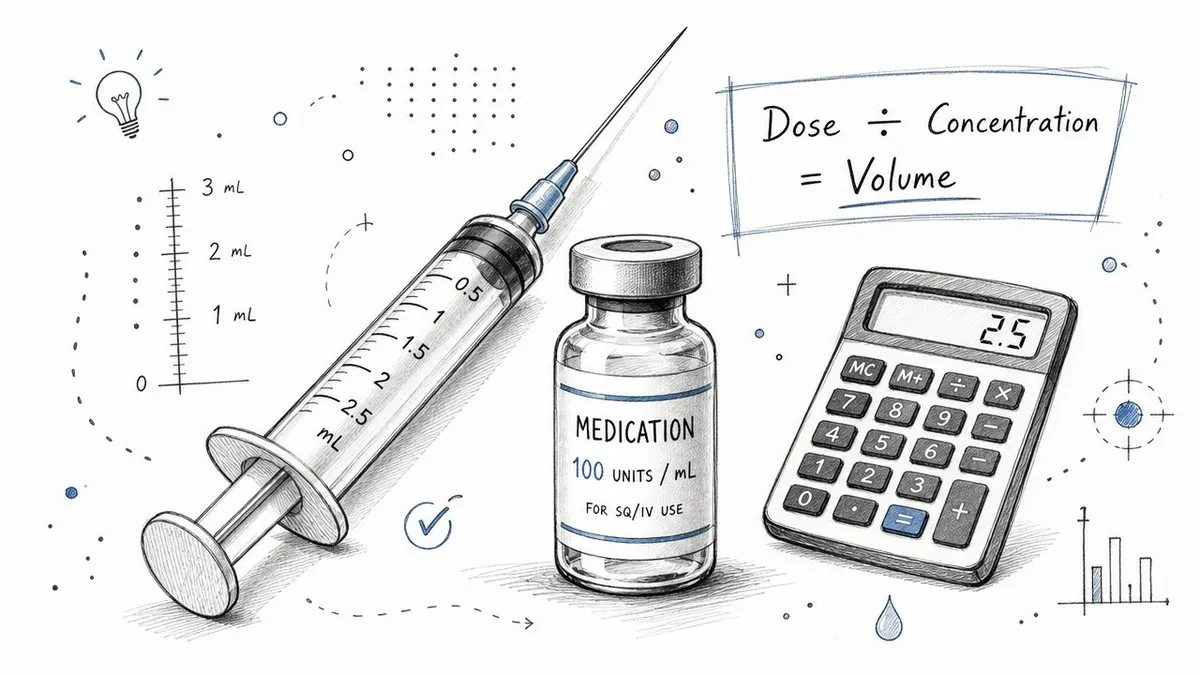
You’re probably looking at a vial, a syringe, and a dose written in mcg or mg, and getting stuck on the part nobody explains clearly. The label gives you one kind of information. The syringe gives you another. Then some forum post tells you to “just convert mL to units” as if that’s universal.
It isn’t.
When people ask how to convert mL to units, what they usually need is a practical dosing method that connects the vial concentration, the dose they want, and the markings on the syringe they have in hand. That’s where mistakes happen. Not in the arithmetic alone, but in assuming the syringe “units” tell you the dose by themselves.
Table of Contents
- Why ‘Just Do the Math’ Is Bad Advice for Dosing
- Understanding the Dose Calculation Formula
- Converting Your Calculated mL into Syringe Units
- Avoiding Common Errors for Accurate Dosing
- How the PepFlow App Automates Your Calculations
- Your Dosing Questions Answered
Why ‘Just Do the Math’ Is Bad Advice for Dosing
A reconstituted vial on the counter, a small insulin syringe in hand, and a tiny target dose can turn a simple calculation into a sloppy draw. The arithmetic matters, but most mistakes usually happen one step earlier or one step later. People mix up the amount of drug, the liquid volume, and the markings on the syringe.

The part most guides skip
Quick explainers often treat “units” like a universal language. They are not. Units only make sense in the context of a specific syringe scale and a specific concentration.
That distinction matters most with small doses. A vial label may show milligrams. The intended dose may be in micrograms. The syringe may be marked in units. If the reconstitution volume changes, the amount of active ingredient at the same draw line changes too. That is why a guide on converting mcg to mL from vial concentration is often the better starting point than staring at the syringe.
Practical rule: Start with the vial concentration, then calculate volume, then match that volume to the syringe marking.
Three variables you have to keep separate
Keeping these separate prevents a lot of avoidable errors:
- Volume: the liquid you draw, measured in mL
- Dose: the amount of active ingredient, usually in mcg or mg
- Syringe scale: the printed markings that represent volume on that syringe
In practice, the trouble shows up when someone remembers a draw line from a previous vial and assumes it still applies. It may not. The same syringe marking can deliver a very different dose after a different reconstitution, a different product strength, or a different unit convention.
There is also a precision problem that basic formulas rarely address. Very small volumes are harder to measure consistently with standard syringes, especially once air bubbles, dead space, and parallax at the plunger edge enter the picture. A mathematically correct answer can still be hard to draw accurately in practice. That is one reason experienced clinicians and careful home users work slowly, confirm concentration twice, and respect how much error a tiny volume can hide.
Understanding the Dose Calculation Formula
A dose calculation usually goes wrong in one of two places. The concentration was assumed instead of confirmed, or the final volume was so small that drawing it accurately became its own problem.
The formula itself is simple:
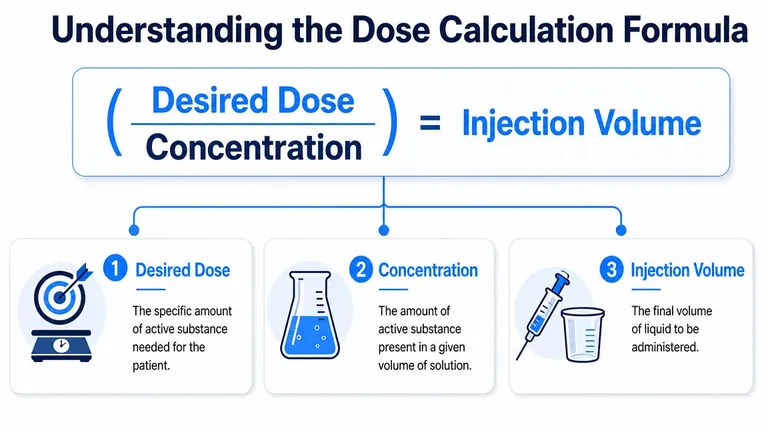
(Desired Dose / Concentration) = Injection Volume
What each part means
- Desired dose is the amount of active ingredient prescribed or intended.
- Concentration is the amount of active ingredient per mL after reconstitution.
- Injection volume is the liquid volume you need to draw into the syringe.
Concentration is the part that changes everything. The same line on the syringe can represent very different doses if the vial strength or reconstitution volume is different.
If you are still working from a target dose to the liquid amount, this guide on converting mcg to mL from vial concentration is the right foundation before you measure anything.
A practical peptide example
Say you have a 5 mg vial reconstituted with 2 mL. First calculate how much drug is in each mL. Then divide the dose you want by that concentration to get the volume to draw.
If the target dose is 500 mcg, the math gives you a specific mL amount. That mL value is the number that matters first. Only after you have that number should you look at syringe markings.
That order matters in practice. People often remember a draw line, not the concentration that made the draw line correct.
Use this workflow every time:
- Read the vial label carefully. Confirm total drug amount.
- Confirm the exact amount of diluent added. Use what you reconstituted, not what you planned to use.
- Calculate concentration in mg/mL or mcg/mL.
- Divide the desired dose by that concentration.
- Pause and check whether the final mL is realistically measurable on your syringe.
That last check gets missed. A mathematically correct answer can still be hard to draw consistently if the volume is tiny. With very small doses, a slight bubble, a plunger read taken at the wrong edge, or a syringe with coarse markings can create more error than people expect.
A short visual walkthrough can help if you prefer seeing the process done live:
Why there is no universal mL to units formula
There is no single mL-to-units rule that works across substances, because units only make sense inside a specific concentration and syringe system. On insulin syringes, the printed “units” are volume markings tied to that syringe scale. They do not tell you the drug dose unless concentration is already known.
Many simplified guides fall short. They give a shortcut for syringe markings but skip the question that determines dose: how much active ingredient is present in each mL of your current vial setup.
Keep these categories separate in your head. mg and mcg measure mass. IU measures biological activity for certain medications. Syringe markings indicate volume on that syringe. Mixing those up is how a clean-looking calculation turns into the wrong dose.
Converting Your Calculated mL into Syringe Units
Once you know the injection volume in mL, the next step is mechanical. You’re no longer solving the dose. You’re translating a liquid volume into the markings on your syringe.
On a standard U-100 insulin syringe, the scale is a volume scale where 1 mL equals 100 units. That means you can convert your already-calculated mL amount into the corresponding unit marking on that syringe type.
The two-step method that actually works
Use this sequence every time:
- Calculate the required mL from the dose and concentration.
- Match that mL value to the syringe scale.
Many people make a common mistake. They jump straight to the syringe before confirming the concentration. If you do that, the markings feel precise, but the dose may still be wrong.
If you want a quick visual refresher on syringe scales, this guide on how to read insulin syringes helps.
Worked examples you can follow
The table below uses common peptide-style setups to show the logic. The key is that units to draw only make sense after concentration is known.
| Vial Size (mg) | Reconstitution Volume (mL) | Concentration (mcg per unit) | Desired Dose (mcg) | Units to Draw |
|---|---|---|---|---|
| 5 mg | 2 mL | 25 mcg per unit | 250 mcg | 10 units |
| 5 mg | 2 mL | 25 mcg per unit | 500 mcg | 20 units |
| 5 mg | 1 mL | 50 mcg per unit | 250 mcg | 5 units |
| 10 mg | 2 mL | 50 mcg per unit | 500 mcg | 10 units |
| 10 mg | 4 mL | 25 mcg per unit | 250 mcg | 10 units |
| 10 mg | 4 mL | 25 mcg per unit | 500 mcg | 20 units |
What the table is really showing
The important lesson isn’t the individual rows. It’s the pattern.
A different reconstitution volume changes concentration, and that changes how many syringe units represent the same dose. That’s why two people using the same peptide name can end up drawing different unit amounts and both be correct, assuming they mixed the vial differently.
Don’t ask, “How many units is my dose?” until you can answer, “What is my exact concentration per mL?”
Once that clicks, the phrase how to convert mL to units becomes much less mysterious. You calculate volume from dose first. Then you map the volume onto the syringe you’re using.
Avoiding Common Errors for Accurate Dosing
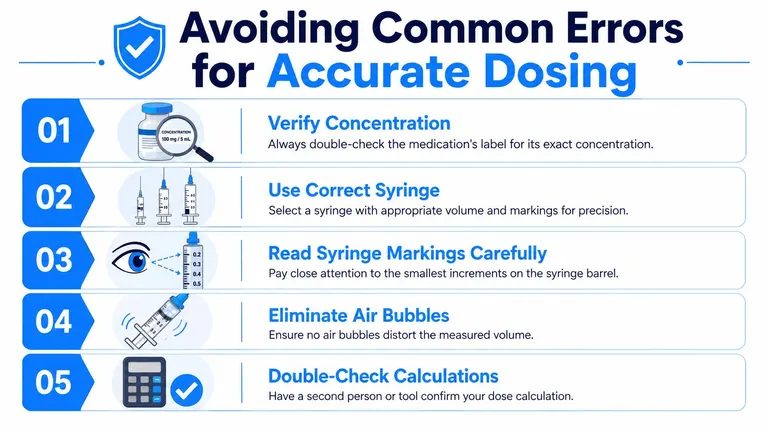
Most dosing mistakes don’t happen because someone can’t divide. They happen because the practical setup is sloppy. Wrong syringe. Unclear label. Tiny volume that looks drawable on paper but is hard to measure accurately in real life.
That’s why syringe choice matters as much as the formula.
Small volumes are where precision falls apart
Pharmacy guidance shows that 0.5 mL and 1.0 mL insulin syringes use fine increments such as 0.01 mL, 0.05 mL, or 0.1 mL, and that small conversion or measurement mistakes can materially change the drawn volume, especially at tiny doses, as explained in this pharmacy dosing guide on unit conversion and syringe increments.
That’s the issue many simplified guides ignore. On paper, a very small calculated volume may be correct. In your hand, it may be difficult to draw consistently.
Five habits that prevent most errors
- Choose the smallest practical syringe. If your draw volume is small, a smaller-capacity insulin syringe is usually easier to read precisely than a larger one.
- Label the vial after reconstitution. Write the concentration clearly. Don’t rely on memory a few days later.
- Avoid aggressive rounding. If your math lands between markings, that’s a signal to rethink concentration or syringe selection.
- Watch for dead space and bubbles. They can distort tiny volumes more than people expect.
- Recheck the setup, not just the answer. Correct math on the wrong vial strength is still a wrong dose.
For anyone handling lyophilized material, this overview of freeze-dried peptides is worth reviewing because the mixing step affects every calculation that follows.
What works better in practice
I’d rather see someone use a concentration that produces an easy, readable draw than chase a mathematically elegant setup that leaves them trying to pull a barely visible amount of fluid. Practical accuracy beats theoretical neatness.
A few signs your setup needs adjustment:
| Situation | Why it causes trouble | Better move |
|---|---|---|
| Calculated dose lands between tiny markings | Hard to repeat consistently | Adjust concentration or syringe size |
| You can’t remember how much diluent you used | Concentration becomes uncertain | Label immediately after mixing |
| You switch syringe types mid-protocol | Markings may be interpreted differently | Standardize one syringe type |
| The draw looks almost empty | Visual confirmation gets harder | Use a setup that gives a more readable volume |
Tiny doses demand better tools, not more confidence.
How the PepFlow App Automates Your Calculations
Manual dosing works if you’re careful, consistent, and willing to recheck every variable. It also creates a lot of opportunities for avoidable mistakes. Individuals typically don’t make one dramatic error. They make a series of small ones.
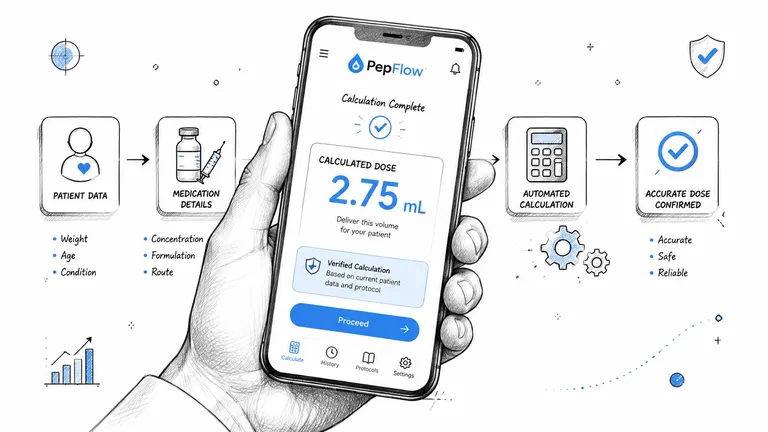
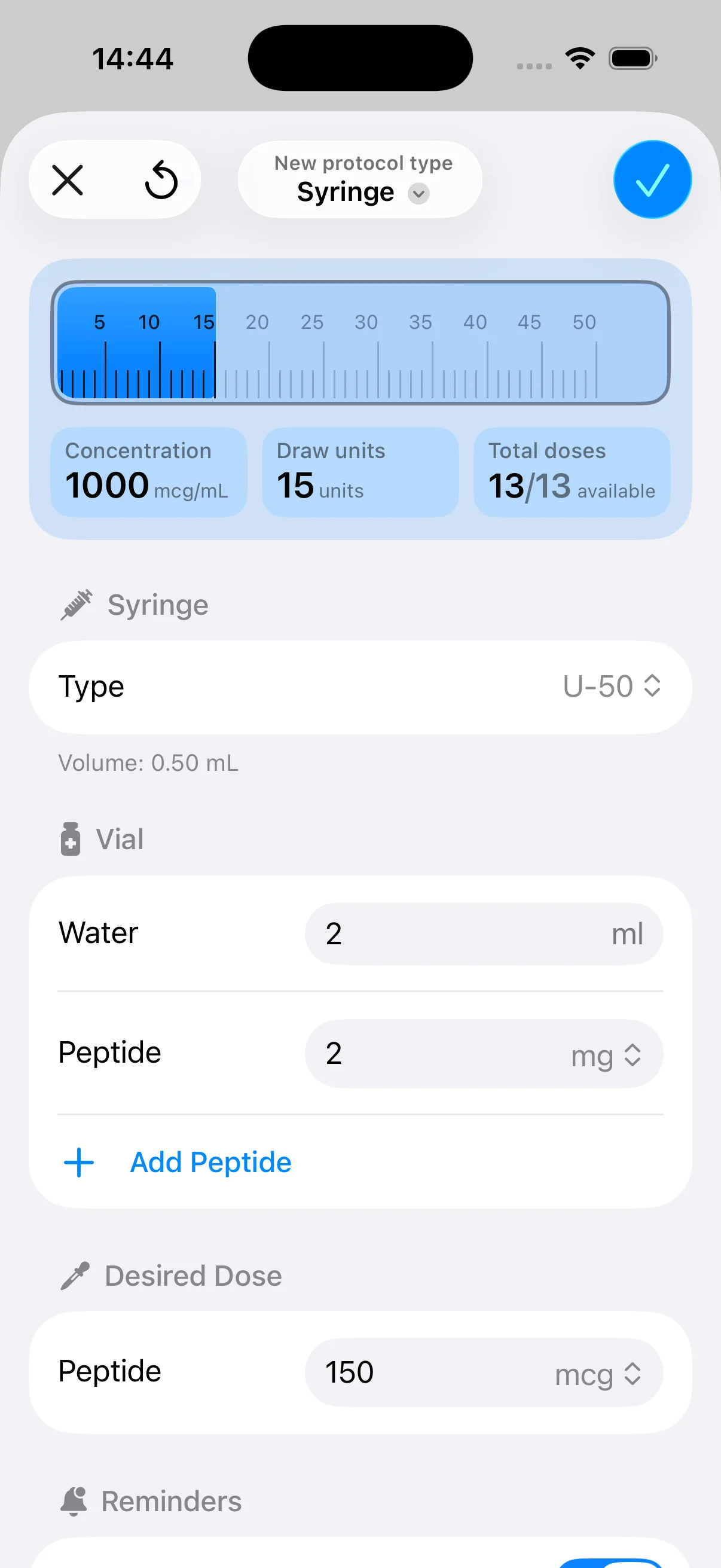
A dosing tool is useful because it forces the right order of operations. You enter the vial amount, the reconstitution volume, and the target dose. Then it returns the practical draw amount for the syringe setup you’re using.
That’s where PepFlow fits. It’s an iOS app built around peptide dosing and scheduling, with a calculator that converts a desired amount into a usable syringe pull after you define the vial and dilution details.
What automation helps with
- It reduces transcription mistakes. You’re less likely to mix up mg, mcg, and mL.
- It preserves consistency. The same vial setup produces the same answer each time.
- It helps with repeat protocols. Once you’ve configured a routine, you don’t need to rebuild the math every dose.
The bigger benefit is mental clarity. You’re no longer juggling concentration math, syringe interpretation, and scheduling in separate places.
Your Dosing Questions Answered
What’s the difference between IU and a unit on my syringe
They’re not automatically the same thing. IU refers to biological activity for certain substances. A unit marking on a syringe is a volume reference on that syringe’s scale. You should never assume one translates directly to the other unless the product and concentration specifically define it that way.
My vial says 10 mg per mL. What does that mean
That label already gives you the concentration. It tells you how much active ingredient exists in each milliliter of solution. That simplifies the process because you can calculate dose-to-volume directly without first figuring out how much you created through reconstitution.
Is it safe to pre-load syringes for the week
That depends on sterility, storage conditions, and the specific substance’s stability. In practice, people should be cautious here. Convenience can create contamination risk or leave you with degraded product if the compound doesn’t hold up well after preparation.
Where can I compare other tools for tracking routines
If you want a broader look at wellness and protocol-support tools beyond a single calculator, the directory of Venus Health apps is a reasonable place to browse what different health-focused apps are designed to do.
What should I do if my calculated dose is too small to measure comfortably
Change the setup, not your standards. Use a syringe with more appropriate markings or rework the concentration so the final draw is easier to read accurately. If the volume is hard to see, it’s hard to repeat.
If you want a simpler way to handle the math and keep your routine organized, PepFlow gives you a practical calculator for peptide dosing plus scheduling, reminders, and protocol tracking in one place.