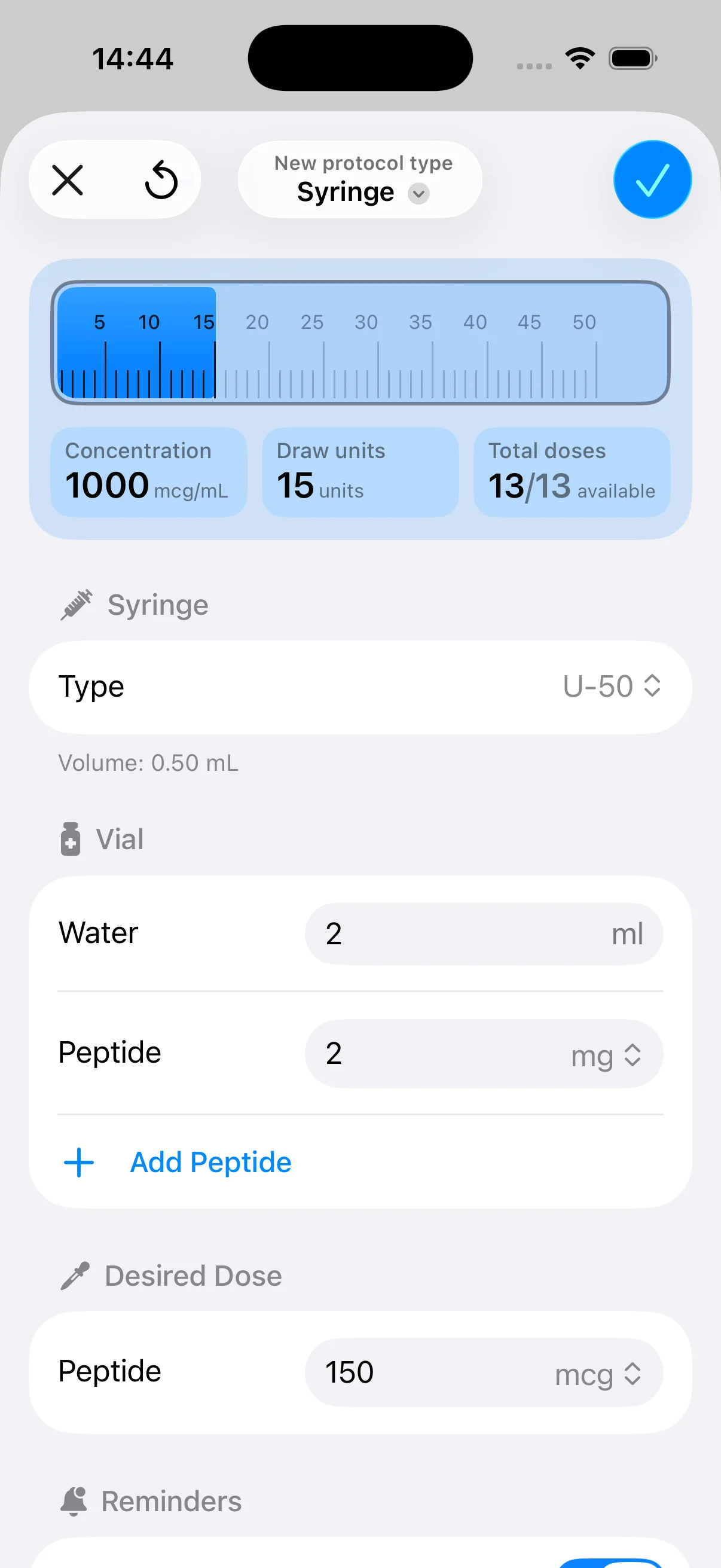
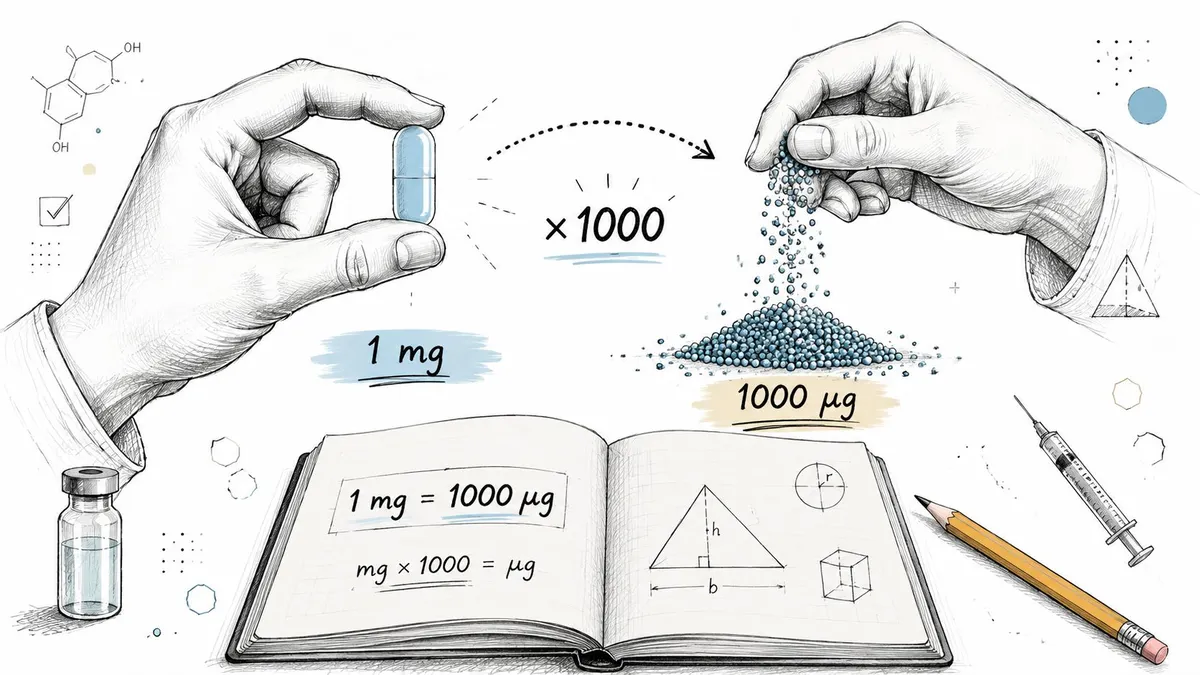
To convert milligrams to micrograms, multiply the milligram amount by 1,000. So 2 mg = 2,000 µg.
Staring at a peptide vial, a syringe, and a dosing note that doesn’t match the units in front of you, the confusion is normal. The math itself is simple. The trouble starts when that simple conversion has to fit into a real dosing workflow, especially once reconstitution volume, vial concentration, and syringe markings enter the picture.
A lot of guides stop at the arithmetic. That isn’t enough if you’re trying to prepare a dose accurately. In practice, the safe move is to convert the mass first, then map that number into the actual liquid volume you’ll draw.
Table of Contents
- The Dosing Dilemma Why Accurate Conversion Matters
- The One Rule to Convert Milligrams to Micrograms
- Worked Examples From Simple Math to Real-World Doses
- Beyond Conversion Practical Application for Peptide Dosing
- Critical Details for Dosing Accuracy and Safety
- From Milligrams to Micrograms with Confidence
The Dosing Dilemma Why Accurate Conversion Matters
You have a 5 mg peptide vial on the bench, a protocol written in micrograms, and an insulin syringe that only measures liquid volume. That is the point where small math mistakes turn into real dosing mistakes.
The problem is not the conversion itself. The label on the vial, the target dose, and the liquid you’ll draw are three different pieces of the same calculation, which is where people get tripped up.
In peptide work, unit conversion is part of dose control. If the protocol is written in micrograms, convert the mass before calculating any syringe volume. The number only becomes useful after you connect it to concentration and draw volume.
When the protocol is written in micrograms, convert the mass first. Then calculate the liquid volume second.
That sequence prevents a common error. Someone sees “5 mg” on the vial, jumps straight to syringe units, and skips the concentration math after reconstitution. Once that happens, the dose is a guess.
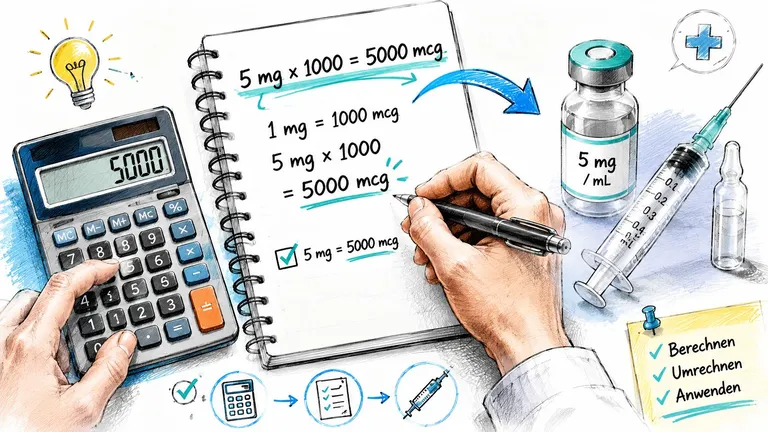
A 5 mg vial contains 5,000 µg total. From there, the practical questions are the ones that affect the injection. How much bacteriostatic water went into the vial? What concentration did that create in µg per mL? How much volume delivers the intended dose?
That full chain is what keeps dosing controlled, especially with peptides where the requested dose is small and the measuring hardware is crude compared with the size of the dose.
The One Rule to Convert Milligrams to Micrograms
A peptide vial says 5 mg. The protocol calls for 250 mcg. If that unit change is handled loosely, every number that follows is off, including the volume you pull into the syringe.
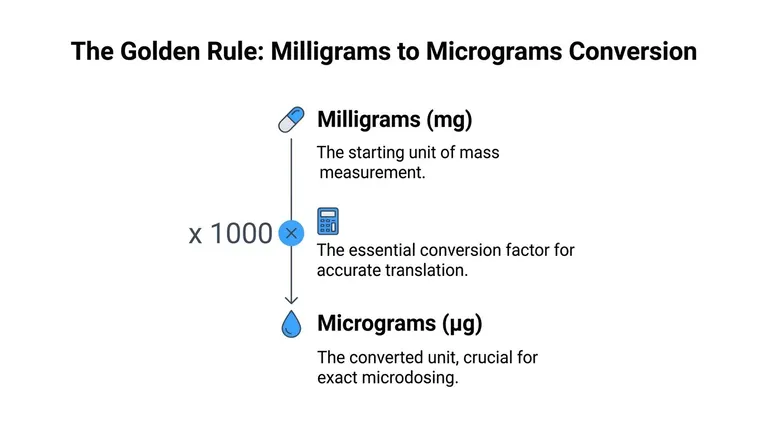
To convert milligrams to micrograms, multiply by 1,000.
Why the rule is fixed
This rule comes from the metric system, not from supplement labels or peptide forums. Milli means 10⁻³ of a gram. Micro means 10⁻⁶ of a gram. That three-place difference is why 1 mg = 1,000 µg every time.
The unit relationship is fixed: multiply milligrams by 1,000 to get micrograms, or divide micrograms by 1,000 to get milligrams.
The formula to use every time
Write it the same way on paper, in your notes app, or on the vial box:
- Start with mg
- Multiply by 1,000
- Label the result as µg or mcg
Examples:
- 0.5 mg = 500 µg
- 15 mg = 15,000 µg
The math is simple. The discipline is what prevents dosing mistakes.
What this looks like in practice
The safest workflow is boring and repeatable. Confirm the vial amount in mg. Convert that total to µg. Then use the reconstitution volume to calculate concentration and injection volume.
A common mistake is switching units in your head while also trying to estimate syringe units. That is where decimal errors show up, especially when the protocol uses mcg and the vial uses mg.
Practical rule: If the vial says mg and the dose says mcg or µg, convert the mass before you calculate mL or insulin syringe units.
If you need the next step after unit conversion, use a guide on converting mcg to mL for peptide dosing. That is the point where the correct microgram number turns into a measurable draw volume.
Worked Examples From Simple Math to Real-World Doses
Examples are where this clicks. The pattern never changes, but the numbers can look different enough that people second-guess themselves.
Example 1 Whole numbers stay simple
Take 10 mg.
Multiply by 1,000:
10 × 1,000 = 10,000
So the answer is 10,000 µg.
This is the cleanest version of the conversion because there are no decimals to distract you. If you’re checking the total content of a vial before reconstitution, whole-number labels are usually straightforward.
Example 2 Decimals are where people slip
Take 2.5 mg.
Multiply by 1,000:
2.5 × 1,000 = 2,500
So the answer is 2,500 µg.
The classic decimal-shift mistake is a common pitfall. A documented example is converting 2.5 mg to 25 µg instead of 2,500 µg. That error appears in roughly 22% of self-administered peptide protocols in the cited observational research on peptide dosing errors.
Use this quick check when decimals are involved:
- If the answer got smaller, you probably went the wrong direction.
- If mg became µg, the number should become larger.
- If the decimal vanished in a strange way, redo the line from the start.
Example 3 A peptide-style dose
Take 0.3 mg.
Multiply by 1,000:
0.3 × 1,000 = 300
So the answer is 300 µg.
That number is much more useful in a real dosing workflow, because many peptide protocols are discussed in micrograms even when the vial itself is labeled in milligrams.
Once you have the target dose in micrograms, the next move is to connect it to concentration and volume. If you’re trying to translate a microgram target into actual liquid drawn, this guide on converting mcg to mL is the practical next step.
A visual walkthrough can help if you like to see the arithmetic done on screen:
The key habit in all three examples is the same. Don’t mix the unit conversion with the volume calculation in one jump. Convert the mass first. Then calculate the liquid.
Beyond Conversion Practical Application for Peptide Dosing
Knowing how to convert milligrams to micrograms solves only the first layer. In actual peptide prep, the more important question is usually, “How much liquid do I draw to get that dose?”
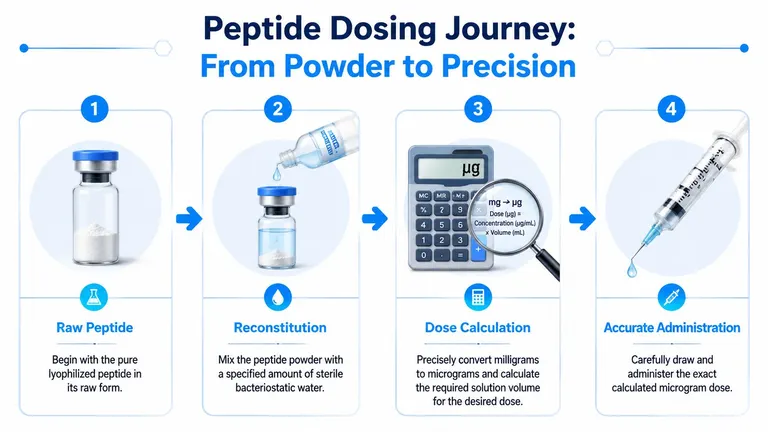
According to FDA guidance, over 35% of dosing mistakes in research peptide use stem from misinterpreting concentration units during vial reconstitution, not from simple math errors, as noted in this FDA guidance on peptide dosing errors. That tracks with what happens in practice. People often convert the dose correctly, then miss the concentration step.
The workflow that actually matters
Use a fixed sequence:
-
Read the vial amount
Start with the total mass in the vial, such as 5 mg. -
Convert total mass to micrograms
5 mg = 5,000 µg. -
Add the reconstitution volume
The amount of diluent you add determines the concentration. -
Calculate concentration
You want to know how many micrograms are present per mL, or per syringe unit if that’s how you measure. -
Draw the matching volume
Only now can you map the dose to the syringe.
For reconstitution technique itself, this walkthrough on how to reconstitute peptides helps because it deals with the liquid side of the process rather than just the unit conversion.
A practical reconstitution example
Say your vial contains 5 mg, which is 5,000 µg total.
If you add 1 mL of diluent, the solution contains 5,000 µg per mL.
If you add 2 mL instead, the same vial now contains 2,500 µg per mL.
The peptide amount didn’t change. Only the concentration changed. That’s the point many people miss. They convert the vial correctly, then assume the syringe draw will be the same regardless of how much liquid they used. It won’t.
The dose is mass. The syringe measures volume. Concentration is what connects them.
Once you understand that, the workflow gets cleaner. You stop thinking “How many units is 250 mcg?” in isolation and start thinking “What is the concentration of this specific vial after I mixed it?”
What does not work well
A few habits create most of the mess:
- Skipping the total-vial conversion. If you don’t know the vial’s total µg content, the rest of the math is shaky.
- Ignoring the water volume. A vial reconstituted with one amount of diluent behaves very differently from the same vial reconstituted with another amount.
- Treating syringe units as a universal dose language. Units on a syringe only mean something after concentration is established.
- Doing two steps in your head at once. That’s where wrong assumptions creep in.
In a lab-style workflow, every variable gets written down first. That’s slower at the beginning and faster once you’re consistent. It’s also a lot safer.
Critical Details for Dosing Accuracy and Safety
A peptide protocol can go off track with one bad line in a notebook. The math may be right, but if the unit is written unclearly, rounded too aggressively, or matched to the wrong syringe volume, the dose delivered is no longer the dose intended.
Mcg and µg mean the same thing, but mg does not
You’ll see µg, mcg, and sometimes ug used for micrograms. In practice, mcg and µg mean the same thing. mg does not.
That difference is 1,000-fold, which is why sloppy notation is not a minor paperwork issue. In peptides, where target doses are often small and repeat injections matter, a unit mix-up can turn a careful protocol into a major dosing error. The same principle shows up across medicine. A simple label or interpretation mistake can produce a disproportionate consequence, as seen in references discussing signs of beta blocker overdose.
If your handwriting makes µg look like mg, write “micrograms” in full.
Rounding and measuring are separate checks
These are two different failure points.
Rounding affects the target number.
Measuring affects whether you can draw that target volume with the tool in your hand.
For example, a calculated dose might be correct on paper but land on a syringe volume that is too small to measure consistently. That is a setup problem, not a conversion problem. In practice, the fix is often to reconsider the reconstitution volume before the first injection, so the final draw lands on a cleaner, more repeatable mark.
Input quality matters too. If the material in the vial is not what you think it is, clean math will not rescue the protocol. For that reason, it helps to review basics like how peptide purity testing affects downstream dosing confidence before trusting any precision calculation.
Reduce opportunities for manual error
Handwritten conversion chains fail in predictable places. The wrong unit gets copied. A decimal shifts. A concentration from one vial gets reused for another vial with a different reconstitution volume. None of those mistakes are complicated. They are ordinary process errors, which is why a written workflow matters.
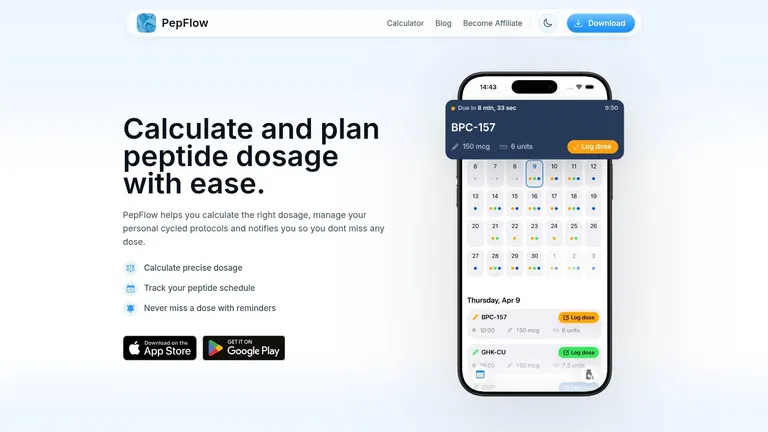
A dedicated tool such as PepFlow can switch dosing inputs between milligrams and micrograms, calculate the practical dose from vial setup, and reduce the number of places where handwritten math goes wrong.
The safer habit is straightforward. Confirm the unit on the vial label. Write the total peptide amount in micrograms. Record the exact diluent volume added. Then calculate the injection volume from that concentration and check that the syringe can measure it cleanly. That extra minute is usually what prevents the error.
From Milligrams to Micrograms with Confidence
The conversion itself is fixed. Multiply milligrams by 1,000 and you get micrograms. That part doesn’t change.
What does change is the context around the number. In peptide use, a dose only becomes practical when you connect the converted mass to the vial’s concentration and the actual liquid volume in the syringe. That’s where careful people separate arithmetic from application.
If you remember one thing, make it this: mass first, volume second. Convert the mg to µg. Confirm how much total liquid is in the vial. Then calculate what volume delivers the intended dose.
That workflow is what prevents the most common mistakes. It also makes your notes cleaner, your repeats more consistent, and your dosing less dependent on guesswork.
Manual math can work, but it doesn’t leave much room for distraction, fatigue, or sloppy notation. If you’re running peptide protocols regularly and want a cleaner system for dose calculation, scheduling, and repeatability, PepFlow gives you a structured way to manage those details without constantly recalculating them by hand.