You’re probably here with a very specific problem. You have a vial, a syringe, a target dose someone gave you in micrograms, and a real concern that getting the math wrong could mean taking far too much or far too little.
That concern is justified. Peptide dosing often looks simple when written as a protocol, but the hard part starts after that. A label might show the vial amount in milligrams, a protocol might list the dose in micrograms, and your syringe measures liquid volume rather than drug weight. That’s where people freeze.
The safest approach is to treat peptide dosing like pharmacy math, not guesswork. You need the right compound, the right protocol, the right reconstitution volume, and the right schedule. If you want a broader primer on injection basics before doing any calculations, this practical guide to peptide injection technique is a helpful starting point. Just keep one rule in front of everything else: get medical guidance before starting any peptide protocol.
Table of Contents
- From Vial to Syringe The Challenge of Peptide Dosing
- Decoding the Language of Dosing Units (µg vs mg vs IU)
- Key Factors That Determine Your Peptide Dose
- The Reconstitution Math Nobody Explains Clearly
- Simplifying Dosing with a Peptide Calculator App
- Building Your Dosing Schedule and Protocol
- Safety First Dosing Red Flags and Next Steps
- Frequently Asked Questions About Peptide Dosing
From Vial to Syringe The Challenge of Peptide Dosing
A common scenario looks like this. You have a small vial of dry powder, a bottle of bacteriostatic water, and an insulin syringe marked in units. The protocol says something like “take a few hundred micrograms daily,” but nothing on the syringe says micrograms.
That disconnect is where most confusion starts. The dose you want is a mass, the syringe measures a volume, and the vial concentration changes depending on how much diluent you add. So when people ask, how much peptides should I take, they’re usually asking two different questions at once: what dose applies to the protocol, and how much liquid do I draw up?
Why the process feels harder than it should
Peptides aren’t usually handled like a standard over-the-counter supplement. They’re often discussed in tiny units, adjusted gradually, and timed around a schedule. A protocol can look short on paper but still require several separate decisions before you can administer anything safely.
Common sticking points include:
- Unit mismatch: The vial may say mg while the protocol says mcg.
- Reconstitution choice: The amount of water you add changes concentration.
- Syringe interpretation: Units on the barrel reflect volume, not the peptide amount itself.
- Schedule drift: A dose can be right on paper but poorly timed in practice.
Many dosing mistakes don’t come from bad intent. They come from converting between the right pieces in the wrong order.
What careful dosing actually looks like
A careful workflow is simple in concept. First identify the intended dose. Then confirm the vial strength. Next calculate concentration after reconstitution. Only then convert the target dose into the syringe volume you’ll use.
That sounds mechanical because it is. Precision matters here, but panic doesn’t help. What helps is slowing down and treating each step as a checkpoint rather than trying to do everything in your head at once.
Decoding the Language of Dosing Units (µg vs mg vs IU)
If you only remember one concept from this guide, make it this one: milligrams and micrograms are not interchangeable.
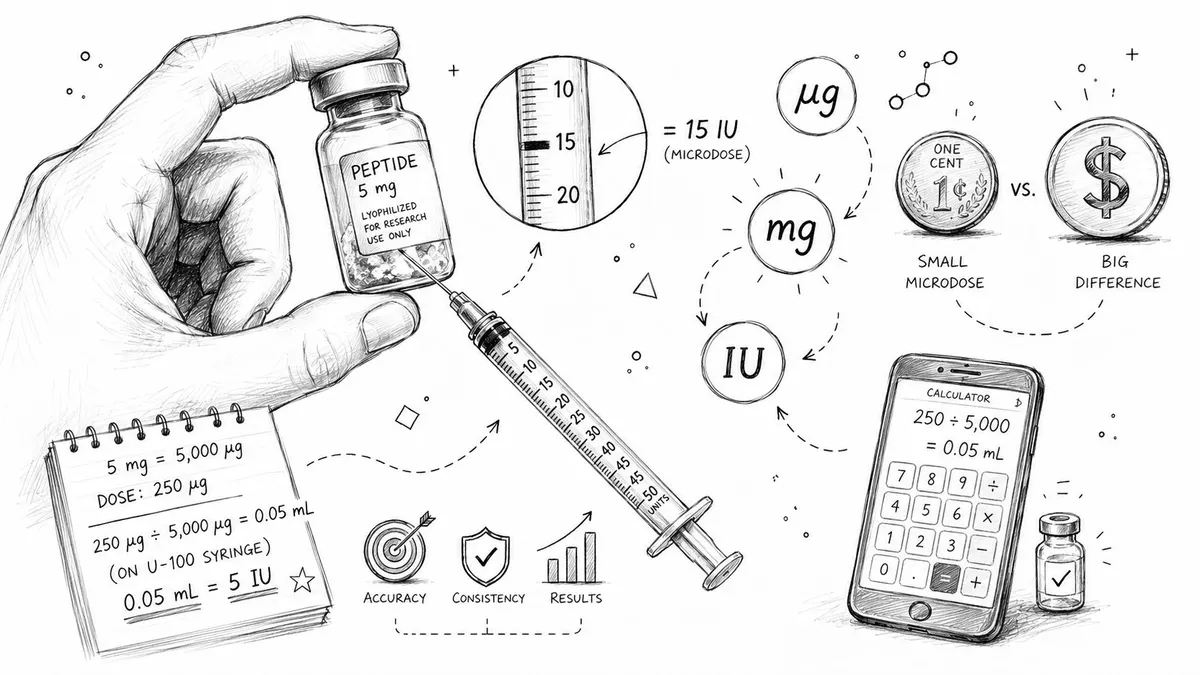
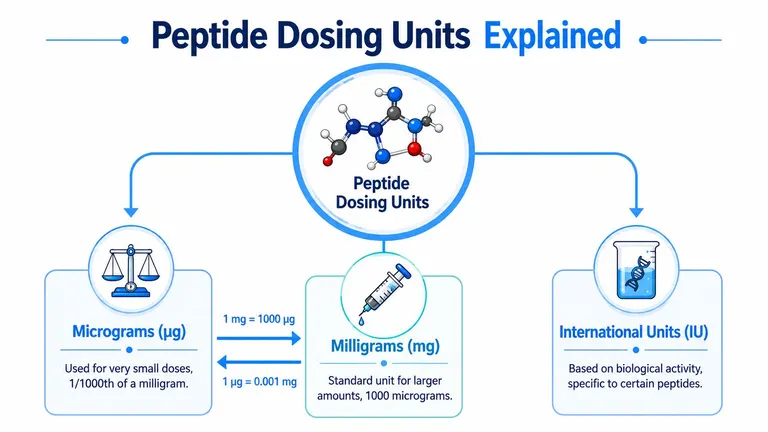
A lot of peptide dosing errors start when someone sees 5 mg on a vial and 250 mcg in a protocol, then treats those numbers as if they’re in the same scale. They’re not. 1 mg = 1000 mcg, and that difference is large enough to completely change a dose.
The simplest way to think about mg and mcg
Use a money analogy. Think of milligrams like dollars and micrograms like cents, except the conversion is by a factor of 1000, not 100. A vial labeled 5 mg contains 5000 mcg total. If your target dose is 250 mcg, you’re taking a fraction of that vial, not anywhere close to the full amount.
Small liquid changes can shift the delivered dose sharply. A peptide dosage calculator example shows that a 5 mg vial mixed with 1 mL of bacteriostatic water and used for a 350 mcg target requires actual syringe math, not eyeballing. Another example shows that 5 mg in 2 mL produces a concentration where 0.1 mL equals 250 mcg. The same calculator notes that confusing mg with mcg can put a person off by a factor of 1,000 in either direction, which is why these conversions need to be explicit, not assumed, in any dosing workflow according to this peptide dosage conversion calculator explanation.
Where IU fits in
IU stands for International Units. Unlike mg or mcg, IU does not describe physical mass. It refers to a standardized measure of biological activity for certain substances. That’s why IU can’t be casually converted the same way you convert mg to mcg unless the specific product and labeling support that conversion.
If you’re used to doing body measurements, this is similar to using a reliable unit converter for accurate client assessment measurements. You don’t guess centimeters from feet by feel. You convert with the right system. Peptide math deserves the same discipline.
Practical rule: Don’t start calculating syringe volume until you’ve written the vial amount and target dose in the same unit system.
A quick unit checklist
- Vial label in mg: Convert it to mcg if your protocol is written in mcg.
- Dose written in mcg: Keep the target there for the calculation.
- Syringe marked in volume or units: Translate concentration into the volume to draw.
- IU listed anywhere: Verify that the product uses IU and don’t assume it means mg or mcg.
Key Factors That Determine Your Peptide Dose
There isn’t one universal answer to how much peptides should I take because peptide protocols don’t work like a one-size-fits-all vitamin serving. Published ranges vary by the exact peptide, route, and goal. One dosing guide gives examples such as BPC-157 at 200–500 mcg/day and some growth-hormone secretagogues starting at 100 mcg in week 1 before increasing by 50–100 mcg per week until a target dose is reached, which shows why peptide dosing has to be calculated from the specific compound, concentration, and schedule in the protocol rather than copied as a blanket number from a forum post in this peptide dosage guide.
The dose changes because the context changes
A protocol depends on more than the compound name. The intended use matters. The route matters. The timing matters. Some people also tolerate a starting protocol well, while others need a slower ramp.
The biggest variables usually include:
- The exact peptide: BPC-157 and a growth-hormone secretagogue aren’t dosed the same way.
- The intended goal: Recovery, performance, and other goals can lead to different protocols.
- The route of use: Dosing conventions can change depending on how the peptide is administered.
- Tolerance and response: Some protocols begin lower and increase gradually rather than jumping straight to a target.
- The vial concentration you created: Even when the target dose is fixed, the amount you draw up depends on your reconstitution.
How the factors influence the number
| Factor | Influence on Dose | Example |
|---|---|---|
| Specific peptide | Different compounds use different protocol ranges | BPC-157 may be discussed in a different daily range than some secretagogues |
| Goal | The same compound may be used differently depending on purpose | A protocol aimed at one outcome may not match a protocol aimed at another |
| Schedule design | Some plans start lower and build up | A secretagogue may begin at a lower week-one dose, then increase gradually |
| Reconstitution choice | Doesn’t change the prescribed target, but changes the volume drawn | Adding more or less diluent changes concentration |
| Individual tolerance | Often affects whether the protocol is advanced slowly | A cautious start can help reveal whether the protocol is tolerated |
Why broad online ranges can mislead
The internet is full of charts that look neat but leave out the reasoning. They may list a range in micrograms without telling you whether that number comes from clinical use, common research-use habits, or informal user convention. That’s a problem because the same number can look authoritative even when it lacks context.
A dose range is not a full protocol. It’s only one part of a safe decision.
The right way to read peptide dosing information is to ask, “Dose for what compound, for what goal, at what concentration, on what schedule?” If those answers are missing, the number alone isn’t enough to act on.
The Reconstitution Math Nobody Explains Clearly
This is the step that turns a dry vial into something you can measure. It’s also the point where people lose confidence, because you have to connect the amount in the vial, the amount of diluent added, and the target dose you plan to inject.
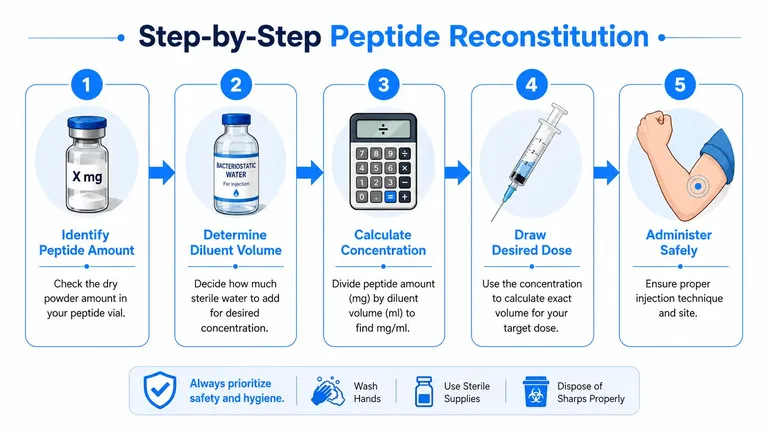
A lot of guides stop after giving a formula. They don’t deal with the core problem, which is translating that formula into a workflow you can repeat without second-guessing yourself. That gap is one reason many people struggle to convert a target dose into a safe, usable injection volume after reconstitution, especially when juggling vial size, water volume, syringe units, and scheduled cycling.
The basic thought process
Start with three inputs:
- Vial amount
- Diluent volume
- Target dose
Here’s a concrete example using one of the verified concentration scenarios.
- Vial amount: 5 mg
- Diluent added: 2 mL
- Target dose: 250 mcg
Now convert step by step.
Step 1 Convert the vial amount into the same unit as the dose
A 5 mg vial contains 5000 mcg total.
Step 2 Calculate concentration
If 5000 mcg is dissolved in 2 mL, then the concentration is:
5000 mcg ÷ 2 mL = 2500 mcg/mL
Step 3 Calculate the volume for the target dose
If the concentration is 2500 mcg/mL and your target is 250 mcg, then:
250 mcg ÷ 2500 mcg/mL = 0.1 mL
So in this setup, 0.1 mL delivers 250 mcg.
Why syringe math still trips people up
The calculation above is clean because the numbers were chosen cleanly. Real life gets messy when the vial strength or water volume changes. If you add a different amount of diluent next time, your concentration changes, which means your syringe pull changes too even if your target dose stays the same.
That’s why consistency matters. If you reconstitute the same peptide two different ways across two cycles, “the same line on the syringe” may no longer mean the same dose.
Reconstitution doesn’t just prepare the vial. It defines the math for every dose that follows.
If you want a separate practical walkthrough of handling the mixing step itself, this guide to safely reconstituting peptides is useful for sterile technique and handling details. There’s also a focused explanation of the mixing workflow in this how to reconstitute peptides article.
A repeatable worksheet you can use
Before drawing anything up, write down:
- Total peptide in vial: in mg and then in mcg
- Water added: total mL
- Resulting concentration: mcg per mL
- Target dose: mcg
- Volume to inject: mL
Later, when your hands are busy and your attention is split, that written sequence matters more than people expect.
A short visual walkthrough can also help reinforce the sequence before you handle the vial:
Simplifying Dosing with a Peptide Calculator App
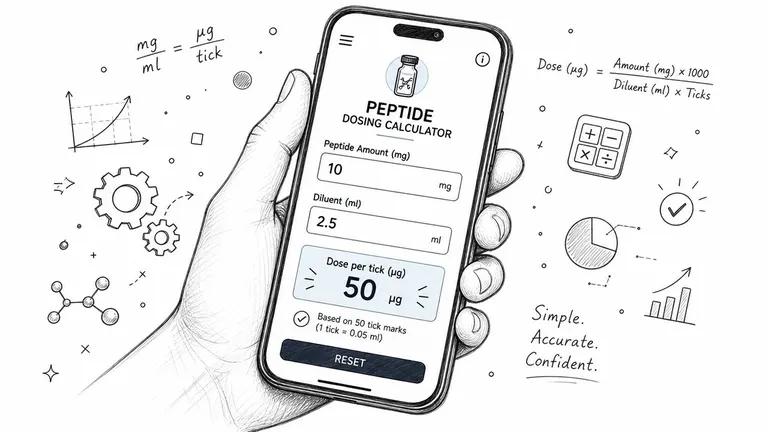
Manual math is useful because it teaches you what the numbers mean. It’s not always the best way to run a day-to-day protocol. Once you understand the logic, using a calculator reduces the chance of a rushed arithmetic mistake.
What a calculator should handle
A good peptide calculator should let you enter:
- The vial amount
- The amount of diluent added
- The target dose
- The syringe format you’re using
From there, it should return the practical output you need: how much liquid to draw. That matters because errors are less common with the concept itself. Instead, mistakes occur when converting the concept into a physical syringe pull while distracted.
Where a tool fits into the workflow
Think of the app as a translation layer. Your protocol speaks in mcg. Your vial label may speak in mg. Your syringe speaks in volume. The calculator converts between those languages cleanly and consistently.
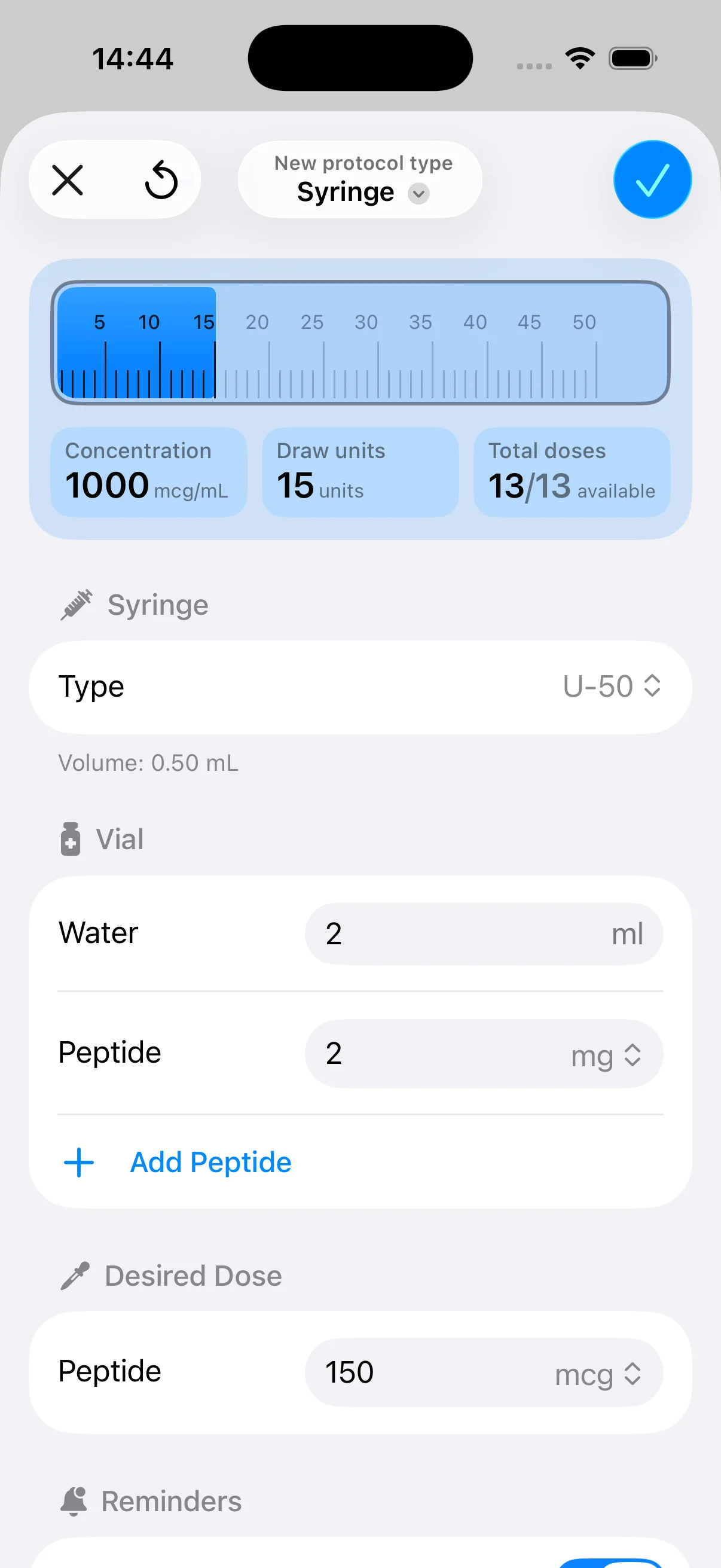
One option built for that job is PepFlow’s peptide calculator app. It’s an iOS tool that lets users enter vial strength, reconstitution volume, and desired dose, then converts that into a practical measurement for dosing and tracking. That doesn’t replace clinical judgment, but it does reduce the odds of a simple math slip.
When using an app is safer than relying on memory
There are a few situations where calculator use becomes especially sensible:
- You changed the reconstitution volume: Even a familiar peptide becomes a new concentration.
- You run more than one peptide: Similar-looking vials can create mix-ups.
- You split doses across the day: Repeated conversions create more chances to drift.
- You return to a protocol after a break: Memory is less reliable than people think.
Digital help is most useful when the protocol is simple enough to feel familiar. Familiarity is when people stop checking.
An app also makes it easier to keep one record of what concentration you created, what dose you intended, and what you took. That consistency becomes even more important once you move from single injections to a structured schedule.
Building Your Dosing Schedule and Protocol
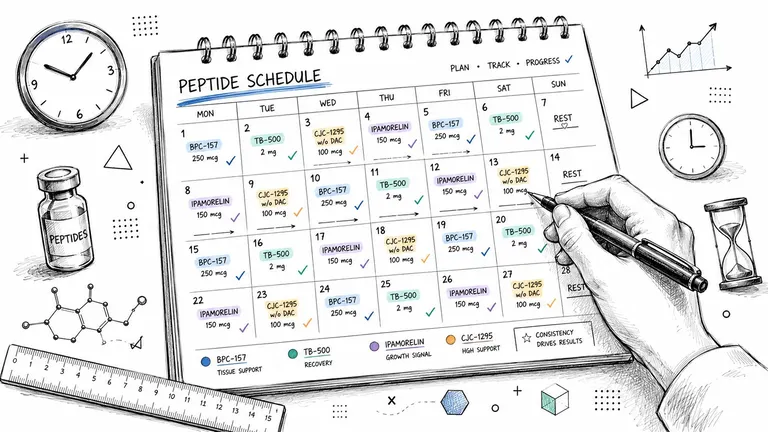
Getting one syringe right is only half the job. The struggle is often not with a single dose. It’s with repeating the same dose on the right timetable for long enough that the protocol stays consistent.
Frequency should match the peptide’s behavior
For many peptide regimens, dose frequency should track the peptide’s half-life because shorter half-lives create larger peak-to-trough swings. A clinical dosing guide notes that peptides with 2–4 hour half-lives often need 3-times-daily dosing, 4–8 hours often need twice-daily dosing, 8–16 hours can usually be dosed once daily, and those with more than 24 hours may be used once daily or even alternate-day depending on formulation. The same guide explains that dividing doses lowers peak-to-trough fluctuation, and it also notes that longer-acting peptides are often timed for morning (0600–0800) or evening (1800–2000) administration, while intermediate-acting peptides are commonly given on 10–14 hour intervals in these peptide half-life and frequency guidelines.
That’s the pharmacology side. The practical side is simpler. If a peptide clears quickly, long gaps can create uneven exposure. If it lasts longer, frequent redosing may add complexity without much benefit.
Building a schedule people can actually follow
A usable protocol usually needs more than a dose and a clock time. It may also include a start date, changes over time, pause periods, and a log of what was taken.
A workable schedule often includes:
- A starting phase: Some protocols begin lower before advancing.
- A stable phase: The dose and timing remain consistent for a period.
- Split dosing when needed: One daily total may be divided into smaller administrations.
- Planned pauses or cycles: Some people follow protocols with breaks built in.
The practical problem isn’t theory. It’s adherence.
Many protocol failures are boring. People forget what concentration they mixed. They miss the evening dose. They can’t remember whether today is an “on” day or an “off” day. Those aren’t chemistry problems. They’re routine problems.
That’s why scheduling tools matter alongside dose calculators. Reminders, logging, and a visible calendar reduce the friction of following a plan exactly as intended. For peptide use, consistency usually comes from organization more than motivation.
Safety First Dosing Red Flags and Next Steps
The biggest safety mistake is treating broad online ranges as personal instructions. Public peptide content often gives generalized microgram ranges without clarifying that doses vary by compound, goal, and the strength of the evidence behind that protocol. Independent review material also notes that many therapeutic peptide discussions remain narrow, often centered on GLP-1 drugs and a few other agents, while general guides still present broad starting ranges such as 250–500 mcg/day or 100–300 mcg doses without clearly separating research-use conventions from clinically validated regimens in this review of evidence quality in peptide dosage guidance.
Red flags that should make you stop and verify
Be cautious if any of these apply:
- The protocol has no clear compound context: A number without a specific peptide name is not usable.
- The source can’t explain the units: If mg, mcg, and syringe units are blurred together, stop.
- You changed the reconstitution but kept using the old syringe amount: That creates a different dose.
- Advice comes from anecdotal posts alone: Popularity doesn’t equal accuracy.
- You notice unexpected effects: Don’t self-adjust aggressively without medical input.
What good practice looks like
A safer routine is slower and more documented than commonly expected.
- Use sterile technique: Mixing and drawing should be deliberate, not improvised.
- Write down your concentration: Don’t rely on memory after reconstitution.
- Log timing and response: Keep a record of doses, timing, and what you notice.
- Ask a qualified clinician: This matters before starting, and again if anything changes.
If the protocol looks simple online but feels confusing in your hands, that’s a sign to pause, not push through.
Frequently Asked Questions About Peptide Dosing
What if I miss a dose
Don’t double the next dose just to “catch up” unless the prescribing clinician who oversees your protocol has told you to do that. A missed dose changes timing, and timing is part of the protocol. If you’re unsure, document what happened and ask for guidance before improvising.
Can I pre-load syringes for convenience
That’s a handling and sterility question as much as a dosing question. Convenience can introduce storage, labeling, and contamination issues. If you’re considering it, get advice specific to the peptide, storage conditions, and preparation method rather than assuming it’s interchangeable with drawing from the vial at the time of use.
Should I change the dose if I feel side effects
Don’t make large unsupervised jumps up or down. Side effects can relate to the dose, timing, concentration, or even a preparation error. First confirm that the reconstitution math and syringe volume were correct. Then discuss adjustment with a qualified medical professional.
Is once daily always better because it’s easier
Not necessarily. Ease matters, but pharmacokinetics matters more. Some protocols are built around split dosing because the peptide doesn’t stay in range long enough with a single daily administration.
How do I know if my syringe amount is right
Check the entire chain, not just the final draw line. Confirm the vial strength, the amount of diluent added, the resulting concentration, and the target dose. If any one of those inputs changes, the syringe amount can change too.
What’s the safest mindset to keep
Treat every dose as the result of a calculation, not an estimate. Write it down. Label it clearly. Recheck before injecting. And when the protocol, product, or your response changes, bring a medical professional into the decision.
If you want a simpler way to translate vial strength, reconstitution volume, and target dose into a usable syringe measurement, PepFlow provides a calculator and protocol-tracking workflow in one place. It’s designed for planning, reminders, and logging, not for medical decision-making, so it works best as an organization tool alongside qualified clinical guidance.