A standard 10 mL vial of U-100 insulin contains exactly 1,000 units, while a 3 mL vial contains 300 units, because U-100 means there are 100 units per milliliter. The arithmetic is simple, but confusing concentration with total volume can turn a routine calculation into a dangerous dosing error.
You may be looking at a vial, syringe, or reconstitution worksheet and asking the same practical question: how many units are available? The answer depends on two label details, not vial size alone: the liquid volume and the insulin concentration. That distinction also provides the foundation for peptide reconstitution, where a vial’s physical volume, the amount of active compound, and the final concentration must remain separate in your calculations.
Table of Contents
- The Short Answer for Standard Insulin Vials
- Calculating Total Units from Volume and Concentration
- Navigating Concentrated Insulin Variants
- Critical Safety Pitfalls and Dosing Errors
- Applying Vial Math to Peptide Protocols
- Core Rules for Accurate Vial Calculations
The Short Answer for Standard Insulin Vials
For standard U-100 insulin, the label describes concentration, not the total contents of the vial. U-100 means 100 insulin units in each 1 mL. Therefore, a common 10 mL vial contains 1,000 total units, while a 3 mL vial contains 300 total units, as documented by Nationwide Children’s Hospital’s insulin guidance.
The calculation is:
Vial volume in mL × concentration in units/mL = total units
For a standard vial:
- 10 mL × 100 units/mL = 1,000 units
- 3 mL × 100 units/mL = 300 units
The word unit needs careful handling. A unit is a standardized biological dose of insulin. It isn’t a measurement of weight, and it isn’t directly the same thing as a milliliter. A milliliter describes physical volume, while a unit describes biological activity under the product’s stated concentration.
That’s why the same liquid volume can contain different numbers of units when the concentration changes. A U-100 product has 100 units in each milliliter, but concentrated products use a higher number of units per milliliter. You can’t safely infer total units from the vial’s size without reading the U-number on the label.
Practical rule: Read the concentration first, then calculate the contents. Never assume that every insulin vial contains 1,000 units.
The syringe introduces another layer of risk because its markings may be designed for a specific concentration. Before converting a prescribed dose into a syringe position, review how to read insulin syringes and confirm that the syringe scale matches the product you’ve been given.
Calculating Total Units from Volume and Concentration
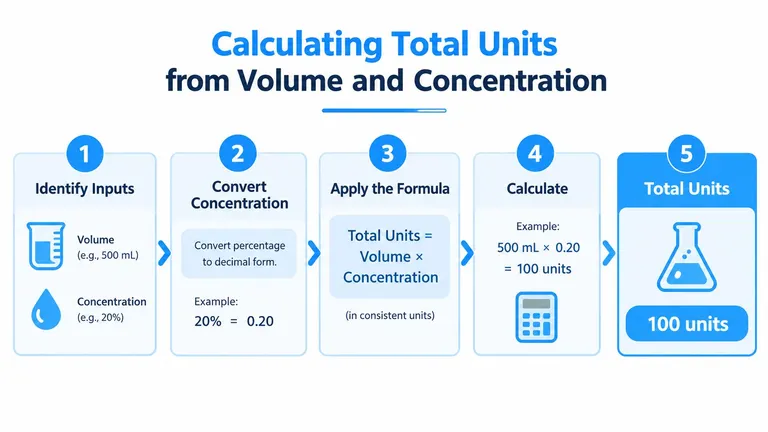
The reliable method works from the label rather than from memory. Find the total liquid volume, find the concentration, and multiply them.
The basic formula
Total units = volume in mL × concentration in units/mL
The units cancel in a useful way. If the vial contains milliliters and the label gives units per milliliter, multiplication produces total units.
Take the standard 10 mL U-100 vial:
- Identify the volume: 10 mL.
- Identify the concentration: 100 units/mL.
- Multiply: 10 × 100.
- Result: 1,000 total units.
Now apply the same process to a 3 mL U-100 vial:
- Volume: 3 mL.
- Concentration: 100 units/mL.
- Multiplication: 3 × 100.
- Result: 300 total units.
This is the standard conversion described in the American Diabetes Association insulin overview. The vial’s capacity follows from the concentration and the amount of liquid inside it. The number printed after the “U” is not the number of units in the entire container.
Why this matters for reconstitution
Peptide calculations follow the same dimensional logic, even when the active compound is expressed in milligrams or micrograms rather than insulin units. You first determine the final concentration after adding the diluent, then calculate the volume corresponding to the intended amount. The label’s active quantity and the added liquid volume answer different questions.
A written calculation should make every unit visible. For example, if a label gives a concentration in units/mL, use units and milliliters. If it gives mass per milliliter, use the matching mass units. Don’t mix milligrams, micrograms, insulin units, and syringe marks without clear notation.
For a separate practical reference on handling used equipment, follow the instructions relevant to your setting when you dispose of dog insulin syringes. For the conversion itself, how to convert mL to units provides a useful way to keep volume and syringe markings distinct.
Navigating Concentrated Insulin Variants
The familiar 1,000-unit figure applies to a 10 mL vial of U-100 insulin. It isn’t a universal rule for every insulin product. Concentrated formulations change the number of units delivered in each milliliter, so the same physical volume can represent a very different biological dose.
Concentrated insulin exists to deliver the prescribed number of units in a smaller injection volume. U-500 regular insulin contains 500 units per milliliter, which is five times the concentration of U-100. The same insulin-unit amount therefore occupies one-fifth the volume compared with U-100, as described in Eli Lilly’s historical announcement about U-500 insulin and specialized vial formats.
Compare the label, volume, and total
The following matrix shows the arithmetic. Where a product’s vial volume isn’t specified, the total capacity can’t be calculated from concentration alone, so the table identifies the required calculation rather than inventing a vial size.
| Insulin type | Concentration | Common vial volume | Total units in vial |
|---|---|---|---|
| U-100 | 100 units/mL | 10 mL | 1,000 units |
| U-100 | 100 units/mL | 3 mL | 300 units |
| U-500 | 500 units/mL | 1 mL example | 500 units |
| U-200 | 200 units/mL | Product-specific | Volume × 200 |
| U-300 | 300 units/mL | Product-specific | Volume × 300 |
The table’s central lesson is more important than memorizing product categories: concentration and container volume are independent variables. A U-300 product in a 3 mL container would not have the same total units as a U-100 product in a 3 mL container, because the concentration differs.
Insulin packaging has moved beyond one dominant vial format as clinical needs changed. Specialized smaller vials and concentrated products can reduce injection volume and support different patient populations, but they also make label verification essential. Treat every “U-number” as a calculation instruction, not as a vial-capacity label.
Critical Safety Pitfalls and Dosing Errors
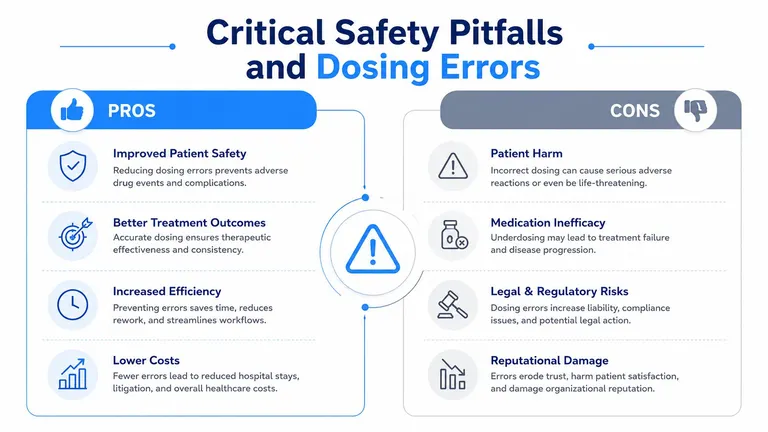
The most dangerous mistake is reading U-100 as though it means “100 units in the vial.” It means 100 units in each milliliter. Misreading that label has been documented as a cause of 10-fold overdoses, according to the Institute for Safe Medication Practices insulin safety guideline.
A second problem occurs when the syringe scale and insulin concentration don’t match. A syringe calibrated for one concentration may display marks that don’t correspond directly to the biological units in a different product. With concentrated insulin, drawing to a familiar visual mark without confirming the device instructions can produce the wrong dose even when the person reads the syringe accurately.
Use a deliberate verification sequence
Before preparing a prescribed dose, check these items:
- Product identity: Confirm the insulin name and formulation.
- Concentration: Read the complete U-label, including whether it’s U-100 or a concentrated strength.
- Vial volume: Record the mL amount separately from the concentration.
- Dose instruction: Use the prescribed units or volume, not an estimate based on vial size.
- Device compatibility: Confirm that the syringe, pen, or delivery device is intended for that product.
- Final draw: Compare the prepared amount with the written directions before administration.
Stop if the label and syringe don’t agree. Ask a pharmacist or prescriber to confirm the conversion instead of improvising.
This caution also applies to diluents and reconstitution supplies. If a peptide or other vial requires a specified diluent, the final concentration depends on the amount added, and the resulting syringe mark must be checked against the written instructions. Review bacteriostatic water and insulin syringes as background, but don’t use an online example to replace product-specific medical guidance.
Public safety guidance treats concentrated insulin as a medication-safety issue because the ordinary 1,000-unit heuristic no longer reliably describes the contents of every vial. The safest habit is simple: read, write down, calculate, and independently verify.
Applying Vial Math to Peptide Protocols
Insulin provides a clear clinical example of a broader reconstitution principle: the amount in the container isn’t the same as the concentration in the solution. Peptide users and students often work with a dry compound, a chosen diluent volume, and a target dose expressed in micrograms. Those values must be connected through the final concentration.
The sequence is:
- Identify the active amount in the vial.
- Identify the final liquid volume after reconstitution.
- Calculate active amount per milliliter.
- Convert the prescribed or planned amount into a volume.
- Translate that volume to the markings on a compatible syringe, if a clinician has confirmed the device.
The calculation should preserve units at every stage. If a vial contains a mass amount, don’t call the result “insulin units” unless the product specifically defines its dose that way. Syringe marks are physical-volume indicators tied to a device and concentration system. They don’t independently tell you how much peptide or medication is present.
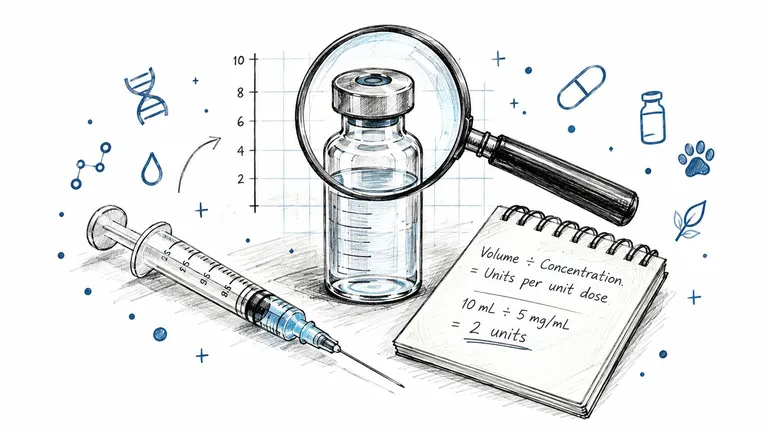
Why concentration errors repeat
Manual calculations become harder when several vials use different active amounts or reconstitution volumes. A person may remember the syringe mark from one preparation and carry it into another, even though the final concentration has changed. Concentrated insulin creates the same cognitive trap, and ConsumerMedSafety’s insulin administration guidance emphasizes that “units per vial” doesn’t map cleanly to the familiar 1,000-unit assumption.
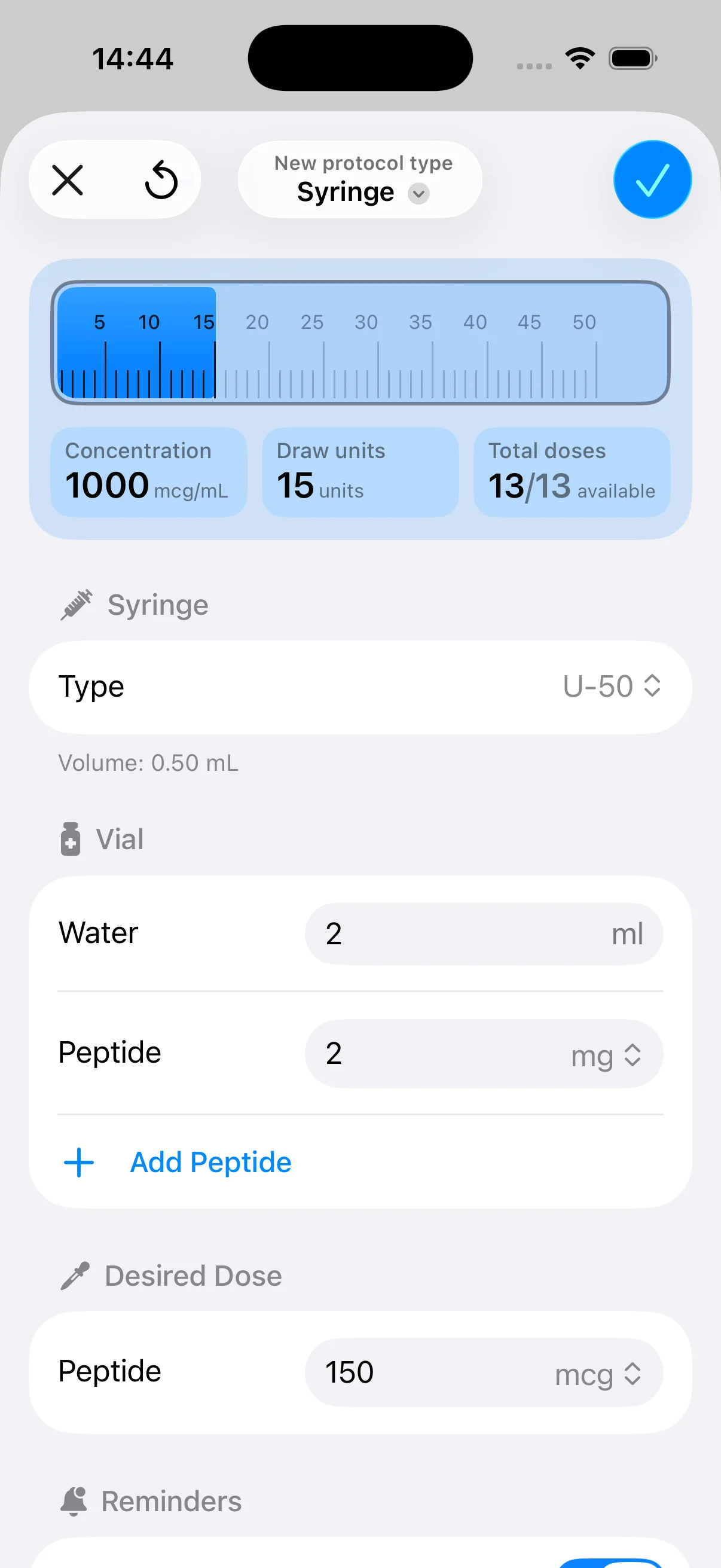
A calculator can reduce arithmetic workload, but it can’t validate an unsafe protocol or identify whether a product is appropriate for human use. PepFlow can organize vial amounts, diluent volumes, syringe selection, calculated draw units, dosing schedules, reminders, and dose history in one workflow. Use any digital tool as a calculation and organization aid, while relying on a qualified clinician or pharmacist for product, route, sterility, and dose decisions.
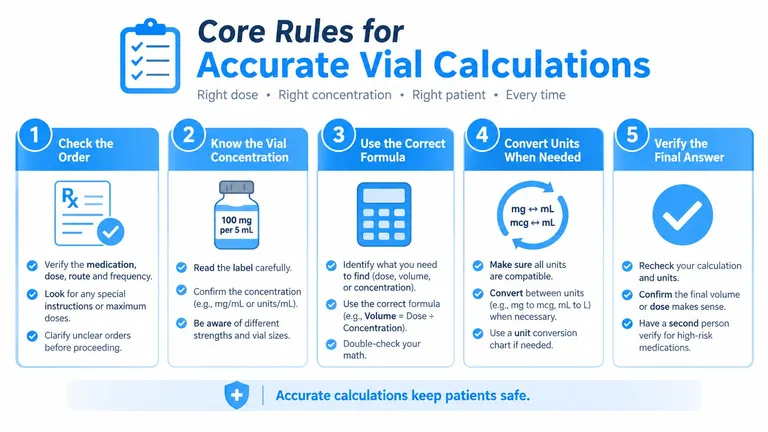
Core Rules for Accurate Vial Calculations
Keep these rules beside the vial rather than relying on memory:
- Start with concentration: “U-100” means 100 units per milliliter, not 100 units per container.
- Multiply the label values: Volume in mL × concentration in units/mL = total units.
- Separate concepts: Units describe biological dose, while milliliters describe liquid volume.
- Check specialized strengths: U-200, U-300, and U-500 products require product-specific verification.
- Match the device: Confirm that syringe or pen markings correspond to the prescribed product and instructions.
- Write the calculation: A visible equation makes silent assumptions easier to catch.
- Ask before injecting: If the label, device, concentration, or written dose is unclear, stop and contact a pharmacist or prescriber.
A standard U-100 vial is straightforward only because its concentration is known. The moment the strength or packaging changes, recalculate from the label.
If you want a structured way to check peptide vial concentration, convert a target dose into syringe units, and organize recurring protocols, visit PepFlow. Use it to reduce manual arithmetic and track reminders and dose history, while confirming all medication decisions with your clinician or pharmacist.