Standard U-100 insulin syringes hold 30, 50 or 100 units, corresponding to 0.3, 0.5 and 1.0 mL. On a U-100 scale, every 1-unit increment equals 0.01 mL, but that doesn’t mean every printed notch represents one unit, or that the marking equals the dose of every medication.
The conversion table below gives you the starting point. Before drawing anything, match the syringe’s scale to the concentration printed on your medication label and the instructions from your pharmacist.
Table of Contents
- How Many Units a Syringe Holds
- What a Unit Actually Measures
- How to Read Syringe Markings
- Converting Units to mL for Any Product
- When the Same Syringe Holds Different Units
- Common Mistakes That Turn Into Overdoses
- Record Concentration and Volume With Every Dose
How Many Units a Syringe Holds
U-100 means 100 insulin units per milliliter, as defined in the FDA-approved insulin labeling. That concentration explains the capacity and volume relationships below, including why a smaller barrel reaches its maximum at a lower unit number.
U-100 syringe sizes and unit-to-mL conversion
| Syringe capacity | Maximum units (U-100) | 1 unit equals | Half-full mark | Common uses |
|---|---|---|---|---|
| 0.3 mL | 30 units | 0.01 mL | 15 units | Small insulin doses, or prescribed peptide draws when this device is approved |
| 0.5 mL | 50 units | 0.01 mL | 25 units | Insulin doses within this capacity |
| 1.0 mL | 100 units | 0.01 mL | 50 units | Larger prescribed draws within this capacity |
The maximum units column tells you how much the syringe can hold, not how much you should inject. A full syringe isn’t a standard dose, and a vial doesn’t necessarily contain only one syringe’s worth of medication.
The halfway column also needs careful reading. Half-full describes the position within that particular barrel, not a dose that stays the same across syringe sizes.
Everyday U-100 conversions
These are direct calculations from the U-100 concentration above. Read “units” in this table as U-100 syringe markings; they equal actual insulin units only when you’re drawing U-100 insulin.
| U-100 syringe marking | Liquid volume |
|---|---|
| 5 units | 0.05 mL |
| 10 units | 0.10 mL |
| 20 units | 0.20 mL |
| 30 units | 0.30 mL |
| 50 units | 0.50 mL |
| 100 units | 1.00 mL |
A smaller-capacity syringe can be useful for a small prescribed draw when its graduations make the target easier to identify. A larger syringe provides more capacity, but capacity alone doesn’t tell you whether its markings are fine enough for your dose.
Ask your pharmacist to select a syringe that both holds the intended volume and clearly marks the intended draw. Don’t choose equipment solely because an online example uses it, particularly for a medicine other than insulin.
Practical rule: Choose the syringe for the prescribed volume and readable graduation marks, not for how full you expect it to look.
The U-100 marking-to-volume relationship remains fixed for a correctly labeled U-100 syringe. What changes with the liquid inside is the amount of medication contained in that volume.
What a Unit Actually Measures
A milliliter measures physical volume: how much liquid sits in the barrel. A medication unit measures a product-defined amount of biological activity, so it can’t stand in for milliliters or milligrams on its own.
A measuring scoop works the same way. The scoop’s size tells you the volume it holds, but nothing about how much active ingredient that volume contains. Two identical scoops can deliver very different amounts of a substance depending on how concentrated the powder is. Units behave the same way: the number on the barrel means nothing until you pair it with the product’s concentration.
The distinction looks like this:

The label supplies the missing relationship
The bridge between units and volume comes from the product, not the syringe. For U-100 insulin, the FDA insulin labeling specifies 100 units per milliliter. That product concentration is why the appropriate insulin syringe can display a dose in units rather than requiring a separate volume calculation.
With a prescribed peptide labeled in milligrams, the question changes. You need the concentration in milligrams per milliliter, then the volume that contains the prescribed milligram amount.
The barrel doesn’t measure milligrams. It only helps you measure liquid using its printed scale.
Keep the terms separate
- Prescribed dose: The amount of medication your clinician intends you to receive.
- Concentration: The amount of medication in a given liquid volume.
- Draw volume: The liquid amount needed to contain that dose.
- Syringe marking: The line used to measure that draw on the specified device.
For background terminology, the Bulk Aussie Peptides glossary can help you distinguish peptide-related terms. A glossary isn’t a replacement for product-specific preparation or dosing instructions.
Say your prescription lists a milligram dose, but your draw-up note lists only units. Don’t assume the terms are interchangeable: ask the pharmacist to connect the prescribed amount, the vial concentration and the syringe marking in writing.
A unit is a real dose measurement, but it isn’t a universal liquid volume. Before any dose is drawn, pair every syringe marking with the product’s labeled concentration, because that ratio is what turns a line on the barrel into an actual amount of medication.
How to Read Syringe Markings
Read the syringe you’re holding, not a remembered picture of another barrel. Two syringes can have similar shapes while using different scales or graduation spacing.
Use this visual as an orientation aid, then verify each detail against your device’s instructions.

Follow a consistent reading routine
-
Confirm the printed scale. Look for U-100, U-500 or milliliter markings. A tuberculin syringe measures in mL; don’t treat its numbers as insulin-unit markings.
-
Find adjacent numbered lines. Establish what the numbers represent before counting the shorter lines between them. The printed capacity and the graduation interval are separate details.
-
Determine the value of each interval. Divide the difference between adjacent labeled values by the number of equal spaces between them. Count spaces, not just the intervening ink marks, and don’t assume every short line represents a single unit.
-
Read the correct plunger edge at eye level. For a conventional flat rubber stopper, use the edge nearest the needle, following the manufacturer’s instructions. Don’t use the back edge, the plunger rod or the liquid’s appearance as your reference.
-
Write small volumes with a leading zero. Put a zero before the decimal point so the written instruction is harder to misread. Ask for a rewritten label if the dose notation is unclear.
Check the interval before choosing a line
For a hypothetical reading exercise, suppose adjacent labels differ by ten units and contain ten equal spaces. Each space represents one unit; a target two spaces beyond the lower label is two units higher.
That conclusion changes if the barrel has fewer spaces between those labels. Never estimate an unmarked position for a dose your syringe can’t clearly measure.
Our guide to reading insulin syringe markings provides another reference for recognizing barrel scales and graduation intervals.
A video can provide a second view of the equipment, but your pharmacist should confirm the reading technique for your specific syringe.
If the stopper is rounded, the printing is difficult to see or the target falls between graduations, stop and ask for help. A different device may be needed rather than a closer guess.
Converting Units to mL for Any Product
A conversion starts with the prescribed dose, the confirmed concentration and the syringe scale. Without those inputs, a calculator can produce a number that looks precise but doesn’t describe your medication correctly.
Keep the prescription and vial label beside you while checking the arithmetic. The calculation illustrates how quantities relate; it doesn’t select a dose, diluent or preparation method.
This illustration shows the information you need to connect.

Match the units before dividing
Volume in mL = prescribed dose ÷ concentration.
The dose and concentration must use matching medication measures: milligrams with milligrams per milliliter, or medication units with medication units per milliliter. Once you have the volume, translate it into the markings on the specified syringe.
For a U-100-marked barrel, the marking is the volume in mL multiplied by its U-100 scale factor. That result describes the barrel position, not a newly assigned biological-unit dose for a non-insulin medicine.
A hypothetical concentration change
Consider an arithmetic-only example, not preparation instructions: assume a vial contains 5 mg, and its confirmed final solution volume is 2 mL. Assume the prescribed target for the exercise is 0.25 mg and the pharmacist has approved a U-100 syringe.
| Calculation | Hypothetical result |
|---|---|
| Concentration | 5 mg ÷ 2 mL = 2.5 mg/mL |
| Volume for the target | 0.25 mg ÷ 2.5 mg/mL = 0.10 mL |
| U-100 barrel position | 0.10 × 100 = 10-unit marking |
Now change only the confirmed final volume to 1 mL. In this hypothetical solution, the concentration becomes 5 mg/mL, so the same 0.25 mg target occupies 0.05 mL, corresponding to the 5-unit marking.
The intended drug amount didn’t change. The concentration changed, so the draw volume and barrel position changed.
Never carry an old syringe-marking instruction over to a newly prepared vial unless the pharmacist confirms that the concentration and prescribed dose still match.
For real preparations, use the concentration supplied or confirmed by the dispensing pharmacist. Don’t assume that adding a stated diluent volume always establishes the exact final volume, and don’t choose a different dilution merely to obtain a convenient syringe mark.
The units-to-mL conversion guide provides additional help with the distinction between volume calculations and syringe scales.
When the Same Syringe Holds Different Units
The same liquid volume can contain very different medication doses. U-500 insulin contains five times as many insulin units per milliliter as U-100, so a barrel’s physical capacity doesn’t answer how many actual medication units it contains.
The FDA insulin-syringe device records identify syringe products and their device descriptions. When comparing these devices, keep capacity, calibration and medication concentration separate.
Units held by syringe type and concentration
The table illustrates the concentration arithmetic: at 100 units/mL, 0.5 mL contains 50 units; at 500 units/mL, that same volume contains 250 units. The columns describe liquid quantities, not a claim that every listed device is available with either capacity.
| Syringe and product | Concentration | 0.5 mL holds | 1.0 mL holds | Reading rule |
|---|---|---|---|---|
| U-100 insulin in a U-100 syringe | 100 units/mL | 50 actual units | 100 actual units | Markings read as actual U-100 insulin units |
| U-500 insulin in a U-100 syringe | 500 units/mL | 250 actual units | 500 actual units | Historical conversion divides actual dose by 5; don’t use this mismatch for self-dosing |
| U-500 insulin in a U-500 syringe | 500 units/mL | 250 actual units | 500 actual units | Dedicated markings read actual U-500 insulin units |
| Tuberculin syringe | mL markings only; concentration comes from the vial | 0.5 mL of liquid | 1.0 mL of liquid | Read volume, then apply the vial concentration if needed |
Why historical conversion instructions are risky
Older instructions sometimes expressed a concentrated-insulin dose as a marking on a less-concentrated insulin syringe. Mathematically, the historical U-500-to-U-100 conversion divided the actual insulin dose by five.
That arithmetic explains how a barrel marking could differ from the actual medication dose. It isn’t a recommendation to draw U-500 insulin with a U-100 syringe.
Use the dedicated delivery device specified by the current product instructions and your prescriber. If an old chart, handwritten note or previous prescription uses a mismatched scale, have the pharmacist replace it with clear instructions for your current device.
A dedicated U-500 syringe avoids that particular scale conversion because its markings represent actual U-500 insulin units. You still need to verify the prescribed dose and product before use.
What if the barrel shows only milliliters?
A tuberculin syringe or another mL-marked syringe displays volume directly. It doesn’t acquire a medication-unit scale just because you fill it with insulin or another injectable product.
The same applies to a barrel labeled in cc, which is another way of expressing cubic-centimeter volume. The concentration on the vial supplies the medication amount; the barrel supplies the liquid measurement.
Our comparison of types of syringes for insulin can help you distinguish the equipment categories. When you ask how many units are in a syringe, identify the product and scale before treating any printed number as a medication dose.
Common Mistakes That Turn Into Overdoses
A correct-looking syringe number can still deliver the wrong dose. The barrel is only a ruler. The vial’s units per mL decide what each mark on that ruler is worth.
On a U-100, 1 mL syringe, the distance between the 5-unit line and the 50-unit line is small. A misread mark, a stray zero or a borrowed draw instruction can multiply an intended dose tenfold before anyone notices.
Run through the checklist with the medication in hand, verifying what each number means rather than how familiar it looks.

Pair each trap with a check
- A familiar vial with a different concentration: Read the current label before using a previous draw instruction. Matching medicine names don’t establish matching strengths.
- A barrel marking mistaken for a milligram dose: Ask the pharmacist to write the prescribed amount and corresponding liquid volume together.
- An extra zero in the draw: Compare the written target with the selected line before drawing, then check again before injection.
- A different syringe supplied with a refill: Confirm its scale and graduation interval rather than relying on where the old plunger used to sit.
- Instructions that disagree: Don’t choose whichever number seems more familiar. Resolve the discrepancy with the prescriber or dispensing pharmacist.
Confirm before the needle enters the vial
Compounded products may be supplied at different concentrations. A draw instruction from someone else’s vial, or from your previous refill, describes that vial’s strength. If the vial in front of you holds more units per mL, the same barrel line now delivers more medication.
Ask the pharmacist to watch you point to the target line on an unused syringe while you’re learning. Then restate the prescribed amount and draw volume in your own words, so a misunderstanding shows itself before injection rather than after.
Stop condition: If the vial label, written draw instructions and syringe scale don’t agree, don’t inject until a clinician or pharmacist resolves the mismatch.
If you think you’ve already injected the wrong amount, seek urgent medical or poison-control advice rather than waiting for symptoms. Keep the vial, packaging and syringe information available so the responder can identify what happened.
Record Concentration and Volume With Every Dose
A useful dose record preserves the relationship between the medication and the device. Recording only a syringe number leaves out the information needed to interpret it later.
Keep the prescribed medication amount alongside these linked details:
- Syringe marking and scale: Record the selected line and whether the device is U-100, U-500 or mL-marked.
- Liquid volume: Record the milliliters drawn, not just the barrel number.
- Concentration: Record the current vial’s units per mL or mg per mL.
Make each new vial a fresh verification
When you replace a vial or change preparation details under professional direction, check the new record against the dispensing instructions. Don’t automatically copy the previous draw marking into the next entry.
Changing barrel size alone doesn’t necessarily change the volume represented by a matching scale. Changing concentration, however, can change the amount of medication in that same draw.
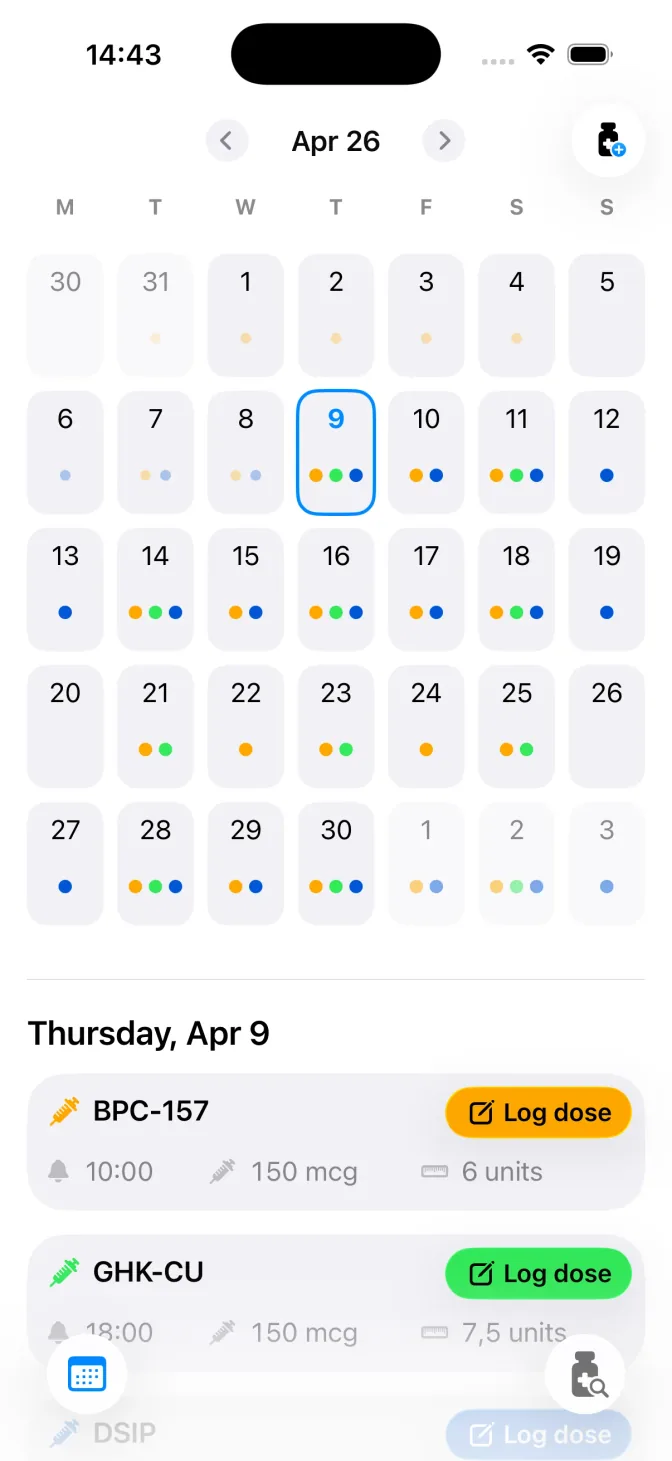
Our PepFlow website calculator uses the syringe, vial, water-volume and target-dose values you enter to calculate concentration, syringe draw and doses per vial. It doesn’t choose the target dose or recommend a preparation; on iPhone and iPad, tracking is separate, and you independently record dose details and optional preparation and syringe information.
Confirm every real dose or preparation change with your prescriber or pharmacist. A calculator organizes arithmetic, while your medication instructions determine what you should administer.
Keep your confirmed dose, concentration and syringe details together rather than relying on a remembered unit count. Visit PepFlow to use the website calculator for checking entered values and to explore dose tracking, schedules and reminders for following your established plan.