
There’s no single answer to how long peptides take to work. Some pharmacologic effects can begin within days, stable exposure for a weekly long-acting peptide generally takes about 4–5 weeks, and meaningful body-composition outcomes are usually judged over months.
That sounds counterintuitive because people often expect an injection to produce one clear moment of action. Biology rarely works that way. You might notice appetite, gastrointestinal, sleep, pain, or recovery changes before the medication has reached a stable level, while the outcome you care about, such as weight change or tissue recovery, may require sustained treatment and consistent measurement.
The useful question isn’t “When will I feel something?” It’s “Which result am I measuring, and how long does that result reasonably take to develop?”
Table of Contents
- The Peptide Timeline Framework
- How Biology Determines Onset Speed
- Expected Timelines by Goal and Peptide Type
- The Research Peptide Reality Check
- How to Track Progress Without Losing Patience
- Using PepFlow for Consistent Adherence
- Setting Realistic Expectations for Your Protocol
The Peptide Timeline Framework
Peptides don’t operate on one universal clock. The timeline depends on the molecule, its formulation, the route of administration, the dose schedule, the reason for use, and whether the product has been properly studied in humans. A compound can enter circulation quickly while its downstream effects take much longer to become visible.
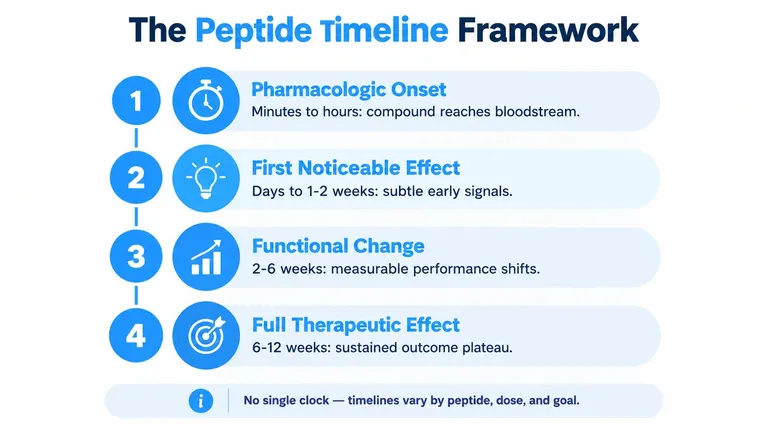
A practical way to understand the process is to separate four milestones:
- Pharmacologic onset is when the compound begins reaching its biological target. This may occur within days, but the timing varies widely between peptides.
- First noticeable effect is the earliest change you personally perceive, such as altered appetite, sleep, discomfort, or gastrointestinal symptoms. A sensation is useful to record, but it isn’t proof of therapeutic benefit.
- Measurable outcome is an objective change related to your goal. That might involve body weight, glucose, recovery time, sleep data, or another defined measure.
- Plateau or full treatment effect is the point at which repeated measurements stop changing substantially, or the treatment reaches the outcome that can reasonably be assessed.
Why the first signal can mislead you
Think of planting a tree. You may see a sprout quickly, but you won’t get shade at the same speed. The sprout confirms that something has started. It doesn’t tell you how large the tree will become or when it will fulfill its purpose.
The same distinction applies to peptide therapy. An early appetite shift may indicate a pharmacologic effect, while stable exposure and lasting body-composition change remain ahead. For semaglutide, the FDA prescribing information describes maximum blood concentration approximately 1–3 days after a subcutaneous dose and steady-state exposure after about 4–5 weeks of once-weekly administration (FDA prescribing information for semaglutide).
Practical rule: Track the first sensation, but judge the treatment by the outcome it was intended to change.
Asking how long peptides take to work is like asking how long a marathon takes without saying whether you mean reaching the start line, completing the first mile, crossing the finish, or building the training plan. Clarifying the milestone prevents premature conclusions and unnecessary protocol changes.
How Biology Determines Onset Speed
Biology sets several clocks at once. A peptide can enter circulation, bind a target, trigger downstream signaling, and produce a noticeable or measurable result on different timelines. Treating those as one event is why people often decide too early that a protocol is either working or failing.
A good place to start is half-life, the time required for the amount of a compound in circulation to fall by half. Peptides differ widely. Unmodified molecules can be broken down or cleared within minutes to a few hours, while structural changes can extend reported half-lives to approximately 33.57 hours (review of peptide pharmacokinetics).
Half-life is only one part of onset. Biological activity involves receptor binding, intracellular signaling, gene expression, and tissue response. Those processes continue after blood concentration declines, and a peptide can reach circulation quickly while still requiring repeated exposure before a meaningful clinical outcome appears.
Steady state is a different milestone
With repeated dosing, exposure builds toward a more stable pattern. Pharmacokinetic steady state is generally approached after about four to five elimination half-lives (discussion of peptide delivery and pharmacokinetics). That means a short-acting compound can approach this point much sooner than a weekly long-acting medicine.
People get tripped up. If you change the schedule after one early dose, you are often judging a regimen before accumulation has settled into its expected pattern. Long-acting designs can reduce clearance and support less frequent dosing. They can also make unwanted effects slower to wash out, which matters when a protocol needs adjustment.
Route and absorption matter too. An injection starts the delivery process, but it does not guarantee that the final outcome should appear right away. If you want a plain-language explanation of absorption after dosing, see how peptide injections work.
Three clocks to record separately
Keep felt effect, objective measure, and cumulative response in separate columns.
A felt effect might be appetite, sleep, soreness, or energy. An objective measure could be a glucose reading, body weight trend, training output, or another defined marker. Cumulative response is what happens across repeated doses after enough time has passed for the regimen to show its real behavior.
That separation prevents a common mistake. A temporary sensation is not the same as a durable outcome, and the absence of an early sensation does not prove the peptide is ineffective.
Expected Timelines by Goal and Peptide Type
The intended outcome changes the timeline you should expect. Appetite or gastrointestinal changes can appear before weight loss becomes clear. A subjective feeling of recovery can arrive before an injury has objectively improved. Skin appearance, metabolic control, and body composition each require different kinds of observation.
| Goal Type | Early Effects | Measurable Outcomes | Full Plateau |
|---|---|---|---|
| Metabolic or appetite-related goals | Appetite or satiety changes may appear during dose escalation | Weight, glucose, or related measures become more useful after sustained treatment | Body-composition effects are evaluated over many months |
| Recovery and performance | A person may notice changes in soreness, energy, or perceived recovery | Repeated recovery times, training tolerance, or performance records provide stronger evidence | The endpoint may stabilize only after consistent training and observation |
| Tissue repair | Symptoms may fluctuate before structural recovery is clear | Function, range of motion, or clinician-assessed findings are more informative than sensation alone | The recovery endpoint depends on the tissue, injury, and treatment context |
| Skin-related goals | Texture or hydration may seem different gradually | Repeated photos under consistent conditions offer a more useful comparison | Visible changes generally require ongoing use and consistent assessment |
Metabolic outcomes need time
The strongest timeline evidence comes from studied medicines used under defined trial conditions. In the 72-week SURMOUNT-1 trial, mean body-weight reductions were 15.0%, 19.5%, and 20.9% across the tirzepatide doses studied, compared with 3.1% with placebo (SURMOUNT-1 trial summary from the American College of Cardiology). Treatment began at 2.5 mg weekly and increased by 2.5 mg every four weeks, so early appetite changes and later weight outcomes represent different stages of treatment.
That trial doesn’t mean every peptide, preparation, or user will experience the same result. It shows why a single injection isn’t an appropriate test of a long-term body-composition outcome. It also shows why increasing a dose early can blur the difference between insufficient observation time and inadequate response.
For a broader comparison of onset expectations across peptide categories, peptide results by type explained offers additional background. Treat those timelines as orientation, not as a dosing instruction.
The molecule matters as much as the goal
A weekly long-acting metabolic medicine and a research peptide intended for recovery shouldn’t be placed on the same calendar. Their absorption, clearance, target receptors, evidence base, and measurable endpoints may all differ. Readers comparing long-acting designs can also review DAC vs no-DAC peptides to understand why molecular design affects duration and scheduling.
The safest expectation is specific: define the outcome first, then choose a measurement period that matches the biology and the available human evidence.
The Research Peptide Reality Check
An early sensation can be real without being beneficial. Nausea, stimulation, fatigue, injection-site discomfort, or a subjective feeling of energy tells you that your body may be responding to something. It doesn’t establish that the product has the intended identity, dose, purity, safety profile, or therapeutic effect.
This matters particularly for research and compounded peptides. Approved medicines are evaluated through a clinical development and regulatory process. Compounded or experimental products aren’t automatically equivalent, even when they use a familiar peptide name.

What the evidence can and can’t tell you
The FDA identified BPC-157 as insufficiently characterized, citing concerns involving impurities, aggregation, immunogenicity, limited safety information, and insufficient evidence of effectiveness (FDA briefing materials on BPC-157). That finding doesn’t answer every question about every peptide, but it demonstrates why a confident onset promise can exceed the available evidence.
A lack of early sensation doesn’t prove that you’re underdosed. A strong sensation doesn’t prove that the treatment is working. The relevant question is whether you have a validated or clinically meaningful endpoint that can be tracked over time.
Readers looking for broader context can review peptide research for biohackers, while keeping the distinction between research discussion and established human treatment evidence clear.
Set a stopping question before you begin
Before using an investigational product, define what would count as benefit, what adverse effects would matter, and when a qualified professional should review the plan. Without those decisions in advance, users often respond to uncertainty by escalating, stacking compounds, or changing schedules.
A waiting period is only useful when you know what you’re waiting to measure.
Product identity, formulation quality, storage, route, and individual physiology can all alter exposure. No calendar estimate can resolve those uncertainties. If the product is compounded or research-only, professional review is especially important before interpreting an apparent response.
How to Track Progress Without Losing Patience
Good tracking turns “I don’t think it’s working” into a question you can examine. Start with the dose time and the exact product or formulation identified by your clinician or supplier. Record early tolerability separately from the outcome you intend to improve.
A simple log can include:
- Dose record: Note the date, time, and schedule followed.
- Early response: Record appetite, gastrointestinal symptoms, sleep, pain, energy, or other noticeable changes without labeling them as success.
- Objective measure: Choose a metric that matches the goal, such as body weight, glucose, recovery time, sleep quality, training performance, or a clinician-selected biomarker.
- Cumulative pattern: Review changes across repeated doses rather than reacting to one unusually good or bad day.
Use a defined review point
Choose the review point with a qualified clinician and keep it separate from daily emotional judgments. A daily check can tell you how you feel today. It can’t reliably establish whether a long-term treatment outcome is developing.
For body-composition goals, consistent measurement conditions matter. For recovery, record the same functional task or activity where possible. For sleep, use the same type of self-report or device measure rather than switching methods whenever the result is disappointing.
Why protocol changes create confusion
Changing dose timing or amount as soon as an effect feels absent changes the experiment. You may no longer know whether the original schedule was ineffective, insufficiently observed, inconsistently followed, or aimed at the wrong endpoint.
Don’t escalate unsupervised. A qualified clinician can help distinguish nonresponse, tolerability problems, adherence gaps, and an inappropriate treatment target. Your role is to collect clear observations that make that conversation more useful.
Using PepFlow for Consistent Adherence
A schedule tool can help with the practical problem that biology can’t solve for you: remembering what you planned to do. PepFlow supports dose scheduling, dosage calculations that convert microgram amounts into unit measurements, cycle management, reminders, countdowns, and dose history. Those functions can reduce missed doses and make it easier to see whether your routine has been consistent.

The app is an organization tool, not a prescribing service. It can’t determine whether a peptide is appropriate, confirm a product’s quality, or tell you to change a dose. Those decisions belong with a qualified healthcare professional.
A useful workflow is to enter the clinician-approved schedule, configure the relevant concentration and volume information carefully, and use the log-dose function after each administration. History tracking then gives you a record to compare with subjective effects and objective measurements.
For practical guidance on maintaining a consistent routine, see adherence to schedule. Consistency won’t guarantee a result, but inconsistent timing makes any result harder to interpret.
A short demonstration shows how a tracking workflow can fit into a routine:
The value of a reminder is modest but concrete. It helps separate a biological question, “Is this treatment effective?”, from an administrative one, “Did I follow the schedule accurately?”
Setting Realistic Expectations for Your Protocol
Patience isn’t just a mindset issue. It reflects the difference between rapid exposure and slower biological adaptation. A compound may begin interacting with its target before you can measure the outcome you care about, and a measurable change may appear before the eventual response has stabilized.
Use four questions to keep your expectations precise:
- What am I measuring? A sensation, a biomarker, a functional ability, and body weight are different endpoints.
- What would count as meaningful? Define the direction and type of change before daily fluctuations influence your judgment.
- How consistent has the routine been? Missed or mistimed doses can make an apparently ineffective protocol impossible to interpret.
- What evidence supports this product? Approved medicines, compounded preparations, and research peptides don’t carry the same level of human efficacy and safety evidence.
Know when to seek review
Contact a qualified clinician when adverse effects appear, when your intended outcome isn’t developing, or when you’re considering a dose or schedule change. Research and compounded products deserve extra caution because an apparent sensation may reflect an unwanted effect, an impurity, or an unrelated fluctuation rather than a useful treatment response.
The most reliable approach is neither blind optimism nor immediate abandonment. Track the schedule, separate sensation from outcome, use a measurement period that matches the goal, and reassess with evidence rather than impatience.
PepFlow helps you organize clinician-approved peptide schedules, calculate practical measurements, set reminders, and review dose history in one place. Visit PepFlow to make your routine easier to follow while you evaluate results with appropriate professional guidance.