
Most DSIP advice online treats side effects like they’re settled facts. The better question is narrower and more useful, what did controlled human research observe, what did later summaries infer, and what still isn’t known because the evidence is thin.
That distinction matters because DSIP, or Delta Sleep-Inducing Peptide, sits in research territory. The human data are old, small, and mostly tied to early clinical work, so a careful reading has to separate documented trial findings from qualitative reports and from the guesses people make when sleep timing or dose doesn’t match their expectations.
Table of Contents
- What This Article Will and Won’t Tell You About DSIP
- A Quick Working Model of DSIP and How It Acts
- The Side Effects Most Consistently Reported in the Literature
- What Controlled Human Trials Actually Documented
- Why Reported Effects May Be Timing and Dose Rather Than the Peptide
- Practical Safety Considerations Before You Start a Protocol
- Talking to a Professional and Tracking Your Routine
What This Article Will and Won’t Tell You About DSIP
DSIP side effects are easy to overstate because the public conversation often blends three different things, controlled trial data, later literature summaries, and personal anecdotes. Those are not the same evidence tier, and they shouldn’t be treated as if they are.
This article keeps those layers separate. It summarizes what peer-reviewed sources reported in early human work, notes where later review-style sources repeat similar symptom patterns, and points out where the evidence gets thin or contradictory. It won’t give dosing instructions, sourcing advice, or protocol recommendations, and it won’t tell you what to do in your own case.
That boundary matters because DSIP is a research-stage compound, not an established therapy. Its human evidence base is narrow, dated, and largely tied to early sleep research, so the safest way to read the literature is as a map of uncertainty, not a verdict.
Practical rule: if a symptom is only described qualitatively, treat it as a report, not a settled mechanism.
The rest of this article follows that evidence-first approach. Where the literature is solid, it says so. Where it’s weak, the gap gets named directly instead of being hidden behind confident language.
A Quick Working Model of DSIP and How It Acts
DSIP is usually described as a nine-amino-acid neuropeptide that was first isolated during sleep research in rabbits, and that origin story still shapes how people talk about it. A plain-language model helps here, because many side-effect questions only make sense once you understand that DSIP is discussed as a brain-active signaling peptide, not as a classic sleeping pill.
The key point is that its proposed action is modulatory, not bluntly sedating. In human discussions, DSIP is often linked to sleep architecture, stress-axis signaling, and circadian coupling rather than to immediate knockout effects. That’s why the side effects people mention most often cluster around sleepiness, headache, dizziness, mood shifts, and next-day heaviness, instead of broad organ toxicity.
A useful way to think about it is this. If a compound nudges the brain toward sleep-depth regulation, then the most visible tradeoffs are likely to show up in alertness, timing, and subjective recovery. If the compound is injected, then local reactions can also appear from the administration method itself, which is why a symptom list can mix pharmacology with injection-site issues.
DSIP is also often discussed alongside GABA-related signaling, melatonin timing, and cortisol modulation, but those pathways remain theoretical in humans. That means the mechanistic story is plausible, not proven, and readers should be cautious about turning a proposed pathway into a certainty.
For a broader sleep-focused context, some readers compare DSIP with other peptide approaches discussed in PepFlow’s sleep peptide overview. The comparison can help frame DSIP as one candidate among several, not as a settled answer.
DSIP’s mechanism story explains why the complaints sound “sleep-related,” but it doesn’t prove that every complaint is caused by the peptide itself.
The Side Effects Most Consistently Reported in the Literature
Across older clinical reports and later summary pages, the most repeated DSIP side effects are daytime drowsiness or sedation, headache, dizziness or vertigo, nausea, mild mood changes, and injection-site irritation. That pattern matters because it’s coherent. A compound discussed as sleep-active and stress-modulating would be expected to nudge alertness and autonomic balance, not necessarily trigger rash, muscle pain, or other effects that don’t match the mechanism.
Symptom patterns by category
- Neurological effects. Headache, dizziness, and drowsiness are the most familiar names in the literature. These can be read as an extension of sleep-architecture effects, especially if a person takes DSIP too late or responds strongly to a sleep-promoting signal.
- Mood-related effects. Some summaries mention transient dysphoria or irritability. That doesn’t prove a direct mood toxicity signal, it may also reflect feeling overly sleepy, off-timing the dose, or waking in a sleep-inertia state.
- Autonomic or general effects. Nausea and “heavy” feelings are often described as mild and transient. Those reports fit a compound that influences the central nervous system and sleep pressure more than one that injures tissue.
- Local administration effects. Injection-site irritation, redness, or discomfort can come from the route itself, not just the peptide. That’s why a person can react to the delivery method even if the molecule’s systemic profile looks mild.
The important qualifier is “most consistently reported” doesn’t mean proven causation or high frequency. It means the same small set of symptoms keeps reappearing in the sources available here, usually described as mild to moderate rather than severe.
A useful comparison for readers who already track other compounds, including retatrutide considerations for athletes, is that peptide side-effect lists often mix direct drug effects with timing, appetite, sleep, and routine disruptions. DSIP is no different, except the sleep angle makes attribution even harder.
For a broader overview of common peptide reactions, some readers also look at general peptide side effects guidance. That context helps, but it shouldn’t be treated as proof that every symptom belongs to DSIP.
What Controlled Human Trials Actually Documented
The cleanest human signal comes from older controlled work, where DSIP was reported as well tolerated and no psychological, physiological, or biochemical side effects were observed in a controlled trial context. That’s an important finding, but it has to be read narrowly. It supports short-term tolerability under monitored conditions, not a universal safety profile for every route, dose, or population.
What the trial record shows
The published human data repeatedly point to short study windows and intravenous administration. One controlled insomnia study used IV DSIP before sleep over a brief treatment period, and another human context noted good tolerability without measurable adverse effects. The older literature also documents that the main human side effects discussed historically were transient headache, nausea, vertigo, and short-lived symptoms, rather than persistent organ toxicity.
A 2001 editorial in the European Journal of Anesthesiology described DSIP as having no known lethal dose in animal research and reported no significant human side effects beyond transient headache, nausea, and vertigo. A PubMed-indexed human study titled Acute and delayed effects of DSIP (delta sleep-inducing peptide) on… reported that the compound was well tolerated and that no psychological, physiological, or biochemical side effects were observed. The early literature therefore points in the same broad direction, which is why DSIP has often been characterized as having a mild observed safety profile in early research. European Journal of Anesthesiology editorial summary, PubMed-indexed human trial summary
Important limit: those findings say something about the setting, not about every real-world use case.
| Trial Context | Route & Dose Range | Documented Effects | Notes on Evidence |
|---|---|---|---|
| Controlled insomnia study | Intravenous, brief pre-sleep use | Well tolerated, no measurable psychological, physiological, or biochemical side effects | Narrow window, monitored human setting, short duration |
| Early human DSIP testing | Intravenous in controlled conditions | Transient headache, nausea, vertigo, drowsiness were the recurring concerns | Symptoms were mostly mild and short-lived |
| Early safety observations summarized in editorial literature | Not consistently standardized across reports | No known lethal dose in animal research, no significant human side effects beyond transient symptoms | Historical summary, not a modern safety trial |
Almost no controlled data exist here for subcutaneous or intranasal use, so the route people talk about online is not the route that generated most of the older human safety signal. That gap matters because a benign IV study doesn’t automatically transfer to other delivery methods, especially when formulation, absorption, and technique change.
Why Reported Effects May Be Timing and Dose Rather Than the Peptide
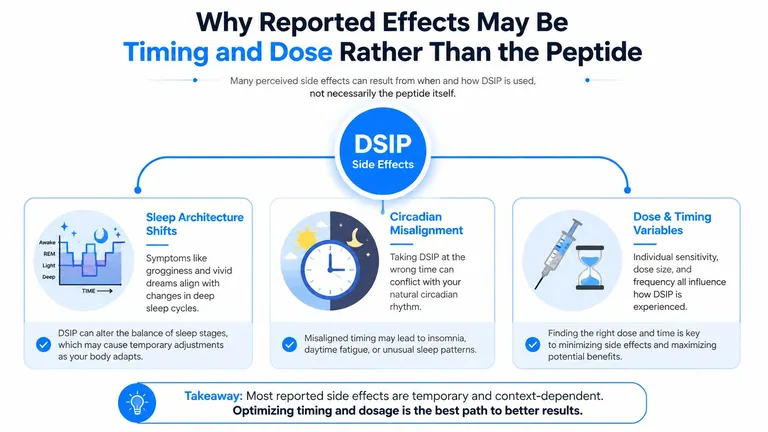
A lot of the disagreement around DSIP side effects comes from a basic attribution problem. If someone feels groggy, has vivid dreams, or wakes with a headache, is that DSIP itself, the time it was taken, the amount used, or the fact that sleep was altered in the first place? The literature does not fully answer that.
The attribution problem
Timing matters because a sleep-active peptide can leave a person feeling off if the dose is placed too late in the night or too close to waking. That can look like next-day heaviness, but it may be a predictable consequence of shifting sleep pressure rather than a toxic reaction. Dose matters for the same reason, a small change in exposure can change the subjective feel of sleep depth, alertness, or dream intensity.
Formulation also matters. Injection-site irritation can come from purity problems, storage issues, solvent choice, or technique, so not every local reaction tells you anything about DSIP’s intrinsic pharmacology. The route difference is important too, because the older controlled human data centered on IV use, while many modern reports come from other administration styles.
Stacking complicates things further. If someone combines DSIP with sedatives, alcohol, sleep aids, or nootropics, the result can be a blended effect where no single compound deserves the full blame. That’s why the most honest interpretation is usually probabilistic, not absolute.
The question isn’t only whether a symptom happened, it’s whether DSIP caused it directly or merely exposed a timing problem already present in the routine.
The coverage available today keeps circling the same unresolved issue, whether symptoms like grogginess, vivid dreams, or “heavy mornings” are intrinsic adverse effects, a dosing-time problem, or a sign that sleep pressure got pushed too far. The sources don’t provide strong dose-response data or recent controlled human evidence to settle that. They leave the question open.
Practical Safety Considerations Before You Start a Protocol
Before anyone treats a peptide routine as a simple sleep fix, the first step is to slow down and organize the safety questions. That’s especially true with DSIP because the evidence is old, the routes vary, and the known risks are mostly about uncertainty rather than dramatic toxicity.
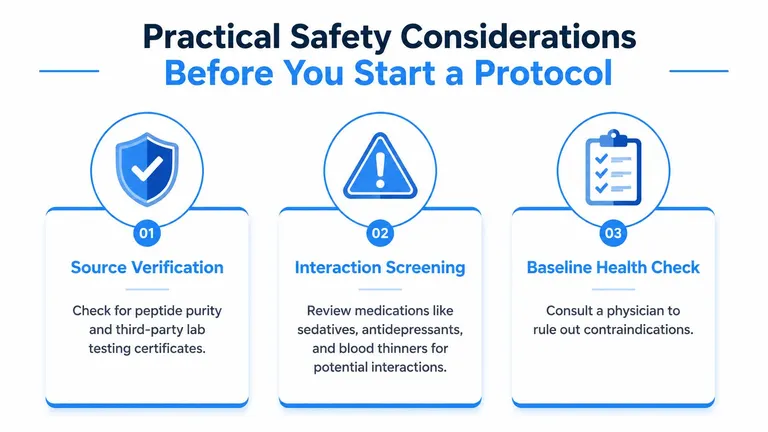
Three checks that matter most
- Source verification. Make sure the product has third-party testing and clear documentation. If purity, identity, or storage is unclear, any side effect becomes harder to interpret.
- Interaction screening. Sedatives, alcohol, antidepressants, and blood pressure medications can all change how a sleep-active peptide feels. That doesn’t mean a problem will happen, only that the combined effect can be harder to predict.
- Baseline health check. Autoimmune, hepatic, renal, psychiatric, and pregnancy-related safety data are sparse or absent in the materials here, so a clinician conversation is the sensible place to sort out whether a protocol is even worth discussing.
A structured baseline is useful too. Track sleep quality, mood, blood pressure, and heart rate before changing anything, because vague impressions are easy to misread and easy to forget. If you later notice drowsiness, a mood dip, or a headache, you’ll have a point of comparison instead of a guess.
For readers who want a broader overview of peptide therapy as a category, ProMD Health’s peptide therapy primer is a useful reference point. It helps situate DSIP inside a larger peptide conversation without pretending the evidence is stronger than it is.
Talking to a Professional and Tracking Your Routine
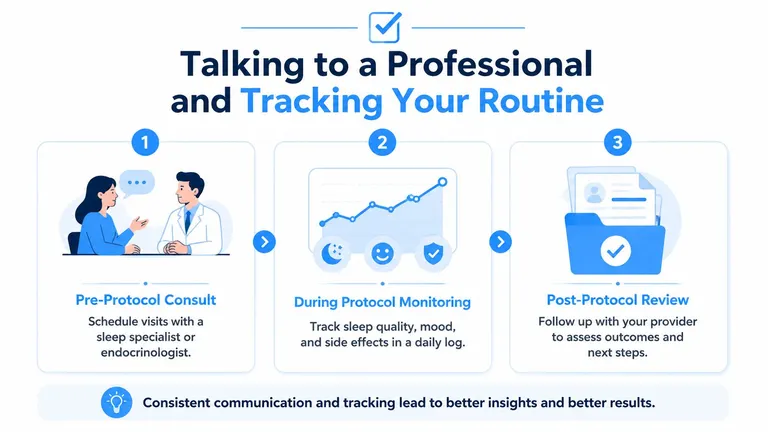
The most useful people to involve are the ones who can interpret uncertainty, not the ones who promise certainty. A prescribing clinician familiar with peptide therapies can help assess whether a DSIP discussion is even reasonable, a pharmacist can flag medication and supplement interactions, and a sleep or mental health specialist can help interpret daytime sedation, mood shifts, or disrupted sleep patterns if they appear.
A simple record turns guesswork into data. Keep a one-page log with the date, time of administration, dose, formulation, sleep window, mood, energy, and any notable symptoms, then review it once a week for patterns. If the same complaint appears only on late nights or only after a certain formulation, that’s a clue, not a conclusion.
A short question list also helps. Write down what you want to ask before each appointment so you’re not trying to remember details in the room, and keep the questions tied to what you observed. That’s especially useful when the issue is subtle, like feeling flat the next morning or noticing that sleep feels deeper but waking feels harder.
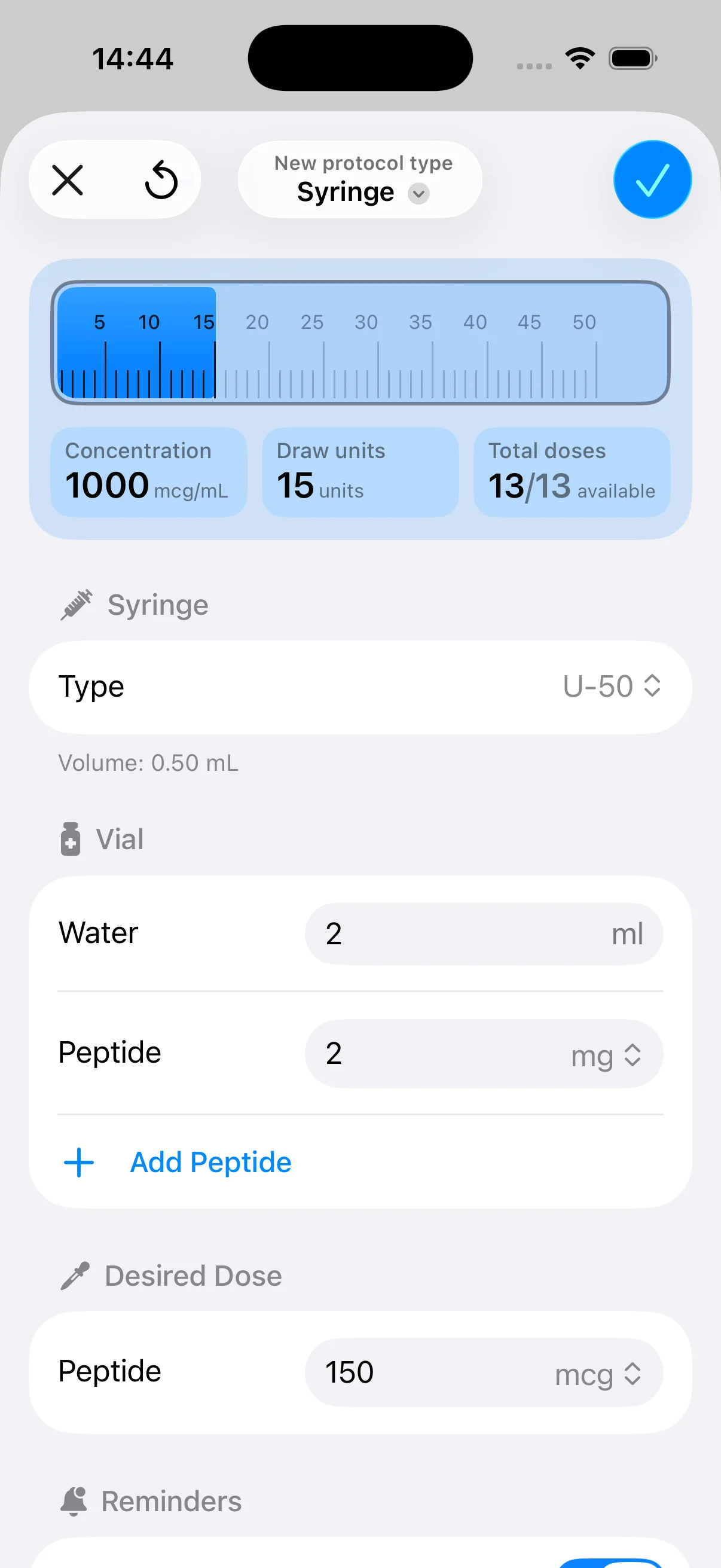
For people who want a practical way to log those details, PepFlow’s peptide tracker guide is one option to review alongside paper notes or other routine tools. PepFlow itself is a lightweight iOS app for tracking doses, schedules, reminders, and logs, so it fits the organizational side of this process without replacing clinical judgment.
Simple rule: if you can’t describe the pattern in writing, it’s hard for anyone else to interpret it safely.
The core takeaway is straightforward. Controlled human data suggest short-term tolerability, the commonly reported symptoms are usually mild and sleep-related, and the biggest unanswered question is whether many complaints come from timing, dose, route, or formulation rather than DSIP alone. A professional conversation plus a basic log gives you the best chance of seeing that difference clearly.
If you’re comparing peptide routines, PepFlow can help you organize dosing schedules, reminders, and logs in one place. Visit PepFlow to see how a structured tracker can support careful, evidence-aware planning around DSIP and other research peptides.