Many individuals ask the wrong question about cjc 1295 dac vs no dac.
They ask which one is stronger. The better question is this: which one can you run consistently, manage cleanly, and tolerate well enough to get the outcome you want?
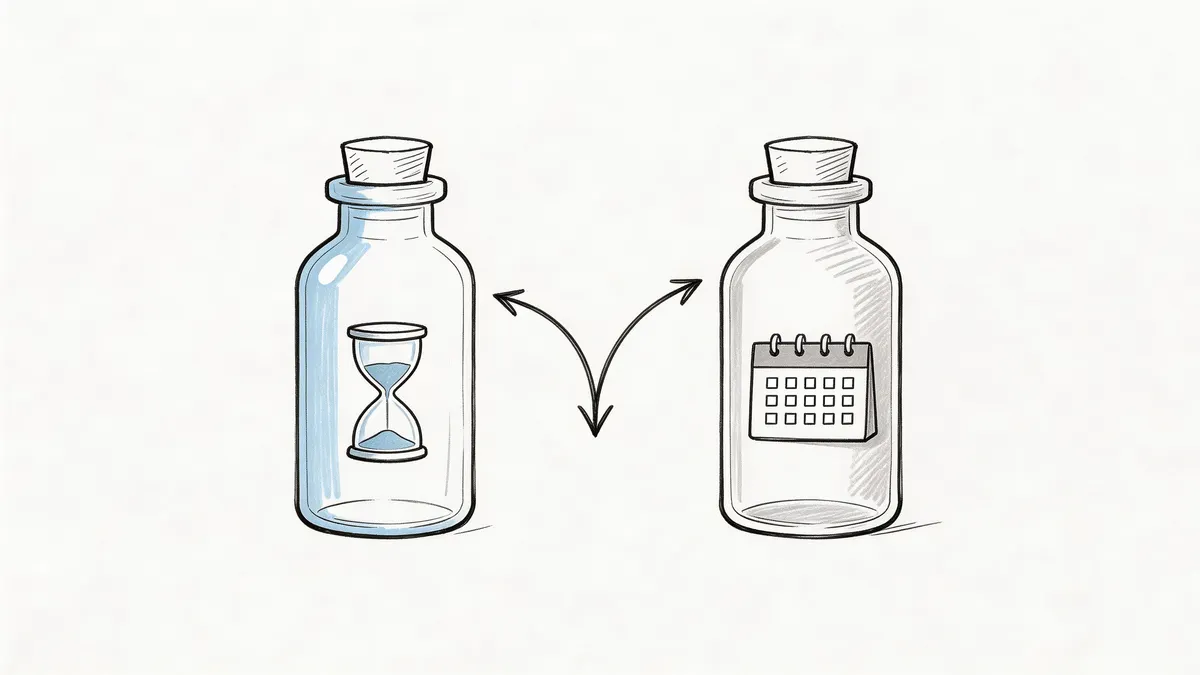
This is the core split. One version is built around convenience and long circulation. The other is built around a shorter, more physiological pulse pattern. On paper, that sounds simple. In practice, it changes everything: how often you inject, how tightly you need to time doses, how quickly you can adjust if something feels off, how you organize vials, and whether your protocol fits your life.
If you’re deciding between the two, don’t think like a shopper comparing labels. Think like someone who has to live with the protocol for weeks. The right choice is the one that matches your goal, your schedule, and your tolerance for complexity.
Table of Contents
- The Core Choice in Your CJC-1295 Protocol
- Understanding the Fundamental Chemical Difference
- Pharmacokinetics The Great Divide in Half-Life and Dosing
- Comparing Efficacy Profiles and Side Effect Risks
- Which Protocol Fits Your Goals and Lifestyle
- How to Set Up Your Protocol in PepFlow
- Final Recommendations and Safety Considerations
The Core Choice in Your CJC-1295 Protocol
The core choice isn’t really peptide versus peptide: it’s physiological mimicry versus scheduling ease.
CJC-1295 with DAC includes a Drug Affinity Complex that keeps the peptide in circulation far longer. That creates a lower-maintenance protocol. It also creates a more sustained hormone signal.
CJC-1295 without DAC, often called Mod GRF 1-29, behaves like the shorter-acting version. It demands more from the user. In return, it gives you tighter control and a pulse-based pattern that aligns more closely with how many experienced users prefer to manage GH-releasing protocols.
Here’s the practical lens I use when helping someone choose:
- Choose based on compliance first: A theoretically better protocol is useless if you won’t follow it.
- Choose based on reversibility second: If you’re cautious about side effects, shorter acting compounds are easier to adjust.
- Choose based on your actual routine: A shift worker, a frequent traveler, and a bodybuilder with a rigid schedule won’t all do well on the same setup.
Practical rule: If you hate frequent injections, forget dose timing, or want the simplest calendar possible, DAC usually fits better. If you care more about control, timing, and preserving a more natural pulse pattern, no DAC is usually the cleaner match.
The mistake is treating the two versions as interchangeable. They aren’t. The half-life difference changes not just dosing frequency, but the whole feel of the protocol: that includes your reminders, your injection windows, and how fast you can respond when the protocol needs adjusting.
Understanding the Fundamental Chemical Difference
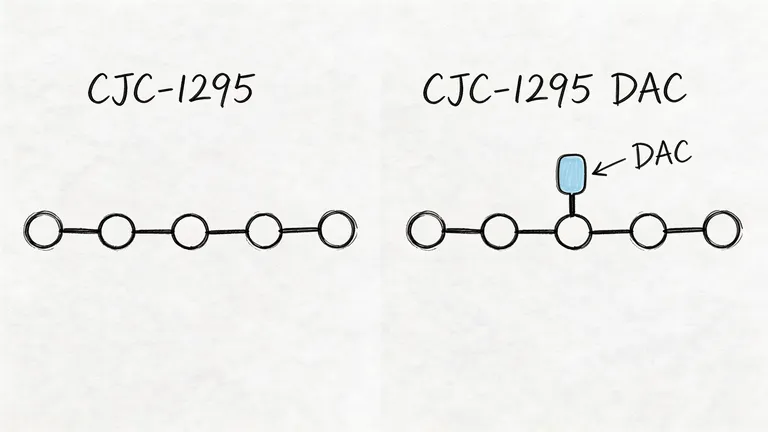
At the receptor level, both versions belong to the same family. They’re used to stimulate endogenous growth hormone release. The reason they behave so differently isn’t that one is a completely different compound: it’s the DAC modification.
What CJC-1295 is actually doing
CJC-1295 is a GHRH analogue. In plain English, it acts like a signal that tells the pituitary to release growth hormone.
That matters because you’re not introducing growth hormone directly. You’re influencing the body’s own release pattern through a signaling pathway. The practical difference shows up in how long that signal stays active.
With the short-acting form, the signal comes and goes relatively fast. With the DAC form, the signal stays around much longer.
What the DAC changes
The easiest way to think about DAC is as a chemical anchor. It attaches the peptide to albumin in the bloodstream, which creates a slower-release effect instead of a quick rise and fall. That albumin binding is the reason the long-acting version behaves like a very different protocol choice in practice.
Without DAC, the peptide acts more like a quick switch. You inject, you get a release pulse, and the effect tapers off. The verified comparison notes that CJC-1295 without DAC produces a pulsatile growth hormone release pattern that more closely mimics the body’s natural endogenous rhythm, which is a major reason many users view it as the more physiological option (Swolverine on CJC-1295 DAC vs no DAC).
That difference sounds technical, but it has a direct consequence: one version asks your body for repeated pulses, the other creates a much longer push.
A useful analogy is this:
- No DAC is like turning a light switch on briefly when you need it.
- With DAC is like installing a dim light that stays on for days.
Neither approach is automatically better. But they are not the same experience. One rewards precision and timing. The other rewards simplicity and consistency.
Pharmacokinetics The Great Divide in Half-Life and Dosing
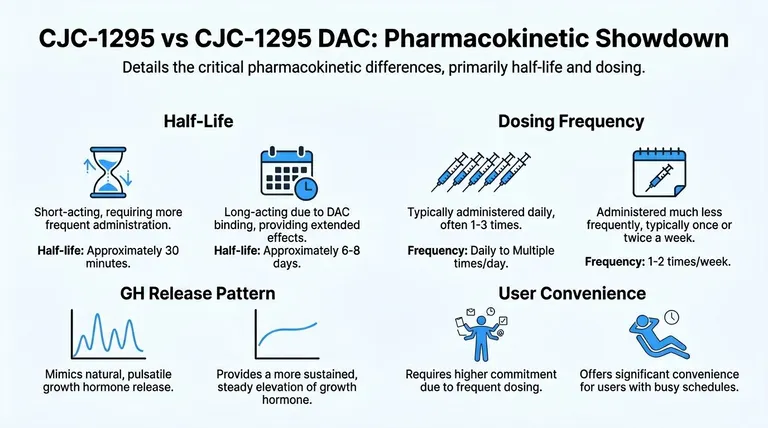
If you only remember one part of the cjc 1295 dac vs no dac debate, remember this section. Half-life decides the protocol.
The numbers that change the whole protocol
The verified data is stark. CJC-1295 with DAC extends the half-life to approximately 6 to 8 days compared to CJC-1295 without DAC, which has a half-life of 30 to 40 minutes. This creates a 200-fold increase in circulating time and shifts injection frequency from daily to weekly (Behemoth Labz comparison of CJC-1295 with and without DAC).
That’s not a subtle difference. It changes your setup from something you manage like a recurring appointment to something you manage like a timed routine.
A good quick-reference tool for translating peptide details into planning logic is this peptide cheat sheet, especially if you’re comparing protocol styles before committing.
What this means for a real calendar
When people read “short half-life” and “long half-life,” they usually think only about convenience. That’s part of it, but not the whole story.
With no DAC, your protocol lives inside the day. You need to care about time windows. If you prefer bedtime timing or want to align injections around training, that flexibility is useful. But the protocol becomes easier to miss, postpone, or mis-time. The shorter the acting window, the less forgiving the schedule.
With DAC, your protocol lives inside the week. That lowers the daily burden. It also means each injection matters more as an event, because the signal hangs around.
Here’s how I frame it for real-world adherence:
| Protocol factor | CJC-1295 without DAC | CJC-1295 with DAC |
|---|---|---|
| Scheduling style | Daily rhythm | Weekly rhythm |
| Reminder need | Tight and time-sensitive | Broad and recurring |
| Best for | Users who like precise timing | Users who want fewer touchpoints |
| Adjustment speed | Faster | Slower |
| Missed dose impact | More disruptive to the day | Less day-to-day friction, but harder to fine-tune |
A lot of users underestimate the management burden of no DAC. It’s not just “more injections.” It’s more decision points.
If your life is messy, the protocol gets messy first. The peptide doesn’t fix poor scheduling.
That’s why weekly compounds often outperform daily compounds for some users, even when the more physiological option looks better conceptually. On the other hand, people who already run structured training, meals, and sleep tend to handle no DAC far better because they already live by repeated routines.
The half-life isn’t just a chemical property. It’s a lifestyle filter.
Comparing Efficacy Profiles and Side Effect Risks
The practical question isn’t whether both versions can increase GH signaling. They can. The useful question is what kind of signal you want to create, and how much management you’re willing to accept to keep that signal working in your favor.
CJC-1295 With DAC vs. Without DAC at a Glance
| Attribute | CJC-1295 without DAC (Mod GRF 1-29) | CJC-1295 with DAC |
|---|---|---|
| Release pattern | Pulsatile | Sustained and continuous |
| Protocol feel | Higher-touch | Lower-touch |
| Receptor sensitivity approach | More favorable for preserving sensitivity | More concern around reduced responsiveness over time |
| Dose timing value | High | Lower |
| Ease of stopping or adjusting | Easier | Harder |
| Best fit | Users who prioritize control and physiology | Users who prioritize convenience and steady exposure |
Where the trade-off shows up in practice
The main benefit of no DAC is that the pulse pattern is generally viewed as more physiologic. The verified data states that CJC-1295 with DAC generates sustained, continuous GH elevation, which may progressively reduce receptor responsiveness. In contrast, no-DAC’s pulsatile approach preserves GH receptor sensitivity and intact negative feedback loops, making it more suitable for extended-cycle protocols without tolerance buildup (Livv Natural peptide comparison).
That matters for two reasons.
First, users who plan to run a longer protocol often care less about convenience and more about keeping the signal clean. They don’t want to feel like they need a stronger and stronger push to get the same response.
Second, side-effect management is different. A short-acting compound gives you a shorter runway. If something feels off, you usually have more room to adjust the protocol quickly. A long-acting compound can feel smoother from a scheduling standpoint, but less forgiving if the response isn’t what you wanted.
Practical upside of no DAC
No DAC tends to work best for people who value:
- More precise timing: You can place doses around sleep or training.
- Cleaner protocol feedback: It’s easier to tell how timing affects your response.
- Long-term flexibility: Pulse-based use often appeals to people who want more control and less constant exposure.
Practical upside of DAC
DAC tends to work best for people who value:
- Lower injection frequency: The protocol takes up less mental space.
- Simpler adherence: Fewer injections means fewer chances to miss one.
- Steady exposure: Some users prefer not having to think about timing windows every day.
A convenient protocol can be the right protocol if it’s the one you’ll execute well.
What doesn’t work well
Where people get into trouble is trying to force the wrong format onto the wrong lifestyle.
A user with poor routine often struggles with no DAC because the peptide demands regular execution. The user starts strong, misses timings, doubles back, then loses confidence in the protocol.
A cautious user may dislike DAC because it removes some day-to-day complexity but also removes some agility. If the protocol needs changing, you don’t get the same quick reset.
So in efficacy terms, the better version is usually not the one with the more appealing description. It’s the one whose signal pattern, scheduling burden, and adjustment profile match your real use case.
Which Protocol Fits Your Goals and Lifestyle
Many decisions become easy once you stop asking which peptide is “best” and start asking what kind of operator you are.
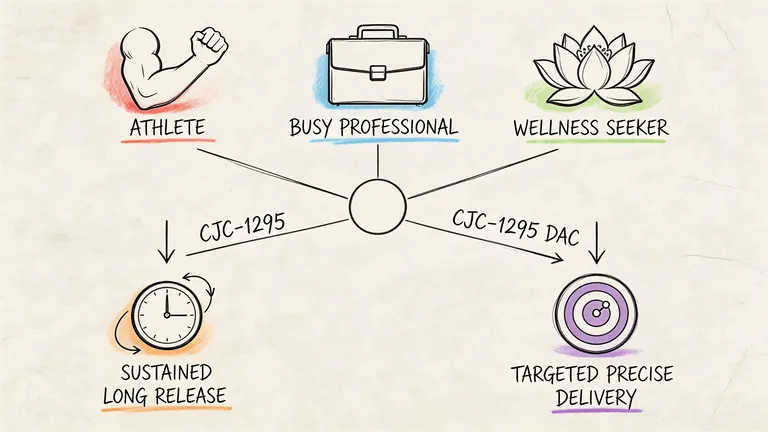
Who usually does better with no DAC
The routine-driven biohacker usually does well with no DAC. This person already tracks sleep, meals, and training. A pulse-based compound fits because they can handle timing and want more control over how the protocol feels.
The cautious experimenter also tends to prefer no DAC. If you like being able to make adjustments quickly, shorter-acting tools are easier to work with. You get more immediate feedback from your schedule choices.
The long-view user often leans this way too. If your priority is preserving a more natural rhythm and avoiding a constant background signal, no DAC is usually the cleaner fit.
Who usually does better with DAC
The convenience-first user is the obvious DAC candidate. If your weeks are busy and your best protocol is the one you barely have to think about, the long-acting format makes sense.
The injection-averse user often chooses DAC for a simple reason: fewer injections usually means less friction. That matters more than people admit.
The compliance struggler can also benefit. If you’ve got a history of missing repeated daily tasks, weekly scheduling may be the difference between running a protocol and abandoning it.
A simple decision filter
Use this if you want the short version:
- Pick no DAC if you want pulse-based use, tighter control, and a protocol that responds faster to adjustments.
- Pick DAC if you want fewer injections, broader scheduling flexibility, and less daily management.
- Don’t pick no DAC if you know you’re inconsistent with reminders.
- Don’t pick DAC if you’re highly sensitive to prolonged exposure and want easier reversibility.
At this juncture, honesty matters. A lot of people choose the more complex option because it sounds better. Then they fail at the basic work of repetition.
The best peptide choice is the one that fits your calendar before it ever touches your physiology.
If your goal is lifestyle-friendly wellness support and low scheduling friction, DAC often wins. If your goal is a more hands-on protocol with more day-level control, no DAC usually has the edge.
How to Set Up Your Protocol in PepFlow
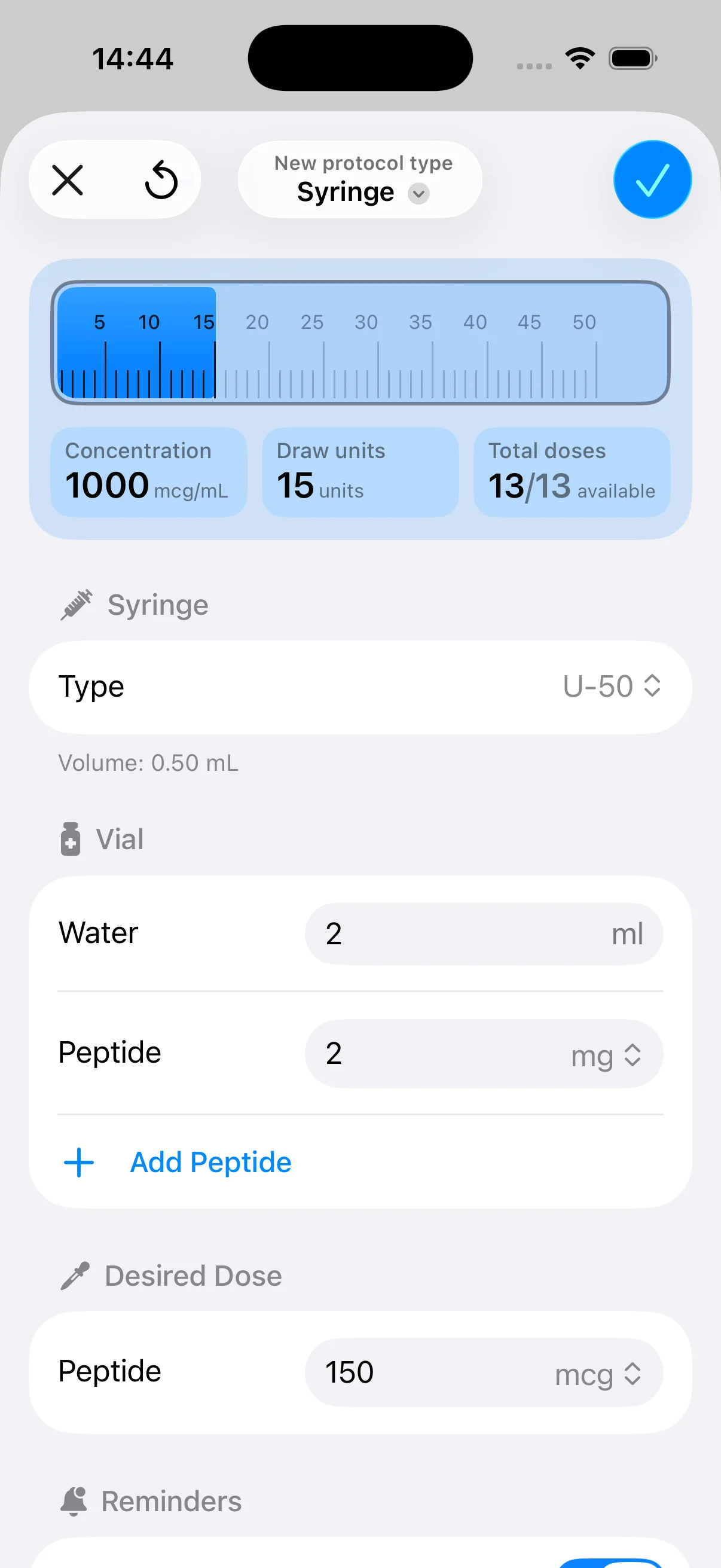
The cjc 1295 dac vs no dac choice stops being theoretical when setting up the protocol. Once you build the protocol, the scheduling difference becomes obvious fast.
The verified data notes that protocols for CJC-1295 without DAC typically require 14–60 injections monthly versus 4–8 for DAC variants, and that this difference makes no-DAC users better served by time-sensitive reminders while DAC users can work with broader weekly scheduling (Revolution Health on CJC-1295 with DAC vs without DAC).
That single difference should shape how you build your reminders, your vial tracking, and your logging habits.
Setting up a weekly DAC protocol
A DAC protocol is mostly about reducing friction.
-
Enter the vial details accurately. Start with the peptide amount on the vial and your reconstitution volume. The goal is simple: make sure the concentration in the app matches what’s in front of you.
-
Convert the intended dose into syringe units. Don’t do this in your head if you can avoid it. Use a dedicated peptide calculator so your microgram target translates into a practical injection volume correctly.
-
Set one recurring weekly reminder. For many individuals, that means attaching it to an existing anchor like Sunday evening or Monday morning.
-
Log immediately after injecting. This matters more with weekly compounds than people think. When doses are infrequent, memory gets fuzzy fast.
-
Track vial depletion at the same time. A weekly protocol is easy to follow until the vial runs lower than expected. Logging each use helps you avoid finding out too late.
Setting up a higher-frequency no-DAC protocol
No-DAC setup is less forgiving. It needs structure.
Start by deciding whether your injections are tied to fixed clock times or tied to events like bedtime and training. That choice matters because your reminder style needs to match your behavior.
Then build the protocol like this:
- Create recurring daily reminders: If you’re using once- or twice-daily timing, make each reminder distinct so you can tell them apart quickly.
- Use event-based labels: “Pre-bed” is better than a generic reminder if sleep timing is part of the plan.
- Tighten the logging habit: With more frequent doses, a missed log becomes a fast source of confusion.
- Watch vial turnover closely: More injections means supplies move faster and refill timing matters more.
What users usually get wrong
Many protocol failures aren’t chemical. They’re administrative.
People forget to update concentration after reconstitution. They leave reminders too vague. They assume they’ll remember whether they already dosed. They underestimate how often a high-frequency protocol interrupts the day.
For DAC, the common failure is the opposite. People assume the low frequency makes tracking unnecessary. Then they drift a day late, skip a log, or lose clarity on cycle timing.
The app solves organization, not judgment. You still need a clean plan. But once the plan is set, the difference between these two compounds becomes easy to manage: DAC needs a dependable weekly rhythm, while no DAC needs stronger daily discipline.
Final Recommendations and Safety Considerations
If you want the shortest answer, here it is.
Choose CJC-1295 with DAC if your top priority is convenience and you want a protocol with fewer injection events. Choose CJC-1295 without DAC if your top priority is control, pulse-based scheduling, and a setup that’s easier to adjust.
This is the core cjc 1295 dac vs no dac decision. Not stronger versus weaker. Simpler versus more precise.
A few handling points matter regardless of which route you take:
- Reconstitute carefully: Use a consistent process and label the vial clearly.
- Store peptides correctly: Follow supplier guidance for storage after reconstitution.
- Track dates: Write down when the vial was mixed and when you started using it.
- Don’t guess on dilution math: Many protocol errors come from sloppy setup, not exotic biology.
If you need a plain-language primer on reconstitution basics, this guide on what bacteriostatic water is used for is worth reviewing before you mix anything.
You should also treat both versions with respect. Long-acting compounds can be harder to adjust once they’re in play. Short-acting compounds can become chaotic if your routine is weak. Neither one rewards sloppy handling.
Use reputable sourcing standards. Keep your records clean. If you’re making health decisions that affect hormones, involve a qualified medical professional instead of relying on forum folklore.
The right protocol should feel sustainable. If it doesn’t fit your life, it won’t hold long enough to matter.
If you want help removing the math and calendar friction from peptide protocols, PepFlow gives you a clean way to calculate doses, organize vials, build recurring schedules, and stay on track with reminders and logs. It’s a useful companion if you want your protocol to be precise, repeatable, and easier to follow day after day.