
Most advice on collagen gets one thing wrong. It treats collagen like a beauty supplement with a little fitness marketing layered on top.
That’s backwards for a lot of men.
If you train hard, sit too much, carry old injuries, or want to keep lifting as you get older, collagen peptides for men make more sense as a structural support tool than a muscle-building staple. They’re not whey. They’re not creatine. They won’t act like a shortcut to size. But they may help the tissues that let you train consistently in the first place: tendons, ligaments, cartilage, skin, and other connective structures.
That distinction matters because men often buy collagen for the wrong reason, then call it useless when it doesn’t perform like a complete protein. Used correctly, collagen fits a narrower but more practical job. It may support joint comfort, connective-tissue recovery, and some training outcomes when paired with resistance work. Used carelessly, it becomes another overpriced powder with vague promises.
Table of Contents
- Why Men Are Looking Beyond the Hype
- What Are Collagen Peptides Exactly
- Evidence-Based Benefits of Collagen for Men
- How to Choose a Quality Collagen Product
- Effective Dosing Timing and Stacking Strategies
- Understanding Safety and Potential Side Effects
- Putting It All Together A Practical Plan
Why Men Are Looking Beyond the Hype
A lot of men come to collagen expecting a muscle supplement. That is usually the wrong starting point.
The more useful way to look at it is as a support tool for the tissues that take a beating from training and age. Tendons, ligaments, cartilage, and skin all rely on collagen-rich structures. If a guy is lifting hard, running regularly, playing golf or basketball on weekends, or just feeling more wear in his knees, shoulders, or elbows than he did ten years ago, that use case makes sense.
That shift in perspective is why collagen has moved beyond the old “beauty supplement” label. Men are not looking for another powder that claims to do everything. They are looking for something that may help them stay consistent in training by supporting connective tissue and joint comfort while they keep the basics in place, including enough total protein, sensible programming, sleep, and load management.
Here is the practical split I give clients.
Practical rule: Use whey or another complete protein to support muscle protein synthesis. Use collagen for structural support and recovery when joints, tendons, or overall tissue resilience are the limiting factor.
That distinction helps clear up a lot of bad buying decisions. Men often buy collagen hoping it will outperform complete proteins for size and strength. It will not. Its value is narrower, but still useful. For the right person, narrower is better because it sets a realistic expectation and makes adherence easier.
You can see the old framing in content built for appearance-first goals, including this guide on Vital Proteins collagen peptides for women. Men usually get more value by asking a different question. Will this support the parts of the body that let me keep training well? If skin is part of the interest, the broader cosmetic angle in this overview of peptides for skin benefits shows why collagen got boxed into that category in the first place.
The hype fades fast once you frame collagen correctly. Then it becomes a simple tool with a specific job.
What Are Collagen Peptides Exactly
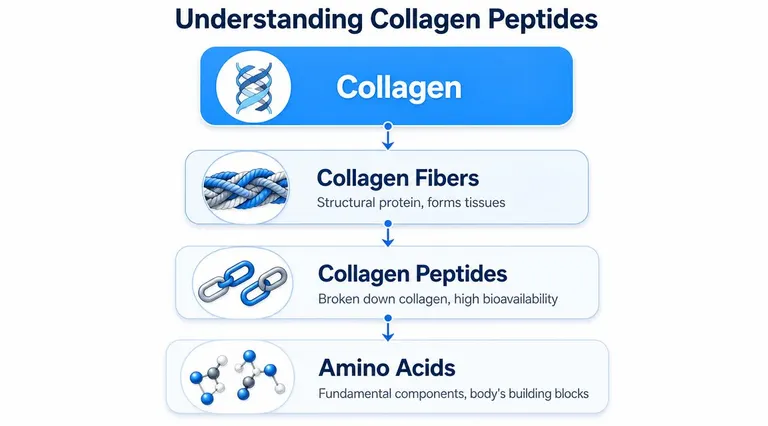
Collagen is a structural protein. It gives tissues shape, tensile strength, and resilience. Tendons, ligaments, cartilage, skin, and bone all depend on it.
Collagen peptides are collagen that has been broken down into smaller pieces through hydrolysis. That matters because smaller pieces are easier to mix, digest, and use in a supplement routine. When a label says hydrolyzed collagen, that’s usually what it means.
Think of Collagen as Structural Rebar
A simple way to understand it is to think of collagen as the rebar inside concrete. Muscle helps produce force. Collagen-rich tissues help transfer and tolerate that force.
Peptides are the pre-cut pieces. They’re not the whole beam. They’re the smaller units that are easier to work with in a powder or drink. That doesn’t make them magical. It just makes them practical.
If you want a broader primer on terminology, this overview of what collagen peptides are is useful. And if you’re also trying to sort out the broader cosmetic language around peptides, Solawave has a helpful explainer on peptides for skin benefits, which helps separate topical peptide talk from oral collagen discussions.
Collagen vs Gelatin vs Peptides
These terms get mixed up, but they aren’t identical.
- Collagen is the intact structural protein found in connective tissues.
- Gelatin is partially broken-down collagen. It gels in liquids and is common in cooking.
- Collagen peptides are broken down further, so they dissolve more easily and fit daily supplementation better.
For most men, peptides are the easiest format. They go into coffee, shakes, yogurt, or water without much friction. That’s one reason they’ve become the standard form in supplements.
Quick Guide to Common Collagen Types
| Collagen Type | Primary Role | Where It’s Found |
|---|---|---|
| Type I | Structural support for skin, bone, tendons, ligaments | Skin, bones, tendons, ligaments |
| Type II | Cartilage support | Cartilage |
| Type III | Structural support for muscles, organs, vessels | Muscles, organs, blood vessels |
In practice, most men don’t need to obsess over type numbers at the start. A better first filter is whether the product is hydrolyzed, clearly labeled, and matched to your actual goal. Joint-focused buyers may care more about cartilage support. Men focused on general tissue support often end up using broader collagen peptide products regularly and judging them by consistency, tolerance, and recovery outcomes.
Evidence-Based Benefits of Collagen for Men
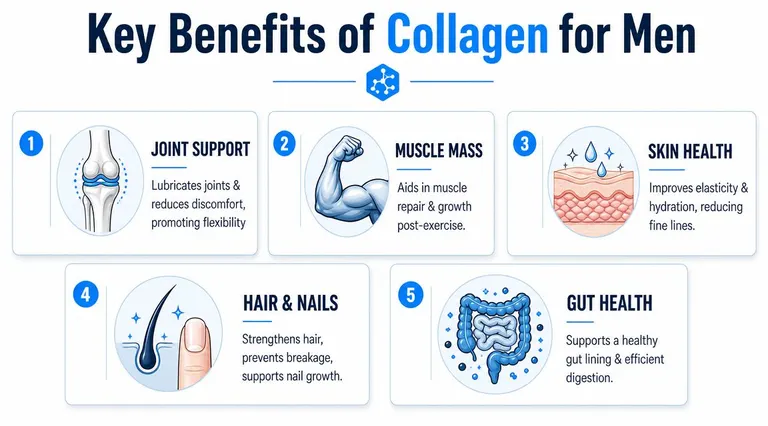
Collagen earns its place by helping men stay durable enough to keep training. That is a narrower job than supplement marketing suggests, but it is also the use case with the clearest practical value.
It supports connective tissue, cartilage, skin, and other structural tissue. It does not replace a complete protein for muscle growth, and it should not be judged by whey standards.
Joint Comfort and Tissue Support
For active men, joint comfort is usually the strongest reason to use collagen peptides.
A 2021 systematic review and meta-analysis of 20 studies found evidence that collagen peptide supplementation improved joint pain and physical function, with benefits showing up most often in the 5 to 15 g/day range. In coaching terms, that matters because irritated knees, elbows, shoulders, and Achilles tendons can reduce training quality long before they stop training completely.
There is also a broader musculoskeletal case. A recent review of bone and muscle outcomes reported small to moderate improvements across some bone and muscle measures. That does not make collagen a fix for every ache. It does support using it as part of a joint and tissue maintenance plan, especially for men lifting hard, running regularly, carrying extra bodyweight, or training through accumulated wear.
The men who tend to notice the most are not looking for a cosmetic upgrade. They are trying to train consistently with less irritation.
Recovery and Training Support
Collagen can support recovery, but the mechanism matters.
Its amino acid profile is rich in glycine, proline, and hydroxyproline, which are tied more closely to connective tissue turnover than to maximizing muscle protein synthesis. That is why I frame collagen as a recovery and structure supplement, not a primary muscle-building protein.
Some research supports that narrower role. In a randomized trial discussed in this video summary of the trial, older men doing resistance training saw better gains with added collagen than with training alone. The useful takeaway is context. Collagen may help training adaptation in certain groups, but it is still a poor substitute for higher-leucine proteins if the main goal is hypertrophy.
Here’s the embedded discussion for context:
A more restrained review from Cleveland Clinic’s overview of collagen peptides is closer to how I explain it to clients. Collagen may have some value for strength and age-related muscle loss in specific settings, but the evidence is not strong enough to treat it as a core muscle supplement. Men who already use whey or another complete protein for muscle repair can use collagen alongside it for a different reason. They are covering connective tissue support, not duplicating the same job.
If you want a broader lifestyle view, Karin Herzog’s piece on science-backed collagen strategies is a useful reminder that sleep, diet quality, and training load still shape recovery more than any powder does.
Skin and Appearance
Skin benefits are plausible, but this is usually a secondary reason for men to buy collagen.
Healthline’s collagen review summarizes research showing hydrolyzed collagen may improve skin hydration, elasticity, and wrinkle appearance compared with placebo. The limitation is that much of that research is based on female participants, so the direct male-specific evidence is thinner than the joint data.
That does not mean men get no skin benefit. It means expectations should stay realistic. If a man is sleeping poorly, getting heavy sun exposure, eating a weak diet, and expecting collagen to clean that up, he is asking the supplement to do work that belongs to basic recovery habits.
How to Choose a Quality Collagen Product
Once you accept that collagen has a narrow job, product quality becomes the primary issue. A weak product won’t suddenly become effective because the tub says “grass-fed,” “premium,” or “multi-collagen.”
That matters because the evidence is still product-specific. Independent reviews note collagen peptides are generally considered safe in studied doses, but efficacy is mixed and depends on what you’re buying. WebMD states there isn’t enough reliable information for many claims, and that doses up to 10 g/day have been used safely for up to 6 months, according to WebMD’s collagen peptides monograph.
What to Look for on the Label
Start with the basics.
- Hydrolyzed collagen listed clearly: If the product doesn’t clearly say hydrolyzed collagen or collagen peptides, skip it.
- A disclosed source: Bovine, marine, and chicken sources each have different practical use cases and allergy considerations.
- Straightforward serving information: You want to know how much collagen you’re getting per scoop, not a vague “proprietary matrix.”
- Third-party testing: Serious athletes should favor products with independent verification. It’s one of the few ways to reduce uncertainty around label accuracy and contamination risk.
- Minimal extras: A plain collagen product is often easier to assess than one padded with trendy add-ons.
For most men, boring is better. A plain powder with a clear dose and clean label usually beats a heavily branded blend.
What Usually Signals a Weak Product
The red flags are predictable.
A company leans hard on dramatic claims but doesn’t tell you the source. The serving size is fuzzy. The label uses buzzwords but avoids specifics. Or the product combines collagen with a dozen ingredients that make it impossible to tell what’s doing what.
A good collagen supplement should be easy to explain in one sentence: source, form, serving, and testing.
I’d also be cautious with any product trying to position collagen as your only protein supplement. That’s not what it’s for. Men who lift still need complete protein sources to cover the basics. Collagen should sit beside those, not replace them.
Effective Dosing Timing and Stacking Strategies
More collagen is not better. Better use is better.
For active men, collagen works best as a boring, repeatable input for connective tissue support and recovery. It is not the supplement that drives muscle gain on its own, and treating it like a second whey protein usually leads to disappointment. The practical goal is simpler: use enough, use it consistently, and pair it with training and nutrition that already make sense.
What Dose Makes Practical Sense
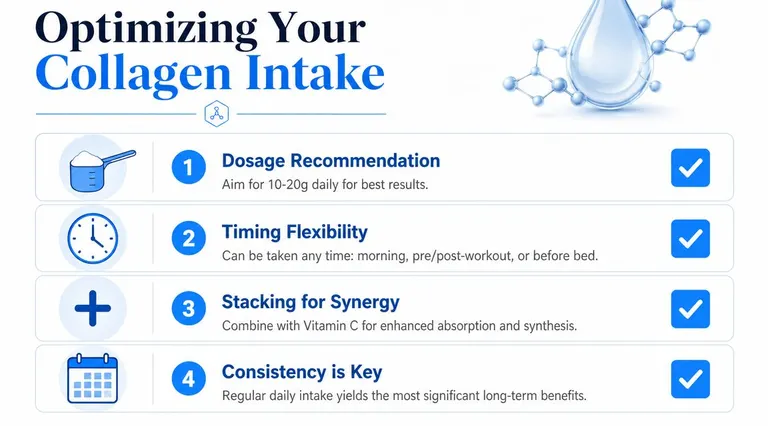
A moderate daily serving is the most practical starting point for most men. In coaching terms, that usually means choosing one label-consistent serving and keeping it steady long enough to notice whether joint comfort, tissue tolerance, or post-training stiffness changes.
A smaller serving can make sense for general daily use. Men training hard, dealing with high running volume, or trying to support tendons and joints often prefer a fuller serving within the common supplemental range. The trade-off is simple. Higher doses cost more and are harder to stick with if the routine is annoying.
Consistency matters more than micromanaging the exact gram amount.
If you keep switching brands, changing scoop sizes, and taking it only on heavy training days, you make it harder to judge whether collagen is helping at all.
When to Take It
Timing matters less than adherence, but routine still matters.
For lifters and field athletes, taking collagen around training is often the easiest option because it attaches to a habit that already exists. For men using it mainly for joint support, first meal, evening, or any other repeatable time can work just as well. The best schedule is the one you can run for weeks without thinking about it.
I usually tell clients to tie it to one anchor point they rarely miss. Coffee. Breakfast. Pre-lift shake. Post-workout meal. That works better than chasing an ideal timing window and forgetting half your servings.
What to Stack It With
Vitamin C is a sensible pairing because collagen formation depends on it. In practice, this does not need to become a complicated stack. Fruit, a meal that contains vitamin C, or a basic supplement routine is usually enough for most men.
Collagen also fits best alongside a broader recovery plan. Adequate total protein, progressive training, sleep, and sane loading matter more. Men comparing collagen with other recovery-focused compounds can get more context in this guide to different peptides used by men.
What Not to Expect
Set the expectation correctly and collagen becomes easier to use well.
- Do not use it as your main muscle-building protein. Collagen is not a complete protein source in the same way whey, eggs, meat, or a well-formulated protein blend can be.
- Do not expect a creatine-like effect. It will not drive obvious changes in strength, power, or training performance.
- Do not expect it to fix bad programming. If your weekly load is excessive or your recovery habits are poor, collagen will not cover that mistake.
Used properly, collagen is a support tool. For men who lift, run, grapple, or accumulate a lot of repetitive stress, that is where it can earn its place.
Understanding Safety and Potential Side Effects
Collagen peptides are generally well tolerated in studied use, but “generally safe” doesn’t mean “worth buying blindly.” It also doesn’t mean every product is equally trustworthy.
For men using multiple supplements, the simplest safety filter is to keep the formula plain, check the source, and pay attention to how your body responds over the first stretch of use.
Who Usually Tolerates It Well
Most healthy men tolerate collagen without much trouble, especially when they start with a moderate serving and use a simple product.
The most common complaints in real-world use are practical rather than dramatic. Some men notice fullness, mild bloating, taste fatigue, or that a powder doesn’t sit well in certain drinks. Those issues are often solved by changing the serving split, the mixing method, or the product itself.
Men who are already exploring broader recovery tools may also be comparing collagen with other compounds. If that’s you, this overview of peptides for men helps place collagen in the broader context without confusing it with injectable or research-focused peptide categories.
When to Pause and Ask a Professional
Caution makes sense in a few cases.
- Known source allergies: Fish, bovine, chicken, or egg sensitivities should match the product source on the label.
- Medical conditions requiring protein guidance: Men with existing kidney concerns or more complex medical issues should ask a clinician before adding regular supplementation.
- Persistent digestive issues: If a product repeatedly causes discomfort, stop using it instead of trying to push through.
Collagen should feel like a low-friction addition. If it becomes a daily hassle, that usually means the product choice or the protocol needs adjustment.
Putting It All Together A Practical Plan
Collagen works best for men who use it for the right job. The practical win is support for joints, tendons, ligaments, and recovery from training wear. It is not a replacement for whey, total protein intake, or progressive training.
The useful daily range, as noted earlier, is 5 to 15 grams. Lower end makes sense for general connective tissue support. The higher end fits men training hard, dealing with more joint irritation, or pairing collagen with rehab-style loading.

A plan that works in real life usually looks like this:
- Choose one hydrolyzed collagen product and stick with it.
- Take the same daily dose consistently instead of changing products and serving sizes every week.
- Tie it to a habit you already have, such as morning coffee, a post-workout shake, or lunch.
- Track outcomes you can feel in training, such as morning joint stiffness, how your knees or elbows handle volume, and whether you recover better from repeated sessions.
- Assess it after a fair trial, not after a few random servings.
Consistency matters more than perfection. In practice, men usually get the clearest read on collagen when they keep the dose stable, keep training stable, and judge it by connective tissue comfort and recovery quality rather than scale weight or pump.
I tell clients to treat collagen like a support tool. If cranky connective tissue is limiting squat depth, pressing volume, running mileage, or day-to-day comfort, collagen can earn its place. If the goal is maximizing muscle protein synthesis, a complete protein does that job better.
If you follow structured supplement or peptide routines and want less guesswork, PepFlow gives you a cleaner way to plan dosing, schedule protocols, and stay consistent day to day. It’s especially useful if you like tracking routines instead of relying on memory.