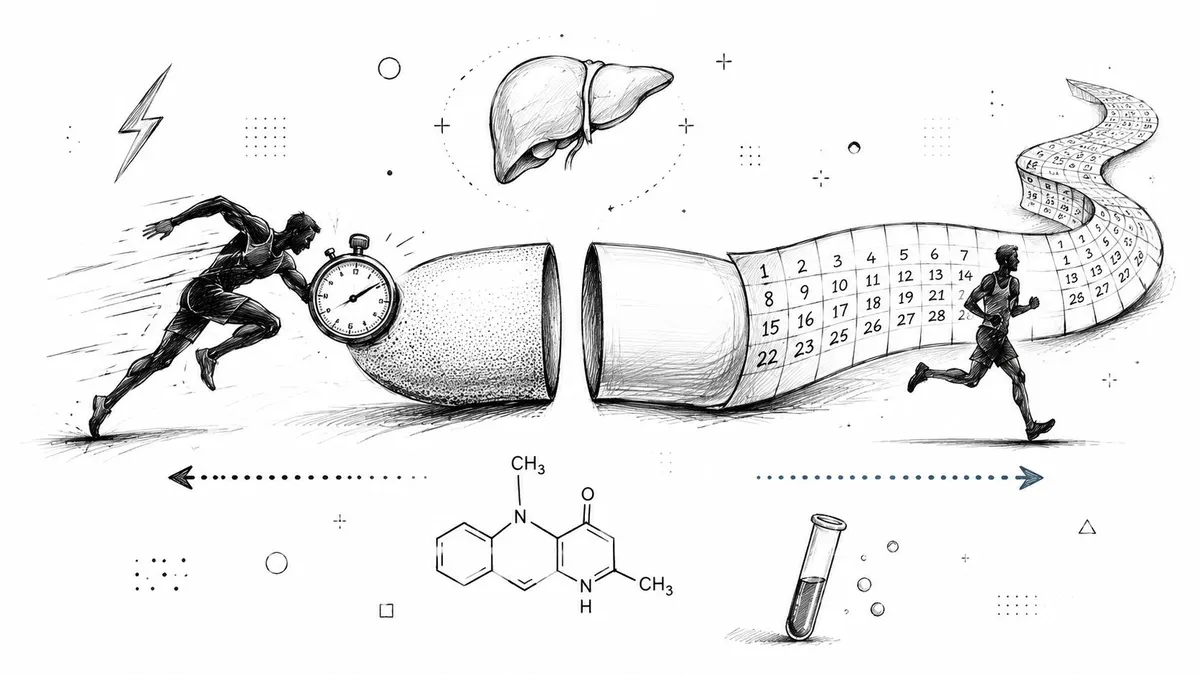
You finish your last Clomid tablet, look at the calendar, and wonder what that date means. Are you basically done with the drug in a few days, or is it still shaping hormone signals weeks later when you get labs, notice side effects, or try to judge whether your body has settled?
A lot of articles give a clean answer: Clomid has a half-life of about 5 to 7 days. That’s not wrong, but it’s incomplete. The part that usually gets skipped is the part that makes Clomid confusing in real life: it isn’t one simple thing acting in one simple way. It’s a mixture of two isomers, and they don’t leave the body on the same schedule.
That difference matters more than many realize. One part clears relatively quickly. The other can linger far longer, which helps explain why some people feel like the drug is “still around” long after the last dose. If you’re trying to make sense of timing, lingering effects, or the practical meaning of Clomid half life, the isomer story is the part worth understanding.
Table of Contents
- The Lingering Question After Your Last Dose
- Understanding Clomid Half Life Basics
- The Two Faces of Clomid Isomers Explained
- Factors That Can Alter Clomid Elimination
- Practical Implications for Dosing and Planning
- How to Precisely Track Your Protocol Schedule
The Lingering Question After Your Last Dose
The most common real-world question isn’t “what is a half-life?” It’s simpler: when is Clomid out of my system?
That question usually comes up in a specific moment. You’ve ended a course, and now you’re deciding when labs might make sense, whether a symptom could still be related, or whether the medication should still be affecting how you feel. Online, the answer often gets flattened into a neat phrase: about five days, maybe a week.
The trouble is that this shortcut can mislead you. A clinical summary highlighted in a practical review notes that many discussions of Clomid half life treat the drug like one single entity, even though the two isomers behave very differently. In that same summary, enclomiphene is described as having a half-life of about 10 hours, while zuclomiphene is described as persisting for 30 to 50 days in a way that can contribute to prolonged estrogenic effects (DrOracle discussion of Clomid isomers).
That’s why two people can both say, “I stopped Clomid,” and mean very different things biologically. One part of the drug may have faded quickly. Another part may still be present and relevant.
Practical rule: If you only remember the average Clomid half life and ignore the isomers, the timeline will seem cleaner than it really is.
A good way to think about it is as a two-person team tied together in a three-legged race. One runner wants to sprint off the track. The other keeps moving long after the crowd has gone home. When people say Clomid “lasts longer,” they’re usually feeling the effect of that mismatch.
Understanding Clomid Half Life Basics
A lot of confusion starts with one simple mistake. People hear a half-life number and treat it like an expiration date.
What half-life means
Half-life is the time it takes for the amount of a drug in the body to fall by 50 percent. That is a rate of decline, not a finish line. If you start with a full bucket, one half-life leaves half the bucket. Another half-life leaves half of that half, and the level keeps shrinking in steps.
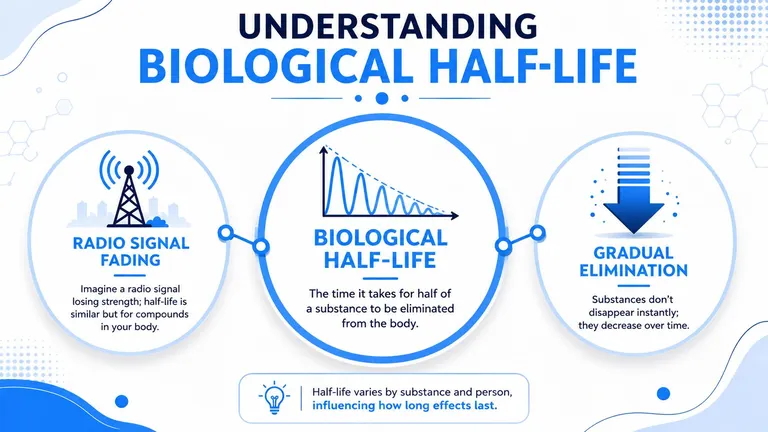
A dimmer switch works better than an on-off switch as a mental model. Drug levels usually fade. They do not drop from “active” to “gone” in one moment.
That matters with Clomid because the widely repeated summary number can sound tidy even when the complete picture is not. A general reference on clomifene lists an elimination half-life of about 5.3 days, which is why many articles reduce the discussion to “about a week” (clomifene pharmacokinetics reference). Useful as a starting point, yes. Complete, no.
Why one number can mislead
A half-life tells you how fast the amount falls. It does not tell you the exact day all biological relevance ends. In practice, small amounts can remain after several rounds of halving, and with Clomid, the situation gets even messier because the medication is not just one uniform compound.
That is the part many quick explanations skip.
Clomid is a mixture, and mixtures behave more like two travelers sharing one suitcase than one person moving through an airport. One traveler reaches the gate quickly. The other gets delayed, circles back, and shows up long after you expected the trip to be over. If you average their arrival times, you get a number, but you lose the detail that explains why effects may not line up neatly with the calendar.
This is also why “drug half-life” and “how long people still notice changes” are related but not identical ideas. Symptoms, lab timing, and perceived after-effects can all feel out of sync with a single average figure. If you are trying to place symptoms in context, this overview of common signs of hormone imbalance can help frame the kinds of changes people often notice during hormonal shifts.
The same broad principle appears in other compounds with uneven clearance patterns, including discussions of how long peptides last in the body. The headline number gives a rough outline. The underlying components often explain the actual timeline better.
Half-life is the speed of the fade, not the exact moment the signal reaches zero.
The Two Faces of Clomid Isomers Explained
Clomid makes more sense when you stop thinking of it as one uniform chemical and start thinking of it as a blend.
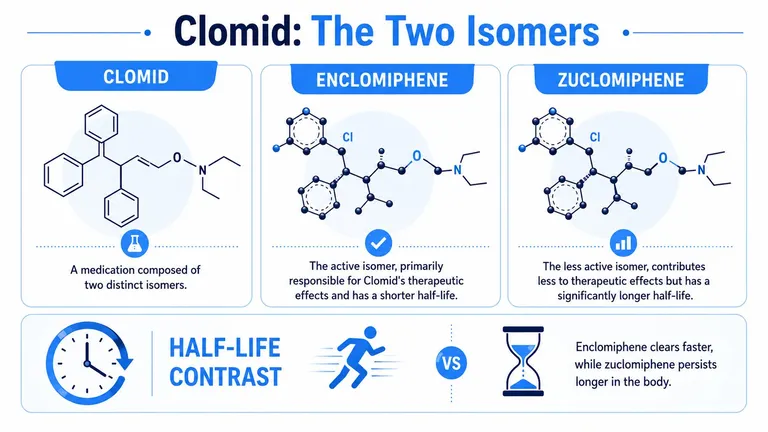
Clomid is a mixture, not a single uniform compound
Clomiphene contains two isomers: enclomiphene and zuclomiphene. They’re related, but they don’t behave identically in the body. This is the pharmacokinetic detail that often gets lost when people discuss Clomid half life as if there were just one clean number.
A useful analogy is two athletes sharing one jersey. Enclomiphene is the sprinter. It moves fast, acts fast, and clears relatively fast. Zuclomiphene is the endurance runner. It stays on the course much longer. If you average their performance together, you get a number, but that number hides what counts.
The FDA label states that zuclomiphene, the cis isomer, has a longer half-life than enclomiphene, the trans isomer, and that detectable zuclomiphene persisted for longer than a month in normal volunteers. The label also notes that this prolonged persistence is consistent with stereo-specific enterohepatic recycling or sequestering (FDA Clomid prescribing label).
That last phrase sounds technical, but the idea is straightforward. The body doesn’t always process and discard every molecule in a one-way trip. Some compounds get re-circulated through the gut and liver or stored in ways that make them hang around longer than expected.
A short explainer can help if you want a visual overview:
Why the longer-lasting isomer matters
The long-lasting isomer is the reason the simple “five to seven days” answer often feels unsatisfying in practice. It may describe the parent drug in a broad sense, but it doesn’t capture the uneven fade-out of the two components.
Here’s the practical difference that readers usually care about:
| Component | General behavior |
|---|---|
| Enclomiphene | Clears relatively quickly compared with the other isomer |
| Zuclomiphene | Persists much longer and can remain detectable well beyond the short dosing window |
That uneven behavior can help explain why someone might stop taking Clomid and still feel like the medication hasn’t fully “let go.” The short-acting part may no longer be doing much. The longer-lasting part may still be present.
Averages hide asymmetry. Clomid’s average half-life matters less than the fact that one isomer lingers far beyond the other.
This also explains why some discussions about response and side effects can sound inconsistent. One person is thinking about the short-lived component. Another is reacting to the residue of the longer-lived one. Both can be describing the same drug accurately from different time points.
Factors That Can Alter Clomid Elimination
The published pharmacokinetic data gives a framework, not a personal stopwatch. Real bodies don’t all process medications at exactly the same pace.
The liver and gut both shape the timeline
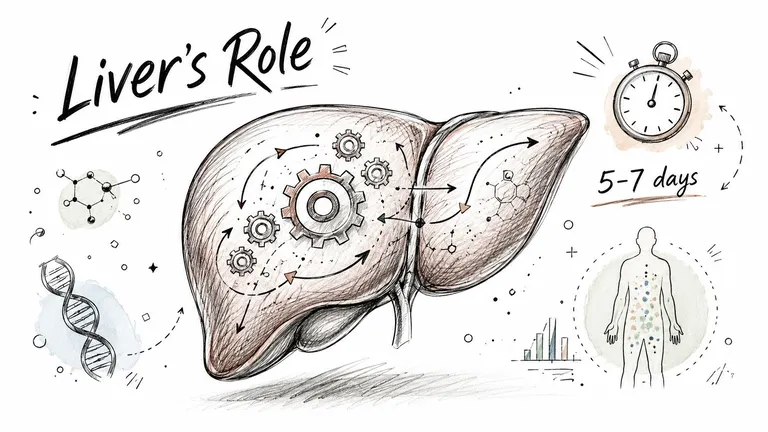
Clomid is processed through systems that involve the liver, the gut, and eventual excretion. That means the timeline isn’t only about the chemical itself. It’s also about the biological machinery handling it.
The FDA-approved label gives a useful snapshot from radiolabeled studies. After dosing, mean urinary excretion was about 8% and fecal excretion about 42%, with total urinary and fecal excretion averaging about 50% of an oral dose after 5 days. The same label notes that some label was still present in feces 6 weeks after administration (FDA pharmacokinetic data for Clomid).
That pattern tells you two things at once. First, elimination is not mainly a quick urinary washout. Second, the body is still dealing with remnants well after the first several days.
Why personal timelines vary
People often want one exact answer, but medicine rarely works that way. The broad timeline can shift based on individual biology and context, including:
- Liver function: The liver helps transform many compounds before the body can eliminate them.
- Other medications or supplements: Concurrent substances may change how a person processes a drug.
- Age and overall physiology: General metabolic differences can shape how quickly levels fall.
- Protocol pattern: Repeated dosing can create a different carryover picture than a single isolated dose.
That doesn’t mean the published numbers are unhelpful. It means they’re anchors, not guarantees.
If you’ve seen the term enterohepatic recycling and want a broader non-technical way to think about recirculation concepts, discussions of long-acting compounds like what DAC means in peptides can make the idea easier to picture. Different molecules use different mechanisms, but the larger lesson is the same: some substances don’t exit the body in a simple straight line.
Your calendar can mark the last dose. It can’t tell you the exact day your body finishes processing every remaining trace.
Practical Implications for Dosing and Planning
You finish your last pill, mark the date on your calendar, and expect the story to be over soon after. With Clomid, that assumption can mislead you.
The practical reason goes back to the two-isomer split discussed earlier. Enclomiphene is the quicker guest. Zuclomiphene is the one who stays long after the visit should have ended. So the question is not just, “When did dosing stop?” It is also, “Which part of the drug is still hanging around enough to matter?”
That distinction helps explain why people can have very different experiences after the same short course. One person may feel that the effect faded fairly quickly. Another may still be trying to make sense of side effects, cycle changes, or lab results weeks later. The common shortcut, a simple 5 to 7 day half-life, misses that slower second clock.
Why the calendar and the biology can disagree
A half-life is a countdown, not an on-off switch. If one component clears relatively fast while another declines slowly, the body is dealing with a mixed exit rather than a clean stop.
Clomid works like a two-part dye dropped into water. One color lightens early. The other fades stubbornly and can tint the whole glass longer than you would expect from the first color alone. That is why the last dose date can be accurate on paper but incomplete in practice.
As noted earlier, lingering drug-related material has been observed well beyond the initial dosing window. For planning, the larger point is simple. Residual influence may outlast active use by enough time to blur what you are seeing.
What that changes in real life
This matters most in situations where timing affects interpretation:
- Blood work: Hormone labs drawn soon after a course may reflect some carryover rather than a clean baseline.
- Symptom tracking: Changes in mood, vision, cycle timing, or physical symptoms can be hard to place on a timeline if the slower isomer is still fading out.
- Cycle planning: If someone is trying to line up medication timing with ovulation tracking, the drug’s longer tail can make the picture less tidy than expected. A guide for irregular cycles and ovulation can help readers understand how to log those patterns more clearly.
- Protocol spacing: Short treatment windows do not always produce short biological windows, which is one reason dose timing should be handled thoughtfully with a clinician.
This is also why online anecdotes often seem to conflict. Two people may both be reporting honestly, but they are describing different endpoints. One is talking about the end of swallowing pills. The other is talking about the end of noticeable carryover.
Good records help here. A simple medication log, especially one built around medication adherence habits that reduce timing mistakes, makes it easier to compare dose dates with symptoms, cycle changes, and lab timing later.
The last dose tells you when administration ended. It does not tell you exactly when Clomid’s slower tail stops being relevant.
How to Precisely Track Your Protocol Schedule
Long half-life drugs reward boring organization. That sounds unglamorous, but it’s what keeps confusion from piling up.
What organized tracking actually helps with
When a compound doesn’t clear quickly, memory becomes a weak tool. People forget the exact date of the last dose, whether they shifted to every-other-day use at some point, or how long a break has been. Then they try to interpret symptoms or labs from fuzzy recollection.
A simple log solves more of this than people expect. Useful tracking usually includes:
- The exact date of each dose
- Any change in frequency
- Start and stop dates for each protocol
- A notes field for symptoms, labs, or questions to raise with a clinician
For readers dealing with cycle irregularity or fertility tracking alongside medication timing, this guide for irregular cycles and ovulation is a practical companion resource because it shows how much clearer patterns become when dates are recorded consistently.
A simple way to reduce guesswork
A scheduling tool won’t tell you what dose to take or when to stop. That’s the clinician’s role. What it can do is remove basic record-keeping errors so you aren’t reconstructing your timeline from memory.
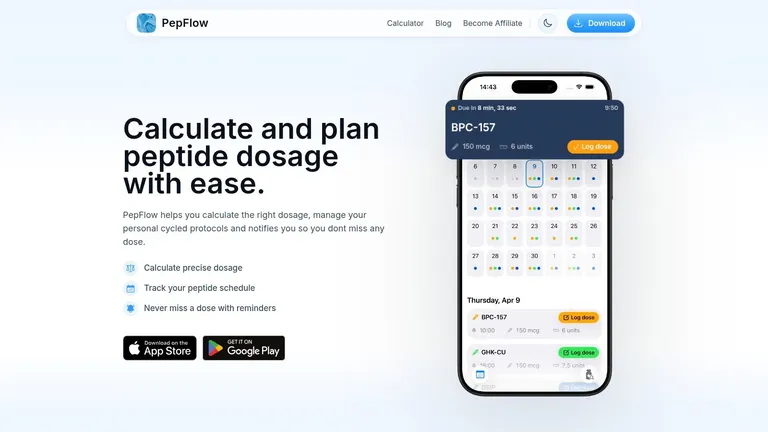
If you’re trying to build a more reliable routine around medication dates, reminder systems, and protocol logs, these ideas for how to improve medication adherence are useful because they focus on consistency rather than willpower.
Clear records make follow-up conversations better. Instead of saying, “I think I stopped a while ago,” you can say exactly when you started, when you changed frequency, and how long it’s been since the final dose. With a drug known for lingering behavior, that precision helps.
If you want a simple way to organize protocol dates, reminders, and dose history in one place, PepFlow is built for that job. It won’t replace medical guidance, but it can make your schedule easier to follow and easier to review when timing matters.