Most advice about CJC-1295 starts in the wrong place. It asks which version is “stronger,” or which one needs fewer injections. That framing misses the part that determines whether your protocol makes biological sense.
For most practical research discussions, CJC-1295 no-DAC and Mod GRF 1-29 refer to the same peptide concept. It’s not a mistake to confuse those two names. The significant error is confusing the no-DAC version with CJC-1295 with DAC, which behaves very differently in the body.
That distinction changes everything. It changes how long the peptide stays active, how the pituitary is stimulated, how often a protocol is scheduled, and how you should interpret any result. A short, pulse-like signal isn’t the same thing as a constant hormonal push. Treating them as interchangeable is like comparing a light switch tap to leaving the lights on all week.
If you’ve seen mixed terminology online, you’re not imagining it. Naming conventions around this peptide family are messy, and many guides flatten the differences into a simple brand-style comparison. A better starting point is to separate the short-acting, pulsatile no-DAC form from the long-acting DAC form and ask why that matters physiologically. If you want a side-by-side primer before going deeper, PepFlow’s guide on CJC-1295 DAC vs no DAC is a useful companion.
Table of Contents
- Introduction Clearing Up the Confusion
- What Is Mod GRF 1-29 and How Does It Work
- The Critical Difference CJC-1295 With and Without DAC
- Potential Benefits and Associated Risks
- Common Dosing Protocols and Stacking Strategies
- Reconstitution Storage and Best Practices
- Scheduling and Tracking Doses with PepFlow
Introduction Clearing Up the Confusion
Two labels cause most of the confusion: Mod GRF 1-29 and CJC-1295 no-DAC. In ordinary peptide discussion, people use them to describe the same short-acting GHRH analog. If someone says they’re using CJC-1295 without DAC, they usually mean Mod GRF 1-29.
The bigger problem is that many people stop there and assume all “CJC-1295” products work similarly. They don’t. The no-DAC version is built for a brief signal. The DAC version is built to hang around. That single design difference changes the rhythm of growth hormone release from something more pulse-like to something much more prolonged.
That’s why the phrase CJC-1295 no-DAC Mod GRF 1-29 matters. It identifies the short-acting version specifically, not the long-acting one. If you’re reading a protocol, comparing reports, or reviewing a product listing, that wording tells you what kind of endocrine pattern you should expect.
Confusion at the naming stage leads to confusion at every later stage. Dosing, timing, stacking, and safety all depend on choosing the right variant first.
A good way to think about the no-DAC form is this: it doesn’t try to force a constant signal. It briefly nudges the same receptor pathway your body already uses for growth hormone-releasing hormone, then it gets out of the way. That design is why many researchers see it as the more physiologically coherent option for pulse-based work.
What Is Mod GRF 1-29 and How Does It Work
The common shortcut is to call Mod GRF 1-29 a “growth hormone peptide.” That description is incomplete and is where a lot of misunderstanding starts. Mod GRF 1-29 does not act like growth hormone itself. It acts upstream, at the signaling step that tells the pituitary when to release growth hormone.
A modified version of natural GHRH
Mod GRF 1-29 is a synthetic 29-amino acid analog of the active N-terminal portion of human GHRH. Its purpose is not to replace physiology with a constant outside signal. Its purpose is to preserve the same receptor target as native GHRH while making the peptide stable enough to be useful in research. Early work on GHRH analog design showed that selected amino acid substitutions can markedly improve resistance to enzymatic breakdown while preserving receptor activity, as described in endocrine peptide research on GHRH fragments and analogs (https://pubmed.ncbi.nlm.nih.gov/1679032/).
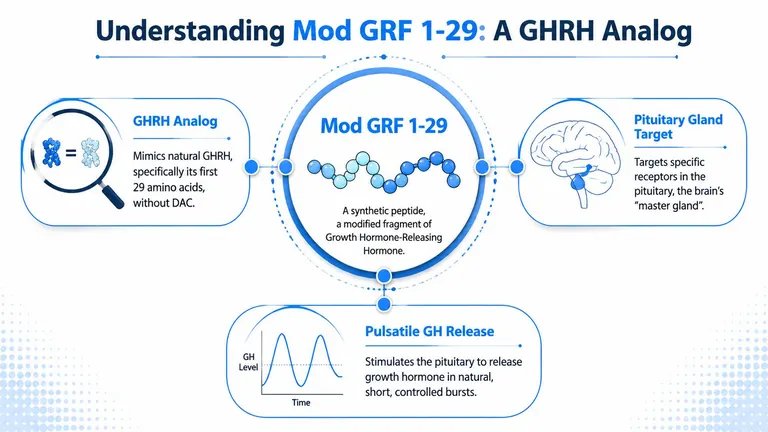
A good comparison is a doorbell rather than a replacement battery. Growth hormone is the output. Mod GRF 1-29 presses the pituitary’s GHRH receptor briefly, which prompts somatotroph cells to produce and release growth hormone through the body’s own signaling machinery. At the cellular level, that means GHRH receptor activation, followed by adenylate cyclase and cAMP signaling, which promotes GH secretion and synthesis, a mechanism outlined in standard physiology references on hypothalamic control of pituitary function (https://www.ncbi.nlm.nih.gov/books/NBK279070/).
That distinction matters. Researchers interested in pulse-based GH release usually care less about forcing a high signal and more about preserving timing. The no-DAC form fits that logic because it behaves more like a short instruction than a long occupation of the system.
Why the short half-life matters
Pharmacokinetics can sound abstract until you frame it in terms of signal shape. A short half-life does not mean a peptide is weak. It means the message fades on schedule.
Native GRF 1-29 is cleared very quickly, which limits how long it can stimulate the receptor. Mod GRF 1-29 was engineered to last longer, but still briefly. Reviews of GHRH analog pharmacology describe the modified peptide as having a short active window measured in minutes rather than days, which is exactly why it is grouped with pulse-oriented secretagogues rather than sustained-release analogs (https://pubmed.ncbi.nlm.nih.gov/1720188/).
A useful analogy is the difference between ringing a bell and holding down an alarm. With Mod GRF 1-29, the receptor gets a short, defined cue. That leaves room for the normal rise and fall of downstream signaling. With a much longer-acting design, the concern is not only duration. It is that the endocrine rhythm itself changes.
Human studies on CJC-1295, the related GHRH analog platform, showed that extending exposure can keep GH and IGF-1 at higher levels for days after a dose, which helps explain why the no-DAC versus DAC distinction has such large physiological implications (https://pubmed.ncbi.nlm.nih.gov/16352683/). That is the part many summaries skip. The debate is not about convenience alone. It is about whether the research goal is to reproduce a pulse or to impose a prolonged signal on an axis that normally runs in bursts.
A few working principles make the mechanism easier to track:
- It is receptor-mediated: Mod GRF 1-29 acts at the GHRH receptor on pituitary somatotrophs.
- It extends the native signal without making it continuous: the peptide is modified for better stability, but it remains short-acting in practical terms.
- It supports pulse-shaped experiments: researchers often choose it when they want a brief GH-releasing cue that aligns more closely with normal endocrine timing.
Practical rule: Mod GRF 1-29 is best understood as a short-acting GHRH analog that prompts a controlled GH pulse, not as a long-duration growth hormone exposure tool.
The Critical Difference CJC-1295 With and Without DAC
A lot of writeups treat DAC like a small formulation detail. It is not. DAC changes the timing profile of the entire signal, and in hormone research, timing is often the experiment.
What DAC actually does
DAC stands for Drug Affinity Complex. In practical terms, it helps the peptide bind to serum albumin, the major carrier protein in blood. Albumin works like a circulating shuttle. If a peptide can hitch a ride on it, clearance slows down and exposure stretches out.
That creates two very different research tools.
Mod GRF 1-29 without DAC is short-acting. It gives the pituitary a brief GHRH-type cue, then blood levels fall relatively quickly. CJC-1295 with DAC is built to persist, so the same receptor system is exposed for much longer. The question is not only how long the peptide remains detectable. The more important question is what kind of endocrine pattern that long residence produces.
Published human work on CJC-1295 with DAC found prolonged increases in GH and IGF-1 after a single dose, which is the key reason these variants should not be treated as interchangeable in study design (PubMed). A separate clinical report describes the DAC form as a long-acting GHRH analog because albumin binding markedly extends its time in circulation (The Journal of Clinical Endocrinology and Metabolism).
Half-life is easiest to picture as a fade-out, not an on-off switch. If a short-acting peptide has a short half-life, the signal drops in steps and soon leaves room for baseline physiology to reassert itself. If a peptide has a half-life measured in days, the signal lingers between doses, and the body is no longer dealing with a clean pulse. It is dealing with carryover.
Side-by-side comparison
| Characteristic | Mod GRF 1-29 (No-DAC) | CJC-1295 with DAC |
|---|---|---|
| Pharmacokinetic profile | Short-acting | Long-acting due to albumin binding |
| Dosing pattern in research discussions | Often administered more frequently | Often administered less frequently |
| Blood behavior | Clears relatively quickly | Persists in circulation for days |
| Signal pattern | Pulse-shaped, time-limited | Sustained, extended exposure |
| Research fit | Timing-sensitive and pulse-focused work | Long-duration exposure studies |
The physiological implication is where the debate sits. A pulsatile system is not just a lower-dose version of a sustained system. It is a different instruction set. Short bursts let receptors and downstream pathways experience rise, response, and recovery. Prolonged exposure can blur those boundaries and make it harder to separate the effect of one dose from the residual effect of the last one.
That distinction matters for safety interpretation too. If GH and IGF-1 remain pushed upward for days, researchers are no longer observing a narrow stimulus. They are observing a modified hormonal environment. For anyone trying to study responses that resemble normal endocrine rhythm more closely, the no-DAC version is usually the cleaner tool.
Three practical conclusions follow from that difference:
- No-DAC is usually chosen for pulse-focused work. It better matches studies where timing relative to sleep, fasting, or co-administered secretagogues matters.
- DAC changes the background signal. Residual exposure can make outcome attribution less precise.
- Shared naming creates confusion. Two compounds can both sit under the CJC-1295 label while producing meaningfully different biological patterns.
For readers who want broader context on how hormone patterns are assessed outside peptide discussions, Repose Healthcare’s hormone guide is a useful reference.
A brief pulse and a days-long exposure can both stimulate the same axis, but they do not test the same biological question.
That is why many experienced researchers regard CJC-1295 no-DAC, often discussed alongside Mod GRF 1-29, as the more physiologically sound option for pulse-based work. The DAC form has its own use case. It just belongs to a different kind of experiment.
Potential Benefits and Associated Risks
A common mistake in peptide discussions is treating “more exposure” as automatically better exposure. With CJC-1295 no-DAC Mod GRF 1-29, the attraction is almost the opposite. Researchers often choose it because a brief signal can answer a cleaner biological question than a signal that lingers and keeps reshaping the background hormonal setting.
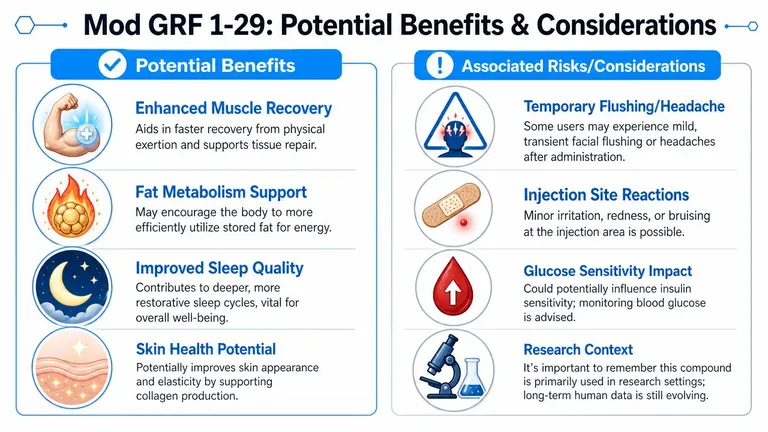
That distinction helps explain the benefits people usually discuss. Growth hormone signaling is relevant to recovery, sleep-related repair, substrate use, and tissue turnover. But no-DAC is not usually chosen because it keeps GH at a persistently high level all day. It is chosen because it gives a short nudge, then clears, which lets researchers observe what happens after the pulse rather than during a prolonged push.
Half-life works a bit like a dimmer switch with a timer attached. A short-acting peptide turns the signal up briefly, then the room returns toward its prior light level. A long-acting peptide leaves the light on, so every later observation happens under altered conditions. For research built around timing, that difference is not cosmetic. It changes what is being studied.
This is why pulse-oriented protocols are often discussed around specific windows such as sleep onset, fasting periods, or pairing with another secretagogue. In that setting, the no-DAC version can be the more precise tool. Readers comparing combinations may find this breakdown of CJC-1295 and Ipamorelin research use patterns helpful for seeing how timing logic changes when compounds are stacked.
For readers who want a broader context on how hormones are typically evaluated and monitored, Repose Healthcare’s hormone guide is a useful general resource.
Researchers and informed readers usually associate pulse-based protocols with a few recurring areas of interest:
- Recovery and repair: Brief GH-axis stimulation is often explored in protocols centered on post-training recovery and tissue remodeling.
- Sleep-linked timing: Some protocols place pulses near bedtime because endogenous GH output already has a strong relationship with early sleep.
- Body composition questions: Short GH pulses are frequently discussed in relation to fat metabolism and lean-mass retention rather than constant exposure.
- Protocol control: A short window can make it easier to interpret the effect of timing, meals, training, or a second peptide.
Understanding the Primary Safety Concern
The main safety question is not merely whether a peptide stimulates the GH axis. The more informative question is what pattern of stimulation it creates and how long that pattern persists.
That is where the no-DAC versus DAC split becomes more than a naming issue. A short-acting GHRH analog produces a pulse. A DAC-linked version is designed to remain active far longer, which can shift the pituitary from receiving brief cues to sitting under a more sustained drive. Physiologically, those are very different experiments.
FDA materials published in December 2024 and available through the agency’s own site raised concern around CJC-1295 with DAC in nonclinical work, including findings such as pituitary cell necrosis and genotoxicity signals associated with prolonged exposure patterns. The point is not that no-DAC should be treated as harmless. The point is that the concern attached to the DAC form is tied to sustained stimulation, not merely to the shared CJC-1295 label.
An analogy helps here. Tapping a doorbell a few times is different from holding the button down for minutes. Both activate the same circuit, but they do not stress the system in the same way. That is the core of the debate many summaries skip past.
So the risk discussion is better framed around exposure shape. How high is the signal, how often is it repeated, and how much recovery time exists between pulses? For research intended to stay closer to normal endocrine rhythm, those questions often make CJC-1295 no-DAC, commonly discussed as Mod GRF 1-29, the more physiologically sound option.
Common Dosing Protocols and Stacking Strategies
Short-acting peptides force discipline. That is not a drawback in this context. It is the whole point.
Mod GRF 1-29 is usually discussed in research protocols as a peptide used in small, repeated subcutaneous doses, often timed around specific parts of the day rather than treated like a long-duration compound. A common research range is 100 to 200 mcg per dose, given 1 to 3 times daily, with the exact schedule shaped by the question being tested rather than by convenience alone.
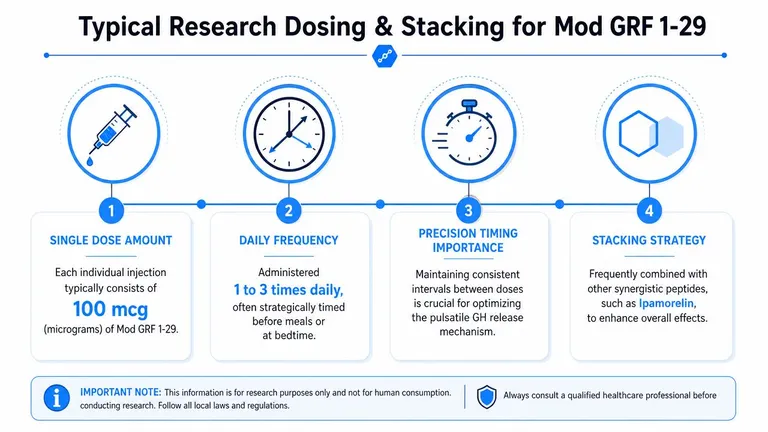
That frequent schedule can look excessive if someone has been reading about DAC-linked CJC-1295. The comparison is misleading. A no-DAC protocol is built to create brief signals, then get out of the way. Half-life works a lot like how long a bell keeps ringing after it is struck. With no-DAC, the ring fades quickly, so repeated timing creates distinct events instead of one long hum.
Research discussions often cluster those doses around three kinds of windows:
-
Before sleep
Nighttime timing is common because endogenous growth hormone secretion has a strong association with sleep onset and early-night pulses. -
After training
Some protocols place a dose after exercise when the goal is to examine recovery-related signaling in a defined window. -
Fixed daytime intervals Additional doses are sometimes used at consistent times to keep the pulse pattern reproducible from day to day.
A short-acting peptide rewards consistency. If timing drifts by hours from one day to the next, the experiment stops testing a clean pulse pattern and starts testing noise.
Why stacking gets so much attention
Mod GRF 1-29 is often paired with a GHRP such as Ipamorelin because the two compounds nudge growth hormone release through different receptors. One acts through the GHRH pathway. The other stimulates the ghrelin or GHS pathway. Used together, they are meant to create a coordinated signal rather than a stronger version of the same signal.
The practical reason this matters is physiological shape. If no-DAC is chosen to stay closer to pulsatile signaling, the stack should respect that logic too. Pairing two short-acting agents in a tightly timed window asks a different research question than placing one sustained agent over the top of everything. One setup examines a pulse. The other starts to blur into continuous drive.
For readers comparing the pairing logic in more detail, PepFlow has a clear overview of the CJC-1295 and Ipamorelin stack.
A useful way to frame stacking decisions is simple:
- Single-agent Mod GRF 1-29 asks what brief GHRH-receptor stimulation does by itself.
- Mod GRF 1-29 plus a GHRP asks what happens when that pulse is reinforced through a second pathway at the same time.
- Poorly timed stacking weakens the interpretation because the intended pulse becomes harder to define.
That last point gets skipped too often. Stacking is not automatically better. It is only better if the added peptide helps answer a sharper question. In no-DAC research, the best protocols usually keep returning to the same principle. Brief signal, clear timing, recovery between pulses.
Reconstitution Storage and Best Practices
Handling the vial correctly
Most Mod GRF 1-29 products arrive as a lyophilized powder, so handling starts with reconstitution. Many avoidable mistakes can arise during this phase. The peptide itself may be well chosen, but poor mixing, contamination, or sloppy labeling can ruin the protocol before the first dose.
The first rule is simple. Work cleanly and work slowly. Use sterile supplies, check the vial label carefully, and confirm the amount of peptide in the vial before adding bacteriostatic water.
A reliable sequence looks like this:
-
Clean the stoppers
Wipe both the peptide vial and the bacteriostatic water vial with alcohol and let them dry. -
Draw the planned volume
The volume you add determines the final concentration. Pick a dilution that makes your target microgram amount easy to measure consistently. -
Add water gently
Let the water run down the inside wall of the vial if possible. Don’t blast it directly into the powder puck. -
Swirl, don’t shake
Gentle rotation is enough. Shaking can be unnecessarily harsh on delicate peptide chains.
Handling note: If you can’t explain your final concentration clearly on paper, don’t inject from that vial yet.
For a broader explanation of how lyophilized products behave before and after mixing, PepFlow’s guide to freeze-dried peptides is a helpful reference.
Storage habits that prevent avoidable mistakes
Once reconstituted, the main priorities are temperature control, labeling, and repeatability. Keep the vial refrigerated, store it upright if practical, and avoid leaving it out during routine handling longer than necessary.
The habits that help most are boring ones:
- Label the vial clearly: Include peptide name, reconstitution date, and concentration.
- Protect the routine: Use the same storage spot so you don’t lose track of what’s active.
- Check appearance before use: If the solution looks off, cloudy, or contaminated, don’t treat it as usable.
- Avoid repeated rough handling: Frequent agitation and careless transport create problems you don’t need.
Most peptide handling errors aren’t exotic chemistry failures. They’re math errors, labeling mistakes, and rushed technique.
Scheduling and Tracking Doses with PepFlow
Short-acting peptides create a practical problem. Even if you understand the biology, it’s easy to miss doses, lose track of timing, or second-guess syringe units after reconstitution. Mod GRF 1-29 is a good example because the protocol often depends on repeated, well-timed administration rather than one weekly injection.

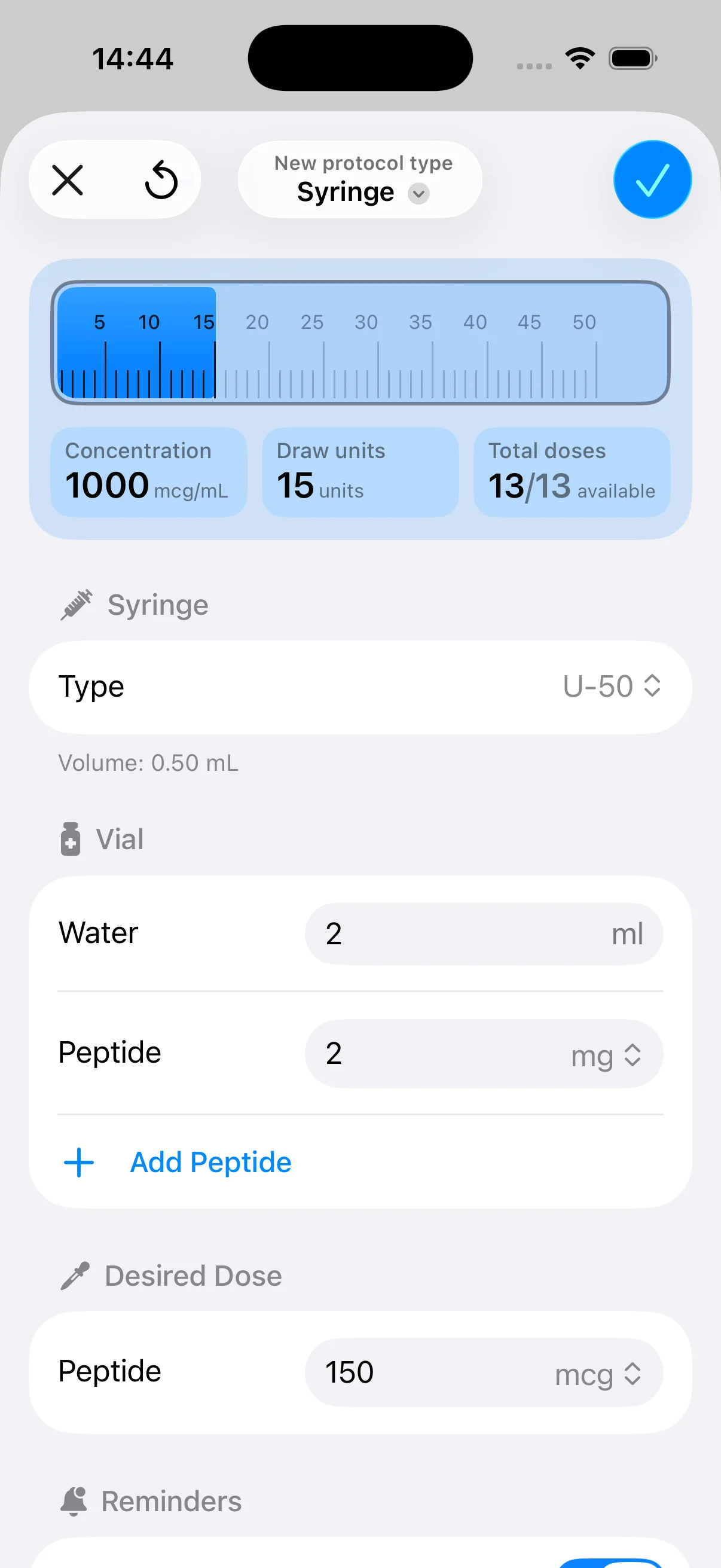
A scheduling tool helps most when it removes math from the moment. You enter the vial amount, the reconstitution volume, and the target microgram dose. The app then translates that into a practical unit measurement so you’re not redoing concentration calculations every time you prepare an injection.
That matters even more when a protocol calls for multiple doses across the day. Reminders reduce drift. Logging reduces guesswork. History makes it easier to see whether the protocol you intended is the protocol you followed.
A simple tracking workflow usually includes:
- Protocol setup: Add your start date, desired frequency, and any cycle timing.
- Dose calculation: Convert the intended microgram amount into syringe units based on your vial concentration.
- Reminders and logs: Mark doses when taken so the schedule stays anchored to reality.
- Review: Look back over the record instead of relying on memory.
The point isn’t to replace medical judgment. It’s to reduce the very ordinary errors that show up when people manage frequent peptide schedules by hand.
If you want a simpler way to calculate concentrations, schedule repeated doses, and keep a clean log for pulse-based protocols like Mod GRF 1-29, PepFlow is built for exactly that kind of routine. It helps you turn vial math into usable syringe units, organize recurring protocols, and stay consistent without juggling spreadsheets, notes apps, and mental arithmetic.