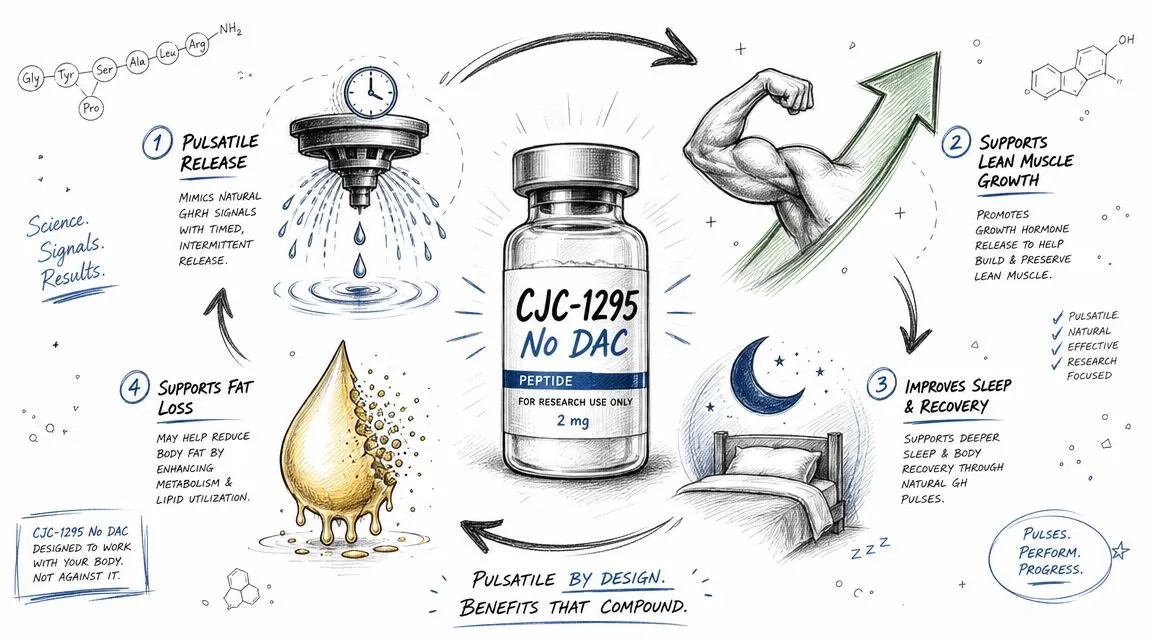
You’re probably here because the usual peptide advice feels too blunt for real life. You train at different times, your sleep schedule isn’t always perfect, and you don’t want something that lingers for days when what you really want is control. That’s where interest in CJC-1295 No DAC usually starts.
A lot of articles treat the short half-life like a drawback. That misses the point. For many people, the main appeal of CJC-1295 No DAC is that it acts more like a timed signal than a constant push. If your goal is to line up a growth hormone stimulus with sleep, training, or a tightly managed protocol, short-acting can be an advantage.
The catch is that the internet often mixes together claims about the short-acting and long-acting versions, then presents them as if they’re interchangeable. They aren’t. The differences in timing, exposure, and practical use matter.
Table of Contents
- Introduction to CJC-1295 No DAC
- Understanding CJC-1295 No DAC and Its Pulsatile Advantage
- The Mechanism Behind Growth Hormone Release
- Reported Benefits and The Supporting Evidence
- CJC-1295 No DAC vs With DAC A Head-to-Head Comparison
- Protocol Design Dosing Timing and Safety
- Frequently Asked Questions About CJC-1295 No DAC
Introduction to CJC-1295 No DAC
A common scenario looks like this. Someone trains early, eats dinner late, sleeps inconsistently, and then tries to fit a peptide protocol into that schedule without turning the whole week into a chemistry project. The first practical question is usually timing. Can the signal be placed where it is wanted, or does it keep running long after that window has passed?
CJC-1295 No DAC, often called Modified GRF (1-29), draws interest because it is built for a short window of action. That short half-life is not just a tradeoff. For people who care about rhythm and timing, it can be the point. A brief signal works more like tapping a doorbell than leaving a switch stuck in the on position.
That distinction matters because hormones rarely behave like a flat background hum. They act more like messages sent in bursts. The no-DAC version is often discussed by people who want that burst-like pattern to line up more closely with sleep, fasting periods, or training sessions. If you want a clearer sense of what the DAC attachment changes, this explainer on what DAC does in peptide design is a useful starting point.
The primary appeal of the no-DAC version is control. A narrower activity window can make planning easier and adjustments cleaner, especially when routines change week to week.
If you are also looking at the broader wellness conversation around peptides, this overview of functional medicine anti-aging solutions places that interest in a wider context instead of treating one compound as a cure-all.
Why the short action changes the discussion
With many compounds, longer-lasting sounds better on paper. With signaling peptides, longer exposure and better fit are not the same thing. A short-lived signal can be easier to position deliberately, much like setting a timed alarm instead of leaving a speaker playing all night.
That can matter for a few practical reasons:
- Sleep timing: Some users prefer a protocol that fits into a bedtime routine without much carryover.
- Training timing: Others want a stimulus that can be placed near a workout block.
- Adjustment flexibility: A short-acting peptide is simpler to stop, shift, or retime if work, travel, or recovery needs change.
There is also an important caution here. Interest in timing and rhythm does not equal proof of superior outcomes. Human evidence is still limited, product quality can vary, and growth hormone signaling is not something to experiment with casually, especially for people with metabolic disease, cancer risk factors, or other endocrine concerns.
Where confusion starts
A lot of readers group all growth hormone related compounds together, and that creates bad comparisons. CJC-1295 No DAC is not growth hormone itself. It is also not the same as CJC-1295 with DAC, which is designed to stay active far longer. Those design differences shape expectations, dosing logic, and safety discussions from the start.
Understanding CJC-1295 No DAC and Its Pulsatile Advantage
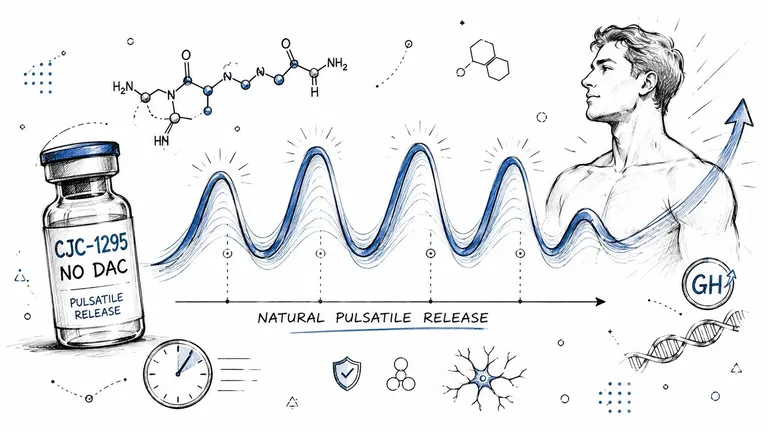
The core difference with CJC-1295 No DAC is its action pattern. It behaves like a timed signal, not a constant presence.
What it was designed to do
CJC-1295 without DAC was developed as a short-acting GHRH analog, often discussed under the Modified GRF (1-29) label. The important practical point is not the exact chemistry but the intended behavior. It enters, sends a signal, and clears relatively quickly. That short window is the whole strategy.
Many readers encounter confusion on this point. In drug design, longer duration often sounds better. With signaling peptides, duration and usefulness are not the same thing. If your goal is to work with the body’s natural rhythm of hormone pulses, a brief signal can be more suitable than a signal that lingers for hours or days.
Half-life is easiest to understand as signal persistence. A short half-life means the message fades sooner, like a text notification that appears, gets your attention, and disappears, rather than a banner that stays on your screen all day. For a peptide meant to prompt growth hormone release, that can be a design advantage rather than a drawback.
Why a pulse can be useful
Growth hormone is normally released in bursts. The body does not run it at one flat, steady level all day. That matters because CJC-1295 No DAC is usually discussed by people who want to place a signal at a specific time, such as before sleep or around training, instead of keeping the system stimulated continuously.
That creates a different kind of control:
- Tighter timing: The signal can be placed in a narrower window.
- Less carryover: The effect is less likely to blur into the rest of the day.
- More flexible scheduling: Timing can be adjusted more easily when sleep, meals, training, or travel change.
Short-acting does not automatically mean weak. It often means more precise.
The practical advantage people often miss
The short half-life is often framed as an inconvenience because it may require more careful protocol design. A better way to look at it is control. If someone wants a pulse-based approach that tries to resemble normal physiology more closely, the shorter action gives them more say over when the prompt begins and when it ends.
That is the primary contrast with DAC-containing versions. DAC changes how long the peptide remains active, which changes the entire scheduling logic. If you want the chemistry behind that difference explained in plain language, this guide on what DAC means in peptides gives helpful context.
A simple comparison makes the distinction clearer:
| Variant | Best mental model | Main scheduling style |
|---|---|---|
| No DAC | Timed signal | Pulse-based, more frequent |
| With DAC | Extended signal | Sustained, less frequent |
None of this proves that No DAC is universally better. It means the peptide fits a different objective. For readers interested in timing, rhythm, and the ability to adjust a protocol closely, the no-DAC version stands out because its short action can be used deliberately rather than worked around.
The Mechanism Behind Growth Hormone Release
CJC-1295 No DAC doesn’t contain growth hormone. That’s one of the biggest points people miss.
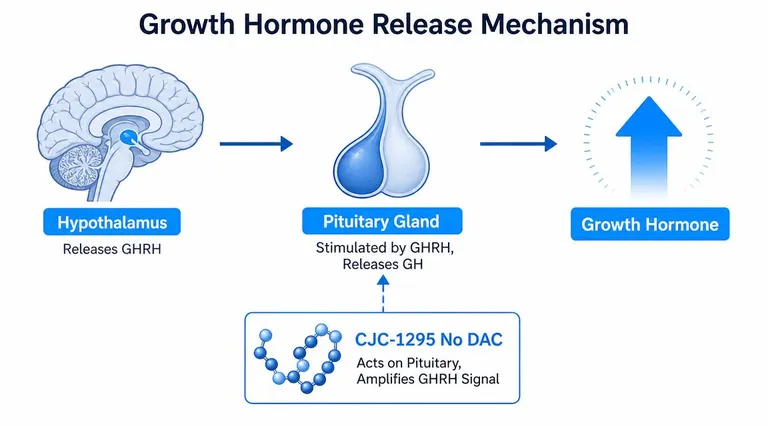
It acts more like a signal that tells your body to release its own growth hormone. A useful analogy is a key in an ignition. The peptide is the key. The pituitary receptor is the ignition. If the key fits, the engine starts.
The core pathway in plain language
The body uses a signaling chain to regulate growth hormone output. At a simplified level:
- The hypothalamus sends growth hormone-releasing signals.
- The pituitary gland receives that message.
- The pituitary releases growth hormone.
- The liver and other tissues respond, including through IGF-1 production.
CJC-1295 No DAC fits into that process as a secretagogue-style signal amplifier, not as replacement growth hormone. That distinction matters because it shapes both the expected effect and the limits of the evidence.
Why people care about the downstream effect
When people talk about muscle support, recovery, or body composition, they’re usually thinking about downstream biology. Growth hormone release can influence later signaling, including IGF-1 activity, and that’s where many of the restorative and anabolic ideas come from.
But it’s important to stay precise. You can say the peptide is intended to stimulate a pulse in the GH axis. You can’t assume that every desired outcome follows automatically from that pulse in every person.
A signal to release growth hormone is not the same thing as a guaranteed change in sleep, fat loss, or muscle gain.
A simple working model
If you want a non-technical picture, think of the pituitary as a responsive relay station.
- The body’s own GHRH: normal incoming message
- CJC-1295 No DAC: a synthetic message designed to trigger the same receptor pathway
- Growth hormone release: the relay output
- IGF-1 response: part of the later cascade
That’s why timing matters so much with the no-DAC form. If the compound acts briefly, the whole protocol becomes more about when you send the signal than about bathing the system in a continuous one.
For a non-clinical reader, that’s the useful takeaway. CJC-1295 No DAC isn’t best understood as a “bigger is better” tool. It’s better understood as a timing tool for a pulse-based signal.
Reported Benefits and The Supporting Evidence
Most interest in CJC-1295 No DAC benefits centers on a familiar list: muscle support, recovery, sleep quality, and fat loss. Those ideas aren’t random. They come from the biology of growth hormone signaling. But the quality of evidence behind each claim varies, and that’s where honest discussion matters.

What people are usually hoping for
The reasoning usually looks like this:
- Muscle support: Growth hormone and IGF-1 signaling are associated with anabolic processes, so users expect help with maintaining or supporting lean mass.
- Recovery: A pulse-based GH stimulus is often discussed in relation to tissue repair and training recovery.
- Sleep quality: Because growth hormone biology is tied to nighttime physiology, many people try to pair the peptide with bedtime routines.
- Body composition: Some users hope that influencing the GH axis may support fat metabolism or recomposition efforts.
Those are the common talking points. The problem is that people often present them as proven outcome claims for the no-DAC form itself.
What the evidence actually supports
The strongest caution here is simple. High-quality human data for CJC-1295 no DAC specifically are sparse. Most detailed clinical evidence comes from the DAC form, which had an estimated half-life of 5.8 to 8.1 days in healthy adults. By contrast, the no-DAC version is described as a short-acting GHRH analog with a roughly 30-minute half-life, and many wellness claims are extrapolated from DAC data without accounting for the different exposure patterns, as noted in this PubMed-indexed clinical report.
That means a lot of common online claims should be read as theoretical or anecdotal, not as settled human outcome evidence for no-DAC use.
A practical way to interpret the common claims
Here’s a balanced framework:
| Claimed benefit | Reason people expect it | Evidence quality for no DAC |
|---|---|---|
| Muscle support | GH axis signaling is relevant to anabolic processes | Mostly indirect or extrapolated |
| Recovery support | Short pulses may fit training and overnight repair windows | Mostly theoretical in no-DAC-specific human terms |
| Better sleep | Users often time it near bedtime because of GH physiology | Commonly discussed, but not well proven specifically for no DAC |
| Fat loss support | GH-related signaling is linked to body composition | Often inferred rather than directly demonstrated for no DAC |
A lot of bad content skips that middle column and jumps straight to promises.
The video below gives a broader look at how people discuss this peptide category in practice:
The most defensible benefit
If you want the most evidence-aligned statement, it’s this: the no-DAC form is valued for its short, pulse-oriented action and the scheduling control that comes with it. That’s the clearest practical advantage.
Treat sleep, recovery, and body composition claims as possibilities people discuss, not as guaranteed outcomes established specifically for the no-DAC version.
CJC-1295 No DAC vs With DAC A Head-to-Head Comparison
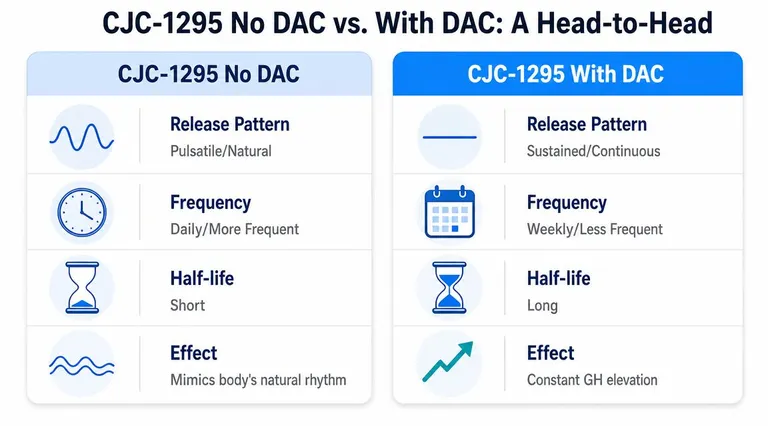
If you strip away the marketing, the choice comes down to a simple question. Do you want a brief, controllable signal, or do you want a sustained signal that stays around?
That difference affects everything else.
The clearest physiological split
The DAC version is the long-acting one. In human subjects, CJC-1295 with DAC raised plasma growth hormone levels by about 2- to 10-fold for 6 days or longer after a single injection, which is the major reason it’s treated as the sustained-exposure version in peptide discussions, as summarized in this CJC-1295 reference overview.
That doesn’t prove the DAC form is better. It proves it behaves differently.
Decision criteria that matter in real life
Here’s the practical comparison most readers need:
| Question | No DAC | With DAC |
|---|---|---|
| What kind of signal does it create? | Short, pulse-based | Sustained, ongoing |
| How much timing control do you get? | High | Lower |
| How often is it typically discussed? | More frequent use | Less frequent use |
| Who tends to prefer it? | People chasing rhythm and flexibility | People chasing continuity and convenience |
Some people want the protocol to feel like a dimmer switch. Others want an on-ramp that stays active. Neither preference is irrational. They’re just different use cases.
Which version fits which mindset
A short-acting protocol often appeals to people who think in terms of sleep windows, training sessions, and protocol adjustment. If your schedule changes a lot, the no-DAC version may feel easier to shape around real life.
The DAC version tends to appeal to people who care more about fewer injections and more continuity.
If you want a more detailed practical comparison of use style and protocol implications, this article on CJC-1295 DAC vs no DAC is a good reference.
The best variant isn’t the one with the longest action. It’s the one whose action pattern matches your goal.
Protocol Design Dosing Timing and Safety
The no-DAC form only makes sense if timing is intentional. If someone chooses a short-acting peptide but doesn’t care when the signal happens, they’re giving up the main advantage.
This is also the section where caution matters most. Peptides that affect the growth hormone axis shouldn’t be approached casually, especially in unsupervised settings.
Timing logic people usually use
Because the no-DAC form is discussed as a pulse-oriented option, users often think about timing in relation to routine rather than “taking it sometime today.”
Common scheduling logic includes:
- Pre-bed use: Chosen by people trying to line up the signal with nighttime physiology.
- Training-adjacent use: Chosen by people who want the pulse closer to a workout block.
- Consistent daily timing: Chosen by people who want cleaner comparisons in a structured protocol.
That doesn’t mean one schedule is universally best. It means timing is part of the intervention, not an afterthought.
Why monitoring matters
If someone is doing anything that affects hormone-related pathways, objective tracking matters more than guesswork. Symptoms alone can mislead. If you’re trying to make sense of broader endocrine context, resources that compare hormone blood tests can help you understand what different panels are designed to assess and why interpretation matters.
You also need to keep the evidence gap in mind. Since no-DAC-specific human outcomes are limited, protocol decisions should be conservative.
Don’t confuse a precise dosing schedule with proof that the underlying protocol is low risk.
Practical safety considerations
Several safety themes come up repeatedly in peptide discussions around the GH axis. These aren’t reasons to panic. They are reasons to stay measured.
- Injection issues: Subcutaneous use can bring irritation, redness, or technique-related problems.
- Systemic symptoms: Some users discuss headaches, flushing, or fluid-related effects.
- Hormonal uncertainty: Responses can vary, and more stimulation isn’t automatically better.
- Metabolic concerns: Anything touching the GH axis deserves caution in people with blood sugar concerns or complex health histories.
A lot of people also pair CJC-1295 with other compounds. If you’re trying to understand one of the most common combinations, this explainer on CJC-1295 and Ipamorelin is a useful orientation point.
Sensible guardrails
The most responsible approach is boring, and that’s a good thing:
- Start conservatively: Avoid treating online enthusiasm like dosing authority.
- Keep timing consistent: If you’re evaluating effects, random scheduling makes interpretation worse.
- Use supervision when possible: A qualified clinician can judge whether the protocol fits your history.
- Stop if the tradeoff looks poor: A short-acting peptide is easier to discontinue and reassess.
This isn’t medical advice, and CJC-1295 products are often sold in research-oriented markets rather than as approved consumer therapies. That alone should make anyone more careful, not less.
Frequently Asked Questions About CJC-1295 No DAC
Is CJC-1295 No DAC usually stacked with another peptide
Yes. People often discuss combining it with a GHRP such as Ipamorelin because the two signals are thought to complement each other. In plain terms, one pathway helps cue the release signal and the other may amplify the response.
That doesn’t mean every stack is smarter than using one compound alone. It means stacking is common because users are trying to shape a stronger or more predictable pulse.
How long do people typically run it
You’ll see many cycle ideas online, but there isn’t a strong reason to treat popular message-board schedules as validated rules. A better way to think about it is that people often use on-periods and off-periods when they want reassessment points, symptom review, and a chance to decide whether the protocol still makes sense.
The right duration depends on supervision, goals, and tolerance, not on internet folklore.
How fast should someone expect results
Expectations should stay modest. The no-DAC version is easier to understand as a timing-oriented research peptide than as a dramatic transformation tool. Some people report subtle changes in sleep, recovery feel, or training tolerance before they notice anything visible.
Others don’t notice much at all. That’s one reason overblown marketing around CJC 1295 No DAC benefits creates confusion.
Does it require PCT like anabolic steroids
No, not in the usual steroid sense. Post-cycle therapy is normally discussed in relation to compounds that suppress the gonadal hormone axis in a different way. CJC-1295 No DAC sits in a different category.
That doesn’t mean you can ignore follow-up. It just means “PCT” isn’t the standard framework people use for thinking about this peptide.
What’s the single biggest advantage of the no-DAC version
Control. If someone specifically wants a protocol built around timing, pulses, and flexibility, the short-acting nature is the reason to choose it in the first place.
What’s the biggest mistake readers make
They assume short-acting means weaker and long-acting means better. In reality, they solve different problems. No DAC is for people who want to place the signal. DAC is for people who want the signal to stay around.
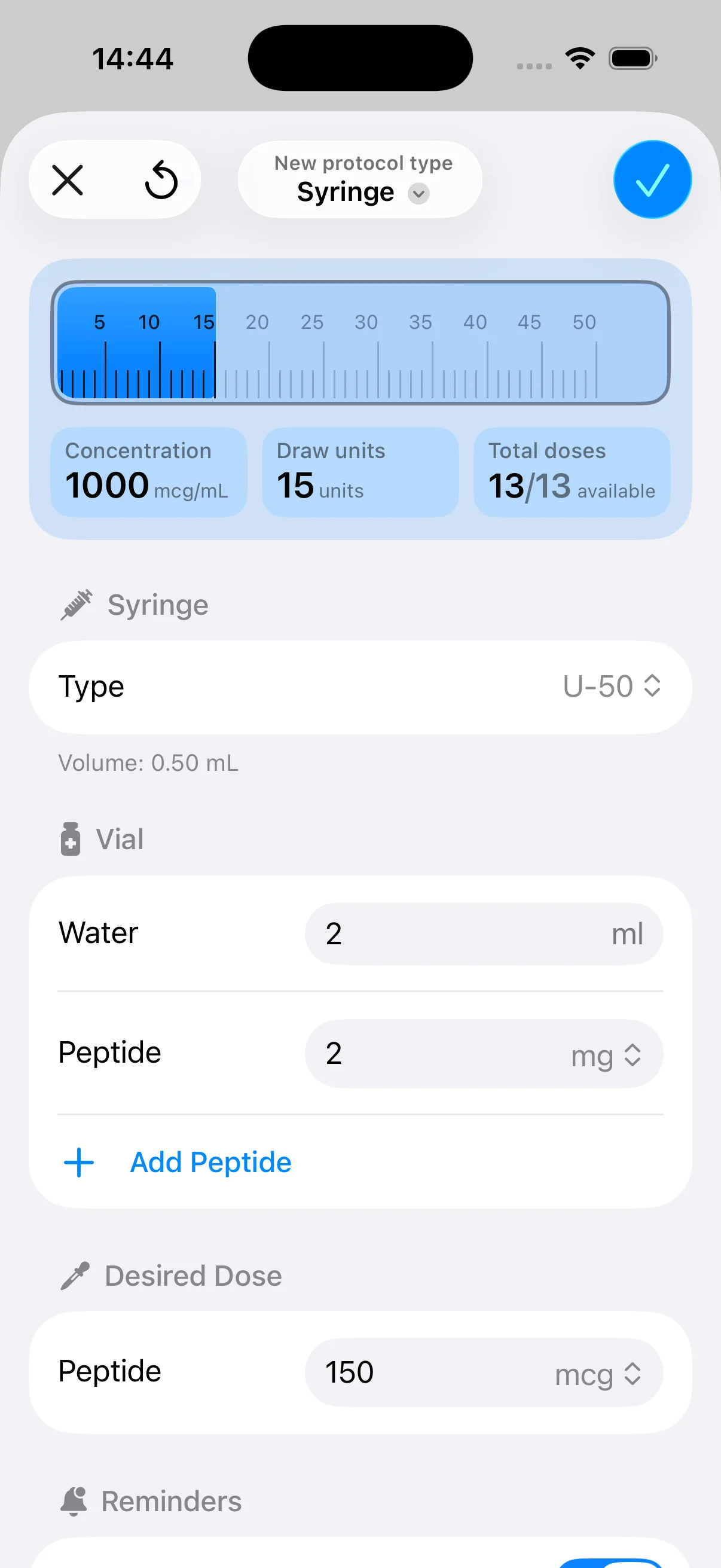
If you’re running a peptide schedule and want less math, fewer missed doses, and cleaner protocol tracking, PepFlow is a practical tool for planning cycles, calculating dosing from vial concentration, and staying consistent with reminders and logs. It won’t replace medical judgment, but it can make the day-to-day logistics much easier.