
Most clinical trials and expert reviews place CDP choline dosage between 250 mg and 1,000 mg per day for healthy adults, with 1,000 mg/day the most common dose in controlled studies. The practical ceiling is real, because going much higher doesn’t automatically mean better cognitive support.
Citicoline, also called CDP-choline, is one of those supplements where dose changes the experience in a meaningful way. Too little can feel like nothing. Too much can add cost, exposure, and sometimes side effects without a clear upside. That’s why the useful question isn’t just “how much should I take,” it’s “which dose fits my goal, body size, and schedule.”
Table of Contents
- Why CDP Choline Dosage Matters More Than You Think
- Evidence-Based Dosage Ranges by Use Case
- How to Calculate Your Personal CDP Choline Dose
- Acute Loading vs Daily Maintenance vs Cycling Protocols
- Timing and Administration Tips for Best Results
- The Dose-Response Ceiling and Why More Is Not Always Better
- Safety, Side Effects, and Contraindications
- Putting It All Together with a Practical Dosing Checklist
Why CDP Choline Dosage Matters More Than You Think
A useful CDP choline dosage starts with the way citicoline has been studied. Human trials have commonly used 500 to 2,000 mg/day, and 1,000 mg/day is often the dose researchers return to most often, while earlier studies sometimes used 100 mg/day and later work moved toward 1,000 mg/day (clinical review). That history matters because it shows citicoline has been tested across a broad therapeutic band, with dosing shaped by purpose rather than by a single fixed target.
A simple way to think about it is this. More choline does not automatically mean more benefit. With citicoline, the useful response often rises with dose up to a point, then begins to flatten, so the practical question becomes where your own response sits on that curve. A healthy adult trying to support focus often needs less than the amounts used in neurological studies, which is one reason generic supplement advice and clinical papers can seem to point in different directions.
Practical rule: start with the smallest dose that matches your goal, then increase only if the effect is clearly too subtle.
The practical context matters too. Someone using citicoline for everyday mental performance usually does not need the same setup as someone following a supervised neurological protocol. If you are already comparing choline options, it helps to separate dose from ingredient choice, and compare choline supplements to see where citicoline fits against other forms. For a broader context on how nootropic-style habits get paired with brain-support stacks, a guide to peptides for brain health can help frame the conversation without confusing the dosing question itself.
A good dosing guide should do two things at once. It should keep you inside the evidence, and it should keep you from overcomplicating a supplement that often works best when the dose is steady, modest, and consistent.
Evidence-Based Dosage Ranges by Use Case
Citicoline dosing makes the most sense when you tie it to the use case, because the same capsule can play a different role in day-to-day support than it does in supervised neurological research. A healthy adult looking for clearer focus usually sits at the lower end, while a more structured protocol can justify a higher intake. Consumer evidence summaries place 250 to 500 mg/day in the healthy-adult range, while 500 to 1,000 mg/day is more typical in neurodegenerative-disease trials and 1,000 to 2,000 mg/day appears in supervised neurological use (Examine).
CDP Choline Dosage Ranges by Goal
| Use Case | Typical Daily Dose | Notes |
|---|---|---|
| Healthy adult cognitive support | 250 to 500 mg/day | Common starting range for focus, clarity, and general support |
| More structured cognitive use | 500 to 1,000 mg/day | Often used when the goal is stronger, steadier support |
| Neurodegenerative or supervised neurological trials | 1,000 to 2,000 mg/day | Higher range used in clinical settings, not casual experimentation |
| Historical controlled human use | 1,000 mg/day | Repeatedly studied over decades, including a 6-week memory-decline trial |
The practical ceiling matters as much as the starting point. A 250 mg dose is usually just one capsule, while 500 mg may mean two standard 250 mg capsules or a single larger capsule, which makes the lower range easier to test without overcommitting. If you are choosing between dose schedules and want a broader framework for stacking or cycling, a peptide dosage guide can help you compare how structured protocols are built, even though citicoline follows its own evidence base.
One more context point helps here. Research has reported no adverse events even at 4,000 mg/day in one study, and another trial with 2,000 mg/day in 899 patients did not produce severe adverse events more often than placebo. That does not mean everyone should take high doses; it means citicoline has shown a wide safety margin in research settings, so the practical question is usually how much is enough rather than how much is possible.
For day-to-day use, the lower bracket usually does the job. 250 mg often suits someone who wants a mild lift without much stimulation, while 500 mg is the more common midpoint when the goal is a noticeable but restrained effect. When the use case is more specific, 1,000 mg becomes a meaningful dividing line, because it is the point where capsule count, budget, and the chance of diminishing returns all start to matter more.
A simple weight check can also make the range feel less arbitrary. For example, a 70 kg person taking 250 mg is using a lighter ratio than an 80 kg person taking the same amount, so the same capsule can land differently even before you think about tolerance or timing. That is why fixed doses are useful as starting points, but not always as final answers.
If you like comparing dosing logic across supplements, the same kind of structured thinking used in thecalcs creatine dose calculator is the right mental model here, even though citicoline uses a different evidence base.
How to Calculate Your Personal CDP Choline Dose
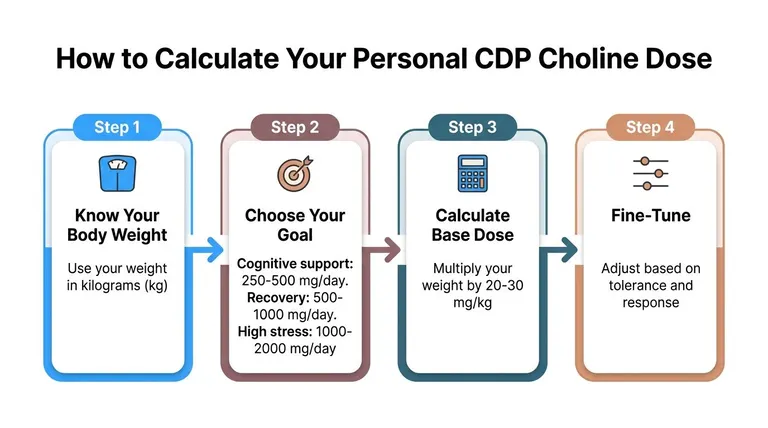
Body weight gives you a better starting point than random internet advice. A PMC review translated common trial doses into roughly 6 to 25 mg/kg for an 80 kg person and 7 to 28 mg/kg for a 70 kg person, using 1,000 mg/day as the common trial anchor. That does not mean everyone needs to calculate to the milligram, but it does show why a fixed dose can be too blunt.
A simple weight-based example makes the math easier to trust. For a 70 kg person at 7 mg/kg, the dose is 490 mg. That lands close to the middle of the range many readers already use as a practical starting point, which is why weight checks are useful when you want the dose to match your body instead of a label average.
A simple starting method
- Pick your target range first. For general cognitive support, start near 250 to 500 mg/day. For more supervised or intensive use, the research ranges move higher.
- Anchor the dose to your weight if you want precision. The review data above show that the same absolute dose maps differently for a 70 kg person and an 80 kg person, so the same capsule can land differently depending on body size.
- Round to a practical capsule size. You will not gain much by overengineering the math, so a workable capsule dose often beats a theoretical one.
- Reassess after a short trial. If the dose feels too subtle, adjust gradually rather than jumping straight to a much higher amount.
Practical rule: if you are between standard capsule strengths, choose the lower one first and let your response decide whether to move up.
A useful conversion detail: 1,000 mg = 1 gram. That matters if you are measuring powders or reading labels on bulk products, because it is easy to misread mg and g when you are moving quickly. Powdered forms also make it easier to overshoot, so a scale or a properly measured scoop helps. If you want a simple framework for that kind of dosing logic, the same stepwise approach used in PepFlow’s peptide dosage guide can help you keep the calculation clean, then track your response instead of guessing.
If you prefer a scheduling mindset, not just a math mindset, this is also the same kind of structured thinking used in thecalcs creatine dose calculator. The details differ, but the habit is the same, start with a clear target, convert it into a practical daily amount, then adjust based on how your body responds.
Acute Loading vs Daily Maintenance vs Cycling Protocols
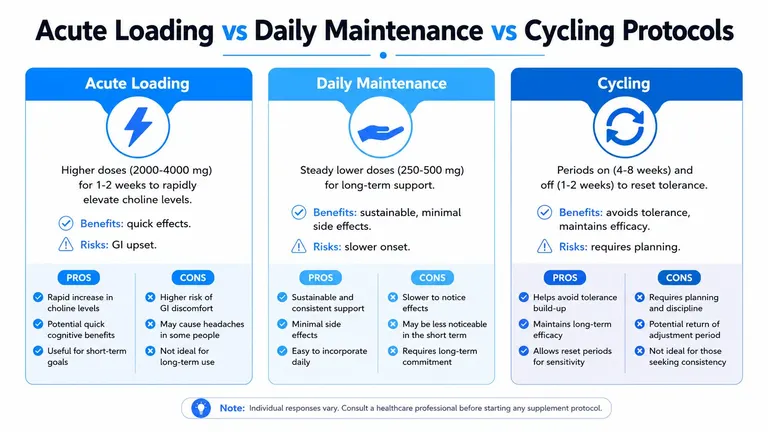
For citicoline, the dosing pattern matters as much as the amount. A short-term push, a steady daily routine, and a planned cycle all serve different goals. The useful question is which pattern matches the reason you are taking it, whether that is temporary mental output, ongoing support, or a built-in pause for reassessment.
Comparing the three approaches
| Protocol | What it looks like | Best fit |
|---|---|---|
| Acute loading | Higher short-term intake within studied ranges | When someone wants a temporary push under close attention |
| Daily maintenance | Lower, steady intake | The most natural fit for routine cognitive support |
| Cycling | Planned periods on and off | Useful when you want to reassess effect and avoid mindless long-term use |
Daily maintenance is the easiest pattern to live with. It fits the common consumer guidance around 250 to 500 mg/day for healthy adults without turning every morning into a decision point. In practice, this style works like a steady drip rather than a spike, which is often a better match for people who want consistency instead of a noticeable stimulant-like feel.
Cycling has become more relevant because many people want a use plan, not an open-ended habit. A practical example is 8 to 12 weeks on, then 5 to 7 days off, followed by a quick check on focus, energy, and sleep. Other consumer summaries suggest reassessing after a few weeks, then again after a longer stretch, which is why a structured tracker or scheduling app can be helpful. If you already use a planning system such as PepFlow’s biohacking app guide, this is the kind of supplement routine where visible on, off blocks make the pattern easier to follow.
Acute loading is the least useful default for most healthy readers. Clinical studies do include higher supervised doses, but the practical lesson is simple, more is not always the better experiment. If your setup resembles a stack calendar instead of a single supplement habit, a scheduling tool such as thecalcs creatine dose calculator can help keep the timing clean so you can evaluate the result instead of guessing.
Timing and Administration Tips for Best Results
A lot of people take citicoline and judge it too quickly, or at the wrong time of day. A morning dose usually makes more sense than a late-night one because some users find it mildly energizing. If sleep is already fragile, timing matters as much as dose.
Take Maya, a consultant who stacks citicoline with coffee and a pre-workout formula. Her problem wasn’t the amount, it was timing plus overlap. Moving citicoline to breakfast gave her a cleaner read on whether the supplement itself was helping, instead of blending it into every other stimulant she used that day.
Keep the first dose boring. If you change too many variables at once, you won’t know what actually caused the effect.
Splitting the dose can also make sense. A smaller morning amount and an early afternoon amount may feel smoother than a single larger serving, especially if you’re trying to avoid a sharp subjective lift. That said, if you’re sensitive to insomnia, morning-only dosing is the cleaner experiment.
Stacking is where people often get sloppy. Citicoline is already a choline source, so adding it on top of other cholinergics can make it harder to interpret headaches, agitation, or sleep changes. If you’re using a structured tracking app, this is the kind of place where logs matter more than memory, because your notes should tell you what changed when the dose changed.
The Dose-Response Ceiling and Why More Is Not Always Better
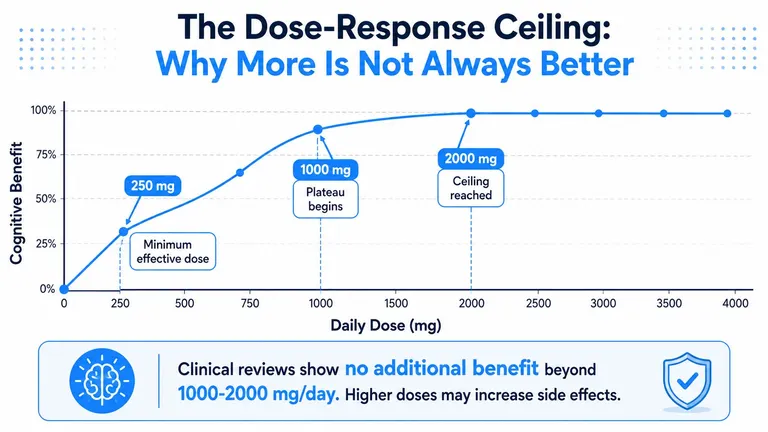
The practical lesson with CDP choline is simple. Past a certain point, higher doses tend to raise exposure more than they raise results. A single 4,000 mg oral dose did not move blood markers more than 2,000 mg, which points to limited upside once you are already in the active range.
That matters because the goal is not to keep pushing milligrams upward. It is to find the smallest dose that gives you a clear effect without making your stack harder to interpret. A dose that is too high can be wasteful, just like paying more for a larger coffee when the extra caffeine only adds jitters.
The ceiling also changes how you should think about value. Moving from 500 mg to 1,000 mg may make sense if the lower dose feels underpowered, but jumping higher does not automatically double the benefit. In real use, the first step up often gives the clearest return, while each additional increase buys less and costs more, both financially and in terms of side-effect risk. If you are comparing that with a structured medication check-in, the same logic applies as in what happens during a med review, where the point is to test whether a change improves outcomes, not just whether it changes the number on the label.
That is why the research clusters around a narrower practical band. Controlled work repeatedly uses doses in the 500 to 2,000 mg/day range, with 1,000 mg/day showing up often in study protocols (PMC review). Once you are in that zone, the more useful question is usually whether your schedule, stack, and sleep are set up well enough to let the dose work.
What the ceiling means in practice
- Below the sweet spot: The effect can feel too faint to notice, which often tempts people to raise the dose too quickly.
- Inside the sweet spot: You are in the range most likely to give dependable support without unnecessary complexity.
- Above the sweet spot: Exposure rises faster than the chance of a cleaner cognitive benefit.
For many people, that is the reason to avoid chasing the highest possible amount. A moderate dose can be easier to sustain, easier to interpret, and easier on the budget. It also makes your tracking cleaner, because if you later change sleep, caffeine, or training load, you are not trying to separate those shifts from a very high citicoline dose.
A simple way to judge the ceiling is by asking what you gain from the next increment. If 500 mg gives you a noticeable lift in focus and memory support, moving to 1,000 mg may be a reasonable trial. If 1,000 mg already feels stable, going much higher may just add cost without giving you a proportionate return. That is the practical center of the dose-response story, and it is why the smartest protocol is usually the smallest dose that still does the job.
A comparable pattern shows up with caffeine, only citicoline is usually calmer. More is not always better once the useful range is reached, and the most efficient strategy is to respect the ceiling instead of trying to force it.
Safety, Side Effects, and Contraindications
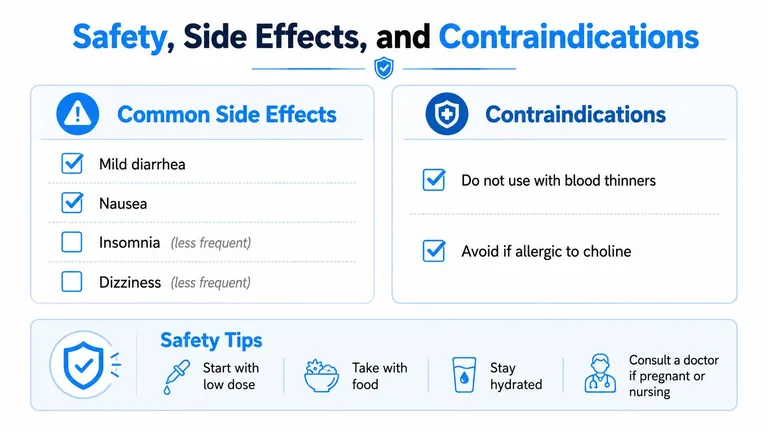
CDP choline dosage is usually well tolerated, but the practical question is not only whether it is “safe.” It is whether your dose fits your sleep, digestion, and medication context. The most common side effect reported in safety summaries is mild diarrhea (Alzheimer’s Discovery Foundation review summary.pdf)). Less common reports include insomnia, dizziness, headache, tinnitus, and vision problems (Mind Lab Pro). That profile is reassuring overall, but it still means your first clue to a poor fit may be a restless night, an unsettled stomach, or a feeling that your total choline load is too high.
A better way to think about safety is as a decision tree. If you are healthy, taking a modest dose, and the only change you notice is a slight effect on alertness, that is usually a simple monitoring issue. If you are adding citicoline on top of other choline sources, or you are already sensitive to stimulatory supplements, side effects are more likely to show up as headache, tension, or sleep disruption. If symptoms are mild, lowering the dose or moving it earlier in the day is often the first adjustment. If symptoms are unusual, persistent, or involve vision or balance, stop and get checked.
The largest practical concern is not a single isolated side effect, but overlap with other drugs and supplements. People using acetylcholinesterase inhibitors, Parkinson’s medicines, or other therapies that alter brain chemistry should be more cautious, because the combined effect may be harder to predict. The same is true if you are stacking citicoline with alpha-GPC, high-dose choline, or a stimulant-heavy nootropic stack. A medication review is the right setting to sort out those interactions, and what happens during a med review explains why that conversation is more useful than guessing. If you are unsure whether a symptom is from citicoline or something else you already take, that is a good reason to pause and review the full stack with a clinician.
Putting It All Together with a Practical Dosing Checklist
The smartest CDP choline dosage plan is conservative, structured, and easy to revisit. The evidence points to a workable range, but your real answer comes from how you respond over time, not from chasing the highest number on the label. For most healthy adults, that means starting near the low end, tracking sleep and digestion, and only moving up if the current dose is clearly too mild.
A simple checklist
- Choose the use case first. General support belongs lower in the range, while supervised neurological use belongs higher.
- Pick one starting dose. A modest daily amount is easier to interpret than a complicated ramp.
- Take it at a consistent time. Morning or early afternoon keeps the sleep variable cleaner.
- Hold the dose long enough to judge it. Short, random changes make the signal hard to trust.
- Watch for stacking effects. Other choline sources can make side effects harder to attribute.
- Reassess on a schedule. Cycling and periodic reviews are more rational than indefinite autopilot.
PepFlow fits this style of use because it lets you organize dosing schedules, reminders, and pause periods in one place. That matters when you’re trying to compare a steady daily run with a cycle or when you want to log changes without relying on memory alone.
If you want a tighter routine for supplements and research-style protocols, visit PepFlow and use it to plan, track, and reassess your dosing schedule with less guesswork.