BPC-157 shows consistent ligament-healing signals in animal studies, but it has no controlled human trials establishing ligament repair, no FDA approval for a musculoskeletal indication, and no established human dose for ligament repair. The central question isn’t whether the laboratory findings are interesting, it’s whether they justify treating an injured human ligament.
That distinction changes how to read recovery stories, injection schedules, and claims about faster healing. A peptide might affect biological repair pathways without producing a stronger, more stable ligament in a patient, and feeling better doesn’t resolve that uncertainty.
Table of Contents
- The Short Answer on BPC-157 and Ligaments
- What BPC-157 Is and How It Is Supposed to Work
- What Animal Studies Show in Torn Ligaments
- The Human Evidence Gap in Plain Numbers
- Pain Relief Is Not Proven Ligament Repair
- Safety Limits, Dosing Unknowns and Product Quality
- What to Do Before Trying BPC-157
The Short Answer on BPC-157 and Ligaments
BPC-157 for ligament repair remains experimental. The animal findings justify further investigation, not a clinical promise that it will repair a torn knee or ankle ligament.
The evidence also needs to be separated by the question it answers. An experiment can support biological plausibility without establishing clinical effectiveness, while a small human report can describe symptom changes without showing that damaged tissue regained its mechanical strength.
BPC-157 ligament-repair claims versus evidence
| Claim | What the evidence shows | Evidence strength | Verdict |
|---|---|---|---|
| Heals ligaments in animals | A rat MCL experiment reported improvements in function, tissue appearance, histology, and biomechanics | Preclinical, with consistent repair signals | Promising laboratory signal |
| Repairs ligaments in humans | The musculoskeletal evidence includes a small retrospective knee-pain series, not a controlled ligament-repair trial | Very low | Unproven |
| Approved for musculoskeletal use | No musculoskeletal approval, and major gaps in human drug-exposure information | Regulatory record | Not approved |
| Known effective dose | No established human ligament-repair dose; self-reported use doesn’t establish one | Anecdotal dosing information | Unknown |
| Safe with long-term use | Small, short clinical studies cannot characterize long-term safety; self-reported adverse effects require investigation | Very low | Uncertain |
What a positive finding actually establishes
The distinction between preclinical and clinical isn’t a technicality. Preclinical work asks whether a compound produces an effect under experimental conditions; clinical research must establish whether patients benefit, at what exposure, and with what risks.
A meaningful human ligament study would need to distinguish the peptide’s contribution from rehabilitation, natural recovery, activity changes, and expectations. Without a comparison group, improvement after treatment doesn’t establish improvement because of treatment.
That leaves several different claims that shouldn’t be bundled together:
- Biological activity: A compound changes a repair-related pathway.
- Structural recovery: Injured tissue develops measurable improvements in organization or load-bearing capacity.
- Patient benefit: A person regains useful function without unacceptable harms.
- Durable recovery: The improvement lasts through activity and longer-term follow-up.
Practical rule: Treat an animal result as a reason to ask a better clinical question, not as permission to borrow the animal’s treatment regimen.
Use the comparison as an evidence filter. Laboratory observations, uncontrolled patient reports, regulatory findings, and unresolved questions belong in different categories, even when a seller presents them as a single story of proven healing.
What BPC-157 Is and How It Is Supposed to Work
BPC-157, short for Body Protection Compound-157, is a synthetic peptide associated with experimental tissue-protection and repair research. Its connection to gastric-protection biology helps explain why investigators became interested in possible effects beyond the digestive tract.
The proposed orthopedic rationale is that repair-related signaling may matter across different tissues. However, a shared pathway doesn’t mean a compound will produce the same useful outcome in the stomach, a tendon, and a weight-bearing ligament.
The concept map illustrates the proposed connection between the peptide’s origins and tissue-repair interest.

The repair-crew analogy
The systematic review published in HSS Journal describes proposed mechanisms involving angiogenesis pathways, cell-growth pathways, increased growth-hormone-receptor expression, and reductions in inflammatory cytokines.
Think of an injured ligament as a repair site. These mechanisms would address different parts of the job:
- Blood supply: Angiogenesis means forming blood vessels, analogous to establishing supply lines to the site.
- Scaffold building: Cell-growth and fibroblast-related activity concerns the cells involved in building and organizing connective tissue.
- Repair budget: Increased growth-hormone-receptor expression could change how cells respond to growth-related signals. It doesn’t establish that circulating growth hormone rises.
- Inflammation control: Reduced inflammatory cytokines could alter the signaling environment around an injury.
The analogy makes the hypothesis understandable, but it shouldn’t make the conclusion seem inevitable. More activity in a repair pathway isn’t automatically better-organized tissue, appropriate joint stability, or a safer return to sport.
Why a mechanism isn’t a treatment result
For a patient, the important issue is the completed repair, not whether a molecular signal changed. Researchers need to connect pathway activity to meaningful structural and functional outcomes, then show that the relationship holds in humans.
Availability doesn’t settle that question either. A vial offered for sale demonstrates that someone supplies a product; it doesn’t establish its identity, clinical effectiveness, or safety.
Biological plausibility is a hypothesis worth testing. It isn’t proof that a human ligament heals stronger.
What Animal Studies Show in Torn Ligaments
The most concrete ligament-specific evidence comes from an experiment in which investigators surgically cut the medial collateral ligament, or MCL, in rats. That created a defined injury whose healing could be examined under controlled conditions.
The rat MCL study in the Journal of Orthopaedic Research reported improved healing over 90 days, testing daily intraperitoneal administration at 10 µg/kg or 10 ng/kg, or local application of 1 µg in water or neutral cream. In that experiment, local treatment began 30 minutes after surgery, with the final application 24 hours before tissue collection.
Those are experimental details, not human dosing instructions. Their value is that they show how specifically researchers defined the intervention, including route, timing, and formulation.
More than a pain observation
The investigators assessed several dimensions of recovery rather than relying solely on whether an animal appeared more comfortable:
- Functional performance: How the injured limb performed.
- Gross appearance: How the healing tissue looked on inspection.
- Histology: What tissue sections showed under microscopic examination.
- Biomechanics: How the repaired tissue behaved under mechanical testing.
The reported improvements across these categories make the result more informative than symptom relief alone. In this model, the signal extended to tissue structure and load-bearing recovery.
That’s the legitimate reason the experiment attracts attention. It addressed whether healing tissue changed, not merely whether an injury seemed less troublesome.
Why the experiment doesn’t supply a human protocol
A surgically transected rat ligament is a deliberately standardized acute injury. A patient may instead have a partial tear, associated joint damage, an older injury, or a recovery complicated by previous treatment.
The delivery routes also matter. Intraperitoneal administration means delivery into the abdominal cavity, not an ordinary subcutaneous injection, and local application to an experimental injury doesn’t establish that a topical product reaches a human ligament effectively.
A body-weight calculation cannot resolve unknown absorption, tissue exposure, formulation quality, or human safety.
Before applying animal findings to your own symptoms, identify the injured tissue. Aspen Falls Wellness offers a patient-oriented explanation of signs of tendon and fascia damage, which can help frame questions for an examination, not replace one.
Tendon discussions require the same discipline. Our overview of BPC-157 and tendonitis addresses a related topic, but a tendon claim shouldn’t be treated as direct evidence for ligament repair.
The rat experiment supports a preclinical signal for acute ligament healing. It doesn’t tell a patient which product, route, schedule, or treatment duration would be effective.
The Human Evidence Gap in Plain Numbers
The FDA’s review of BPC-157 identified five clinical studies in the public medical literature and found no human pharmacokinetic data for oral, subcutaneous, nasal, or transdermal administration. That means the clinical record doesn’t establish how those routes translate into absorption, distribution, metabolism, elimination, or relevant tissue exposure.
The FDA also found that the available evidence was insufficient to characterize the safety profile of BPC-157 free base or BPC-157 acetate. Although the identified studies reported no serious adverse events, they were short, involved small samples, and used doses the agency considered likely exploratory.
Different counts answer different questions
A broad regulatory literature review and an orthopedic systematic review don’t necessarily include the same studies. Their search methods, inclusion criteria, and clinical focus can differ, so their totals shouldn’t be added together as though they describe independent groups of ligament patients.
Likewise, human studies across unrelated indications don’t become ligament-repair evidence just because they involve the same compound. The musculoskeletal report concerns knee pain, not a controlled investigation of confirmed ligament tears.
Where the BPC-157 evidence sits
| Evidence source | Scope | Human ligament studies | What it supports |
|---|---|---|---|
| Orthopedic systematic review | Mostly animal and laboratory musculoskeletal studies | A knee-pain series, not a validated ligament-repair study | Preclinical signal |
| FDA literature review | Publicly available clinical literature across indications | Controlled ligament efficacy not established | Safety remains insufficiently characterized |
| Human pharmacokinetics | Oral, subcutaneous, nasal, and transdermal routes | No established human ligament-exposure profile | No validated route-to-exposure framework |
| Broader human evidence summary | Small investigations across unrelated indications | No additional controlled ligament-repair evidence | Very-low-certainty clinical evidence |
What missing pharmacokinetics means for dosing
A dose printed on a label isn’t the same thing as a known exposure at an injured ligament. Without human pharmacokinetic information, a schedule can look precise while the relationship between the administered amount and the target tissue remains uncertain.
This is why a clinic’s confident protocol doesn’t fill the evidence gap. Precision in measurement is different from validation of treatment.
Ask anyone making a ligament-repair claim to identify:
- The enrolled patients: Did they have confirmed ligament injuries?
- The comparison: Was there a control group receiving an appropriate alternative?
- The measured benefit: Did investigators assess structure and stability, or just symptoms?
- The safety follow-up: Was it sufficient to investigate more than immediate tolerability?
The defensible conclusion is investigational, not established. That wording recognizes the animal findings without implying that the missing clinical work has already been done.
Pain Relief Is Not Proven Ligament Repair
Say an athlete’s knee pain fades after starting an experimental peptide. They interpret the improvement as healing, resume cutting and pivoting, and the knee gives way again.
That scenario doesn’t prove the peptide caused harm. It shows why comfort and structural readiness must be assessed separately.
The review in Current Reviews in Musculoskeletal Medicine identified 36 studies, of which 35 were preclinical and one was clinical; the human report was a small retrospective knee-pain series, not a study of imaging-confirmed ligament tears with validated ligament-healing outcomes. It also lacked a randomized comparison with rehabilitation or surgery.
Judge the outcome, not the recovery story
A retrospective symptom report can generate a question for further study. It can’t establish collagen remodeling, restored mechanical strength, or reduced reinjury risk.
The framework below applies specifically to human ligament-repair claims. Animal biomechanical findings shouldn’t be inserted into the human evidence column.
Judging a ligament-healing claim layer by layer
| Outcome layer | What it measures | Covered by BPC-157 evidence? | Why it matters |
|---|---|---|---|
| Pain | Subjective symptom severity | Uncontrolled symptom reports, not ligament-specific proof | Less pain doesn’t mean a stronger ligament |
| Range of motion | Joint mobility during recovery | No validated human ligament-repair outcome established | Mobility is useful but doesn’t establish stability |
| Imaging | Ligament appearance, tear characteristics, and structural change | No validated human ligament-repair evidence | Assesses structure, although imaging alone doesn’t prove strength |
| Laxity testing | Joint displacement or stability under applied force | No validated human ligament-repair evidence | Examines whether the ligament restrains the joint |
| Return-to-play performance | Sport-specific strength, movement, and functional capacity | No validated human ligament-repair evidence | Tests readiness beyond comfort at rest |
| Reinjury rates | Subsequent rupture, recurrent instability, or further surgery | No validated human ligament-repair evidence | Evaluates durability over time |
Turn a testimonial into checkable questions
When a vendor says a ligament healed, ask what changed besides pain. Was the original injury confirmed, did a clinician reassess stability, and were functional outcomes documented?
Then ask what else happened during recovery. Reduced training, rehabilitation, bracing, surgery, and the passage of time make it impossible to attribute improvement to a peptide from a testimonial alone.
A useful boundary: Symptom improvement can justify reassessment. It cannot authorize return to sport by itself.
Even objective findings need interpretation together. A scan, a stability examination, and functional testing answer different questions; none should be reduced to a marketing before-and-after claim.
The strongest conclusion a patient can draw from feeling better is that their symptoms have improved. Calling that proven ligament repair requires evidence the current human BPC-157 literature doesn’t supply.
Safety Limits, Dosing Unknowns and Product Quality
Safety decisions have to account for both an experimental compound and the product administered. A promising mechanism doesn’t resolve either problem.
The checklist captures the main uncertainties a clinician would need to discuss before any consideration of use.

The Acta Orthopaedica Belgica evidence summary describes three small human pilot investigations totaling 30 participants across unrelated indications, which don’t establish a ligament-injury dose or long-term safety standard. It also discusses an early self-report signal with a median dose of 366 micrograms per injection and 27.2% reporting at least one side effect.
Those observations aren’t prescribing guidance or a reliable population-wide estimate of adverse effects. Self-reported use cannot establish product composition, verify every exposure, or prove that the compound caused a reported symptom.
Separate dose records from product assurance
A perfectly recorded amount can still be an uncertain exposure. A log doesn’t verify what’s inside a vial, whether the concentration matches its label, or whether preparation and administration were sterile.
If you’re already using a product, preserve information that could help a clinician evaluate a problem:
- Product identification: Record the stated compound, formulation, manufacturer or supplier, and lot number.
- Exposure history: Document the labeled concentration, amount used, route, dates, and other medications or supplements.
- Original documentation: Keep packaging, receipts, and any testing documents rather than relying on a seller’s current webpage.
- Symptom timing: Note when symptoms started relative to administration, activity, and other treatment changes.
A research-use label isn’t a clinical quality standard. Our explanation of whether research peptides are legal provides regulatory context, but a legal discussion cannot establish that a particular product is appropriate for injection.
For additional context on experimental peptide discussions, this video is supplementary material, not a substitute for the evidence assessment or medical advice.
Stop and seek evaluation for warning signs
Don’t respond to worsening symptoms by increasing the amount or changing routes. Pause further experimental use and seek medical assessment when concerning symptoms develop.
- Fever or spreading redness: Seek prompt evaluation, particularly after an injection.
- Increasing pain or swelling: Have the injury and any administration site assessed.
- New numbness, weakness, or instability: Stop loading the affected joint and obtain medical advice.
- Allergic-type symptoms: Stop use and seek urgent help; breathing difficulty, throat swelling, or fainting warrants emergency care.
These are general medical warning signs, not a validated BPC-157-specific adverse-effect checklist. BPC-157 doesn’t replace diagnosis, rehabilitation, or clinician oversight, and an absence of immediate symptoms doesn’t establish long-term safety.
What to Do Before Trying BPC-157
The appropriate response to promising animal findings and unresolved human risks is a better clinical decision process, not a more elaborate self-designed protocol. Caution remains the evidence-based default.
For broader terminology, our guide to peptide therapy can help you prepare questions, but general peptide education shouldn’t be mistaken for endorsement of a particular treatment.
A decision path that protects the recovery plan
-
Get the injury diagnosed first. Arrange an examination and imaging when indicated. Establish which ligament is injured, how severe the damage is, and whether associated injuries change treatment.
-
Agree on a rehabilitation and reassessment plan. Ask your clinician or physical therapist what loading, bracing, rehabilitation, or surgical assessment your injury requires. MedAmerica Rehab Center’s explanation of knee ligament injury exercise progression can help frame that conversation, but exercise selection should follow your diagnosis and recovery stage.
-
Discuss experimental treatments before using them. Bring the actual claim, product information, and any proposed schedule to a qualified clinician. Ask what evidence applies to your injury and whether a properly governed clinical trial is available; clinician involvement doesn’t itself make an unproven treatment effective.
-
Disclose and document any use. If you’ve already started, tell your treating clinician rather than leaving it out of your medication history. Keep a single record of the compound, lot, source, exposure dates, labeled dose, and symptoms, and bring it to follow-up visits.
-
Make return to activity an objective decision. Ask what stability, strength, movement, and sport-specific checks you need to meet. Stop experimental use and seek evaluation if warning signs arise rather than treating them as a reason to adjust the routine yourself.
The next meaningful answer will come from controlled human trials that measure ligament-specific outcomes and adequately assess harms. Until then, the responsible goal is to protect your recovery without confusing an interesting experimental signal with a validated treatment.
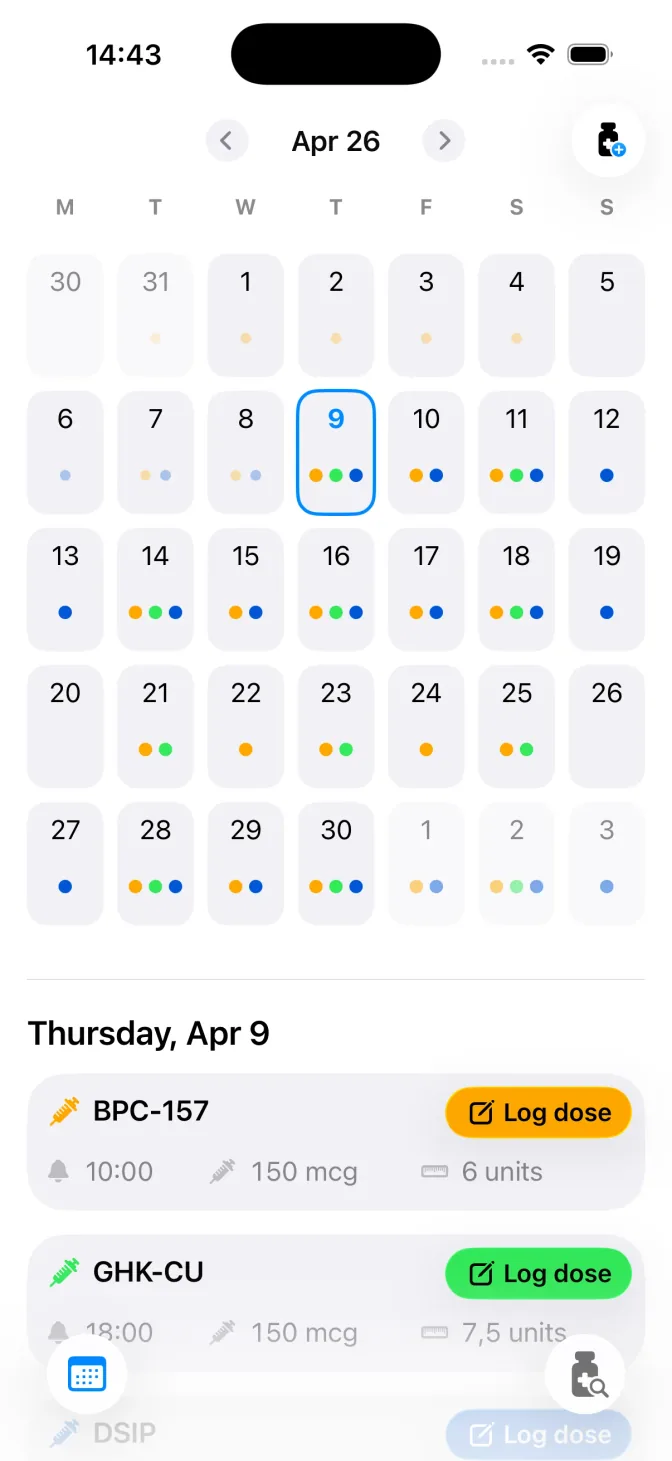
Our tools at PepFlow include a Peptide Calculator, Peptide Knowledge Base, Peptide Cheat Sheet, and Reconstitution Guidelines, alongside scheduling and dose-record features for organizing an established plan. Visit PepFlow for educational references and clearer records to discuss with your clinician, not to determine whether BPC-157 is appropriate or what dose to use.