You’ve got a watch buzzing with sleep scores, a drawer with two half-used supplements, and a feed telling you to try three new routines before breakfast. Nothing feels clearly better, because you changed everything at once and measured none of it properly. That’s the normal starting point, and it’s fixable with a notebook, one small change, and a rule for when to stop.
Table of Contents
- What Biohacking Means for Beginners
- Why Legal and Popular Do Not Mean Proven
- Low-Risk Starter Experiments Compared
- Choosing Metrics and Trackers You Can Trust
- How to Run a Two-Week Self-Experiment
- When to Stop and Involve a Clinician
- Start Your First Logged Experiment This Week
What Biohacking Means for Beginners
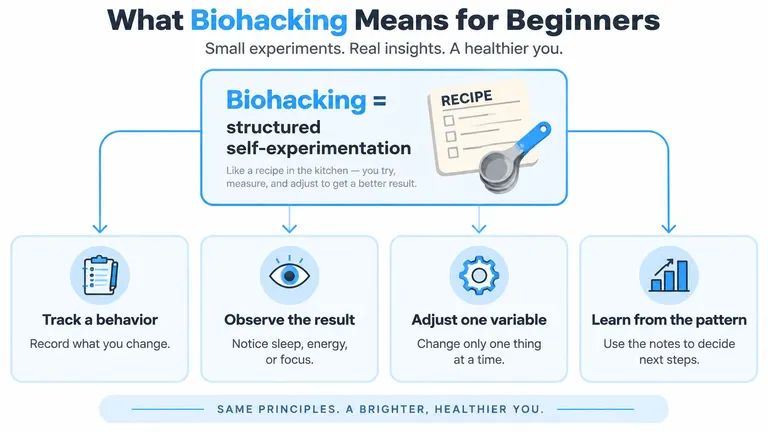
Think of a home kitchen, not a secret laboratory. You test a recipe by changing one thing, say a little less sugar, tasting the result, and writing it on the recipe card. Biohacking for beginners works the same way, only the recipe is your daily routine and the card is a dated log.
In plain terms, it’s structured self-experimentation. You track a behavior or a body signal, change one variable, and compare outcomes over time. You don’t need expensive gear to start. You need a repeatable record.
Wearables have made that record easier to keep. A 2024 estimate on the HearSmart fitness and wearables statistics page reported that 18.5% of U.S. adults used a wearable device daily, compared with 15.1% in 2020, an increase of 3.4 percentage points, or roughly 22.5% relative growth. Adoption isn’t universal, but continuous data is now ordinary.
Measurement Before Optimization
The core loop has three steps. First, establish a baseline by recording your normal routine. Second, make one limited change. Third, review the trend across many days rather than reacting to a single reading.
A dated record of sleep, activity, heart rate, food, symptoms, or supplement use beats isolated measurements because it shows patterns. One great night tells you almost nothing. Fourteen ordinary nights tell you what your sleep looks like.
Practical rule: If you didn’t write down what you changed and when you changed it, you don’t have an experiment. You have a memory, and memory edits itself.
Watch out for the most common beginner trap, confusing correlation with causation. Say your sleep improves the week you start a new evening routine. That change could also reflect lighter training, less caffeine, lower stress, or recovering from illness. The log can’t prove a cause by itself, but consistent entries help you spot those other explanations.
Keep measurement conditions steady, use the same device or scale, and set your review date before you start. What follows gives you a way to judge evidence, a short list of low-risk starters, a method for reading tracker data, a simple two-week protocol, and a clear stop rule.
Why Legal and Popular Do Not Mean Proven
Two products can sit side by side on the same shelf, both legal to sell and both bestsellers, while only one has human evidence behind it. The FDA consumer guidance on dietary supplements explains that the agency is generally not authorized to approve supplements for safety and effectiveness before they reach consumers, under a framework set when the Dietary Supplement Health and Education Act became law in 1994. The FDA also reports that the number of supplement products on the market has multiplied many times over since then.
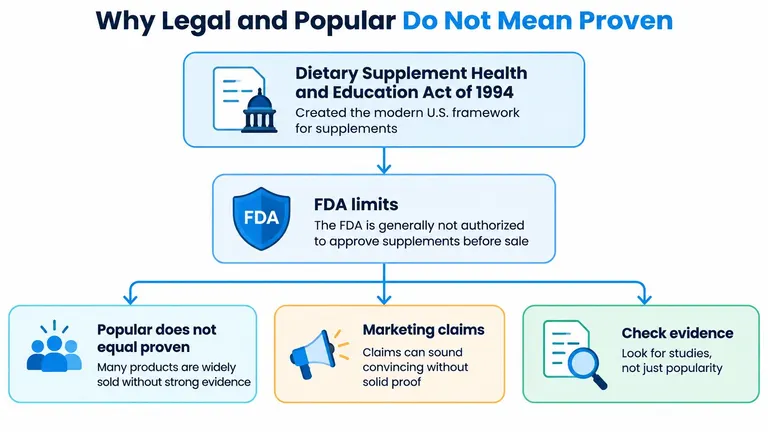
That history matters because available for sale, legal, natural, and clinically validated are four different categories. A product can fit the first three and never reach the fourth.
Popularity is the easiest trap to fall for.
Collagen makes the point cleanly: it is legal, heavily marketed and sold everywhere, and this collagen guidance for Australian supplement shoppers shows how the claims can outrun the human evidence. A bestseller badge is a sales signal, not a study result. Use this ladder as a lookup before anything enters your routine.
| Evidence level | Typical example | What it can show | How beginners should treat it |
|---|---|---|---|
| Approved human treatment | Prescription medicine after clinical trials | Safety and effectiveness for a stated use | Follow the label and clinician guidance |
| Controlled human research | Randomized trial of a supplement | An effect in a studied group, dose and population | Promising; check the study design and dose |
| Animal or laboratory findings | Mouse or cell study | A possible mechanism | Hypothesis only; not proof in people |
| Anecdotal reports | Forum or social media experience | That something happened to one person | Weak; there is no control group |
| Grey-market claims | Unregulated product marketing | Little beyond the seller’s claim | Avoid as a basis for any routine |
Three Checks Before Anything Goes in Your Log
- Identify the exact compound and dose: A brand name isn’t enough, and blends that hide amounts make tracking meaningless. If the label won’t tell you the dose, your log can’t tell you anything either.
- Confirm labeling and source quality: Read the Supplement Facts panel yourself, compare the dose per serving against the dose used in human research, and look for independent third-party testing rather than the seller’s own assurances.
- Look for human study evidence: Testimonials tell you someone liked a product. They don’t tell you it worked.
Keep supplements, prescription medicines, and research chemicals in separate mental boxes, because the rules differ. If you’re unsure where a compound sits, our guide on whether research peptides are legal walks through that distinction. Anything resting on anecdotes or grey-market claims alone is a hypothesis, and hypotheses stay out of your routine until the evidence catches up.
Low-Risk Starter Experiments Compared
Start with the problem you already have, not the trend you just saw. The six options below are ranked roughly from lowest to highest risk, and each one can begin this week without special equipment beyond a phone, a watch, or a notebook.
| Starter experiment | Metric to log | Minimum trial length | Risk level | Clinician check needed |
|---|---|---|---|---|
| Fixed morning light exposure | Sleep onset time, morning alertness (1-10) | 2 weeks | Low | Not usually needed for healthy adults |
| Caffeine cutoff eight hours before bed | Sleep latency and sleep rating | 2 weeks | Low | Consult if you take medication that interacts with caffeine |
| Fixed bedtime window | Time in bed, wake time, alertness | 2-4 weeks | Low | Not usually needed |
| Daily step target of about 7,000 | Steps, resting heart rate, mood | 2-4 weeks | Low | Yes, if you have heart or joint conditions |
| Protein at breakfast | Afternoon energy rating, hunger rating | 2 weeks | Low | Yes, if you have kidney disease or a restricted diet |
| Single supplement added alone | Sleep rating, symptoms, adherence | 4 weeks | Moderate | Yes, if you take any medication |
How to Pick Your First Row
Match the experiment to your complaint. If you crash at 3 p.m., try protein at breakfast and rate afternoon energy daily. If you’re wide awake at midnight, try the caffeine cutoff or a fixed bedtime window instead. Testing a sleep fix when your problem is afternoon hunger gives you clean data about the wrong question.
Notice what’s missing. Peptides and injectable compounds aren’t on this list because they aren’t beginner experiments. They carry dosing, storage, sterility, and interaction questions that a starter trial can’t answer safely.
A clean low-risk trial teaches you how to measure. That skill transfers to everything else you’ll ever test.
The supplement row is the only moderate-risk option, so it shouldn’t come first. Run one low-risk trial cleanly, then consider a single supplement added alone. If you’re comparing products in that category, a catalogue page such as the Supplemynts longevity supplement selection is a place to read labels, not a substitute for the evidence checks. Our overview of longevity supplements can help you sort claims before you buy.
Any supplement or medication change needs a clinician check before the trial begins, especially if you take other medication. A stable baseline matters more than speed. Two patient weeks beat four chaotic ones.
Choosing Metrics and Trackers You Can Trust
Your tracker is a helpful estimator, not a laboratory. Consumer sleep wearables infer sleep from movement and pulse, so quiet wakefulness in bed can be scored as sleep and restless sleep can be scored as wake. That single fact explains most confusing scores.
Compared with polysomnography (PSG), the reference standard that records brain, eye, muscle, and cardiovascular signals, the umbrella review of consumer sleep wearables found that wearables commonly overestimate total sleep time and sleep efficiency while underestimating wake after sleep onset, with an average total-sleep-time difference of approximately 22 minutes per day and overestimation often exceeding 10%. Errors varied substantially by device, user, sleep metric, and context.
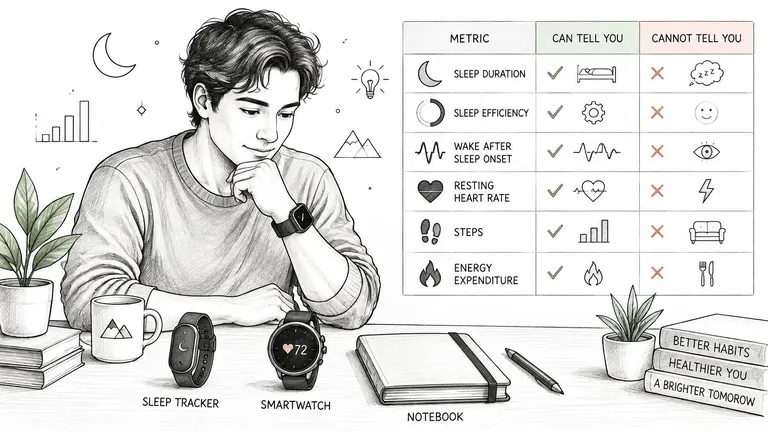
| Metric | Typical source | Good for trends? | Trust as an exact value? |
|---|---|---|---|
| Sleep duration | Wrist accelerometer and pulse sensor | Yes, over 2-4 weeks | Low; often overestimated |
| Sleep efficiency | Same sensors | Yes, over 2-4 weeks | Low; often overestimated |
| Wake after sleep onset | Same sensors | Yes, with caution | Low; often underestimated |
| Resting heart rate | Optical pulse sensor | Yes, if worn daily | Moderate; varies with fit |
| Steps | Accelerometer | Yes | Moderate; check against a manual count occasionally |
| Energy expenditure | Heart rate and activity algorithms | Weak | Low; error often large |
| Subjective alertness | Daily 1-10 rating in your log | Yes | Not a device value; consistency matters |
A Worked Example of Noise
Say your deep-sleep score drops 15 points after a late workout, and you feel tempted to move training to the morning. Before you rebuild your schedule, check the two-week trend. If sleep onset time, wake time, and your morning alertness rating are unchanged across that period, that single score is most likely noise. The right decision is to keep logging, not to change the routine.
Your bedroom environment belongs in the log too, since stuffy or polluted air can disturb sleep. If you suspect air is part of the picture, you can find an indoor air quality monitor and record readings alongside your sleep notes. For the tracking side, our roundup of the best health tracking apps compares tools that keep these entries in one place.
Wear one device consistently, because switching devices mid-trial changes the ruler. Rate alertness by hand each morning, since that simple 1 to 10 score often tracks how you function better than a proprietary sleep stage estimate. Treat large changes in daytime symptoms or repeated suspected breathing disturbances as reasons to consult a clinician, not as puzzles for self-treatment.
How to Run a Two-Week Self-Experiment
Three terms make the whole method click. An N-of-1 design means you are your own control, so the trial compares you against yourself rather than against strangers. The BMJ guide to N-of-1 trials describes this design as highly relevant for individual treatment decisions because the same person serves as their own control.
A-B-A-B alternation means A is your normal routine and B is the single change, repeated in blocks. A confounder is anything else that can move your outcome, such as travel, illness, a hard training session, alcohol, or a late meal. You can’t eliminate confounders, but you can write them down.
The diagram below sums up the flow before the detailed steps.
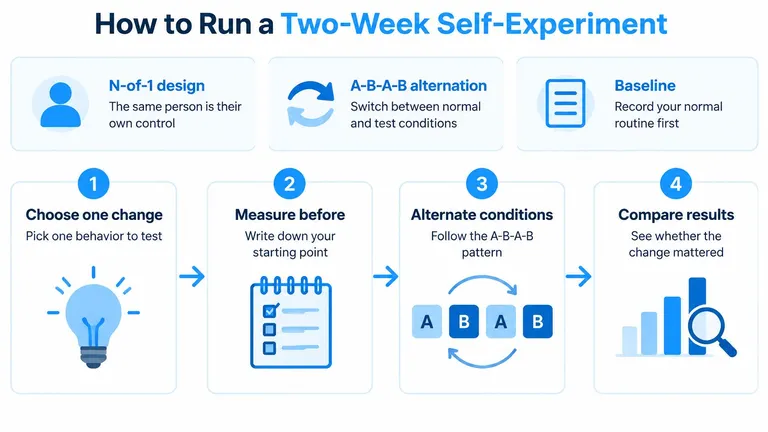
The Eight Steps
- Pick one measurable outcome: Choose sleep onset time or afternoon energy rated 1 to 10. The common slip is tracking several outcomes at once, then cherry-picking whichever moved.
- Record a baseline: Log your normal routine (A) for 1 to 2 weeks without changing anything. The slip is starting the change on day two because you’re excited.
- Choose one low-risk variable: Pick something like a fixed morning light routine or a consistent caffeine cutoff. Keep everything else as steady as life allows.
- Alternate in blocks: Run A-B-A-B blocks of about one to two weeks each. Returning to A shows whether the effect disappears when the change does, which strengthens your conclusion.
- Log daily: Write down adherence, the outcome value, and confounders every day, including the messy days. Missing entries usually hide the very days that explain your results.
- Define success in advance: Write what counts as meaningful, for example sleep onset 20 minutes earlier on most nights, plus your stop rule for adverse effects. Deciding afterwards lets hope rewrite the target.
- Review the whole block: Compare averages and trends across blocks, not single days. One favorable night can reflect regression to the mean, where an unusually bad stretch naturally drifts back toward normal.
- Stop if harm appears: End the experiment at once if you notice an adverse effect, and don’t restart it to check whether it happens again.
If a video walkthrough helps these ideas stick, watch the short explainer below and then return to your own log.
What a trend summary sounds like: During baseline weeks, sleep onset averaged around 11.40 p.m. During both morning-light blocks, it shifted earlier on most nights, and it drifted later again in the second baseline block. That pattern supports keeping the light routine and retesting in winter.
That’s the standard you’re aiming for. It’s modest, specific, and honest about uncertainty. A well-run small experiment that shows no effect is still a success, because it saves you months of effort on something that doesn’t help you.
When to Stop and Involve a Clinician
Curiosity has a boundary, and knowing where it sits is a skill, not a failure. This matters most with peptides, which are heavily promoted in biohacking circles. The Stanford Medicine explainer on peptide science notes that some heavily promoted peptides have not been tested in humans or manufactured through a regulated process, leaving uncertainty about both efficacy and contamination risk.
A separate medical review covered in that discussion reports that many commonly discussed peptides lack reliable human safety profiles. Reported risks from non-sterile injectable products include abscesses, cellulitis, systemic inflammatory reactions, and hospital-treated infections. Those aren’t minor side effects you can troubleshoot with a spreadsheet. They’re medical events.
The Contrarian Lesson
Natural, research-grade, and widely discussed don’t mean low-risk. A compound can be all three and still have no human safety data behind it. The biggest upgrade for many beginners isn’t a new device or product. It’s learning when not to experiment.
If you can’t state the human evidence, the regulatory status, and your stop rule in three sentences, you’re not ready to test it.
Clinician Triggers
- Any injectable compound: Sterility, dose calculation, storage, and administration all carry medical consequences.
- Pregnancy: Safety data for most supplements and experimental compounds doesn’t exist here.
- A chronic disease: Kidney, heart, metabolic, or psychiatric conditions change how interventions behave.
- Any concurrent medication: Interactions can turn a mild supplement into a real problem.
- Any new, severe, or persistent symptom: Pain, rash, swelling, fever, palpitations, or mood changes end the experiment.
The action is simple. If a symptom appears during an experiment, stop the experiment and contact a clinician. Don’t lower a dose, swap products, or wait a week to see whether it settles. Bring your log, because dated entries help a clinician see timing clearly.
A tracker or calculator is a record, not a treatment adviser. It can show what you did and when, but it can’t decide whether a regimen is appropriate for you. Stop rules written before the trial are your first line of defense, because they’re set by the calm version of you. If you meet any trigger on that list, you’ve left the beginner track, and medical care takes over from self-experimentation.
Start Your First Logged Experiment This Week
Pick one experiment from the starter table today. Before you change anything, write three things on paper: the outcome you’ll measure, the baseline length, and your stop rule. That half page is your protocol, and it’s what separates an experiment from a whim.
Your Daily Log Template
- Date: The calendar date, every day, even on rest days.
- Routine: A for normal, B for the changed condition.
- Adherence: Did you do the change today, yes or no.
- Outcome value: Your chosen number, such as sleep onset time or energy rated 1 to 10.
- Confounders: Travel, illness, alcohol, hard training, late meals, unusual stress.
- Short note: One line on anything the numbers miss.
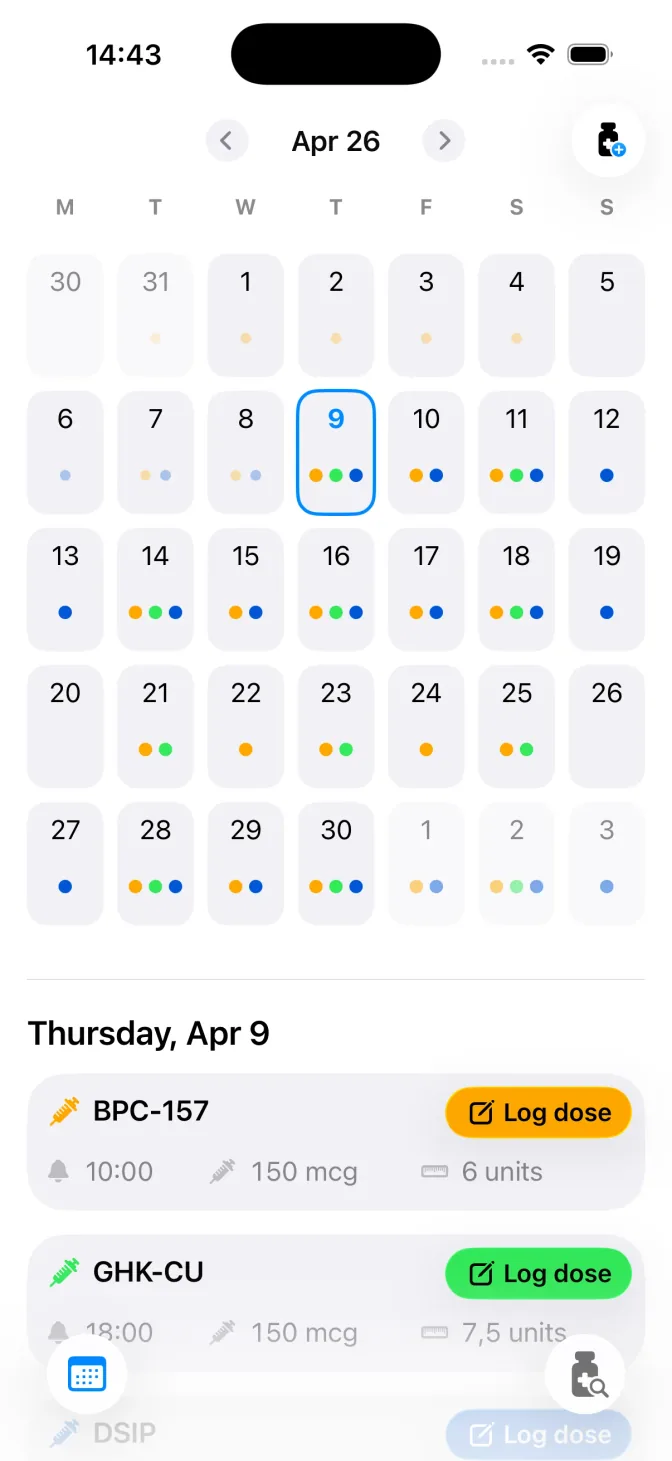
Set your review for the end of week two. Compare block trends, not single heroic or terrible days, and count how many days you adhered before judging the result. Paper works fine. A simple digital log works too, as long as dated entries and reminders stay in one place and don’t get lost. In our case, PepFlow stores the personal data you provide, including protocols, dose logs, schedules, and saved preparation details, which suits people following an established routine set with professional guidance.
Keep the log’s job narrow. It records and reminds. It doesn’t decide whether an experiment is appropriate, and your beginner log shouldn’t be calculating doses for anything. If a symptom or medication enters the picture, the log goes with you to a clinician.
At review, you have three honest options. Keep the change if the trend met your preset target, drop it if nothing moved, or retest it with a longer baseline if life was too chaotic to tell. Choose one, write it down, and start the next small question. That’s biohacking for beginners done properly, one recipe card at a time.
Ready to keep your experiments and any established routine organized in one place? PepFlow helps you calculate the right dosage, manage your personal cycled protocols, and sends notifications so you don’t miss any dose, while your dated dose history stays ready to review or share with your clinician. Visit PepFlow to set up your schedule, log your first entries, and turn this week’s baseline into a record you’ll trust.