
There is no evidence-based best time to take IGF-1 LR3 established in published human research. The clinically backed timing rule belongs to FDA-approved mecasermin, not LR3: administer it within approximately 20 minutes before or after a meal or snack.
That distinction undermines the popular advice to inject before training, immediately afterward, or during a fasted morning routine. A confident schedule isn’t the same as a tested schedule, and a workout window can’t substitute for glucose-risk management.
My recommendation is straightforward: don’t build an LR3 injection routine from fitness folklore. Ask a licensed clinician whether any IGF-1-related treatment is appropriate before discussing timing, food, monitoring, or reminders.
Table of Contents
- Why the Best Time Question Is Miscast
- What IGF-1 LR3 Actually Is and Why That Matters
- What Exercise Studies on Native IGF-1 Actually Show
- Half-Life Claims and the Local Effect Trap
- The Meal-Linked Safety Rule That Actually Holds
- Cutting Through Pre-Workout, Post-Workout, and Bedtime Myths
- Building a Clinician-Supervised Scheduling Framework
- Frequently Asked Questions on IGF-1 LR3 Timing
Why the Best Time Question Is Miscast
Searching for the best time to take IGF-1 LR3 usually means searching for a performance advantage. Readers want to know which moment will produce better recovery, more muscle, or less interference with their training. The problem is that recommending a moment assumes researchers have already established how the injected analogue behaves in humans.
They haven’t established a clinically validated LR3 timing protocol. Consequently, morning, evening, and workout-linked recommendations aren’t competing medical options supported by comparative evidence. They’re proposed routines, and readers shouldn’t mistake their popularity for proof.
Safety before synchronization
The strongest practical anchor comes from a different product. The FDA mecasermin prescribing information instructs administration within approximately 20 minutes before or after a meal or snack, with a dose skipped when the meal is missed.
That instruction addresses a pharmacological safety concern, not a muscle-building opportunity. It also belongs to mecasermin specifically. It doesn’t establish a safe LR3 schedule, a suitable LR3 dose, or permission to self-administer a research analogue.
A familiar injection time is an organizational choice. It isn’t evidence that an injection is appropriate or safe.
A better starting question is whether a clinician has assessed the treatment, eating pattern, medication list, and monitoring needs. Only after those decisions should a calendar or reminder enter the discussion.
Don’t borrow the supplement mindset
Fitness readers often approach peptides as another item in a supplement routine. For a separate discussion of ordinary strength-supplement scheduling, NZ Supps’ creatine intake schedule for strength provides relevant context. It shouldn’t be used as an analogy for deciding when to inject a growth-factor analogue.
The trade-off is plain: a clock-time answer is convenient, while a clinician-led assessment takes more effort. Convenience doesn’t resolve missing clinical evidence. Reject any advice that treats food availability and medical monitoring as optional details after the workout schedule has already been chosen.
What IGF-1 LR3 Actually Is and Why That Matters
Native IGF-1, mecasermin, and IGF-1 LR3 aren’t interchangeable names for the same clinical product. Native IGF-1 is the naturally occurring growth factor. Mecasermin is recombinant human IGF-1 used in a defined medical setting, while LR3 is a modified research analogue.
The clinical overview distinguishing LR3 from mecasermin explains that mecasermin’s FDA-approved use is limited to children with severe primary IGF-1 deficiency or growth-hormone gene deletion with neutralizing antibodies. That approval doesn’t cover adult muscle gain, recovery, longevity, or athletic performance.
The concept map below separates these categories. Any reference in the graphic to extended LR3 activity should be read as a proposed characteristic, not an established human duration.
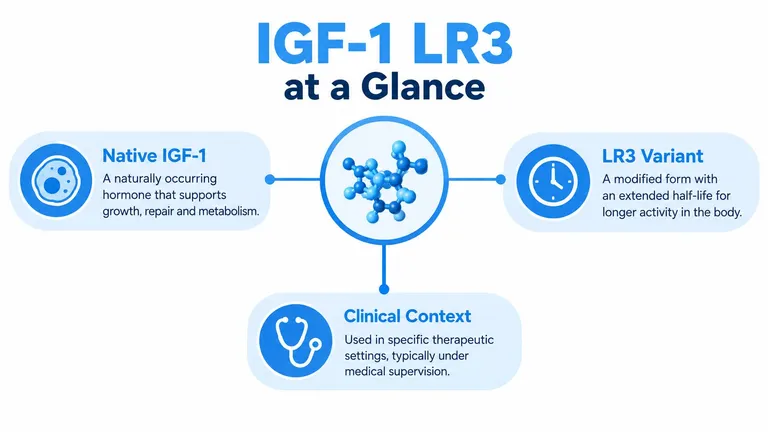
Similar names don’t establish equivalent behavior
Think of native IGF-1 as a key and LR3 as a modified version of that key. The analogy helps explain why related molecules can interact with the same biological system without behaving identically throughout the body. It does not prove that the modified key lasts longer in humans or produces better results.
The relevant distinctions include:
- Binding-protein interactions: Related molecules can interact differently with the proteins that carry IGF-1.
- Free fraction and distribution: Their availability and movement through the body cannot be assumed equivalent.
- Clearance: Information about one form doesn’t automatically establish how another disappears from circulation.
These differences are why a timing rule borrowed from another IGF-1 product needs explicit limits.
Read educational material with a clinical filter
Readers exploring Peptoro’s peptide research for self-improvement should distinguish descriptions of research interest from evidence supporting human treatment. Likewise, the publisher’s IGF-1 injection overview should be treated as educational context, not an individualized prescription.
Ask what molecule a claim concerns, what population was studied, and whether the evidence measured clinical outcomes. If those details aren’t clear, don’t convert the claim into an injection schedule. Take the uncertainty to a clinician instead.
What Exercise Studies on Native IGF-1 Actually Show
Exercise-related IGF-1 research can look like a rationale for post-workout LR3 use. The reasoning sounds plausible: exercise changes naturally occurring IGF-1, so adding an injected analogue near training should improve the response. The second part, however, doesn’t follow from the first.
A 2020 randomized crossover study of exercise, protein intake, and circulating IGF-1 involved 24 young adults completing meal, exercise, and exercise-followed-by-meal conditions. In the exercise-only condition, free IGF-1 increased by 3.14 pg/mL roughly 30 minutes after exercise, with a 95% confidence interval of 0.39–5.90 pg/mL and p=0.04.
What the finding supports
The study supports a specific observation about endogenous free IGF-1 after the exercise condition. Researchers measured a naturally occurring substance in healthy participants. They didn’t test injected LR3 or compare LR3 administration before and after training.
| Question | What the exercise finding establishes |
|---|---|
| Can exercise change measured endogenous free IGF-1? | Yes, under the studied conditions |
| Does that identify an LR3 injection window? | No |
| Does it establish better LR3 recovery outcomes? | No |
| Does it compare LR3 timing-related safety? | No |
Statistical significance doesn’t enlarge a study’s scope. A measured change in circulating IGF-1 isn’t a measurement of muscle growth, and it isn’t evidence that adding an analogue at that moment improves adaptation.
Where the timing argument breaks
The unsupported leap occurs when someone turns an endogenous response into an administration recommendation. To justify that recommendation, researchers would need to study the injected molecule and the relevant outcomes, not merely observe the body’s response to exercise.
Readers interested in training-related growth-factor discussions can use the mechano growth factors overview as additional educational context. Keep the same standard: a biological explanation isn’t a validated treatment protocol.
My advice is to reject workout-timing recommendations that cite native IGF-1 exercise research as if researchers administered LR3. Ask your clinician what evidence applies to the product under discussion. If the evidence doesn’t test that product, the recommendation shouldn’t be presented as established practice.
Half-Life Claims and the Local Effect Trap
The often-repeated LR3 half-life estimate sounds precise enough to support a routine. It isn’t. Even a valid half-life measurement would answer only part of the timing question, and a borrowed estimate answers less.
A review of IGF-1 physiology and circulating forms describes an approximately 4-hour half-life for free IGF-1 and roughly 18–20 hours for the circulating 150-kDa IGF-1 complex. Those values describe different biological forms, not interchangeable measurements of LR3.
Comparing IGF-1 Half-Life Estimates and What They Cover
| Molecule or Form | Quoted Half-Life | Evidence Base | Applies to LR3? |
|---|---|---|---|
| Free native IGF-1 | Native free-form estimate described above | IGF-1 physiology literature | No |
| Circulating IGF-1 complex | Bound-complex estimate described above | Literature on circulating complexes | No |
| IGF-1 LR3 | Commonly repeated extended-duration estimate | No validated human benchmark established | Not a dependable scheduling basis |
The key distinction isn’t short versus long. It’s which molecule was measured, in which form, and under what conditions. A claim about a circulating complex can’t become a claim about a modified analogue.
Separate duration from destination and benefit
Evaluate timing claims through distinct questions:
- Plasma persistence: How long does a substance remain measurable in circulation?
- Receptor exposure: What exposure do receptors receive?
- Tissue targeting: Does the proposed schedule preferentially affect the intended tissue?
- Functional outcomes: Does that schedule improve recovery, performance, or another clinically relevant result?
Someone may discuss persistence and then jump straight to muscle-specific benefits. That’s not a demonstrated chain of evidence.
Staying in circulation and producing a useful, safe outcome are different questions.
The “local effect” argument makes another leap when it treats administration around a trained muscle as proof of targeted growth. A timing preference doesn’t establish tissue selectivity, and tissue selectivity wouldn’t by itself prove a useful outcome.
Don’t let a half-life estimate become a daily-frequency recommendation, an injection-site recommendation, or a promise of muscle gain. A clinician should evaluate whether treatment is appropriate, rather than use an uncertain duration claim to rationalize an otherwise unsupported regimen.
The Meal-Linked Safety Rule That Actually Holds
For someone prescribed mecasermin, meal timing is a treatment instruction, not a suggestion for optimizing training. The FDA mecasermin safety labeling links administration to food because of insulin-like glucose-lowering effects, recommends glucose monitoring when treatment begins, and identifies hypoglycemia symptoms including dizziness, confusion, seizures, and loss of consciousness.
The graphic below concerns mecasermin specifically. It must not be treated as an LR3 administration guide.
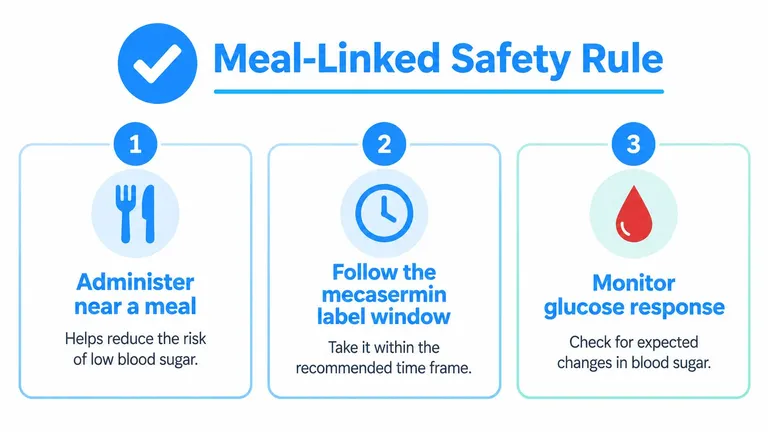
Confirm readiness before following a prescribed schedule
A useful readiness check asks whether the circumstances match the clinician’s plan. A reminder alone can’t answer that question.
- Food is available: Confirm that the planned meal or snack can be eaten.
- Timing matches the prescription: Follow the meal-linked label window and your prescriber’s instructions, rather than a gym routine.
- Monitoring is arranged: Know when to check glucose and what actions your clinician has specified.
- The plan hasn’t changed: Bring illness, disrupted eating, medication changes, or unusual exercise demands to the treating clinician.
If the meal is missed or eating isn’t possible, the mecasermin instructions call for skipping the dose. Don’t compensate later or invent a replacement schedule. Ask the prescriber how to resume the prescribed routine.
Record observations without improvising adjustments
A paper diary, spreadsheet, or scheduling app can record the prescribed administration time, meal context, glucose readings when directed, and symptoms. These records help a clinician review what happened; they don’t tell you how to alter treatment independently.
Safety boundary: Having food nearby doesn’t validate LR3 use or eliminate the need for medical oversight.
Dizziness or confusion deserves prompt attention under the clinician’s hypoglycemia plan. Seizures or loss of consciousness require emergency assistance, not a routine message or an app entry.
The practical lesson is narrower than an LR3 protocol: clinically supported IGF-1 treatment requires attention to food and glucose risk. Applying that concern responsibly means seeking medical assessment, not copying mecasermin instructions onto a different molecule.
Cutting Through Pre-Workout, Post-Workout, and Bedtime Myths
The common timing recommendations differ in their stories, not in the strength of their human LR3 evidence. One appeals to training synergy, another to recovery, and another to nighttime hormone patterns. None provides a clinically established performance window for LR3.
The comparison below is a prompt to examine those assumptions, not a menu of administration options.
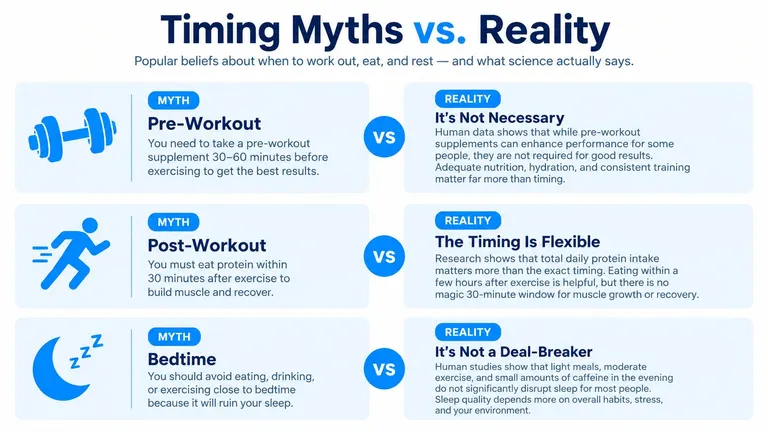
Pre-workout and post-workout claims
Pre-workout advice assumes synergy. It treats simultaneous training and analogue exposure as beneficial, without establishing the exposure or comparing outcomes. Don’t reorganize treatment around a supposed synergy that hasn’t been demonstrated.
Post-workout advice relies on a different shortcut. It takes the endogenous exercise finding discussed earlier and converts it into an injection opportunity. The safer alternative isn’t automatically another injection time; it’s refusing that conversion and following a clinician’s product-specific instructions.
For a separate nutrition discussion, you can check Gym Snack’s post workout tips. Keep snack planning separate from peptide prescribing, and don’t interpret a post-workout food recommendation as evidence for LR3 use.
The embedded video is supplemental viewing, not a replacement for product-specific clinical evidence.
Bedtime claims and athlete responsibilities
The bedtime argument assumes an injected analogue can reproduce or enhance natural hormone rhythms. That rationale doesn’t establish a safe nighttime schedule, especially when eating and monitoring arrangements haven’t been assessed.
Compare the claims by asking what each leaves unanswered:
- Pre-workout: Where is the evidence of superior outcomes from simultaneous exposure?
- Post-workout: Where is the injected-LR3 study rather than an endogenous-hormone observation?
- Bedtime: Where is the evidence that this analogue safely reproduces the proposed rhythm?
Athletes also need to check the current anti-doping rules that govern their competition, with their medical team or relevant sporting authority. Don’t assume a research designation, a timing choice, or a clinician conversation resolves eligibility.
My recommendation is consistent across these myths: don’t replace missing evidence with a persuasive mechanism. For prescribed IGF-1 treatment, prioritize the actual label and clinician’s instructions, not the training narrative.
Building a Clinician-Supervised Scheduling Framework
A responsible schedule begins with a treatment decision, not a notification. Ask a licensed medical professional to assess whether an IGF-1-related therapy is appropriate and whether the proposed product has evidence applicable to your situation.
The LR3 evidence and pharmacokinetic limitations overview identifies no published human dataset supplying LR3-specific numbers for absorption, peak concentration, bioavailability, half-life, glucose effects, or adverse-event rates. A tracker can’t fill those gaps, and supervision doesn’t make an unvalidated timing claim valid.
Organize the prescribed plan, not an experiment
Bring your clinician a medication list, eating pattern, training routine, and any existing dose history. Ask for explicit instructions about monitoring, missed meals, symptoms, and when to seek help.
| Planning detail | What to clarify with the clinician |
|---|---|
| Treatment and product | Whether use is appropriate and supported |
| Food context | What the prescribed product requires |
| Monitoring | What to measure and how to respond |
| Schedule disruption | What to do rather than improvise |
| Follow-up | How records will be reviewed |
For recordkeeping ideas, the dosing schedule planning guide provides organizational context. Use scheduling resources to document an established medical plan, not to generate one.
The screenshot illustrates an organizational interface rather than evidence of treatment safety.
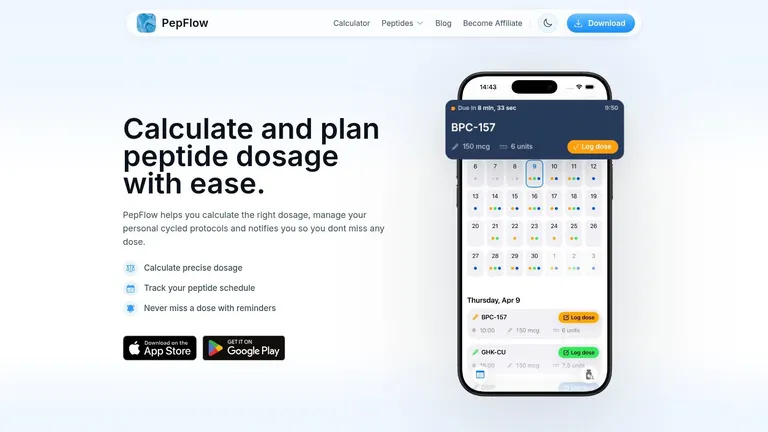
Keep observations separate from conclusions
Record actual administration times, meal proximity, clinician-directed glucose measurements, and symptoms. Subjective recovery notes can add context, but feeling better doesn’t establish that a regimen is safe or that its timing caused the change.
Review those records at medical appointments instead of adjusting dose, frequency, or timing yourself. If competition is relevant, include anti-doping compliance in that review.
The useful framework is assessment, explicit instructions, documentation, and reassessment. Consistency serves accountability. It isn’t proof that repeated use is medically justified.
Frequently Asked Questions on IGF-1 LR3 Timing
Can I fit LR3 into intermittent fasting?
Don’t create a fasted LR3 schedule from online advice. Discuss your eating window with a clinician before considering any IGF-1-related treatment. The mecasermin food requirement isn’t evidence that another product becomes safe once the fast ends.
Does alcohol the night before change timing?
There’s no validated LR3 interval that makes prior alcohol consumption irrelevant. Tell the clinician what you drank and whether your eating pattern or ability to monitor has changed. Don’t compensate by moving an injection to a different hour.
What if I take insulin or a sulfonylurea?
Bring the exact medication names and prescribed doses to your treating clinician. Given the glucose-regulation concerns discussed earlier, don’t combine treatments or adjust diabetes medicines independently. Ask for a product-specific assessment and monitoring plan.
What should I do when a planned meal is missed?
For prescribed mecasermin, follow the missed-meal instruction already described and contact the prescriber if resuming the schedule is unclear. For LR3, don’t invent a catch-up dose or assume the mecasermin rule supplies a complete protocol.
A scheduling problem isn’t a reason to improvise medical treatment. Get the treatment decision and contingency instructions settled first.
PepFlow offers dosage calculation, configurable schedules, reminders, and dose-history tracking as an organizational option alongside a paper diary or spreadsheet. Visit PepFlow to organize a clinician-established routine and keep administration records for follow-up, not to generate an unsupported LR3 timing protocol.