Most advice about MGF starts from the conclusion: it’s the muscle repair peptide, so the only question is how powerful it is. That framing is too simple.
Mechano growth factors are interesting because the biology is real, specific, and unusually elegant. But the commercial story built around that biology often skips a harder truth. A signal that appears inside damaged muscle at the right moment is not automatically the same thing as a synthetic peptide injected from the outside. That gap matters.
The result is a topic that attracts both serious scientific interest and a lot of overconfident claims. In animal and lab contexts, MGF has shown striking regenerative behavior. In one preclinical murine line of research, MGF exposure over three weeks increased mean muscle fiber size by 25% according to the Mechano Growth Factor overview. At the same time, some later work failed to reproduce the expected effects in human muscle cells.
If you want to understand MGF well, don’t ask only, “Does it work?” Ask better questions. What exactly is MGF? When does the body make it? What does it seem to do in a tissue-repair setting? And why do positive findings and negative findings coexist?
That approach makes this topic much more useful. Instead of repeating peptide folklore, you can learn how to evaluate mechanistic claims, research formulations, and the difference between endogenous biology and exogenous use.
Table of Contents
- Introduction The Promise and Puzzle of MGF
- What Exactly Is Mechano Growth Factor
- How MGF Initiates Muscle Repair
- MGF vs IGF-1 A Critical Comparison
- MGF Research Applications and Formulations
- Evaluating MGF Efficacy and Safety
- Common Questions About Mechano Growth Factors
Introduction The Promise and Puzzle of MGF
MGF has a reputation problem. In peptide circles, it’s often presented as if the science were already settled and only the protocol details remained. That isn’t what the literature shows.
What makes MGF compelling is that it fits a believable biological role. Muscle gets mechanically stressed, local repair signals turn on, and stem-like satellite cells need to respond quickly. MGF appears in that early response window, which is why people talk about it as a kind of first alert for tissue repair.
That story has enough truth in it to be persuasive. It also has enough missing context to mislead readers.
Why this topic stays controversial
The central puzzle is simple. Endogenous MGF appears to be part of how muscle responds to damage. But the evidence for exogenous MGF peptide use, especially in human muscle cell settings, is much less clean. Some findings suggest strong proliferative effects in certain models. Other findings don’t show the expected response at all.
Bottom line: MGF is neither obvious nonsense nor proven miracle. It’s a real biological concept sitting inside an unsettled translational story.
That distinction matters for anyone reading peptide forums, product pages, or “recovery stack” recommendations. A lot of advice collapses several different ideas into one bucket:
- The body’s own MGF expression after damage
- Synthetic MGF peptide used in experiments
- PEG-MGF, a modified formulation designed for longer activity
- Assumptions about human outcomes based on animal or cell data
Those aren’t interchangeable.
A better way to think about the claim
The useful question isn’t whether MGF sounds anabolic. It clearly intersects with repair biology. The useful question is whether a particular formulation, in a particular context, produces a meaningful effect that replicates.
That’s the lens worth keeping throughout this topic.
What Exactly Is Mechano Growth Factor
Mechano Growth Factor, usually shortened to MGF, isn’t a completely separate hormone unrelated to IGF-1. It’s a specific splice variant produced from the IGF-1 gene under conditions such as mechanical stress or hypoxia. In the verified literature, MGF is described specifically as the IGF-IEb mRNA splice variant, induced immediately after mechanical damage to skeletal muscle, with later up-regulation of the IGF-IEa variant during the repair timeline according to Endocrinology.
A plain-English analogy helps. Think of the IGF-1 gene as a master workshop. It can produce different tools depending on the problem. MGF is one of those specialized tools. The body seems to pull it out when tissue has been mechanically strained and needs an early, local response.
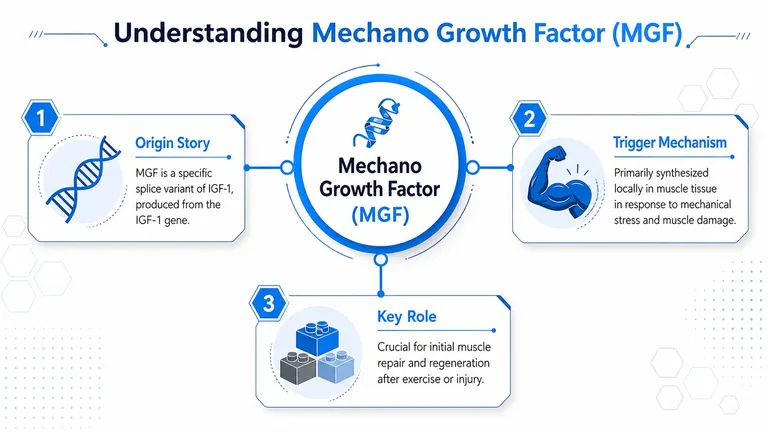
The IGF-1 gene uses different versions for different jobs
Alternative splicing sounds technical, but the core idea is simple. One gene can be edited into different message versions before the cell builds the final product. That’s how the body gets multiple functional outputs from the same genetic template.
In MGF’s case, this splicing process generates a distinct 24-amino-acid C-terminal E-peptide fragment, called MGF-Ct24E, in response to mechanical or hypoxic stress as described in Endocrinology. That fragment is the part often discussed in relation to satellite cell activation and repair signaling.
If you’ve ever looked into other regenerative approaches where the local tissue environment matters more than broad systemic signaling, the same logic shows up elsewhere. A good example is how clinicians discuss localized biologic approaches like PRP for hair rejuvenation, where the important question isn’t just “what molecule is involved?” but “where, when, and in what tissue context is it acting?”
Why the local nature of MGF matters
The perception of MGF often leads to misconceptions. They hear “IGF-1 variant” and assume MGF is just a smaller version of systemic IGF-1. It isn’t that simple.
Systemic IGF-1 is usually discussed as a broader growth-related signal. MGF is better understood as a local emergency repair crew. It appears tied to the early period after mechanical insult, not to general whole-body growth messaging.
MGF makes the most sense when you picture it as a short-lived, on-site repair instruction rather than a circulating growth program.
That local framing also helps explain why translation to peptide products is difficult. A signal that evolved to appear briefly, inside stressed tissue, may not behave the same way when isolated, synthesized, and used outside that exact context.
How MGF Initiates Muscle Repair
Mechanical damage doesn’t repair itself. Muscle fibers need a coordinated response, and one of the first jobs is to mobilize satellite cells, the stem-like cells that sit alongside muscle fibers waiting for a signal.
MGF’s proposed role is early and specific. It doesn’t “build the whole muscle” by itself. It appears to help push the repair system into action, especially by promoting cell proliferation.
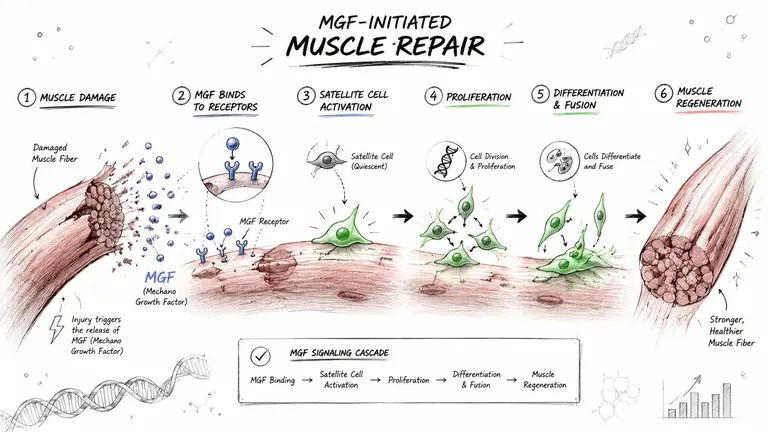
From mechanical stress to a repair signal
A useful way to visualize the process is as a sequence:
- Mechanical strain occurs. Training, overload, or injury creates local tissue disruption.
- The muscle changes gene expression. The mechano-sensitive IGF splice response turns on.
- MGF-associated signaling appears early. This is the “wake up” phase, not the full rebuild.
- Satellite cells leave a resting state. They begin preparing to divide.
- Cell proliferation increases. The repair system expands the pool of available cells.
- Later-stage repair signals take over. Other growth and differentiation pathways shape the tissue that follows.
That early timing is the key idea. MGF seems less like the bricks and more like the foreman who tells the crew to show up.
For people interested in broader recovery biology, this early-phase signaling logic fits alongside other tissue-repair discussions, such as the overview of peptides for tissue repair. The important distinction is that MGF is usually framed as an initiator of local regenerative events, not a catch-all recovery compound.
What the cell cycle data actually means
The strongest mechanistic appeal of MGF comes from cellular work on the MGF-Ct24E fragment. In that research, MGF-Ct24E showed the highest pro-proliferation activity among three tested growth factors, with activity 1.4 times greater than standard IGF-1, and it shifted cell accumulation in the G2/M phase from 4.85% to 26.63% while increasing S-phase DNA synthesis from 10.98% to 31.88%. The same study reported an effective fivefold enhancement of mitosis activity through promotion of entry into G2/M according to Endocrinology.
Those numbers sound abstract, so here’s the plain-language translation. Cells move through a cycle before they divide. If more cells are being pushed into the phases associated with DNA synthesis and division, the tissue has more raw material available for repair.
Practical interpretation: MGF’s headline action in the lab isn’t “instant hypertrophy.” It’s stronger evidence for helping cells enter a proliferative repair state.
That matters because people often confuse proliferation with mature muscle growth. They’re related, but they’re not the same step. A signal can be very good at expanding precursor cells and still not be the main driver of later differentiation, fusion, or long-term tissue architecture.
If someone is recovering from training and seeking hands-on care for actual movement problems, those decisions still belong in the world of sports medicine and rehab, not peptide mythology. Resources like the guide from Aspen Falls Wellness chiropractors are useful reminders that tissue recovery is usually multi-factorial.
MGF vs IGF-1 A Critical Comparison
People often treat MGF and IGF-1 as if one were just a stronger or more targeted version of the other. That shortcut creates confusion.
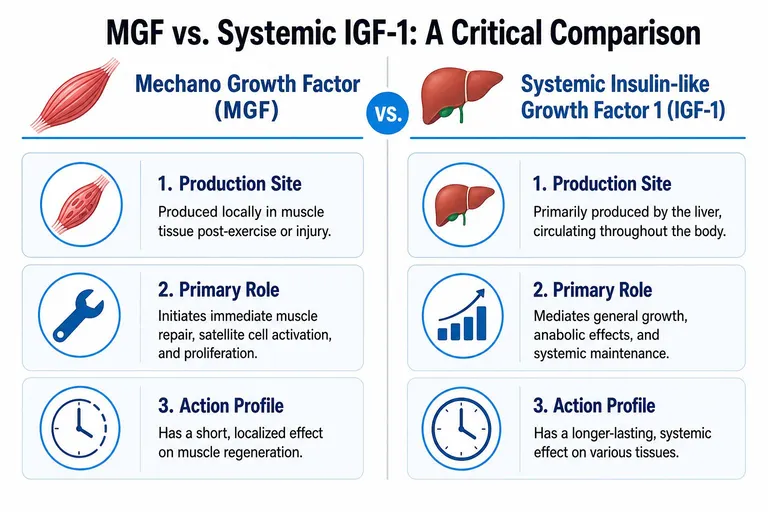
They’re related because they come from the same gene family context. But functionally, they don’t occupy the same niche. A better comparison is this: IGF-1 is the broader growth program, while MGF is the local repair dispatch.
They share a gene but not the same job description
The clearest distinction is scope. MGF is discussed as a local, transient response tied to mechanical stress and tissue repair. Systemic IGF-1 is associated with a more distributed, body-wide growth signal.
That difference in scope shapes what readers should expect. If you’re evaluating peptide claims, don’t assume “IGF-related” means “same outcome, different brand.” Biology is less tidy than that.
A broader peptide context can be useful here too. Readers comparing how MGF is positioned relative to other compounds should keep in mind that popularity lists and mechanistic certainty aren’t the same thing.
MGF vs Systemic IGF-1 Key Distinctions
| Characteristic | Mechano Growth Factor (MGF) | Systemic IGF-1 |
|---|---|---|
| Production site | Produced locally in muscle tissue after mechanical stress | Commonly discussed as a circulating, more systemic signal |
| Primary role | Early repair initiation and satellite cell activation | Broader anabolic and maintenance signaling |
| Action profile | Short, localized, and tied to tissue damage context | Longer-lasting and more body-wide in effect |
| Main emphasis | Cell proliferation at the start of repair | Growth, metabolism, and later anabolic functions |
The video below gives more visual context for readers who like side-by-side explanations.
Why signaling pathways matter
The deeper distinction is intracellular signaling. Verified data on MGF-Ct24E shows it drives osteoblast proliferation primarily through the MAPK-Erk1/2 pathway, with negligible PI3K/Akt involvement, while IGF-1 relies heavily on PI3K/Akt according to this PMC article.
That’s not a minor detail. It suggests MGF-related signaling may push cells toward a proliferative repair response without producing the same pattern of metabolic and growth signaling associated with systemic IGF-1.
For a smart reader, this is the takeaway: when two molecules look related on paper, check the pathway, not just the label.
MGF Research Applications and Formulations
MGF stays relevant because the underlying idea is compelling. A local repair factor that responds to mechanical damage could have uses beyond simple workout recovery talk.
Researchers have looked at MGF in muscle, but also in tissues where regeneration and protection matter. The evidence is still mostly preclinical, yet the range of interest helps explain why the compound keeps showing up in peptide discussions.
Where researchers focus their attention
The most intuitive application is muscle. That’s where the MGF concept was built, and where the local-response model makes the most biological sense. The murine hypertrophy finding mentioned earlier is one reason MGF gets framed as anabolic in preclinical settings.
But the research interest doesn’t stop at skeletal muscle. Verified data also describes a sheep myocardial infarction model in which MGF administration produced a 35% reduction in cardiomyocyte compromise, reported in the PEG-MGF overview at Exploring Peptides. That doesn’t prove routine human use, but it does show why researchers see MGF as more than a bodybuilding curiosity.
Some coverage also discusses cartilage and chondrocyte-related repair signaling qualitatively. The broader pattern is that MGF attracts attention wherever localized tissue recovery is the main question.
Researchers are often less interested in “building more tissue everywhere” and more interested in whether a signal can improve repair at a damaged site.
If you want a more conversational overview of how peptides get discussed in longevity and recovery culture, the anti-aging peptides podcast offers useful context for the surrounding debate, even if it shouldn’t replace direct literature review.
Why PEG-MGF exists
A major practical problem with native peptide signals is that they may not stay active very long. That’s where PEG-MGF comes in. Pegylation is a formulation strategy used to extend biological half-life, making a short-lived peptide more workable in research settings.
In the verified data, PEG-MGF is described as being used in research at 100 to 400 micrograms, administered two to three times weekly, and also discussed in terms of 1 to 5 micrograms per kilogram in protocol descriptions at Exploring Peptides. The practical point isn’t that these are consumer instructions. It’s that pegylation exists because researchers are trying to solve a delivery and persistence problem.
Readers who want a separate overview focused on this modified form can compare the concept with this explainer on what is PEG-MGF.
The important interpretive rule is simple. PEG-MGF is not just “MGF but better.” It’s an engineered research formulation designed to change exposure dynamics. Once you change duration and pharmacokinetics, you’re no longer looking at a perfect mirror of the body’s original local signal.
Evaluating MGF Efficacy and Safety
Most articles get selective. They describe the exciting mechanism, then glide past the evidence conflict. That’s the wrong order.
The central issue isn’t whether MGF sounds plausible. It does. The issue is whether findings replicate across models, especially in human-relevant systems.
The replication gap is the main story
One independent laboratory found no myoblast effect from MGF peptide. In the verified data, concentrations up to 500 ng/ml failed to increase proliferation in C2C12 cells or primary human skeletal muscle myoblasts, while mature IGF-1 doubled cell number under the same conditions according to a summary from Superpower. Related background discussion of negative in vitro findings also appears in the NCBI article on MGF’s physiological uncertainty.
That single point changes the tone of the whole topic. It means you can’t responsibly talk about MGF as if all the evidence points in one direction.
It also forces a harder distinction that many peptide discussions avoid:
- Endogenous gene up-regulation after injury may be real and important.
- Synthetic peptide administration may not recreate that biology cleanly.
- Human cells may not respond like rodent systems or certain in vitro models.
- Positive anecdotes don’t resolve mechanistic disagreement.
How to read peptide claims more critically
When you see strong marketing around mechano growth factors, ask four questions.
- What exactly was studied? A gene expression event, a peptide fragment, a pegylated analog, or a whole-animal model are not the same thing.
- What species or cell type was tested? Rodent and human responses can diverge.
- Was the outcome proliferation, differentiation, or functional tissue repair? Those endpoints matter.
- Is the claim regulatory or commercial rather than clinical? Many peptide products are sold as research materials, not approved therapies.
“Promising mechanism” is not the same statement as “proven human therapy.”
On safety, readers should stay grounded. MGF is not presented here as an FDA-approved routine medical treatment, and products are often sold in research-chemical contexts rather than through standard pharmaceutical pathways. That creates familiar concerns around purity, labeling accuracy, and the absence of substantial long-term human data.
The result is a balanced but uncomfortable conclusion. MGF may be biologically meaningful. That doesn’t mean current exogenous use claims are established.
Common Questions About Mechano Growth Factors
What’s the practical difference between MGF and PEG-MGF
MGF refers to the native mechano growth factor concept or peptide form tied to local repair signaling. PEG-MGF is a modified version designed to stay active longer. In practice, that means PEG-MGF is an attempt to make a short-lived signal more usable in research. It also means the modified version doesn’t perfectly mimic the body’s original timing.
Why do anecdotes sound more confident than the literature
Anecdotes collapse many variables at once. People change training, food intake, sleep, expectations, and other compounds, then assign the outcome to one peptide. The literature usually asks narrower questions. That’s why stories can sound decisive while controlled findings stay mixed.
Is MGF usually thought of as local or systemic
The core biological idea is local. MGF is typically described as a repair signal produced in response to mechanical stress within tissue. Once researchers move to exogenous peptide use, especially with pegylated versions, they’re already stepping away from that native local-only picture.
Does negative human cell data mean MGF is useless
Not necessarily. It means the translation problem is real. A peptide may matter as part of a natural tissue program and still fail to reproduce that effect when used as an isolated external product. That’s a much narrower and more scientifically honest conclusion.
What’s the safest mindset for reading MGF claims
Treat MGF as a debated research topic, not as settled recovery doctrine. Look for model details, species context, and whether the claim refers to endogenous biology or exogenous peptide use. That one habit will save you from most of the hype.
If you’re already following structured peptide protocols and want help organizing schedules, vial math, and reminder workflows in one place, PepFlow is a practical tool built for that job. It helps users calculate doses, map cycles, and stay consistent with timing, while keeping the focus on planning and adherence rather than replacing medical guidance.