Most advice about bacteriostatic water treats the preservative as a safety upgrade. The reasoning goes that benzyl alcohol keeps the vial clean, so you can keep drawing from it and the water will look after you. That framing gets the product backwards.
Benzyl alcohol is a preservative, not a sterilizer. It slows the growth of bacteria that get in. It doesn’t kill what a contaminated needle delivers, it doesn’t clean a stopper, and it does nothing at all about the chemical stability of whatever you dissolved in it. The preservative is the reason a container can be designed for repeated withdrawals. It isn’t a reason to relax the technique those withdrawals demand.
The larger correction is about authority. The water doesn’t set the rules for a mixed vial. The medication’s own labeling does, naming the diluent, the volume, the storage temperature, and the period after which the preparation is no longer usable. Read the water’s label to identify what’s in your hand. Read the drug’s label to know what to do with it.
Table of Contents
- What Bacteriostatic Water Is and How to Identify It
- How It Differs From Preservative-Free Sterile Water
- When Benzyl Alcohol Rules Out Bacteriostatic Water
- Where Bacteriostatic Water Is Used to Reconstitute Medicines
- How to Handle a Multiple-Dose Vial Safely
- How Long a Mixed Vial Stays Usable
What Bacteriostatic Water Is and How to Identify It
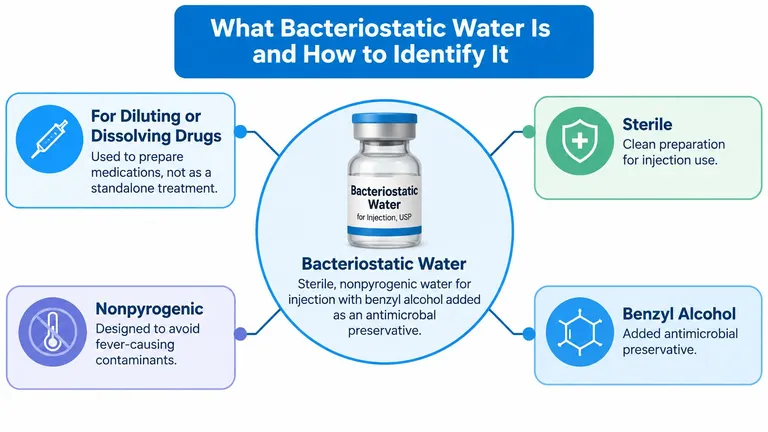
Bacteriostatic Water for Injection, USP is a sterile, nonpyrogenic diluent made of water for injection with benzyl alcohol added as an antimicrobial preservative, as the FDA labeling for the product sets out. Four descriptors carry the whole identity: water, sterile, nonpyrogenic, preserved. Nonpyrogenic means it is prepared to avoid the contaminants that cause fever. Preserved means the container is built to be entered more than once.
The product works like a preserved stock base in a kitchen rather than a finished dish. It is an ingredient that goes into someone else’s recipe, measured to their instructions. The label says this outright: it is intended for drug-diluent use only and is not a standalone therapeutic injection, which is why the preservative should be read as a condition of use rather than a feature that upgrades anything.
The numbers printed on the label
| Label Element | Value | What It Tells You |
|---|---|---|
| Preservative strength | 0.9% benzyl alcohol (9 mg/mL) | One of the two U.S. labeled strengths |
| Preservative strength | 1.1% benzyl alcohol (11 mg/mL) | The other U.S. labeled strength; check which is printed |
| Container | Multiple-dose vial | Designed for repeated withdrawals, not single use |
| Common presentation | 30 mL vial | A commonly marketed U.S. size |
| Carton configuration | 25 vials per carton | One listed package configuration |
| Intended use | Diluent for drugs only | Not a standalone therapeutic injection |
Read the rows together and the product stops being generic. The strength line tells you how much preservative each milliliter carries: 9 mg per mL at 0.9%, or 11 mg per mL at 1.1%, and you need to know which of the two is in your hand. The container line states the design intent, repeated withdrawals rather than a single use. The 30 mL vial is a commonly marketed presentation, and the 25-vial carton is one listed package configuration, which matters mainly for how you store and rotate stock.
The intended-use row is the one people skip. A diluent has no dose of its own, so almost every real question about bacteriostatic water turns out to be a question about the drug being diluted. The labeling also warns against use in newborns, because benzyl alcohol exposure has been associated with toxicity in that group.
First check, every time: read the strength printed on the carton, then read the strength printed on the vial, and confirm the two match before anything is opened.
If you’re sourcing for laboratory work rather than for a patient, you can find bac water for laboratory use at Novagenesis Biopharma, and the first thing worth matching is the strength on the vial against the strength your protocol or label names.
How It Differs From Preservative-Free Sterile Water
The confusion is fair. Two clear, colorless liquids sit one word apart on a shelf, in near-identical glass. The differences that change a handling decision fit into five rows.
| Feature | Bacteriostatic Water | Sterile Water for Injection |
|---|---|---|
| Antimicrobial preservative | Benzyl alcohol, 0.9% or 1.1% | None |
| Container | Multiple-dose vial | Single-dose container, used once |
| Repeated withdrawals | Designed for them | Not intended |
| Neonatal use | Labeling warns against benzyl alcohol exposure | Depends on the drug label |
| Aseptic technique required | Yes, on every access | Yes, on the single use |
Why the preservative changes the container and not the care
Picture a jar with a lid you open many times against a sealed ampoule you snap once. Both need clean hands. What differs is how many times the package is designed to be opened, and that design is the preservative’s entire job.
One misconception deserves naming. The preservative does not make the water sterile after the vial is punctured. It slows microbial growth between entries. That’s why the two products are not just better and worse versions of each other, and why the same care applies at every single access.
The rule that follows: the preservative buys a container design, not a shorter list of precautions. Fresh needle, alcohol-wiped stopper, dry time before the needle goes in. Every time, both products.
The neonatal row also shows why the two aren’t interchangeable. That warning exists because of the preservative, not the water, so a swap between them is a decision about a patient rather than a preference about packaging. If you want the side-by-side on where each diluent is the labeled choice, this comparison of bacteriostatic water and sterile water walks through the settings that specify each one.
As a rule of thumb, match the diluent the drug label names. Treat any substitution, in either direction, as a decision for a pharmacist or prescriber.
When Benzyl Alcohol Rules Out Bacteriostatic Water
Most guidance treats bacteriostatic water as the default and everything else as the exception. Reverse it. The default is whatever diluent the medication’s label names, and benzyl alcohol is one possible answer among several. The FDA labeling for bacteriostatic water limits the product to diluting or dissolving drugs according to the manufacturer’s instructions, and it states that benzyl-alcohol-containing solutions must not be used in neonates because of potential toxicity.
Three questions settle the diluent before any mixing: what the medication’s official insert specifies, whether the patient has a relevant preservative sensitivity or vulnerability, and whether the vial is built for single or repeated withdrawals.
| Situation | Diluent Decision | Who Confirms |
|---|---|---|
| Medication label names bacteriostatic water | Use the labeled diluent and volume | Pharmacist or prescriber |
| Label specifies preservative-free sterile water | Do not substitute bacteriostatic water | Pharmacist before any change |
| Known benzyl alcohol sensitivity | Do not use unless a clinician approves | Prescriber |
| Neonatal use | Do not use a benzyl alcohol diluent | Pediatric clinician |
| Label silent on diluent or storage | No default; do not guess | Pharmacist |
The neonatal restriction is the clearest line in the document, and it follows from the preservative rather than from the water.
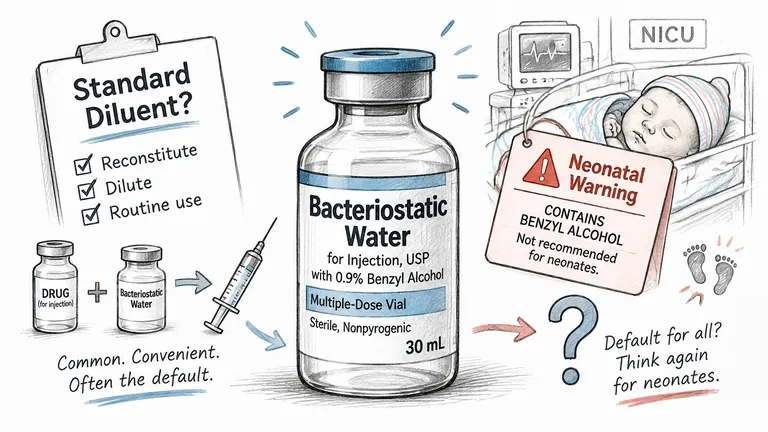
Sensitivity is the second line. Drug-specific labeling identifies sensitivity to benzyl alcohol as a contraindication or warning, so a known reaction to preserved injectables belongs in the conversation before mixing, not after. Strength is the third. The label lists both 0.9% and 1.1% formulations, which means two products sold under a similar name, in different markets or from different suppliers, aren’t necessarily chemically identical, and an instruction written for one isn’t automatically valid for the other.
The contrarian point is worth stating: preservative-free sterile water is not automatically safer either. The right choice depends on the drug, the route, the patient, formulation compatibility, and how long the container will be in use.
A working checklist, in order
- Read the strength printed on the label rather than the strength you expected.
- Confirm the approved diluent and volume against the medication’s own instructions.
- Record the first-use and reconstitution dates on the vial and in a log.
- Note the storage period the label allows for the mixed preparation.
- Bring any open question to a pharmacist before the first mix, not after it.
A dated log shows what was mixed, when, and with which diluent, which is exactly what a pharmacist or clinician will ask for. PepFlow, a peptide tracker available for iPhone, iPad, and Android, can hold the dose history, schedules, and preparation details you enter. It records the instructions you choose and doesn’t choose the treatment or the diluent.
Where Bacteriostatic Water Is Used to Reconstitute Medicines
A powdered medicine becomes measurable only after a stated volume of liquid dissolves it. That liquid is part of the drug’s instructions. Bacteriostatic water belongs in the syringe only when the medicine’s label names it as the diluent.
Benzyl alcohol is often treated as an upgrade because it lets a vial be entered more than once. Read it the other way. The preservative is a limit on use: it supports repeated withdrawal for the period the drug label allows, and it does not choose the volume, the route, the patient, or the discard date. Those rules sit on the medication label. A water vial that looks right on the shelf still stays closed if the drug names a different diluent.
A cake mix states how much liquid to add. Change the liquid or the amount and you have made a different preparation, however evenly you stir.
Every reconstitution instruction answers the same six questions. Read them in this order:
- Product and vial size: what the powder is, and how many milligrams the vial holds.
- The diluent named: bacteriostatic water, preservative-free sterile water, sodium chloride, or a diluent supplied by the manufacturer.
- The volume to add: the milliliters written for that vial, because concentration follows from that volume.
- Storage temperature: refrigeration or room temperature, as the label states.
- Maximum storage period after mixing: the day the mixed preparation must be discarded.
- Any population or route restriction: who should not receive it, and which route is approved.
Those six answers are product-specific. A volume written for one vial can double or halve the concentration of another. A storage period written for one reconstituted drug does not travel with the water to the next vial.
This diluent is used at a large scale. Research and Markets valued the global bacteriostatic water for injection market at US$1.2 billion in 2025. That figure describes how often the water is chosen as a diluent. It is not a mixing recipe.
Match the six answers to the label in your hand before you draw. The preservative limits how a mixed vial may be re-entered. It does not license a volume, a temperature, or a discard date the medicine never stated.
How to Handle a Multiple-Dose Vial Safely
A multiple-dose vial is a container designed for repeated entries, and the preservative is the reason that design is permitted. It doesn’t sterilize contaminated contents and it doesn’t give complete protection against bacterial contamination, per the FDA labeling for bacteriostatic water. Every access still requires aseptic technique, a sterile needle and syringe, and alcohol on the septum before piercing. The CDC also recommends dedicating multidose vials to one patient whenever possible, because repeated access creates cumulative contamination opportunities even when a preservative is present.
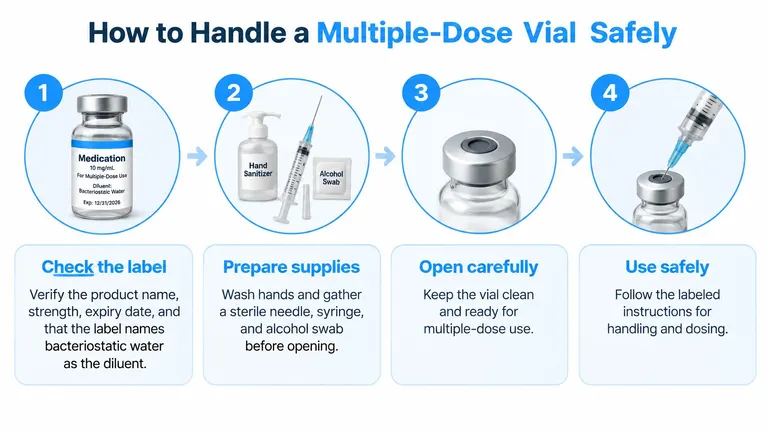
Seven steps, and the reason for each
- Check the label before anything else. Product name, strength, expiry date, and whether the medication’s label names bacteriostatic water as its diluent. If it doesn’t, you’re done, and the vial stays closed.
- Wash your hands, then lay out a fresh needle, syringe, and alcohol swab. Setting everything out first means you never reach across a bench mid-draw with a needle in your hand.
- Wipe the rubber stopper with alcohol and let it dry. Piercing a wet stopper pushes alcohol and surface debris into the vial. Dry time is part of the step, not an optional pause.
- Withdraw only the volume the drug label specifies. A syringe that pulls more than the dose leaves you with an open question about what to do with the surplus.
- Keep the needle sterile for the whole draw. If it touches a counter, a finger, or the outside of the vial, it’s spent. Start again with a new one.
- Write the first-use date on the vial. The label can’t track itself, and a date on the glass is the only reliable record of when the clock started.
- Store the vial as the label directs, and keep it to one patient. The allowable beyond-use period is set by the medication’s labeling and applicable sterile-compounding policy, not by the presence of benzyl alcohol.
The most common slip: wiping the stopper and then touching it, or reusing the same swab for the vial and the injection site. Both undo the step you just took.
The same discipline applies to the injection site and to anything else that meets the needle. This guide to preventing contamination in a peptide routine covers the handling habits around the vial as well as the draw.
What a good access looks like is unremarkable. A clean, dry stopper. A vial with a date written on it. A written record of the volume withdrawn and the diluent used. Nothing dramatic, which is the point.
How Long a Mixed Vial Stays Usable
The popular answer to this question is a number. The accurate answer is that several separate clocks are running, and the water doesn’t own any of them. FDA labeling for bacteriostatic water describes a preserved, multiple-dose product, but nothing in that description makes contamination impossible or extends a drug’s stability.
The four clocks
- The sealed vial: expires on the manufacturer’s printed date while it stays closed and stored as directed.
- The first puncture: starts a separate countdown on the container as an opened multiple-dose vial.
- The reconstituted medication: carries its own timeline, set by the drug’s labeling or the dispensing pharmacy.
- The drug’s chemical stability: depends on the molecule, the concentration, and the storage temperature, and has nothing to do with the diluent’s preservative.
The label sets no single post-opening or post-mixing timeline. It warns instead that adverse outcomes can come from the solution, the added drug, or the reconstitution and administration technique, including abscess, tissue necrosis, and infection at the injection site. That list is the reason a universal number doesn’t exist, and why a rule borrowed from a different product can be worse than no rule at all.
Preserved jam makes the same point. A sealed jar keeps for a long time. The same jar, opened and re-opened in a warm kitchen with a used spoon, stops being a safe bet long before the printed date.
What to follow instead: the period printed for the medication you mixed, counted from the date on your own vial. When no period exists, ask a pharmacist rather than adopting a figure from a forum.
Record four things at the moment of mixing, because reconstructing them later is guesswork: the first-puncture date, the reconstitution date, the storage temperature, and the maximum storage period the drug’s label states. If you want a second reference on how sealed and opened timelines are typically separated, understanding bacteriostatic water shelf life from Herbilabs Labware sets out both clocks, and the operative rule remains the one printed on your medication.
Peptide preparations raise the stakes because the label sometimes travels with the pharmacy rather than the box. The guide to how long peptides last once reconstituted covers how to think about a beyond-use date you were given verbally. Keep the answer where you can find it again.
PepFlow is built for the part that comes after the mixing decision: organizing a protocol, recording doses, and keeping a clear history you can read back weeks later. It works on iPhone, iPad, and Android, with flexible schedules, reminders, and a dose log that holds what you enter about your routine. Visit PepFlow to see how it keeps your preparation details and dosing record in one place instead of scattered across notes.