Become Affiliate
PepFlow app icon

PepFlow

Download

The Thymic Signal

Thymulin

A nine-amino-acid thymic hormone whose zinc-bound form participates in immune-cell maturation and endocrine signaling.

Calm inflammation
TierD
EvidenceLimited
SafetyLimited Data
FDA statusNot Reviewed
Last reviewed October 25, 2026 44 citations How to read these labels

What is Thymulin?

Thymulin is a hormone produced by thymic epithelial cells. Its peptide component, serum thymic factor or FTS, has nine amino acids: pyroglutamyl-Ala-Lys-Ser-Gln-Gly-Gly-Ser-Asn.[2][1]

Zinc binding gives the complex its described immunoregulatory activity. This distinction matters: a peptide sequence, zinc-bound thymulin and a study of zinc supplementation do not describe the same intervention.[1][3]

The hormone participates in communication between the thymus, immune cells and the endocrine system. It is distinct from Thymalin, a mixed thymus extract, and from modified thymulin-related compounds.[1][44]

What Thymulin is investigated for

Thymulin evidence is grouped by practical use case and intraperitoneal route context. Each use case separates confidence, human evidence, animal or mechanistic support, and the practical takeaway.

T-cell maturation

Mixed research context, Intraperitoneal

30%Limited

Endogenous biology is better characterized than any current human product, route or treatment benefit.[1][5]

Human evidence

Human immune-treatment evidence is preliminary and depends on the thymic-peptide preparation.[6][5][3][7][8]

Animal / mechanistic evidence

The zinc-bound hormone has an established role in thymic signaling and T-cell development.[1]

Age-related immune inflammation

Intraperitoneal

28%Limited

This is a preclinical immune-aging signal with a distinct treatment setting; it does not establish healthier aging or cancer treatment in people.[32]

Human evidence

Human benefits for age-related immune inflammation remain unestablished.[32]

Animal / mechanistic evidence

Preclinical findings concern age-related inflammatory immune signaling.[32]

Inflammatory pain

Intraperitoneal

24%Limited

The animal findings do not establish pain relief or a repeat-treatment schedule in people.[36]

Human evidence

Human pain-relief benefits remain unestablished.[36]

Animal / mechanistic evidence

Preclinical findings suggest possible effects on inflammatory pain.[36]

Evidence snapshot

35%

Human evidence

Preliminary

Human treatment evidence remains limited; endogenous thymulin activity also depends on zinc status.[6][5][3]

32%

Animal / preclinical

Limited

Structural studies characterize its zinc-dependent conformation and support a role in thymic peptide signaling.[1][2][3][4]

68%

Mechanism support

Moderate

Zinc-bound thymulin contributes to T-cell maturation and communication between the thymus and hormone-producing organs. Its activity depends on both the peptide and zinc being present.[1]

Forms & administration

Experimental thymulin forms include intravenous synthetic FTS and zinc-bound injections, with animal-only formulations kept separate. Gene-based delivery produces the peptide within tissues. Zinc binding and delivery method influence activity and exposure.[1][5][3][36]

Intraperitoneal

Dosing & protocols

These ranges are general reference points, not personal dosing instructions.

Typical Range

A current standalone human zinc-thymulin dose range is not established; historical FTS and related-variant doses describe different preparations.[5][7][1]

Frequency

Historical FTS reports and animal thymulin experiments use different frequencies; no repeat schedule is established for a current human product.[5][36]

Timing Considerations

A meal, exercise or bedtime anchor is not established for administered human zinc-thymulin.[1][5]

Cycle Length

A complete current-product human course is not established. Zinc-supplementation courses describe zinc exposure, rather than thymulin administration.[3][6]

Safety profile

Historical FTS reports and zinc-biomarker studies do not establish safety for a current zinc-thymulin product. The active zinc-bound complex, unbound FTS and gene-transfer preparations are different exposures.[1][5][3]

Cautions

  • Zinc-bound thymulin, FTS and expression vectors differ[1][35]

What we don't know

Dose-dependent immune responses, repeated-use effects and interactions need study in an identified zinc-bound preparation.[5][1]

How it works

Zinc-bound thymulin contributes to T-cell maturation and communication between the thymus and hormone-producing organs. Its activity depends on both the peptide and zinc being present.[1]

It may also influence inflammatory signaling and pain responses. The body’s own thymulin activity and the effects of an administered preparation are distinct.[36][3]

Research gaps & open questions

What the current literature has not yet settled about Thymulin:

01

A defined zinc-thymulin preparation needs controlled human studies measuring infection burden or immune function, rather than inferring treatment effects from circulating hormone measurements.[1][3]

02

Studies need to measure how long the active zinc-bound form remains available after administration and which doses are tolerable; historical FTS reports do not resolve those product questions.[5][2]

03

Animal inflammatory-pain and immune-aging findings need independent replication and human outcome trials before they can establish pain relief or healthier aging in people.[36][32]

Common questions

Does a zinc study prove thymulin treatment works?

No. Zinc supplementation can change the activity of endogenous thymulin, but it does not test administration of a thymulin medicine.[3][1]

Is thymulin the same as Thymalin?

No. Thymulin is a defined zinc-dependent hormone; Thymalin is a heterogeneous thymus-derived extract.[1][44]

History & discovery

Thymulin was identified as a thymic signal in the early 1970s. Subsequent work distinguished the nine-amino-acid factor from the zinc-bound active complex and examined its links with the endocrine system.[1]

Small human reports administered synthetic FTS in immune deficiency or cancer and measured immune responses. These preparations and incomplete courses do not establish a present-day zinc-thymulin product.[6][5]

Nuclear magnetic resonance experiments examined the peptide’s conformation. This strengthened molecular understanding without supplying evidence for a general clinical treatment.[2]

Published research44 citations

Thymulin research centers on zinc-dependent immune signaling and communication between the thymus and endocrine system. Therapeutic evidence remains preliminary, with important differences between the native hormone and related preparations.[1][5][7][3][35][9][16][17][22][34][32][36]


Show citationsHide citations
[1]Thymulin and the neuroendocrine systemPeptides, 2004 Jan. review.[2]NMR study of thymulin, a lymphocyte differentiating thymic nonapeptide. Conformational states of free peptide in solutionJ Biol Chem, 1986 Jun 15. in vitro.[3]Serum thymulin in human zinc deficiencyJ Clin Invest, 1988 Oct. human clinical.[4]Effect of oral zinc administration on prolactin and thymulin circulating levels in patients with chronic renal failureJ Clin Endocrinol Metab, 1989 Jan. human clinical.[5]Effect of a synthetic thymic factor (facteur thymique serique) on natural killer cell activity in humansInternational Journal of Immunopharmacology, 1983. human clinical.[6]Improvement of cellular immunity and IgA production in immunodeficient children after treatment with synthetic serum thymic factor (FTS)The Lancet, 1982. human clinical.[7]An open trial of thymulin (FTS-Zn) in rheumatoid arthritis patients: sequential clinical and immunological follow-upClinical and Experimental Rheumatology, 1987. human clinical.[8]Nonathymulin in rheumatoid arthritis: two double blind, placebo controlled trialsAnnals of the Rheumatic Diseases, 1987. human clinical.[9]Nonathymulin treatment of multiple sclerosis: double-blind pilot studyActa Neurologica Scandinavica, 1989. human clinical.[10]Allogeneic bone marrow transplantation in man: in vitro activity of FTS-Zn on T-cell markers and functions.Br J Haematol, 1984 Dec. ex vivo.[11]Thymulin (Zn-facteur thymique serique) activity in anorexia nervosa patients.Am J Clin Nutr, 1985 Aug. human clinical.[12]Evidence that appearance of thymulin in plasma follows lymphoid chimerism and precedes development of immunity in patients with lethal combined immunodeficiency transplanted with T cell-depleted haploidentical marrow.Transplantation, 1990 Jul. human clinical.[13]Thymulin (facteur thymique serique) and zinc contents of the thymus glands of malnourished children.Am J Clin Nutr, 1988 Aug. human clinical.[14]Thymulin (Zn-FTS) activity in protein-energy malnutrition: new evidence for interaction between malnutrition and infection on thymic function.Am J Clin Nutr, 1988 Feb. human clinical.[15]Thymulin, a zinc-dependent hormoneMed Oncol Tumor Pharmacother, 1989. review.[16]Peripheral and mesencephalic transfer of a synthetic gene for the thymic peptide thymulinBrain Res Bull, 2006 May. animal.[17]Inhibition of wound repair by thymic hormonesSurgery, 1989 Aug. animal.[18]Role of zinc and other metals in the biological activity of the serum thymic factor (thymulin)C R Seances Acad Sci III, 1981 Mar. in vitro.[19]Thymulin (FTS-Zn) induced in vitro modulation of T cell subsets markers on lymphocytes from rheumatoid arthritis and systemic lupus erythematosus patientsInt J Immunopharmacol, 1984. ex vivo.[20]Studies on the zinc binding site to the serum thymic factor.Biochim Biophys Acta, 1984 Feb. in vitro.[21]Interleukin 1 regulates secretion of zinc-thymulin by human thymic epithelial cells and its action on T-lymphocyte proliferation and nuclear protein kinase C.Proc Natl Acad Sci U S A, 1992 Aug. in vitro.[22]Zinc induces thymulin secretion from human thymic epithelial cells in vitro and augments splenocyte and thymocyte responses in vivo.Int J Immunopharmacol, 1995 Sep. animal.[23]Studies of the thymus in mice bearing the Lewis lung carcinoma. II. Modulation of thymic natural killer activity by thymulin (FTS-Zn) and the antimetastatic effect of zinc.Clin Immunol Immunopathol, 1983 Aug. animal.[24]Zinc and bromocriptine long-term administration in patients with prolactinomas: effects on prolactin and thymulin circulating levels.Int J Neurosci, 1991 Jul. human clinical.[25]Modifications of thymulin titers in patients affected with prolonged low or high zinc circulating levels are independent of patients' age.Arch Gerontol Geriatr, 1992. human clinical.[26]Immunological evaluation of patients with beta-thalassemia major.Acta Haematol, 2001. human clinical.[27]A physiological amount of zinc supplementation: effects on nutritional, lipid, and thymic status in an elderly population.Am J Clin Nutr, 1993 Apr. human clinical.[28]Role of the low zinc bioavailability on cellular immune effectiveness in cystic fibrosis.Clin Immunol Immunopathol, 1995 Jun. human clinical.[29][Effect of zinc on thymulin level in mice].Wei Sheng Yan Jiu, 2005 Jul. animal.[30]Comparison of Thymulin Activity with Other Measures of Marginal Zinc Deficiency.Biol Trace Elem Res, 2021 Feb. animal.[31]Impaired peripheral zinc metabolism in patients with senile dementia of probable Alzheimer's type as shown by low plasma concentrations of thymulin.Biol Trace Elem Res, 1996 Jan. human clinical.[32]Thymulin restrains age-associated myeloid inflammation and enhances cancer immunotherapyNature Communications, 2026-07-21. animal.[33]Protective effect of exogenous peroxiredoxin 6 and thymic peptide thymulin on BBB conditions in an experimental model of multiple sclerosisArchives of Biochemistry and Biophysics, 2023-09-15. animal.[34]Thymulin and peroxiredoxin 6 have protective effects against streptozotocin-induced type 1 diabetes in miceInternational Journal of Immunopathology and Pharmacology, 2021. animal.[35]Nanoparticle-based thymulin gene therapy therapeutically reverses key pathology of experimental allergic asthmaScience Advances, 2020-06. animal.[36]Thymulin treatment attenuates inflammatory pain by modulating spinal cellular and molecular signaling pathwaysInternational Immunopharmacology, 2019-05. animal.[37]Effect of thymulin on intracellular cyclic nucleotides and prostaglandins E2 in peanut agglutinin-fractionated thymocytes.European journal of immunology, 1985 Jun. ex vivo.[38]Lessons Learned from Experimental Human Model of Zinc Deficiency.Journal of immunology research, 2020. review.[39]Prenatal and childhood exposures are associated with thymulin concentrations in young adolescent children in rural Nepal.Journal of developmental origins of health and disease, 2020 Apr. human clinical.[40]Effectiveness of interleukin-4 administration or zinc supplementation in improving zinc deficiency-associated thymic atrophy and fatty degeneration and in normalizing T cell maturation process.Immunology, 2022 Apr. animal.[41]Thymus-derived hormonal and cellular control of cancer.Frontiers in endocrinology, 2023. review.[42]Drugs@FDA brand/generic name search for ThymulinU.S. Food and Drug Administration, Drugs@FDA via OpenFDA. database query.[43]Nonathymulin bibliographic route recordINIST-CNRS Pascal-Francis database, 1987. reference catalog.[44]Peptides Regulating Proliferative Activity and Inflammatory Pathways in the Monocyte/Macrophage THP-1 Cell LineInt J Mol Sci, 2022 Mar 25. in vitro.

Keep It Organized

Bring consistency to your well-being routine.

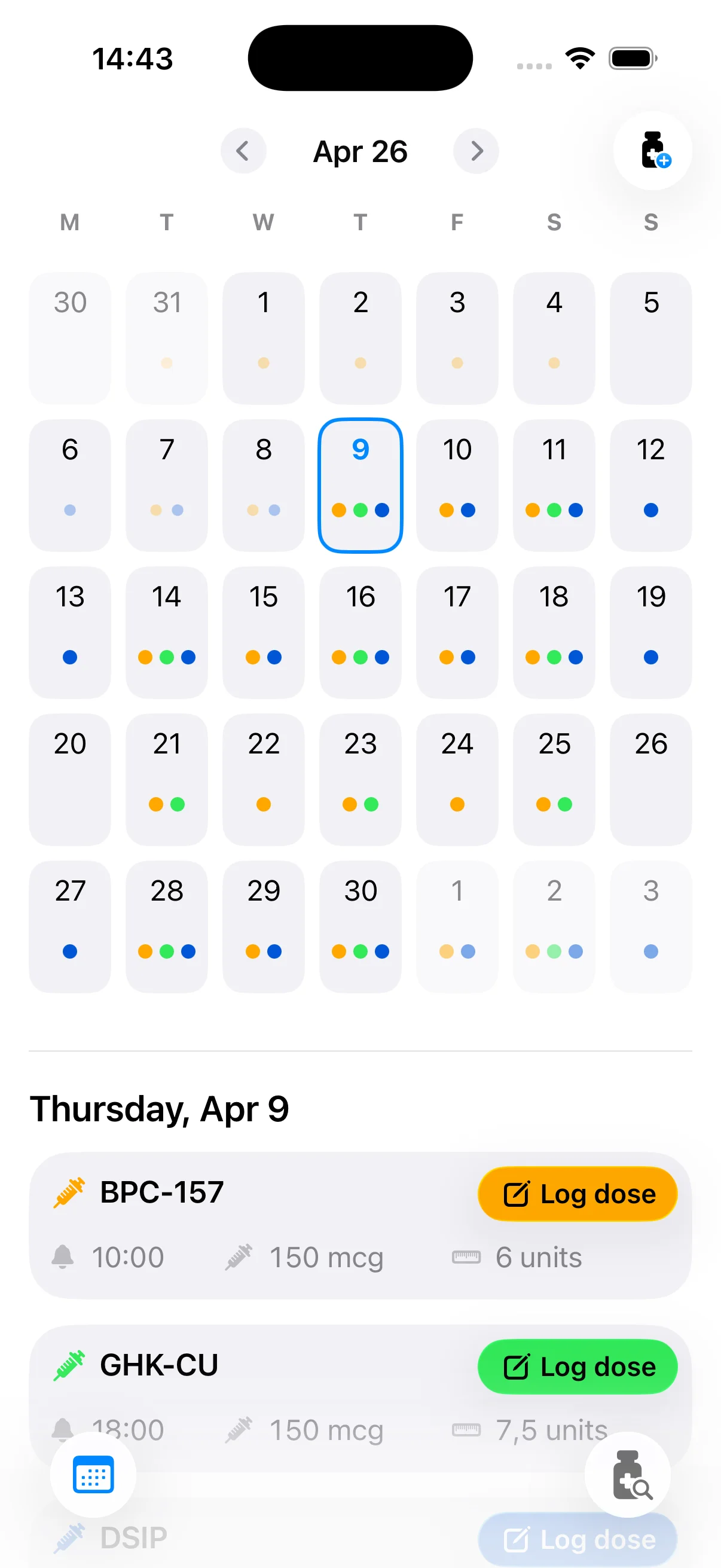
Use PepFlow to record your Thymulin protocol, set reminders for your own schedule, and review your history.

Download on the App StoreGet it on Google Play
PepFlow calendar and scheduled protocols
iPhone showing PepFlow schedule tracking