
Most MOTS-c dosage guides make one mistake at the top. They present a tidy number as if human clinical dosing were settled. It isn’t.
If you’re building a MOTS-c peptide dosage protocol, the first practical fact is also the least convenient one: there’s no peer-reviewed randomized controlled human trial establishing an approved clinical dose, and the commonly repeated 5 to 10 mg subcutaneous ranges used 3 to 5 times weekly come from animal-model extrapolation and community practice, not validated human efficacy data, as noted in this MOTS-c dosing review.
That changes how the protocol should be approached. Not as plug-and-play supplementation, but as a research framework where calculation, route, timing, cycle design, and tracking matter more than confident forum advice. The most useful mindset is conservative and technical. You’re not trying to mimic certainty. You’re trying to reduce avoidable error.
Table of Contents
- What Is MOTS-c and Why Dosage Is So Complex
- The Essential Guide to MOTS-c Reconstitution and Calculation
- Common MOTS-c Dosing Protocols and Cycle Structures
- Administration Timing and Advanced Considerations
- How to Implement and Track Your Protocol with PepFlow
- Safety Precautions and Monitoring Your Progress
What Is MOTS-c and Why Dosage Is So Complex
MOTS-c isn’t just another injectable peptide in the usual performance or recovery conversation. It’s a mitochondrial-derived peptide, which is part of why people frame it around metabolic regulation, exercise-mimetic effects, and resilience under metabolic stress. Mechanistically, that makes it interesting.
It also makes dosing messy.
The problem is that many readers assume there must be a clinically established human standard behind the familiar community numbers. There isn’t. The practical ranges circulating in research communities are extrapolated. If you want to explore Mots C peptides, that’s fine, but it helps to do it with a clear distinction between research convention and validated human dosing.

Why the usual advice is incomplete
Most popular writeups collapse three separate questions into one:
- What route is being discussed
- What dose is being discussed
- What evidence level supports that dose
Those aren’t interchangeable. A protocol can be common without being clinically proven. It can be widespread without being optimized. And it can be tolerated without having established efficacy in controlled human use.
Practical rule: Treat every MOTS-c dose recommendation as a research-context estimate unless the writer can clearly separate animal data, human safety data, and community practice.
That distinction matters because route changes everything. Timing changes interpretation. Body size probably matters, yet most guides don’t deal with it in a serious way. Reconstitution math can distort the actual delivered dose before you even get to protocol design.
Why careful users approach it like a researcher
The right frame for a MOTS-c peptide dosage protocol is risk mitigation.
That means you don’t start by asking, “What dose is best?” You start by asking, “What exactly am I administering, by what route, at what concentration, on what schedule, with what record of response?” That’s a very different standard from copying a screenshot from a forum thread.
In practice, the people who run into problems usually don’t fail because the peptide itself is impossible to use. They fail because they borrow a number without understanding the assumptions under it. With MOTS-c, those assumptions are doing most of the work.
The Essential Guide to MOTS-c Reconstitution and Calculation
The most common dosing mistake doesn’t happen at injection time. It happens when the vial is mixed or when the syringe volume is interpreted incorrectly.
A good protocol starts with arithmetic, not enthusiasm.
Why reconstitution errors happen
Most users know the label on the vial. Fewer know the concentration after reconstitution. Even fewer convert that concentration correctly into syringe units.
That’s where underdosing, overdosing, and false confidence start. If you reconstitute a vial one way and calculate it as if you reconstituted it another way, the rest of the protocol is wrong even if your injection technique is clean.
For a useful primer on handling lyophilized material before it ever becomes an injectable solution, this guide to freeze-dried peptides is a good reference point.
The exact math that matters
One technical benchmark is especially useful because it gives a concrete, repeatable example. A 10 mg vial reconstituted with 2 mL of bacteriostatic water yields 5 mg/mL, and at that concentration 0.1 mL, which is 10 units on a U-100 syringe, equals 0.5 mg. A 5 mg dose therefore requires 1.0 mL, or 100 units, according to this MOTS-c reconstitution reference.
That one example tells you several things at once:
-
Concentration drives everything.
The vial amount alone is not the dose per injection. -
Units are only meaningful after concentration is known.
“I took 20 units” says nothing unless the vial concentration is already established. -
Injection volume can become impractical fast.
At 5 mg/mL, a 5 mg shot is already a full 1.0 mL.
If someone tells you a unit number without telling you the vial size and reconstitution volume, you still don’t know the dose.
A practical preparation sequence
The handling process itself should stay boring. That’s the goal.
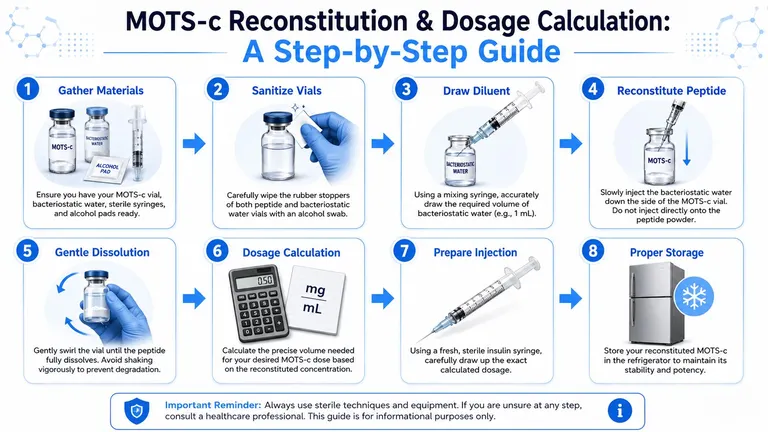
- Gather the basics: MOTS-c vial, bacteriostatic water, sterile syringes, alcohol pads, and a place to write down the final concentration.
- Sanitize first: Wipe both vial stoppers before introducing any needle.
- Add diluent slowly: Let the bacteriostatic water run down the vial wall rather than blasting the powder directly.
- Swirl gently: Don’t shake aggressively. The aim is dissolution, not froth.
- Record the concentration immediately: Write the final mg/mL somewhere you’ll see it every time.
A simple example helps. If the vial contains 10 mg and you add 2 mL, you now have 5 mg/mL. Once that’s written down, syringe math becomes mechanical instead of speculative.
| Reconstituted vial example | Amount |
|---|---|
| Vial content | 10 mg |
| Bacteriostatic water added | 2 mL |
| Final concentration | 5 mg/mL |
| 0.1 mL on U-100 syringe | 10 units |
| Dose delivered by 0.1 mL | 0.5 mg |
| Volume for 5 mg | 1.0 mL |
What works better than mental math
Mental math is fine once. It’s unreliable over weeks.
Researchers and careful self-trackers usually do better when they standardize three records from day one:
- The vial setup
- The intended dose
- The exact drawn volume
That sounds basic, but it prevents a lot of protocol drift. Most dosing confusion I see comes from people remembering the target milligrams but forgetting the actual concentration they created.
Common MOTS-c Dosing Protocols and Cycle Structures
Once the vial math is correct, the next question is schedule. At this point, online advice becomes crowded. Some of it is useful. Some of it ignores the fact that a protocol should match a goal, tolerability, and a realistic injection burden.
The most commonly repeated research-context pattern is not mysterious. It’s just often presented too confidently.
The protocol most people actually use
The most frequently replicated MOTS-c protocol in research contexts is 5 mg subcutaneously 3 to 5 times per week for 4 to 8 weeks, followed by a 2 to 4 week break, while more intensive approaches use 10 mg at the same frequency for metabolic or exercise-mimetic goals, according to this research protocol summary.
That gives a practical baseline. It does not create a validated human standard.
The difference matters because people tend to hear “frequently replicated” and mentally upgrade it to “proven.” Those aren’t the same. In day-to-day practice, what you can say is that this pattern is common enough to serve as a reference template.
Example MOTS-c protocol tiers
A simple tiered view is useful when comparing burden and intensity.
| Protocol Tier | Dosage per Injection | Frequency | Cycle Example |
|---|---|---|---|
| Conservative | 5 mg | 3 times weekly | 4 to 8 weeks on, then 2 to 4 weeks off |
| Standard | 5 mg | 3 to 5 times weekly | 4 to 8 weeks on, then 2 to 4 weeks off |
| Intensive | 10 mg | 3 to 5 times weekly | 4 to 8 weeks on, then 2 to 4 weeks off |
If you want a broader foundation for thinking about concentration, injection volume, and protocol setup across compounds, this general peptide dosage guide is a useful companion read.
What tends to work and what usually fails
The protocols that work best operationally are usually the ones that are easy to execute accurately. That sounds obvious, but it’s often ignored. A neat-looking schedule on paper can fail if the injection volume is annoying, the cycle is hard to remember, or the user keeps changing the plan midstream.
A few practical patterns stand out:
- Structured cycles work better than improvisation. Consistent on-periods and off-periods make response easier to judge.
- Moderate frequency is easier to sustain. Protocols that demand constant rescheduling tend to drift.
- Clear stop dates matter. Without them, many people blur an active cycle into indefinite use.
The protocol isn’t just the milligram number. It’s the repeatability of the whole schedule.
What usually fails is the hybrid protocol assembled from scattered advice. Someone starts with one frequency, borrows a different timing strategy, then changes injection volume after reconstituting a new vial differently. At that point, the user is no longer testing a protocol. They’re testing a moving target.
Administration Timing and Advanced Considerations
Timing is where protocol design becomes more individualized. There’s no single settled answer, and that’s exactly why broad rules should stay modest.

Some practitioners prefer consistent morning administration because it’s easy to repeat. Others tie administration to training days when the peptide is being used in a performance-oriented context. The practical question isn’t which camp sounds smarter. It’s whether the timing choice is stable enough to let you interpret response.
Timing around training and meals
For exercise-focused use, pre-training timing is common because it aligns with the reason many people use MOTS-c in the first place. For metabolically oriented use, consistency often matters more than a perfect clock time.
A few real-world trade-offs usually shape the decision:
- Pre-workout timing: Easy to pair with training intent, but inconsistent if the person’s schedule changes.
- Morning dosing: Simpler for routine adherence, especially for people who train at irregular hours.
- Meal-aware timing: Useful when someone wants a repeatable metabolic context, but harder to maintain if meals drift.
None of those choices automatically improves a weak protocol. Timing only helps when the rest of the plan is already controlled.
This short explainer adds context to the broader discussion around mechanism and application:
The weight based gap nobody really solves
One of the most important dosing gaps is also one of the least discussed clearly. Current guidance often defaults to flat totals without solving for body size, even though current content overwhelmingly prescribes fixed weekly totals while failing to address body-weight-adjusted titration, despite animal efficacy scaling by mg/kg and human guidance remaining arbitrary, as noted in this analysis of MOTS-c dosing gaps.
That leaves a practical problem. A flat dose may represent very different exposure for a lighter person and a heavier one. Yet most guides skip the issue entirely and move straight to a generic recommendation.
A flat protocol is convenient. It isn’t necessarily individualized.
That doesn’t mean everyone should invent their own mg/kg conversion. It means they should recognize the limitation of pretending the common flat-dose framework is precise when it isn’t. The experienced approach is to acknowledge that uncertainty, keep timing consistent, and interpret outcomes cautiously rather than attributing every change to a supposedly exact dose.
How to Implement and Track Your Protocol with PepFlow
MOTS-c becomes tedious the moment the schedule stops being simple. That’s especially true when someone isn’t using one fixed injection amount for the entire cycle.
A common subcutaneous titration method starts at 200 mcg daily for 2 weeks, increases by 200 mcg every 2 weeks, and reaches 1,000 mcg (1 mg) daily by week 10, according to this MOTS-c dosing workflow. On paper, that’s manageable. In practice, it’s exactly the kind of schedule people misremember.
Where manual tracking breaks down
Most protocol failures here are administrative, not conceptual.
People forget when they changed concentration. They forget whether the current week is still part of the build-up phase. They draw the old volume out of habit. They lose track of the off-cycle window and restart early. None of that means the person is careless. It means the schedule has exceeded what memory handles well.
A tracking system should at minimum keep four things visible:
- Vial concentration
- Target dose for the current date
- Cycle phase
- Dose history
A cleaner way to run the schedule
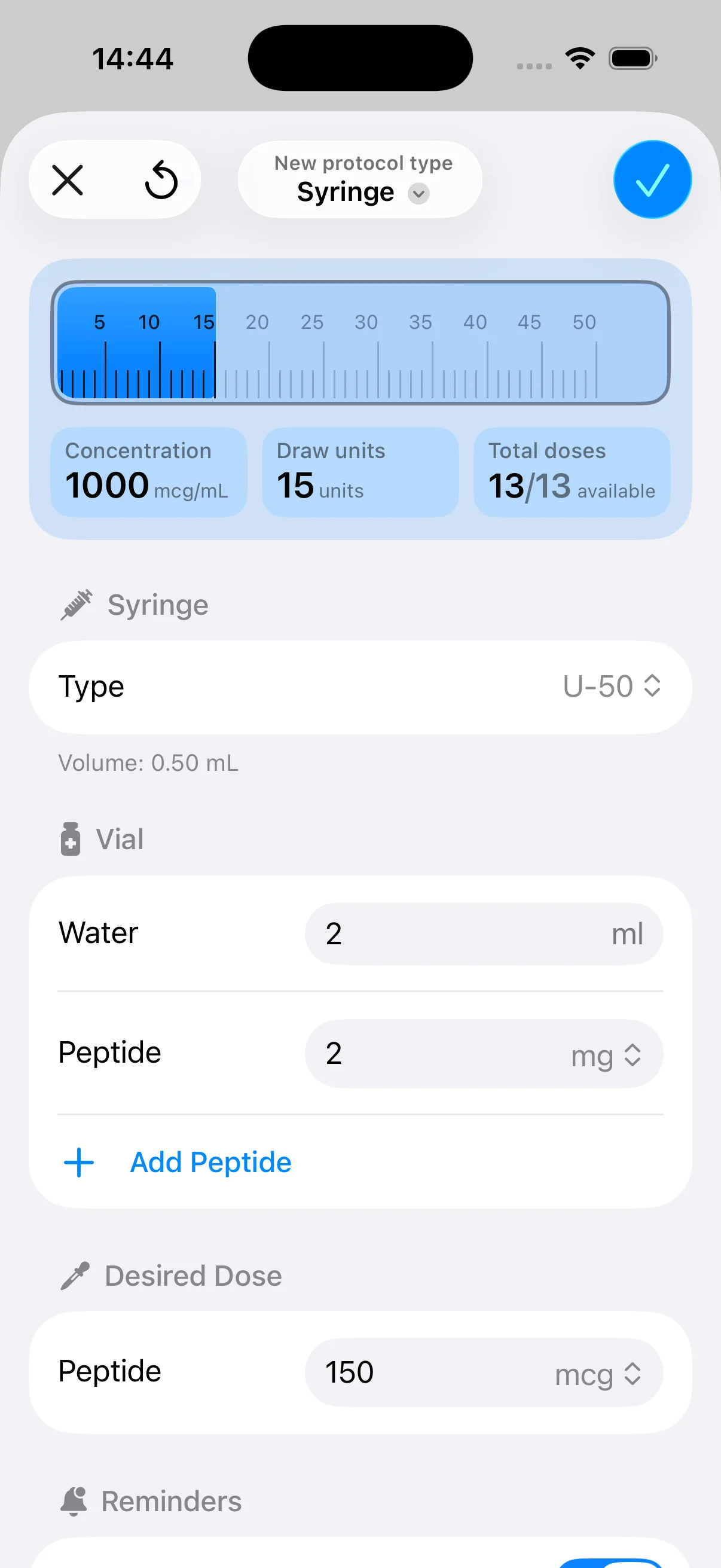
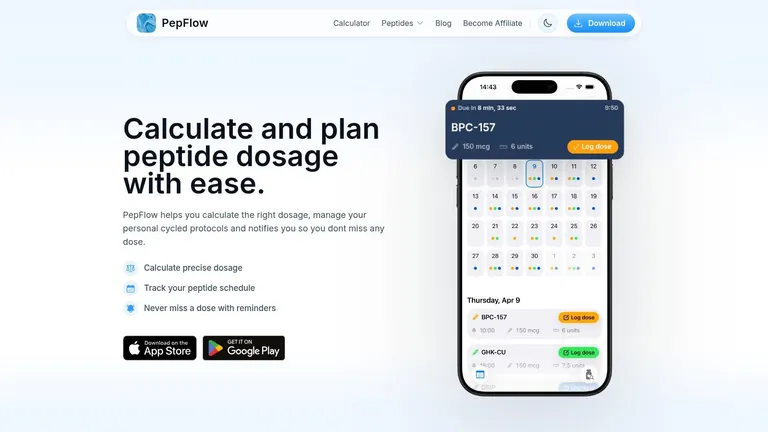
A dedicated calculator and schedule tool offers significant utility. With PepFlow’s peptide calculator, a user can configure vial concentration, convert target amounts into practical injection volumes, and keep the active protocol aligned with the actual calendar rather than a note in their phone. That’s a factual use case, not a magic solution.
The practical workflow is straightforward:
- Enter the vial amount and reconstitution volume.
- Save the resulting concentration.
- Build the schedule around the chosen cycle or titration pattern.
- Log each dose as administered, not as intended.
- Review the history before changing anything.
Good tracking doesn’t make the protocol more validated. It makes the protocol more legible.
That distinction matters. A tool can’t supply missing human efficacy data. It can reduce preventable errors, which is still valuable. For a peptide like MOTS-c, where route, concentration, timing, and cycle design are already easy to blur, that administrative clarity is often the difference between a usable record and a vague recollection.
Safety Precautions and Monitoring Your Progress
The most responsible way to run a MOTS-c peptide dosage protocol is to treat it as an ongoing observation process. That means watching both tolerance and usefulness. A protocol that is easy to calculate but impossible to assess isn’t a strong protocol.
The safety conversation should stay disciplined. Don’t overstate reassurance, and don’t invent danger where the literature hasn’t established it. Stay practical.
What to watch in practice
Monitoring usually works better when it mixes subjective notes with a few consistent objective markers.
- Day-to-day feel: energy stability, training readiness, recovery perception, appetite changes.
- Training notes: whether performance feels more durable across repeated sessions.
- Metabolic context: if someone already tracks glucose or body composition under professional oversight, consistency matters more than novelty.
- Injection tolerance: local irritation, site preference, and whether volume itself becomes the limiting factor.
One of the easiest mistakes is changing too many variables at once. If training load, diet, sleep, and peptide schedule all shift together, interpretation gets weak fast.
How to judge whether the protocol is worth continuing
A useful protocol should produce a pattern you can recognize. If the user can’t tell what changed, can’t confirm what was administered, and can’t maintain the cycle cleanly, the protocol may be too noisy to justify continuing in the same form.
That’s where restraint matters. A lower-complexity schedule with solid records is usually more informative than a highly ambitious plan with poor adherence.
Keep the standard high:
- Know what dose was delivered
- Keep timing stable long enough to observe
- Respect off-periods if the protocol includes them
- Stop pretending extrapolated numbers are settled clinical truth
MOTS-c is interesting because it sits at the intersection of metabolism, mitochondria, and performance. It’s difficult because the human dosing evidence hasn’t caught up to the enthusiasm. The disciplined user acknowledges both.
If you want a cleaner way to manage concentration math, cycle timing, reminders, and dose logs in one place, PepFlow is built for that planning workflow. It won’t answer the unanswered clinical questions around MOTS-c, but it can help you run your chosen protocol with fewer calculation mistakes and better records.