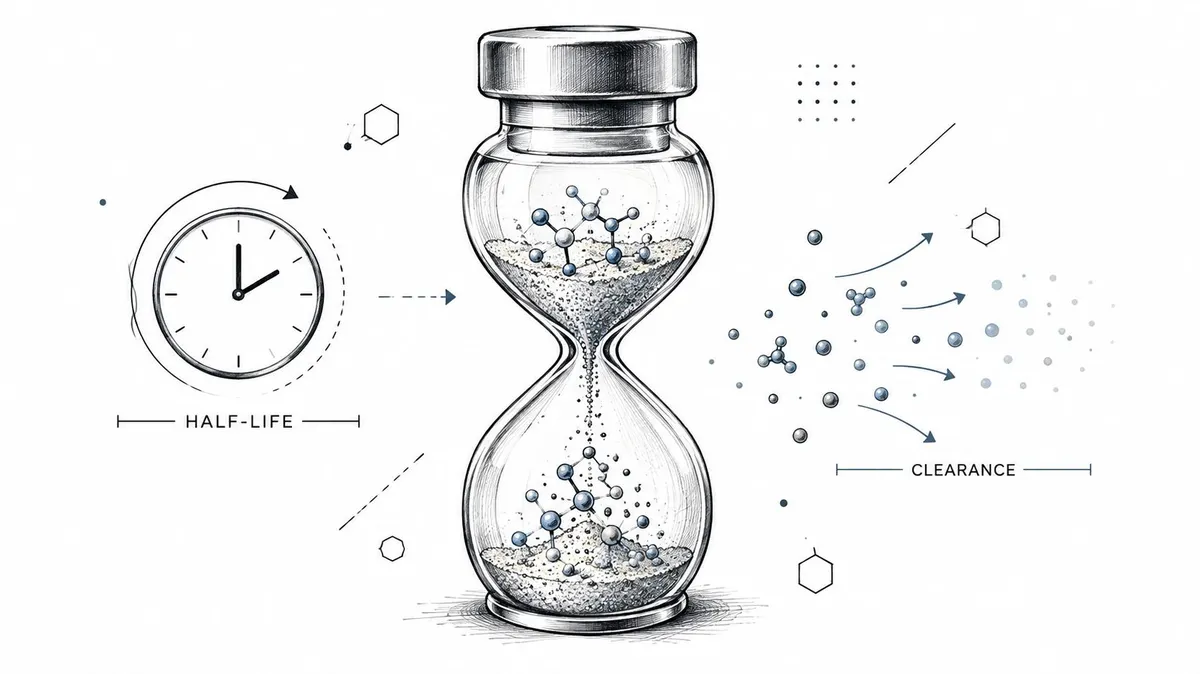
Most advice about Melanotan II half life starts with a confident number and ends with a false sense of precision. That’s the problem. A short plasma estimate does not tell you how long the tanning signal lasts, how quickly a subcutaneous dose is absorbed, or whether repeated use is building risk.
Table of Contents
- The Myth of a Single Precise Half Life
- Analyzing the Early Pharmacokinetic Data
- Plasma Clearance vs Biological Duration
- Managing Protocols with Precision Tools
- Accumulation Risks and Adverse Effects
- Building a Safe and Consistent Routine
The Myth of a Single Precise Half Life
A single, universal Melanotan II half life sounds tidy, but the evidence does not support that kind of precision. The human data are limited, and they do not come from a modern pharmacokinetic program designed to pin down one dependable elimination value. As a clinical summary notes, Melanotan II does not have a reliably established, universally accepted human elimination half-life, and the available evidence comes mainly from early small studies rather than a full PK program The Triton Co library on Melanotan II.
Why the internet keeps repeating one number
A number is easy to copy. It is harder to keep the study details attached to it, so the number gets repeated until it sounds settled.
That is the central problem in peptide discussions. A figure pulled from one setting starts to look like a property of the compound itself, even though route, dose, and study design all shape what the figure means.
Practical rule: if a half-life figure does not state the route, the study design, and the endpoint, it is not a dosing-grade number.
The most common mistake is mixing up plasma elimination with overall duration of effect. Those are related, but they are not interchangeable. A compound can disappear from the bloodstream relatively quickly and still produce longer-lived changes in tissue when the mechanism depends on receptor signaling and pigment production.
Why this matters for real-world interpretation
When people ask about Melanotan II half life, they are usually asking one of three different questions. How fast does circulating drug fall? How long do effects last? How often should a dose be repeated? Those are separate questions, and only the first one is even partly answerable from the limited data.
The phrase “half life” sounds exact, but here it hides uncertainty. The safer reading is modest. Melanotan II has biological activity in humans, but not a dependable universal half-life that can be applied across all formulations, routes, doses, or individuals PubMed clinical pilot study. That is why protocol calculators and forum schedules should be treated as rough planning aids, not medical instructions. For a broader primer on how peptide timelines are usually framed, see how long peptides last.
Analyzing the Early Pharmacokinetic Data
The foundational human evidence is very small, and that shapes how much weight the numbers can carry. The key clinical study enrolled only 3 healthy men, used alternating-day subcutaneous injections over a 2-week period, and focused mainly on pigmentation and tolerability rather than dense sampling for elimination kinetics PubMed clinical pilot study. That gap matters, because a study built to observe visible effects is not the same thing as a study built to map clearance.
Where the commonly cited intravenous estimate comes from
A frequently repeated figure places the intravenous plasma half-life at about 33 to 40 minutes, but that estimate is route-specific and preliminary Bergdorf Bio guide. Intravenous dosing puts the compound directly into circulation, so the measured decline reflects elimination under that exact setup. It does not automatically translate to the subcutaneous use people usually mean when they talk about Melanotan II.
Subcutaneous injection adds an absorption phase. The dose first has to leave the injection site and enter the bloodstream before elimination becomes the main driver of the curve. That creates a different exposure pattern, with a delayed peak and an apparent duration that can look longer than the IV number suggests.
| Administration Route | Absorption Phase | Observed Half-Life Estimate | Practical Implication |
|---|---|---|---|
| Intravenous | None, enters circulation directly | About 33 to 40 minutes (route-specific, preliminary) | Useful as a route-specific clearance reference, not a subcutaneous dosing rule |
| Subcutaneous | Present, because the dose must absorb from tissue | Not reliably established in humans | Exposure can look longer because absorption and elimination overlap |
Why the old study can’t settle modern dosing questions
The same 1996 pilot did not run a modern PK program with dense blood draws, validated modeling, or a statistically powered terminal half-life estimate. It supports the basic point that the compound is biologically active in humans, but it does not support precise scheduling claims. Even the study’s recommended future Phase I dose of 0.025 mg/kg/day was a research suggestion, not a validated consumer regimen PubMed clinical pilot study.
That is where a lot of confusion starts. Visible tanning can last after circulating peptide has already fallen, so online half-life charts often mix effect duration with blood clearance. A second source of confusion is the way some guides describe a “biological half-life,” which refers to persistence of effect rather than measured elimination from plasma FDA enforcement concerns.
Plasma Clearance vs Biological Duration
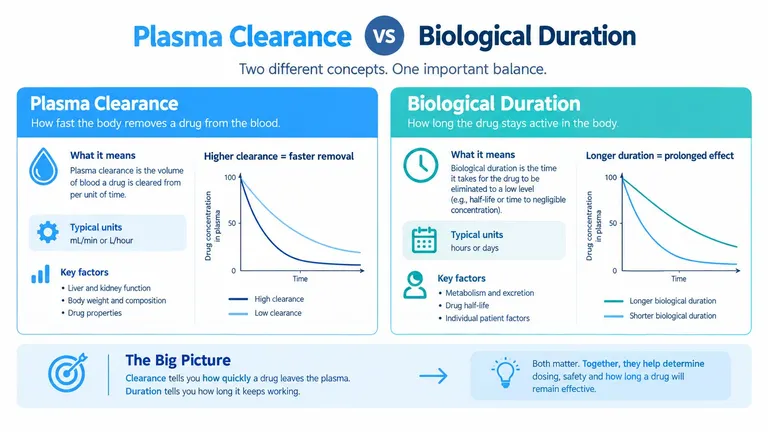
A short plasma half-life does not close the story. With Melanotan II, the peptide can fall in circulation fairly quickly, while melanocortin signaling and pigment-related cellular changes can continue longer. That is the distinction readers often miss when they treat “out of the blood” and “no longer active” as the same thing.
What the body is doing
Pharmacokinetics asks how the compound moves and clears. Pharmacodynamics asks what the compound does at its target. Here, the target pathway includes melanocortin receptor activation, which can set off downstream changes that outlast measurable circulating peptide.
A falling plasma concentration can coexist with ongoing tanning-related effects. The effect does not prove high blood levels are still present, and the blood level does not prove the effect should already be finished. These are separate layers of biology.
A fast-clearing peptide can still leave a slow-moving signal behind.
That is why “dose again when the blood should be clear” is not a dependable self-guided rule. Tissue-level response may still be unfolding even after the peptide itself has been substantially cleared.
Why effect duration can mislead users
When a guide uses the phrase “biological half-life,” it is describing persistence of effect, not elimination from plasma. That wording is easy to read as a dosing interval, especially for people looking for a simple injection schedule. The result is confusion. A user may think lingering color means circulating drug is still present, or assume a fading visible effect means the compound has already stopped working.
The cleaner frame is simple. Plasma clearance answers one question, biological duration answers another. If those are blurred together, timing assumptions become shaky, and safety judgment gets worse. As the route-specific estimate above shows, the regulatory status also matters. Melanotan II is not an FDA-approved human drug, and the FDA has documented enforcement concerns about its marketing as an unapproved new drug.
Managing Protocols with Precision Tools
For people who track research compounds carefully, the practical challenge isn’t just the chemistry, it’s the math. Vial concentration, injection volume, and schedule drift can create errors long before anyone thinks about half-life. That’s where a structured log matters more than a guessed number.

Keep the protocol reproducible
The safest workflow is boring, and that’s a compliment. Record the vial strength, the reconstitution amount, the injection volume, and the date every time. If you change any one of those variables, you change the actual exposure pattern, even if the nominal dose looks the same on paper.
A dosing calculator can help with the unit conversions, but it doesn’t replace judgment. PepFlow is one option for converting target microgram amounts into practical unit measurements, then logging cycled protocols, start dates, frequencies, and pause periods in one place. If you want a simple conversion tool for this topic, the Melanotan II dosage calculator is the relevant starting point.
Use planning tools to reduce avoidable errors
Once the math is organized, the next problem is consistency. Reminders, history tracking, and log-dose actions reduce the chance of accidental repetition or skipped doses. That matters because a vague routine tends to create vague exposure.
If you’re also comparing how a protocol fits into a broader budget, it can help to look at peptide protocol cost estimates alongside your dosing plan. Costs don’t tell you whether a regimen is appropriate, but they do make the long-term commitment clearer. For readers who prefer a one-screen workflow, the point is simple, use tools to keep the routine visible, not to make guesses feel scientific.
Accumulation Risks and Adverse Effects
A short plasma half-life can create a false sense of safety. It can also tempt people to re-dose too quickly, then ignore symptoms that do not fit a neat clock-based explanation. That is a poor way to handle a compound with known uncertainty and a broad side-effect profile.
Symptoms can outlast your timeline
Dermatology guidance warns about potentially serious effects including changes in moles, atypical naevi, melanoma concern, rhabdomyolysis, and other systemic reactions DermNet NZ on Melanotan II. A delayed symptom does not become harmless just because someone expects the peptide to be gone by then. Nausea, flushing, erection changes, lesion darkening, or muscle-related symptoms deserve attention when they persist.
The phrase “it’s out of your system” becomes dangerous here. A short plasma estimate does not prove a delayed reaction is unrelated to the peptide, and it does not prove the symptom is benign. Ongoing symptoms after expected clearance should raise caution, not comfort.
Accumulation is a protocol problem, not just a number problem
Repeated doses taken before the prior dose is substantially cleared can create accumulation. Because repeated doses taken before clearance can stack exposure, review the compound profile at https://pepflow.app/peptides/melanotan-ii/ before adjusting any schedule. The literature on Melanotan II is not strong enough to give reliable accumulation ratios or steady-state timing, so pretending otherwise is a category error. Users often ask for a neat half-life number because they want a neat re-dosing schedule, but the biology does not guarantee one.
Safety note: persistent adverse effects deserve observation, not calendar-based reassurance.
Another practical issue is product uncertainty. Online preparations may not have consistent identity, concentration, sterility, or impurity profiles, so one vial’s behavior cannot safely stand in for another’s. That makes self-directed escalation even harder to justify. The combination of uncertain product quality, uncertain human PK, and known systemic concerns is a strong reason to keep medical supervision in the picture for the reasons DermNet outlines above.
Building a Safe and Consistent Routine
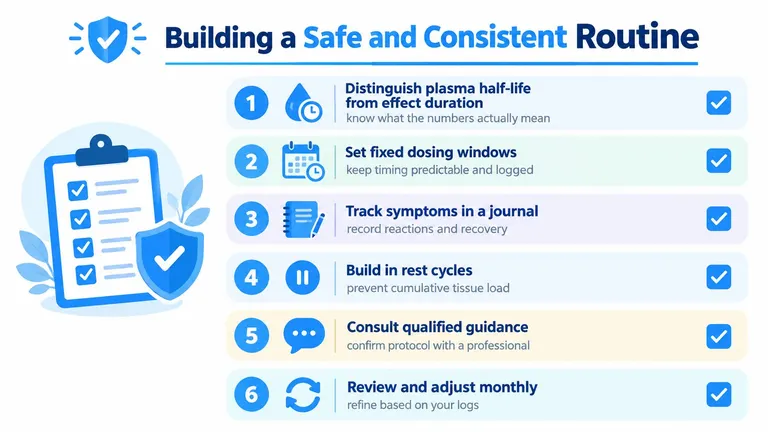
A safer routine starts with uncertainty, not confidence. Melanotan II half life is better treated as a range of imperfect estimates than as a single clean number, and that distinction changes how you read every schedule, delay, and side effect. The goal is not to force certainty onto weak data. It is to avoid turning a rough estimate into a rule.

A simple way to think about routine
A written log helps more than memory. If someone records each dose, the timing, and the body’s response, patterns become easier to spot than if they rely on guesswork. That matters because the visible effect and the plasma estimate do not always move together.
A second issue is that different users manage uncertainty in different ways. One person documents symptoms, pauses when reactions linger, and reviews the pattern before repeating a dose. Another copies a forum schedule and assumes the numbers will fit. Only one of those approaches leaves room for adjustment.
For broader context on skin care and pigmentation, Mesoderm RX skincare tips is a useful reminder that hyperpigmentation is not solved by a single compound or by a single clock. That point matters here too, because peptide timing and skin response are not the same problem.
What to check before you act
- Separate the numbers: plasma clearance is not the same thing as how long an effect feels active.
- Track reactions: note flushing, nausea, mole changes, or muscle-related symptoms.
- Keep timing consistent: documentation is easier to review when the pattern is stable.
- Pause when symptoms linger: a half-life estimate should not override what the body is showing.
- Get professional input: changing lesions or ongoing systemic symptoms deserve clinical review.
Product quality adds another layer of uncertainty. Online preparations may vary in identity, concentration, sterility, or impurity profile, so one vial should never be treated as a guarantee for the next. That is why self-directed dose escalation becomes harder to justify, especially when the regulatory status covered in the routine section below is already part of the picture.
If you want help keeping that process organized, visit PepFlow to log your protocol, convert doses accurately, and keep notes in one place. It is built to make structured peptide tracking easier, so your protocol rests on documented routine rather than on a half-life figure the evidence was never strong enough to give you.