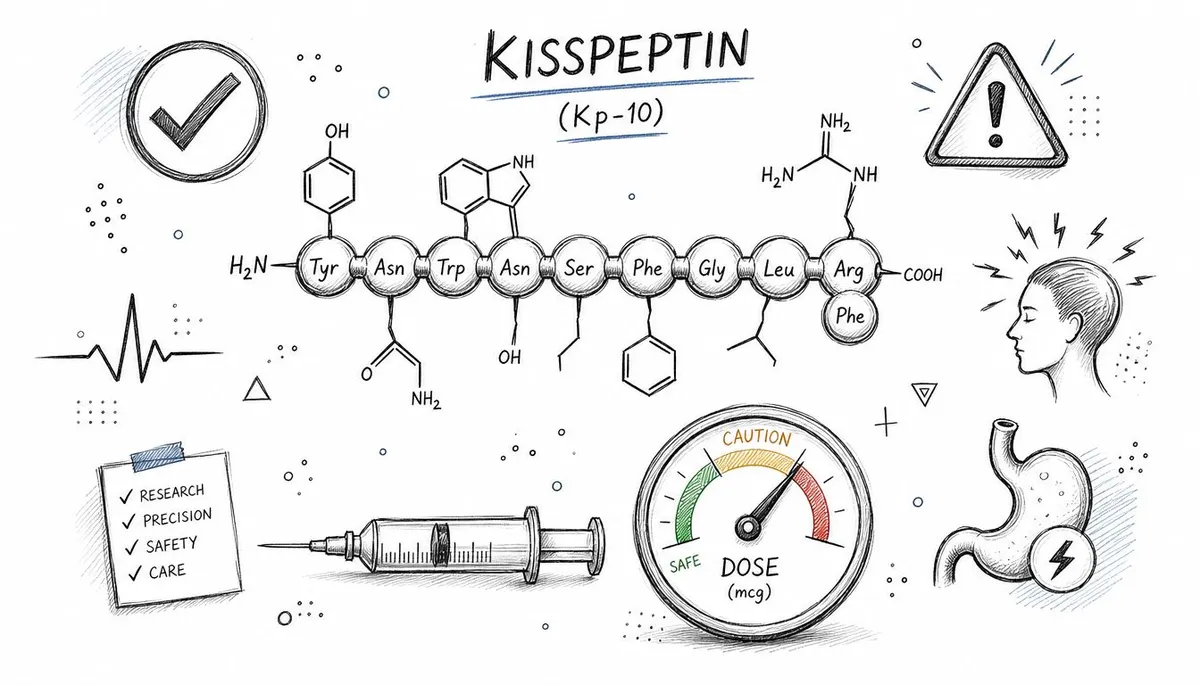
The safest reading of the evidence is also the least intuitive: kisspeptin can look almost side-effect free in clinical trials and still produce real problems in unsupervised use. That isn’t necessarily a contradiction. It reflects a change in context. Controlled studies used defined protocols, medical monitoring, and pharmaceutical handling, while many self-research reports come from repeated dosing, unverified supply chains, and no clinical guardrails.
That difference matters because people often search “kisspeptin side effects” expecting a simple yes-or-no answer. The evidence doesn’t support one. It supports a narrower claim: under controlled conditions, kisspeptin appears unusually well tolerated; outside those conditions, the risk profile becomes less about the peptide in isolation and more about how, how often, and in whom it’s being used.
Table of Contents
- The Kisspeptin Safety Paradox Explained
- What Clinical Trials Reveal About Kisspeptin Safety
- Why Real-World Side Effects Emerge
- A Practical Guide to Reported Side Effects
- Advanced Risks Dosing Cycles and Specific Populations
- Framework for Responsible Use and Management
The Kisspeptin Safety Paradox Explained
Kisspeptin has earned a reputation as a remarkably clean signaling peptide. That reputation isn’t marketing fiction. It comes from controlled human research showing a strong safety profile. But the online conversation around kisspeptin side effects sounds very different. Users describe nausea, headaches, sweating, appetite changes, sleep disruption, and loss of response over time.
Both narratives can be true at once.
The key distinction is that clinical medicine asks whether a compound is tolerated under a defined protocol, while self-research culture often asks whether it feels tolerable under personal experimentation. Those are not the same question. A peptide can be well tolerated on its own and still become problematic when dosing frequency, source quality, injection technique, or user selection drift away from the conditions that generated the safety data.
A “zero side effects” headline is only meaningful if the protocol behind it matches the protocol being copied.
That’s where many readers get misled. They see reassuring trial summaries, then apply them to a very different setting, often one closer to repeated subcutaneous self-administration than to medically supervised research. If you’re reviewing kisspeptin protocol resources, that context shift matters more than any isolated anecdote.
A second issue is category error. Some reported problems are likely delivery-related, such as injection site irritation. Others are better understood as protocol-related, such as diminishing responsiveness with chronic exposure. And some are population-specific, especially in women using kisspeptin in fertility contexts where ovarian response can’t be treated casually.
The practical conclusion is narrower than most articles make it. The question isn’t whether kisspeptin is “safe” in the abstract. The useful question is this: safe under what pattern of use, in which person, with what monitoring, and for how long?
What Clinical Trials Reveal About Kisspeptin Safety
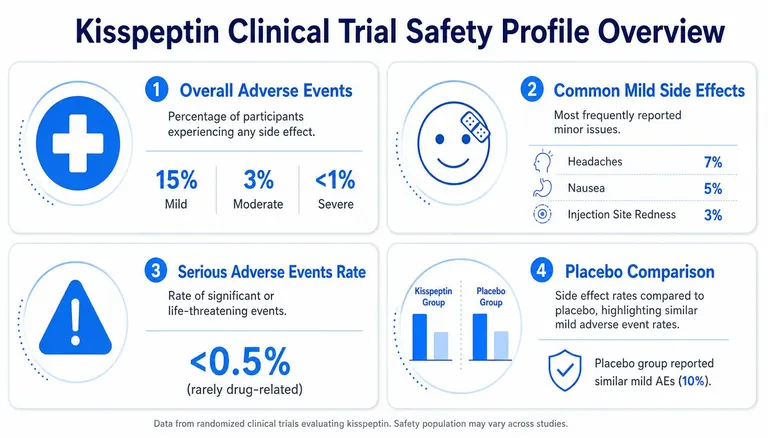
Clinical trials support a narrower claim than many summaries online. Under short, medically supervised protocols, kisspeptin has usually looked well tolerated.
What the strongest trial evidence actually shows
The best human data come from controlled studies using defined doses, screening criteria, and active observation. In that setting, investigators reported no serious safety signal and no consistent pattern of systemic side effects. That finding matters, but its meaning is specific. It applies to acute exposure inside a protocol, not to every form of self-directed use.
One female trial is often cited for more than the headline result. Alongside the absence of reported adverse events, investigators observed a clear rise in circulating kisspeptin after administration without corresponding changes in state anxiety or in key downstream sex steroid measures during the study window. That combination weakens a common assumption that any unpleasant reaction after use must reflect immediate endocrine disruption. In supervised acute dosing, that mechanism was not obvious.
Male data point in the same direction. Researchers did not report a meaningful effect on routine cardiovascular measures such as blood pressure or heart rate during monitored administration. For readers trying to separate plausible pharmacology from forum speculation, that is useful. It suggests the early safety profile is cleaner than the compound’s reputation in some self-experiment circles.
A second pattern is easy to miss. The adverse events that do appear in human research materials tend to be minor local reactions around administration, such as injection discomfort, bruising, or slight bleeding. Those findings fit the delivery method at least as well as they fit the molecule itself.
What that does and does not prove
Clinical trials establish a baseline. They do not establish safety across indefinite duration, changing dose schedules, mixed compounds, or unverified product quality.
That distinction matters because kisspeptin acts upstream in reproductive signaling. A compound can appear benign during brief supervised exposure and still create problems under repeated or prolonged use, especially if receptor responsiveness changes over time or if ovarian stimulation becomes relevant in susceptible users. Those concerns are not disproven by clean short-term trials. They were often outside the question the trials were designed to answer.
Practical rule: Use clinical safety findings as evidence for the studied protocol only.
The most responsible reading is therefore restrained. Current trials support good short-term tolerability in selected participants under medical oversight. They do not justify the stronger internet claim that kisspeptin has “no side effects,” full stop.
Why Real-World Side Effects Emerge
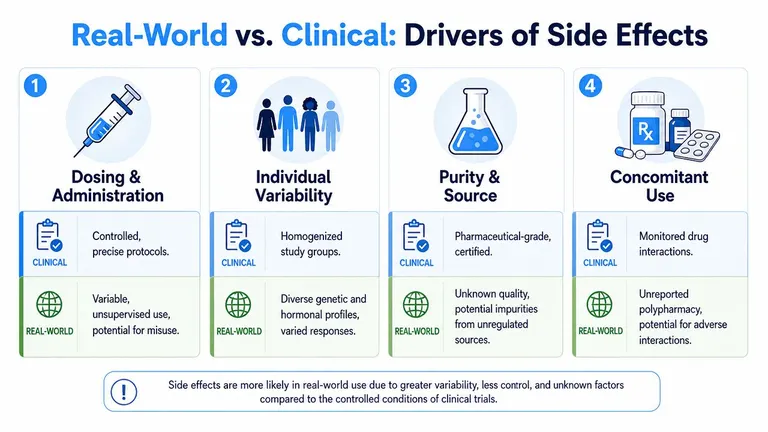
The cleanest way to misunderstand kisspeptin safety is to treat trial tolerability as a property of the molecule in every setting. It is a property of a specific protocol, in a selected population, using verified material, over a limited timeframe. Once those controls disappear, the safety profile can change for reasons that have little to do with the trial result itself.
Real-world use changes the biological question
Under supervision, investigators define the dose, route, frequency, and stopping rules. Self-experimenters often modify all four. A short exposure designed to test acute endocrine effects is not equivalent to repeated subcutaneous use over weeks or months, and it does not answer the same safety question.
That difference matters because kisspeptin sits high in the reproductive signaling pathway. Repeated stimulation can produce outcomes that short studies were not built to detect, including reduced responsiveness over time and excessive ovarian stimulation in susceptible users. In other words, the internet claim of “no side effects” usually rests on evidence from conditions that omit the very variables most likely to create real-world problems.
The practical consequence is simple. Once someone extends duration, changes frequency, or combines kisspeptin with other agents, they are no longer reproducing a studied protocol. They are running a new experiment with weaker guardrails.
Product quality and attribution get harder outside research settings
As noted earlier, some adverse events in human research look more like procedure effects than drug effects, especially local irritation around injection. That distinction often disappears in self-research communities, where redness, bruising, poor injection technique, contaminated supplies, and peptide pharmacology can all get grouped together as “side effects.” For a broader primer on delivery-related reactions, see potential side effects of regenerative injections.
The product itself also changes. Clinical material is manufactured, stored, and documented under standards that are hard to match in the gray-market peptide supply chain. Outside that setting, purity, concentration, sterility, and reconstitution practices may vary. A user may attribute nausea, flushing, or an unusual endocrine response to kisspeptin when the actual problem is degraded product, inaccurate dosing, or an undisclosed contaminant.
This attribution problem is one reason peptide adverse-event discussions often become confused. The reported symptom may come from the compound, the injection, the supplier, the dosing schedule, or the rest of the stack.
Long-term, unsupervised use is where the risk profile changes most
Short-term tolerability does not rule out long-term problems. It leaves them unanswered.
That gap is especially important for biohackers and fertility self-researchers, because the main concerns are mechanistic rather than dramatic. Chronic stimulation can push receptor systems toward desensitization. In women with high ovarian responsiveness, repeated or poorly timed use could also shift from benign signaling support toward overstimulation risk. Those are not fringe hypotheticals. They follow directly from how the pathway works and from how far real-world use can drift from trial design.
A useful comparison appears across other peptide side effect patterns in unsupervised use. Reported problems often increase when three things happen together: dosing extends beyond the studied window, source quality becomes uncertain, and users stack compounds without clear attribution.
The main safety paradox is not that clinical trials were misleading. It is that unregulated use removes the controls that made the reassuring trial data interpretable in the first place.
A Practical Guide to Reported Side Effects
The useful question is not whether kisspeptin has “side effects” in the abstract. The useful question is which reported problems plausibly fit kisspeptin biology, which fit injection technique, and which point to a poorly designed self-experiment.
That distinction matters because real-world reports are noisy. A headache after an injection does not carry the same weight as a reproducible change in appetite across multiple doses, and neither should be interpreted the same way as sleep or mood changes that appear only after prolonged use. Readers who lump all three together usually either overstate the danger or dismiss signals that deserve caution.
Short-term reactions people report early
The early complaints are usually nonspecific. Self-research communities commonly mention nausea, gastrointestinal upset, headache, sweating, and a general sense of feeling unwell during the first doses. Those reports are compatible with a short-lived physiologic response, but they are weak evidence for a defined toxicity pattern because they are common, subjective symptoms with many competing explanations.
Injection-site irritation is easier to interpret. Redness, swelling, tenderness, or a small area of pain after subcutaneous administration often reflects the procedure itself, the diluent, or local tissue irritation rather than the peptide alone. Readers unfamiliar with injection technique often benefit from broader context on potential side effects of regenerative injections, especially when trying to separate routine local reactions from signs of infection or a sterile inflammatory response.
Appetite changes sit in a more interesting category.
Some self-experimenters report reduced hunger or altered meal timing. That does not establish kisspeptin as a reliable appetite tool, but it is biologically plausible enough to justify tracking. If a user notices a repeated shift in hunger cues after dosing, the right response is documentation, not a broad claim about fat loss or metabolic benefit.
Longer-term warning signs
The more informative reports are the ones that emerge after repeated use over weeks or months. They tend to involve sleep disruption, mood volatility, a sense that the protocol “stopped working,” or a gradual drift into chasing the original effect with more frequent dosing. That pattern is more concerning than a transient headache because it suggests the protocol is pushing beyond the conditions under which human tolerability has been studied.
This is also where side-effect discussions often become misleading. A person may describe insomnia or emotional instability as if they were isolated adverse events, when the larger problem is repeated stimulation of a hormonal signaling pathway without lab monitoring, endpoint definition, or a stopping rule. In practice, those reports may be early markers of protocol failure rather than standalone symptoms.
A better way to classify what users report
| Reported issue | More plausible explanation | How to interpret it |
|---|---|---|
| Nausea, headache, sweating, GI upset | Early systemic reaction, expectation effect, dosing error, or unrelated background symptom | Track timing and recurrence before assigning causality |
| Redness, swelling, local pain | Injection technique, diluent irritation, or minor local inflammatory response | Usually procedural, but worsening redness or systemic symptoms need attention |
| Appetite suppression or altered hunger | Possible central or endocrine effect, but inconsistent and anecdotal | Worth logging, not a basis for broad efficacy claims |
| Sleep disruption, mood changes, feeling “wired” or unstable | Repeated exposure, stacking, dose escalation, or poor protocol design | Higher concern, especially if symptoms build over time |
| Loss of expected response | Adaptation to repeated stimulation rather than acute intolerance | Suggests a dosing-strategy problem, not simply “needing more” |
This classification is more practical than a simple safe versus unsafe label. It helps self-researchers decide whether to adjust injection practice, stop a protocol, or seek medical evaluation.
It also aligns with broader patterns seen in reported peptide side effect patterns in unsupervised use. Problems become harder to interpret when users change several variables at once, especially dose, frequency, supplier, and other compounds in the stack.
Clinical evidence and anecdotal reporting answer different questions
| Side Effect Category | Finding in Clinical Trials | Reported in Unregulated Use |
|---|---|---|
| Acute systemic effects | Controlled studies generally report good short-term tolerability | Users still report nausea, headache, sweating, and GI discomfort |
| Anxiety and vital signs | Monitored settings have not shown a consistent signal of instability in these measures | Self-reports of feeling “off” are common, but attribution is uncertain without monitoring |
| Hormonal downstream effects | Trial findings are tied to narrow populations and defined dosing windows | Long-term self-experimentation may produce a different response pattern |
| Injection-related issues | Local injection effects are recognized procedural risks | Redness, pain, and swelling are commonly discussed |
| Extended use | Human data are limited for casual long-duration use | Sleep, mood, and response-loss complaints appear more often in unsupervised settings |
The central point is simple. Short-term tolerability in a monitored study does not resolve what happens when people use a research peptide repeatedly, from uncertain sources, for goals and timeframes that were never formally tested.
Advanced Risks Dosing Cycles and Specific Populations
The highest-risk kisspeptin mistake is often not an acute side effect. It is a protocol that stops working unnoticed while the user assumes the biology is still responding.
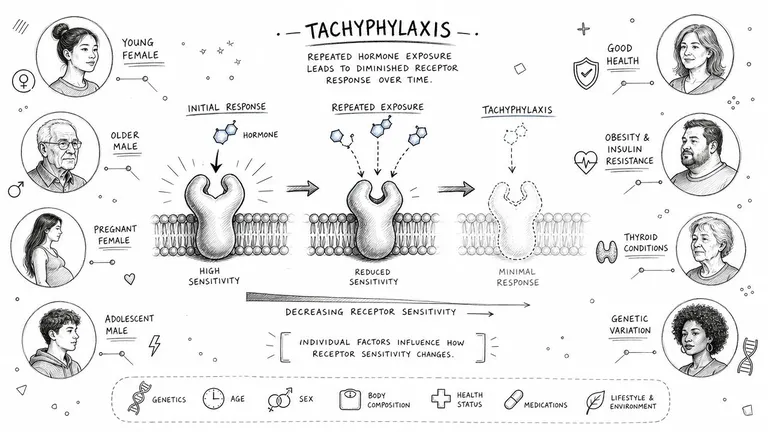
Tachyphylaxis is the hidden protocol risk
Kisspeptin does not create the same risk profile under every dosing pattern. That is the main reason real-world reports can diverge from short clinical summaries that describe it as well tolerated.
A key concern is tachyphylaxis, a diminishing biological response after repeated exposure. The evidence reviewed in this paper on chronic kisspeptin exposure suggests that repeated daily stimulation can reduce responsiveness, while intermittent dosing with recovery periods appears more likely to preserve it. For self-researchers, that changes the meaning of “tolerated.” A compound can produce few immediate symptoms and still become less useful, or biologically less predictable, if the schedule pushes the receptor system toward desensitization.
The practical consequence is easy to miss. Loss of effect may prompt a user to raise the dose, add another compound, or shorten the interval between doses. Each of those changes makes interpretation worse. The problem may not be underdosing. The problem may be that the protocol has shifted the endocrine response itself.
Frequency often matters as much as amount.
A clearer way to frame the risk is to separate common dosing patterns by what they are likely to test:
- Intermittent use tests whether the system remains responsive across spaced exposures.
- Daily chronic use tests whether the system can tolerate repeated stimulation without a declining response.
- Escalating doses after response loss confounds the picture because desensitization can look like weak product or insufficient dose.
- No planned off-periods remove the main strategy used to reduce concern about response attenuation.
This matters beyond peptide forums. Resources on safely starting hormone therapy are useful for the same reason. Upstream hormonal interventions require follow-up, defined goals, and a plan for what counts as nonresponse.
Why female users need a narrower safety lens
Women using kisspeptin in fertility-related contexts face a different risk calculation from people using it for general hormone optimization. The relevant question is not whether kisspeptin is “safe” in the abstract. It is whether a given ovarian context makes stimulation risky, difficult to monitor, or easy to misread.
One example is ovarian hyperstimulation syndrome (OHSS). Clinical discussions have described kisspeptin-triggered protocols as carrying a lower OHSS risk than hCG-based triggering, but lower risk does not mean absent risk, as noted earlier in the article. That distinction matters because simplified online summaries often collapse “lower than hCG” into “no meaningful ovarian risk.” For a fertility-oriented user, that is not a safe assumption.
Symptoms also matter more in this subgroup because the downside is not limited to feeling unwell. Abdominal bloating, pelvic discomfort, rapid weight change, nausea, or worsening shortness of breath can carry a different significance in an ovarian stimulation setting than they would in a casual wellness experiment.
Here’s a short explainer for readers who prefer a visual overview before going deeper:
Protocol design matters more than enthusiasm
Kisspeptin should be treated as an endocrine signaling tool, not a generic recovery or performance peptide. That is especially true in longer cycles, fertility-related use, or any protocol built around maintaining a repeatable LH and gonadotropin response.
The non-obvious risk is that side effects and ineffectiveness can merge into the same problem. A protocol that drives desensitization may fail before anything dramatic happens subjectively. A fertility-focused protocol that ignores ovarian context may appear acceptable until symptoms are interpreted too late. Any peptide dosage planning framework should therefore account for dose, frequency, cycle length, pause periods, and user population, rather than treating syringe volume as the whole safety question.
Framework for Responsible Use and Management
The safest assumption is not that kisspeptin is harmless. It is that a compound that looks well tolerated in short, supervised studies can become less predictable when people change the dose, duration, sourcing, and clinical context on their own.

That difference is the core safety problem. Clinical protocols reduce variables and define stopping rules. Self-research often does the opposite. The result is that side effects, loss of effect, and user error can blur together unless the protocol is built around observation rather than optimism.
A conservative monitoring framework
A reasonable harm-reduction framework starts with traceability. If a symptom appears, the first question is not whether kisspeptin is “safe” in general. It is whether anything in the protocol makes that symptom interpretable.
Use a written system that captures:
- One change at a time. If dose, frequency, source, and co-administered compounds all shift together, causality becomes guesswork.
- Administration details. Record date, time, amount, route, batch or source, and reason for use.
- Same-day and delayed effects. Note physical symptoms, sleep changes, appetite changes, mood changes, libido shifts, and injection-site reactions.
- Planned pause periods. Receptor signaling is one of the places where more exposure can mean less response. Intermittent scheduling helps test whether a protocol is still producing a consistent effect.
- Context-specific caution. Fertility-related use, ovarian stimulation, pregnancy planning, active endocrine treatment, and unexplained hormone symptoms all raise the threshold for acceptable uncertainty.
A written timeline matters because memory edits mild symptoms into a story that feels coherent but often is not.
For readers who want a cleaner way to organize medication and protocol history before any medical discussion, Patient Talker templates for patients are useful because they force details into a format a clinician can review.
When to stop and seek medical input
Some patterns should end self-experimentation, even if no single event feels dramatic.
- Persistent sleep disruption, agitation, or mood instability. These symptoms are easy to rationalize in unsupervised use and hard to interpret without a timeline.
- Worsening local reactions. Increasing redness, swelling, pain, or unusual tissue changes deserve medical review rather than site rotation and continued use.
- Loss of expected response after frequent dosing. Repeating the dose more often is not a neutral adjustment. It can push a desensitization problem further.
- Abdominal bloating, pelvic discomfort, rapid weight change, nausea, or shortness of breath in a reproductive context. In ovarian stimulation settings, these symptoms carry more significance and should not be treated like generic side effects.
The practical rule is simple. Stop when the protocol becomes harder to explain than the reason for using it.
Documentation beats memory
Many avoidable mistakes in peptide self-research are not dramatic. They come from skipped notes, changing suppliers without documenting it, stretching cycle length because nothing felt wrong, or assuming a previous response guarantees the next one.
Good records reduce two common errors. The first is overreacting to noise after one bad day. The second is missing a reproducible pattern because each event seemed minor in isolation. A useful log includes dose, route, timing, purpose, concurrent compounds, immediate effects, later effects, and whether anything else changed that day.
That record also helps separate three different problems that users often collapse into one. True side effects reflect an adverse response. Protocol failure reflects a design problem such as excessive frequency or duration. Product quality issues reflect sourcing uncertainty. The management plan differs for each one.
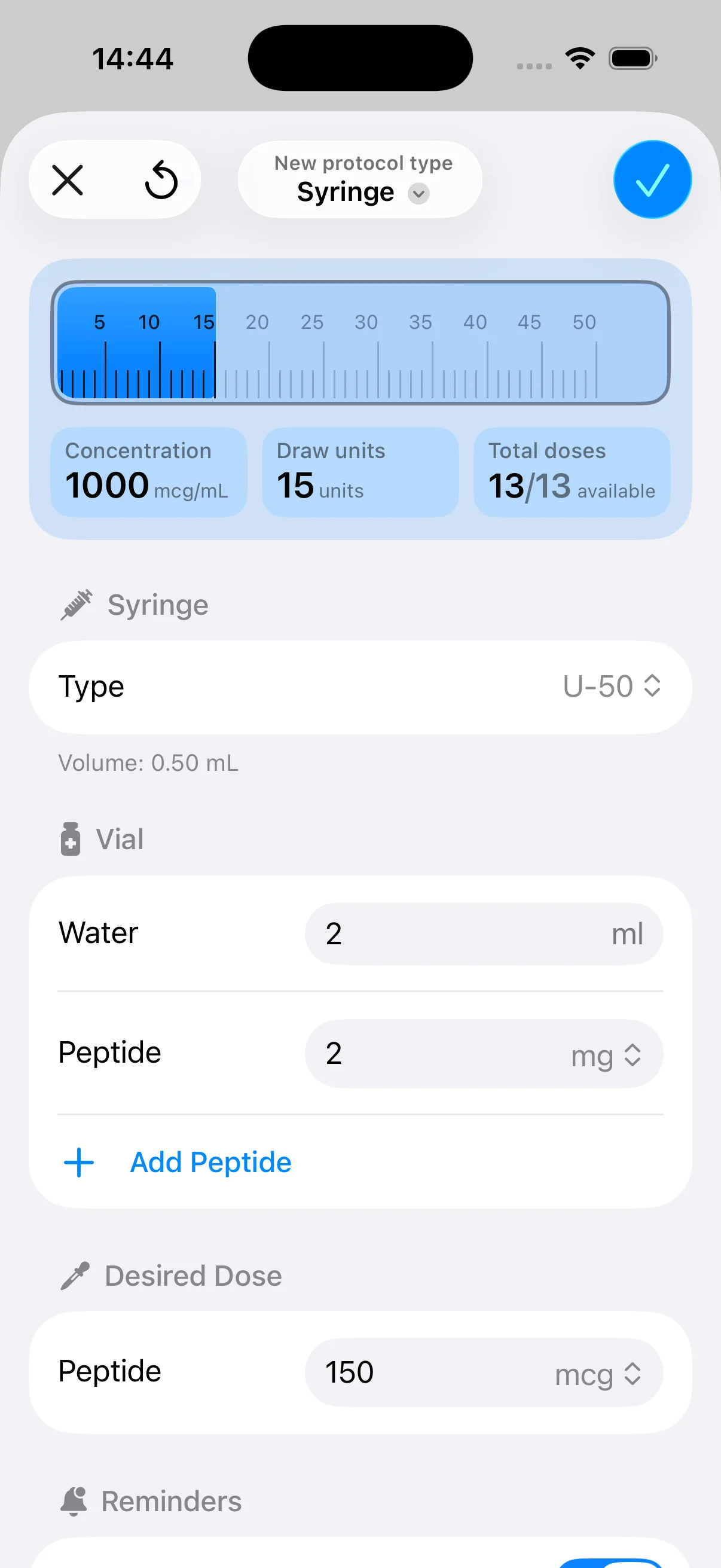
If you want a simpler way to organize peptide schedules, track doses, and avoid manual math errors, PepFlow helps you manage structured protocols with dosing calculations, reminders, history tracking, and planned pause periods. It’s built for consistency and record-keeping, not as a replacement for medical advice.
The clearest conclusion is narrower than “kisspeptin has no side effects” and more useful than alarmism. Under controlled conditions, kisspeptin appears well tolerated. In self-directed use, risk rises when people ignore exposure length, dosing frequency, population-specific concerns, and the possibility that reduced effect is itself a warning sign.