IGF-1 is a real muscle-growth signal, but the evidence doesn’t show that raising it reliably builds muscle in healthy adults. The popular advice to maximize IGF-1 confuses a biological mechanism with a proven treatment.
That distinction matters when evaluating IGF-1 for muscle growth. A molecule can help regulate muscle tissue without its blood concentration measuring your progress, and without an injected product producing useful, safe gains. Those are separate questions, requiring different kinds of evidence.
Table of Contents
- Does IGF-1 Build Muscle? What the Evidence Says
- How IGF-1 Signals Muscle to Grow
- Why a Blood IGF-1 Spike Is Not a Growth Signal
- What Actually Drives Muscle Growth
- Measuring Muscle Gain Beyond Hormone Levels
- Clinical Extremes, Research Chemicals and Warning Signs
- Take a Complete Dose Log to Your Clinician
Does IGF-1 Build Muscle? What the Evidence Says
IGF-1 participates in muscle growth, but that doesn’t establish externally administered IGF-1 as an effective muscle-building intervention for healthy adults. The answer changes depending on whether investigators study molecular activity, muscle size, circulating hormones, or physical function.
A useful evidence hierarchy asks not just whether something happened, but to whom, under what conditions, and with which outcome. Manipulating a pathway in an animal can establish biological plausibility. It can’t establish a favorable benefit-risk balance for an adult lifter.
Evidence by context for IGF-1 and muscle
| Context | What was observed | Applies to healthy adult lifters? |
|---|---|---|
| Cell and animal models | Muscle hypertrophy after manipulating IGF-1 levels | Partly; adult treatment benefits aren’t established |
| Transgenic growing mice | Myofiber hypertrophy with elevated IGF-1 | Not necessarily; effects differed in adult mice |
| Exercise in healthy people | Blood IGF-1 rose while muscle IGF-1 protein didn’t change | Not as a blood-based indicator of local signaling |
| Acromegaly with excess GH and IGF-1 | Muscle weakness and impaired physical performance | Not as evidence of benefit; prolonged excess can impair function |
| Recombinant IGF-1 in myotonic dystrophy | Lean mass increased without significant strength improvement | Not directly; participants had a neuromuscular disease |
| IGF-1 LR3 research chemical | No registered clinical or randomized human trials for muscle growth identified in the available evidence | Unknown; human efficacy isn’t established |
These contexts don’t form a simple progression toward stronger proof. Healthy-person exercise experiments address normal physiology, not injection efficacy. Disease-treatment studies involve a different starting condition, while acromegaly illustrates the consequences of pathological hormone excess rather than a controlled enhancement strategy.
What would establish a useful intervention?
For a healthy lifter, persuasive evidence would require controlled human studies of a specified product, with meaningful changes in muscle size and function, alongside adequate safety assessment. Neither a receptor diagram nor an impressive before-and-after photograph answers those questions.
Evidence standard: A plausible growth mechanism is a reason to investigate a treatment, not a reason to assume it works.
The defensible conclusion is narrow: IGF-1 is a credible biological pathway, not a proven muscle-building intervention for healthy adults. Claims about particular products remain unconfirmed without appropriate human testing.
How IGF-1 Signals Muscle to Grow
Think of IGF-1 as a key that fits a receptor on a muscle fiber. Once that receptor is activated, the downstream response resembles a site foreman increasing protein assembly while restraining the demolition crew.
The review The Role of IGF-1 Signaling in Skeletal Muscle Atrophy describes the PI3K/Akt pathway, its downstream protein-synthesis signals, and its role in limiting protein breakdown. The important concept is net balance: muscle tissue reflects both the production and removal of proteins, not synthesis alone.
The diagram separates these complementary actions.

The signaling sequence
- IGF-1 binds its receptor. Receptor activation allows the muscle fiber to respond to the signal. The molecule’s presence alone isn’t the same as a completed growth response.
- PI3K and Akt become active. These intracellular signaling components connect receptor activation to processes governing protein turnover.
- Protein-synthesis signaling increases. Downstream targets include mTOR-related signaling and p70S6 kinase, which help regulate the machinery that assembles proteins.
- Akt suppresses FoxO transcription factors. This lowers expression of muscle-wasting E3 ubiquitin ligases, limiting proteasomal protein breakdown rather than adding another synthesis signal.
Each step explains a possible contribution to maintaining or enlarging muscle fibers. None, by itself, specifies how much additional muscle an adult will gain from a product.
Circulating and local IGF-1 aren’t interchangeable
Circulating IGF-1 is produced mainly by the liver under growth-hormone control. Muscle also produces local IGF-1 isoforms that may act on the producing cell through autocrine signaling or on nearby cells through paracrine signaling.
The distinction resembles a mailed letter versus a note posted on a workplace wall. Both carry information, but their destination, timing, and audience differ. A measurement from the circulation doesn’t automatically describe what’s happening inside a particular exercised muscle.
For terminology surrounding local isoforms, this explanation of mechano growth factors provides additional context. Those terms shouldn’t be interpreted as proof that a marketed peptide recreates normal training-induced signaling.
Age and tissue context matter, too. An effect during development cannot be transferred directly to mature muscle, and externally supplying a signal doesn’t reproduce every condition of an experimental model. The mechanism explains biological possibility, not a personal dosing strategy or a guaranteed adult outcome.
Why a Blood IGF-1 Spike Is Not a Growth Signal
A hard workout raises a hormone measurement, so the workout must produce more muscle. That’s the common misreading: treating a temporary blood result as a forecast of long-term adaptation.
The distinction is illustrated below.

In a high-power exercise study discussed in the IGF-1 exercise review hosted by Simon Fraser University, circulating IGF-1 increased and muscle IGF-1 mRNA rose by approximately 40%, yet skeletal-muscle IGF-1 protein didn’t change. A change in gene-expression messaging therefore wasn’t equivalent to a measured increase in the corresponding muscle protein.
Blood measurements describe a different compartment
A coastal weather report doesn’t tell you the exact conditions inland. Likewise, a circulating hormone concentration doesn’t describe every local response within an exercised muscle.
Broader evidence reviewed in that document also challenges the idea that acute IGF-1, growth-hormone, or testosterone responses are necessary or sufficient for training-induced gains. A transient endocrine response isn’t a validated score for workout quality.
Keep that distinction in mind when watching explanations of exercise hormones.
A post-workout IGF-1 spike isn’t evidence that the session will produce more muscle.
For training decisions, look at what you can repeatedly perform and what changes over time. IGF-1-related medicines belong under qualified medical supervision, not in a strategy designed to maximize a post-workout laboratory result.
What Actually Drives Muscle Growth
For a healthy adult, the practical priorities are progressive resistance training, adequate protein and energy intake, and sufficient recovery. These address the work performed by the muscle and the resources available for adaptation, rather than trying to optimize an isolated hormone value.
A review of systemic hormones and muscle hypertrophy emphasizes local mechanotransduction and downstream signaling rather than acute circulating IGF-1 as the explanation for training adaptations. That supports a straightforward choice: organize training around repeatable muscular work, not endocrine spikes.
Make the training stimulus measurable
- Choose repeatable exercises. Keep core movements consistent enough that you can compare performance. Changing exercises constantly makes it harder to tell whether capacity is improving.
- Progress reps or load. Say you perform a squat with the same technique and range of motion. Completing more controlled repetitions, or later using a heavier load, gives you a concrete progression target.
- Support training with food. Include protein-containing meals and enough overall food to sustain training. The evidence supplied here doesn’t establish a precise protein target, so there’s no basis for presenting a specific intake as an IGF-1 optimization formula.
- Protect recovery. Record disrupted sleep, unusual fatigue, and missed sessions. Those details help explain performance changes without attributing every fluctuation to hormones.
For readers learning how to organize these basics, Empire Athletics’ muscle growth advice for new lifters offers a training-focused starting point. Use such guidance to develop a coherent routine, not as evidence for a peptide intervention.
Don’t confuse effort with progression
A workout can feel exceptionally hard without providing a better long-term stimulus. Conversely, a familiar session may be productive even when it doesn’t feel dramatic.
Judge the routine across repeated exposures: Are you completing the intended work? Is technique consistent? Can you gradually perform more without accumulating fatigue that disrupts subsequent sessions?
Consistency makes results interpretable. If you simultaneously change exercise selection, food intake, sleep, and a substance, you won’t be able to identify which change explains the outcome.
Measuring Muscle Gain Beyond Hormone Levels
Lean mass isn’t synonymous with stronger, more functional muscle. A body-composition result can improve without demonstrating the performance benefit a lifter wants.
In an uncontrolled study of recombinant IGF-1/IGF-binding-protein-3 in myotonic dystrophy, 15 participants underwent 24 weeks of treatment and gained 1.95 kg of lean body mass, but muscle strength and functional outcomes didn’t significantly improve. The disease population and absence of a control group limit what that finding can establish for healthy adults.
Outcomes to track for a muscle-growth goal
| Measure | What it shows | Main limitation |
|---|---|---|
| Body weight | Total mass change over time | Includes fat, water, and digestive contents |
| DXA lean mass | Estimated non-fat mass | Can include water and non-contractile tissue |
| Limb circumference | Local size change at the same landmark | Affected by pump, hydration, and measurement error |
| Strength on standard lifts | Functional capacity under load | Influenced by training progression and technique |
| Serum IGF-1 blood value | Circulating hormone level | Weak proxy for muscle hypertrophy |
The implication isn’t that body-composition testing is useless. It’s that a measurement answers a specific question, and no single measure establishes size, composition, function, and treatment causality together.
Build a consistent measurement routine
Start with a training log. Record the exercise, load, repetitions, and relevant technique details, including range of motion or equipment changes. A heavier lift performed with a shortened movement isn’t a clean comparison.
For circumference measurements, use a tape at the same anatomical landmark and under similar conditions. Avoid comparing a relaxed measurement with one taken immediately after training, and note circumstances that could affect the result.
Keep body-composition assessments consistent, too. Use the same method and comparable preparation rather than treating measurements from different devices as interchangeable.
Finally, record symptoms and adverse effects separately from performance. A favorable size trend doesn’t cancel a concerning glucose-related event, and a laboratory value doesn’t determine whether an intervention is tolerable.
Measurement principle: Look for agreement between muscle-size trends and standardized physical capacity, not a favorable change in whichever metric moves first.
Strength can improve through technique and practice, while circumference can change without additional contractile tissue. Agreement across measurements is more informative than either outcome alone, although it still doesn’t prove that a particular substance caused the change.
For a muscle-growth goal, prioritize measured size and usable capacity. A clinician may interpret serum IGF-1 for diagnosis or treatment monitoring, but it isn’t a standalone growth score.
Clinical Extremes, Research Chemicals and Warning Signs
Acromegaly offers a direct counterexample to the assumption that sustained GH and IGF-1 excess builds better muscle. People with prolonged excess frequently develop weakness and impaired physical performance rather than superior muscular function.
A review of GH, IGF-1, and skeletal muscle links acromegaly to insulin resistance, oxidative stress, neuromuscular-junction problems, and fatty infiltration. These findings describe a disease state, so they cannot predict the outcome of every exposure. They do undermine the claim that pushing IGF-1 higher is desirable, and they show that chronic elevation can damage the tissue it is supposed to build.
Approved medicine and research chemicals require separate judgments
Mecasermin is an FDA-approved recombinant IGF-1 medicine for severe primary IGF-1 deficiency in children. Approval for that narrow indication says nothing about benefit for muscle enhancement in healthy adults.
IGF-1 LR3 raises a different evidentiary problem. The Molecular Reference overview of IGF-1 LR3 identifies no registered clinical trials or randomized human trials testing it for muscle growth, and it notes glucose-lowering effects, uncertain product quality, and unresolved long-term tissue-growth concerns.
That overview is not itself a controlled trial or a formal regulatory safety assessment. Where human evidence is absent, the honest conclusion is uncertainty. Safety data from mecasermin cannot be converted into a safe LR3 dose either, because the molecules, formulations, exposure patterns, and manufacturing quality all differ.
Labels matter here. Research use, no established human efficacy, and not approved for muscle building describe central limitations. Treating them as boilerplate to skim before a dosing recommendation reverses their meaning.
A hypothetical lifter’s mistaken inference
Consider a lifter who assumes a higher laboratory result must mean faster gains. Even if an exposure raises that number, the measurement cannot establish added contractile tissue or improved strength.
If swelling or glucose-related symptoms develop, they are not signs of productive hypertrophy. The appropriate response is clinical assessment, and adjusting the dose until symptoms seem manageable only extends the exposure that may be causing them.
When comparing online peptide explanations, distinguish the compound being discussed. ProMD Health peptide therapy insights describe AOD-9604, a different molecule, so that material cannot support claims that IGF-1 LR3 is effective or safe.
Operational explainers raise the same problem in reverse. A page covering how to take IGF-1 LR3 can describe schedules and handling without establishing that using the compound is safe or justified, because administration detail answers no clinical question.
Risks of IGF-1 exposure and what to do
| Risk | Why it matters | What to do |
|---|---|---|
| Blood glucose changes | IGF-1 signaling can lower blood glucose | Report symptoms and ask a clinician about glucose monitoring |
| Muscle weakness or fatigue | Can occur with prolonged GH and IGF-1 excess | Stop self-experimenting and seek medical review |
| Swelling or joint pain | Requires assessment during IGF-1-related exposure | Report it to a clinician promptly |
| Uncertain product identity | Unapproved products may differ in purity and batch consistency | Record product name, batch, and source |
| Abnormal tissue growth concern | Long-term oncologic effects remain unresolved | Discuss the uncertainty with a doctor before any exposure |
These risks do not share the same evidentiary basis. Clinical observations of hormone excess, the known pharmacology of IGF-1, and concerns about unapproved products each answer a different question. Combining them into a single precise risk estimate would overstate what the evidence can support.
Seek prompt medical contact for suspected low blood sugar, new swelling, joint pain, or an unexpected change after exposure. Severe symptoms require urgent care rather than waiting for a routine appointment.
Take a Complete Dose Log to Your Clinician
A complete record helps a clinician understand what was taken and what changed afterward. It’s useful documentation, not permission to start an intervention or proof that continued use is safe.
If exposure has already occurred, record what happened rather than reconstructing an ideal schedule. Keep the log on paper or in a notes app that you can bring to the appointment.
Use this checklist to organize the relevant details.

What to bring
- Product identification: Record the name, labeled concentration, batch number, and source. Bring packaging or label photographs if available.
- Actual dose and timing: List what you took and when, including missed administrations, interruptions, and deviations from any prescribed regimen. Don’t replace actual entries with planned ones without noting the change.
- Symptoms and onset: Note when each symptom began, its duration, and whether it followed exposure, exercise, or a meal.
- Glucose-related events: Document dizziness, sweating, shakiness, or other concerning episodes. Include measured glucose readings if they already exist, without delaying care to collect them.
- Other substances: List prescription medicines, over-the-counter products, supplements, and other peptides so the clinician can assess the complete context.
- Training and measurements: Bring consistent performance, body-weight, circumference, and body-composition records. Flag changes in food intake, exercise selection, or sleep.
- Questions for the appointment: Ask what evaluation is needed, what symptoms require urgent action, and whether any continued exposure is medically appropriate.
Keep documentation separate from treatment decisions
A medication log template can help organize the record. Its purpose is to reduce missing information, not to calculate a safe research-chemical regimen.
Dates and context matter because several changes may occur together. If you started a new training routine, changed your diet, and altered an exposure during the same period, a clinician needs those details before interpreting the outcome.
Bring product labels and relevant peer-reviewed summaries if they help clarify your questions. Neither marketing language nor a reference sheet substitutes for an individualized medical assessment.
Do not start, change, or continue a dose because of a perceived muscle response. Get a medical evaluation before considering any IGF-1-related product.
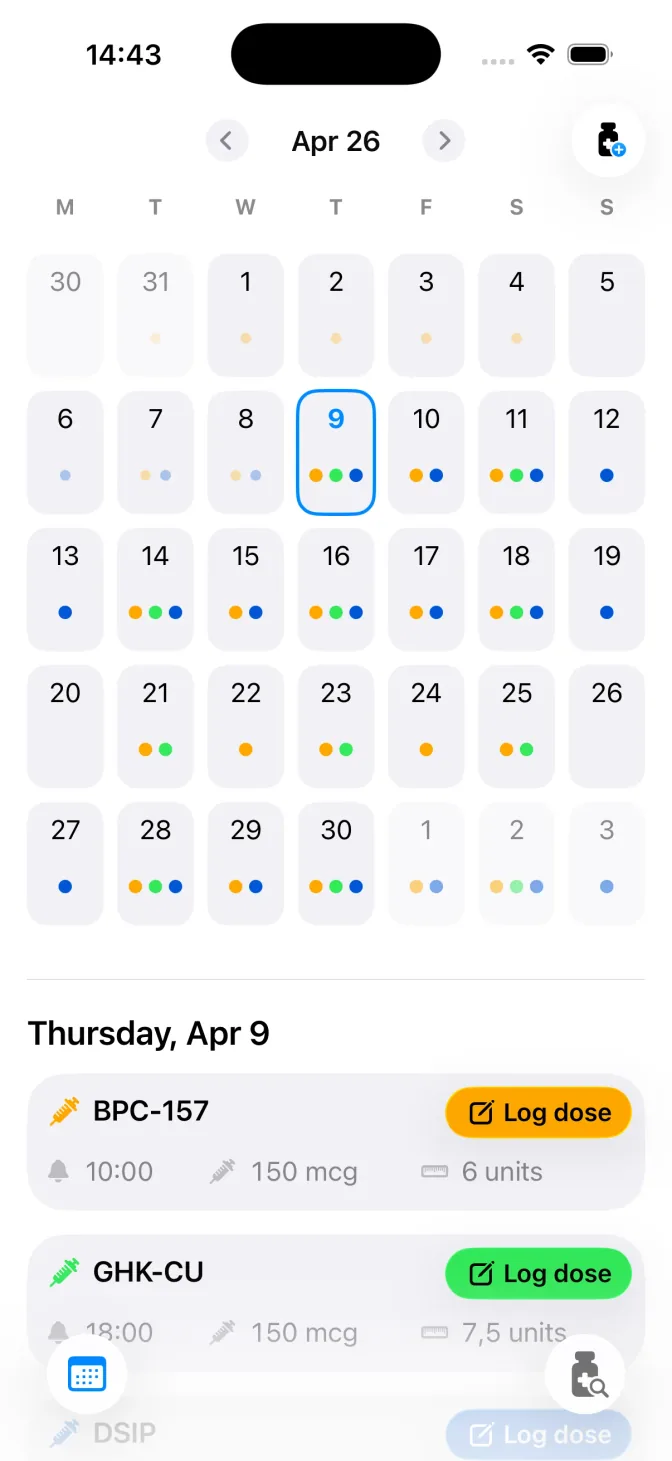
PepFlow offers a Peptide Knowledge Base and a Peptide Cheat Sheet, alongside tools for recording doses and organizing an established routine. Visit PepFlow to organize information for your clinician discussion, while keeping treatment selection, safety assessment, and dosing decisions with a qualified medical professional.