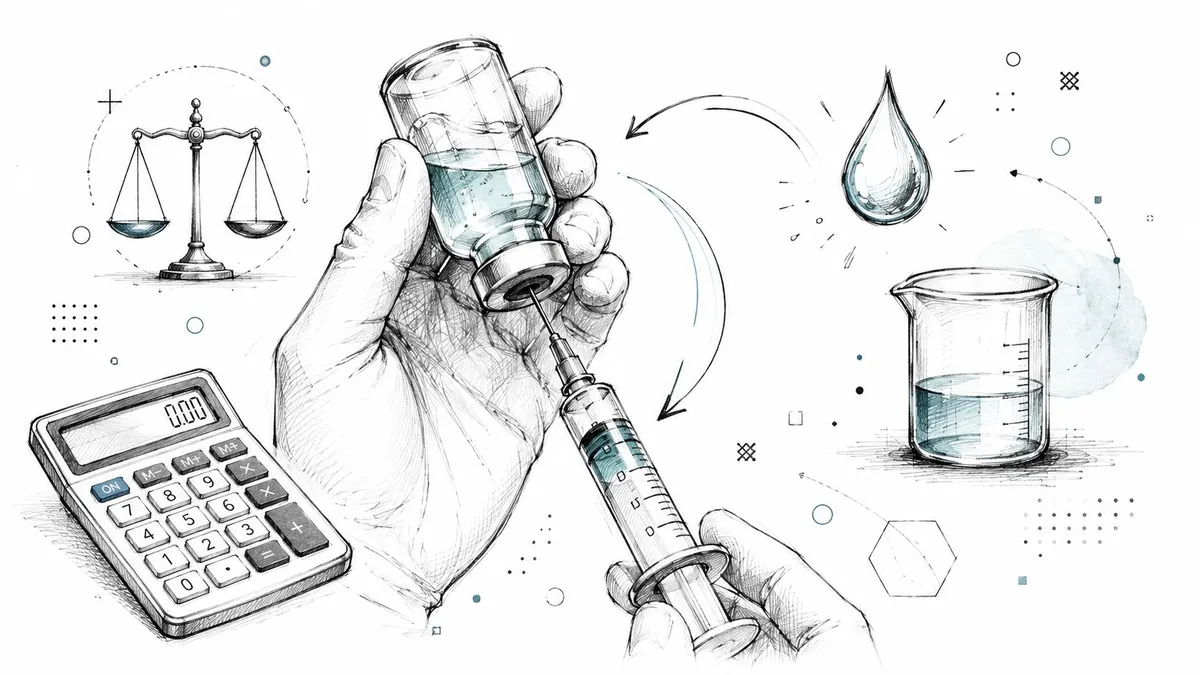
You’re probably here because you have a vial in front of you, a dose written in micrograms, and a syringe measured in milliliters. That gap feels small on paper and huge in practice. When the dose matters, “close enough” isn’t good enough.
Many people get tripped up by this, especially with peptide protocols. The math looks simple until units start shifting between mcg, mg, mL, and sometimes syringe markings. If you learn the logic once, carefully, you can check your work instead of guessing.
Table of Contents
- Why You Cannot Directly Convert Micrograms to Milliliters
- Understanding Concentration The Key to the µg to mL Conversion
- The µg to mL Conversion Formula Explained
- Worked Examples From Real World Scenarios
- Common Dosing Mistakes and How to Avoid Them
- Skip the Math The Smart Way with a Dosing Calculator
Why You Cannot Directly Convert Micrograms to Milliliters
A common question sounds straightforward: “How many milliliters is this many micrograms?” The problem is that the question skips a required piece of information.
Micrograms measure mass. Milliliters measure volume. Those are different kinds of measurements. You can’t move from one to the other with a fixed conversion factor.
Think of it this way. Asking to convert mcg to mL without concentration is like asking how many cups hold a certain weight of powder without saying what the powder is or how packed it is. The answer changes depending on what’s in the container.
That’s why there isn’t one universal answer to how to convert micrograms to milliliters. The missing variable is concentration, which tells you how much substance is dissolved in a given liquid volume. Without it, any answer would be a guess.
If the vial label doesn’t give you a concentration, stop there. You don’t yet have enough information to calculate a safe volume.
People often expect dosage math to work like basic metric conversion. Some parts do. For example, converting between micrograms and milligrams is a straight metric step. But converting from a mass unit to a volume unit depends on the product itself.
This same “the scale doesn’t tell the full story” problem shows up outside medication math too. If you’ve ever wondered why your body measurements change even when body weight doesn’t move much, Strive Workout’s guide to body changes is a useful example of how one number alone can mislead you. Dosing works the same way. One unit by itself doesn’t tell the whole story.
Understanding Concentration The Key to the µg to mL Conversion
Concentration is the bridge between the amount of drug you want and the amount of liquid you need to draw.
Mass, volume, and the missing piece
A concentration label tells you how much drug is present in a specific liquid volume. You’ll usually see it written as mcg/mL or mg/mL. That format matters because it ties mass and volume together in one statement.
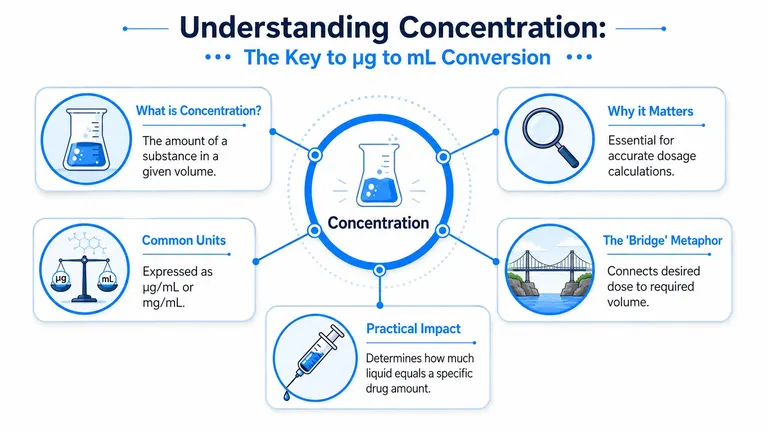
The safest way to think about it is this:
- Mass is how much drug you need.
- Volume is how much liquid contains that drug.
- Concentration links the two.
According to nursing dosage guidance on mcg and mg conversion, you cannot convert micrograms to milliliters with a fixed factor because micrograms measure mass and milliliters measure volume. A valid conversion requires the substance’s concentration or density. The same guidance states that 1 mg = 1,000 mcg, and when a solution is labeled in mcg/mL, volume is calculated as desired dose in mcg divided by concentration in mcg/mL.
Practical rule: Don’t ask “What’s the mcg-to-mL conversion?” Ask “What is the concentration of this specific solution?”
Where to find concentration
Look for concentration on the vial, carton, pharmacy label, or preparation instructions. It may appear clearly, or you may need to calculate it after reconstitution. Either way, you need that number before pulling a dose.
A quick label-reading checklist helps:
- Find the drug amount. This may be listed in mcg or mg.
- Find the liquid volume. This is usually listed in mL.
- Write the concentration as a ratio. For example, drug amount per mL.
- Match units before dividing. If your dose is in mcg and your vial is in mg/mL, convert one so both mass units match.
Without concentration, the result is undefined. Not difficult. Undefined.
The µg to mL Conversion Formula Explained
Once you know the concentration, the math becomes orderly.
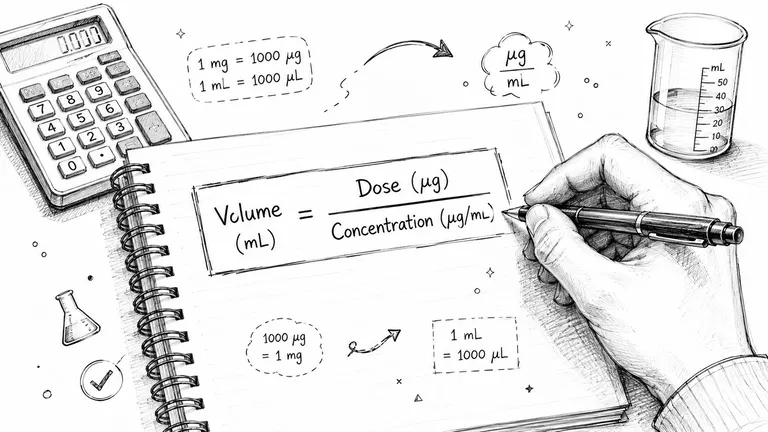
The core formula
If your concentration is already written in mcg/mL, use this:
Volume (mL) = Desired dose (mcg) ÷ Concentration (mcg/mL)
This works because the microgram units cancel, leaving milliliters.
Here’s the logic in plain language. If each milliliter contains a known number of micrograms, and you know how many micrograms you want, division tells you what fraction of a milliliter contains that dose.
When the label uses mg per mL
People often hesitate at this juncture. Your target dose might be in micrograms, but the vial may be labeled in mg/mL. You can still solve it, but your units must match first.
The cleanest route is to convert the concentration into mcg/mL before calculating volume. Since 1 mg = 1,000 mcg, multiply the mg amount by 1,000 to express it in micrograms, as outlined in the earlier nursing guidance.
Unit match first: If the dose is in mcg, rewrite the concentration in mcg/mL before using the formula.
If you want extra practice on that step alone, PepFlow’s guide on mg to mcg conversion walks through the unit logic that tends to cause the most mistakes.
A simple pattern looks like this:
| What you have | What to do |
|---|---|
| Dose in mcg, concentration in mcg/mL | Divide dose by concentration |
| Dose in mcg, concentration in mg/mL | Convert concentration to mcg/mL first |
| Dose in mg, concentration in mcg/mL | Convert dose to mcg first, or convert concentration to mg/mL |
A clean manual workflow
When you’re doing this by hand, use the same order every time:
- Write the desired dose exactly as prescribed.
- Write the vial concentration exactly as labeled.
- Make the mass units match.
- Divide dose by concentration.
- Check whether the final answer in mL makes sense for the syringe you’re using.
That last step catches a lot of errors. If your answer looks oddly large or vanishingly small, recheck the units before you draw anything.
For a visual walk-through, this short video helps reinforce the formula and the unit-matching habit:
Worked Examples From Real World Scenarios
Seeing the method in action usually clears up the last bit of confusion.
Example one using a ready made liquid
You need a 250 mcg dose. Your vial concentration is 5 mg/mL.
Start by matching units. Your dose is in micrograms, so convert the concentration from milligrams per milliliter to micrograms per milliliter.
- 5 mg = 5,000 mcg
- So the concentration is 5,000 mcg/mL
Now use the formula:
Volume (mL) = Desired dose (mcg) ÷ Concentration (mcg/mL)
So:
- 250 mcg ÷ 5,000 mcg/mL = 0.05 mL
That means you would draw 0.05 mL.
Notice what made this work. Not the word “micrograms.” Not the syringe alone. The essential step was translating the vial label into a concentration that matched the dose unit.
Example two after reconstitution
This is common with peptides supplied as freeze-dried powder. In that situation, you often have to determine the solution concentration after adding diluent, then calculate the dose volume from that new concentration. If you want a primer on the product form itself, PepFlow’s article on freeze-dried peptides is a helpful companion.
Say a vial contains 5 mg of powder, and you add 2 mL of liquid.
First calculate the new concentration:
- The vial contains 5 mg in 2 mL
- That equals 2.5 mg/mL
If your desired dose is 250 mcg, convert the concentration into mcg/mL so the units match:
- 2.5 mg = 2,500 mcg
- So the concentration is 2,500 mcg/mL
Now calculate the volume:
- 250 mcg ÷ 2,500 mcg/mL = 0.1 mL
So the dose volume is 0.1 mL.
A lot of mistakes happen because people jump straight from “the vial contains 5 mg” to “how much should I draw?” That skips the concentration step. Once liquid is added, the question is no longer only how much drug is in the vial. Instead, the question is how much drug is in each milliliter of the final solution.
Common Dosing Mistakes and How to Avoid Them
The math itself isn’t the only risk. Most errors come from setup mistakes, label mistakes, or rushing.
The errors that cause the most trouble
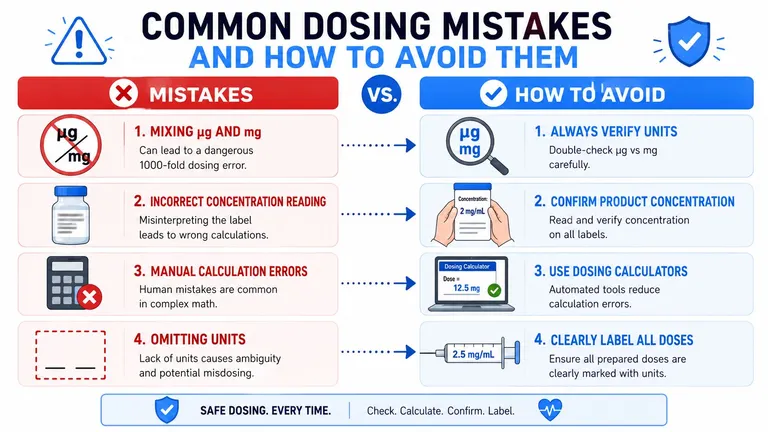
One of the biggest hazards is confusing mcg and mg. Those units are not interchangeable. Because 1 mg = 1,000 mcg in the nursing dosage guidance cited earlier, mixing them up creates a 1000-fold dosing error when the calculation is carried through incorrectly.
Other problems are less dramatic but still serious:
- Reading the wrong concentration. Similar labels can look alike when you’re tired or distracted.
- Using syringe markings without confirming what they represent. Some people think in “units” when the prescription is written in mL.
- Skipping units during note-taking. A bare number on paper can mean almost anything later.
- Doing mental math under pressure. Even competent people transpose numbers.
Clear units prevent a surprising number of errors. Write the number and the unit every single time.
Medication safety isn’t just a math skill. It’s also a process skill. If you’re interested in the broader systems side of avoiding preventable errors, this overview of patient safety in medication management gives useful context.
A safer routine
Use a repeatable checklist instead of relying on memory:
- Verify the label twice. Read concentration, total drug amount, and total volume carefully.
- Convert before you calculate. Don’t divide until the mass units match.
- Write every step down. Short calculations are where people often skip the line that would have revealed the mistake.
- Pause before drawing. Compare the final mL amount to the syringe scale and ask whether it looks reasonable.
That pause matters. A careful routine is faster than fixing an avoidable mistake.
Skip the Math The Smart Way with a Dosing Calculator
Manual calculation is worth learning because it teaches you what the numbers mean. But once you understand the process, repeating it by hand every time invites preventable errors, especially when you’re dealing with reconstitution, changing vial strengths, or small peptide doses.
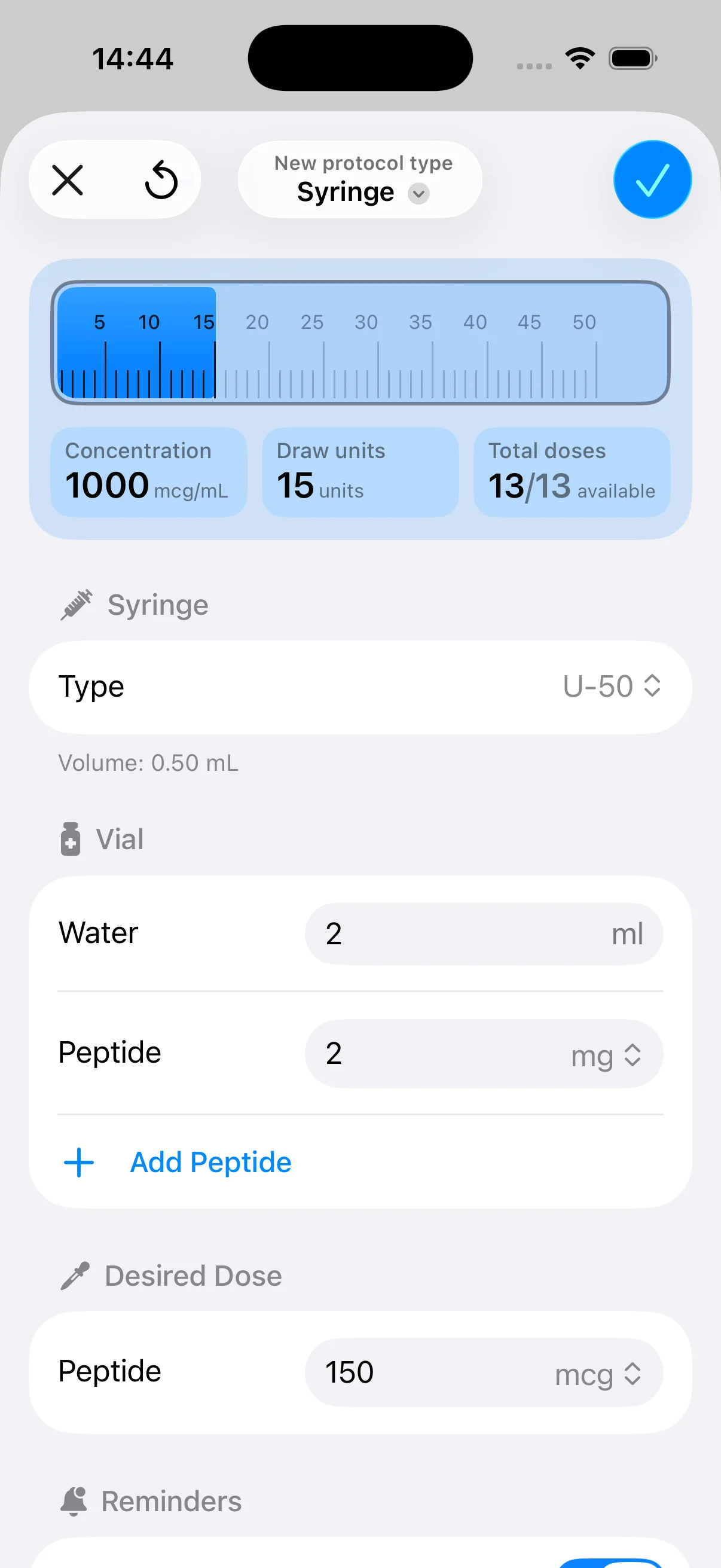
A dedicated calculator reduces that friction. Instead of rewriting formulas, you enter the known values, such as vial amount, liquid volume, concentration, and target dose, and let the tool return the volume to draw.
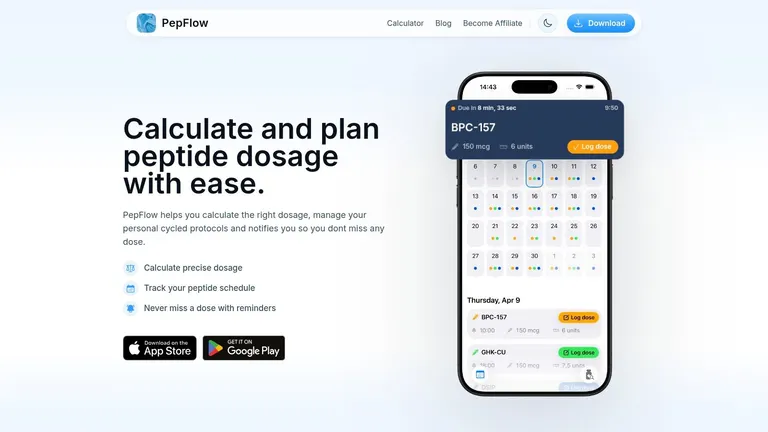
One option is the PepFlow peptide calculator, which is built for peptide dosing workflows and supports the practical steps people usually need, including concentration setup and translating a target dose into a usable draw volume.
The point isn’t to avoid understanding the math. It’s to avoid redoing delicate unit work when a purpose-built tool can handle it consistently. For peptide users following structured protocols, that usually means fewer transcription mistakes, less second-guessing, and a cleaner routine.
If you want a simpler way to handle peptide dose math, scheduling, and day-to-day consistency, PepFlow gives you one place to calculate volumes, organize protocols, and stay on track without relying on handwritten notes or repeated manual conversions.