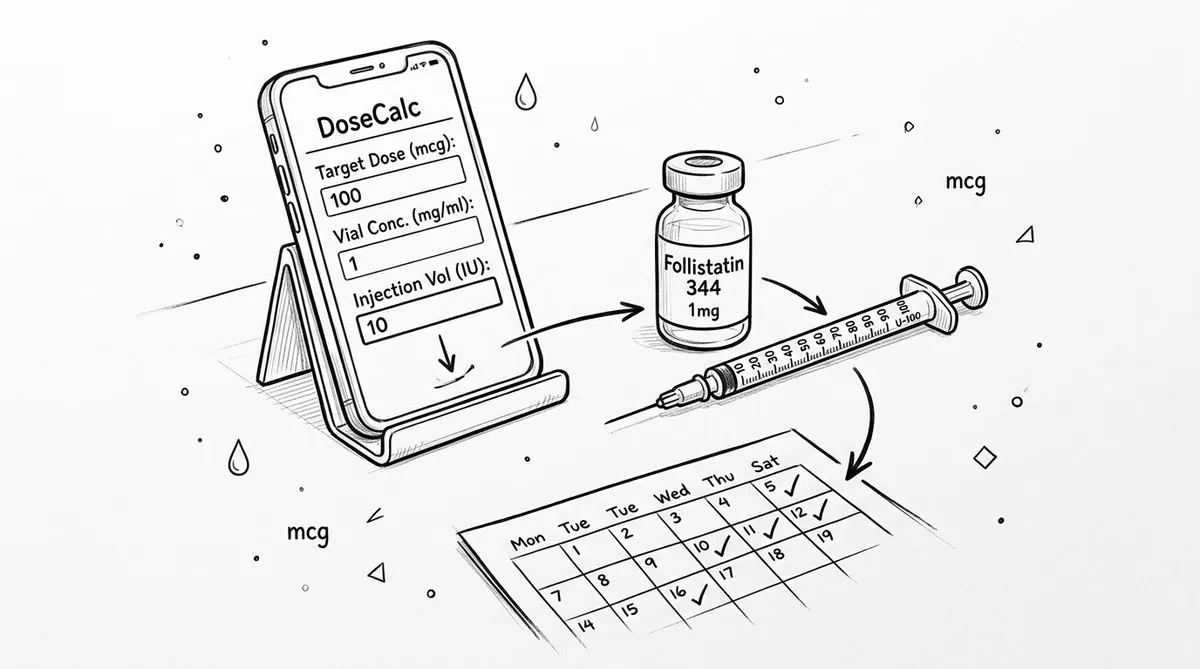
You’re probably staring at a vial, a syringe, and three different tabs telling you three different things. One guide says dose daily. Another says Monday, Wednesday, Friday. A third throws out cycle lengths with no explanation of why any of it should fit your setup.
That’s where most follistatin 344 dosage mistakes start. Not with bad intent, but with sloppy translation from vague protocol talk into real-world execution. The problem usually isn’t the idea of a protocol. It’s the math, the schedule, and the lack of clear guardrails.
A workable approach has to do three things at once. It has to keep the dose conservative, make the preparation process repeatable, and turn the calendar into something you can follow without guessing.
Table of Contents
- Decoding Follistatin 344 Dosage Principles
- Establishing a Safe Dosage Range
- How to Calculate Your Follistatin 344 Dose
- Structuring Your Dosing Cycle and Frequency
- Integrating PepFlow for Flawless Execution
- Essential Safety Considerations and Legal Status
Decoding Follistatin 344 Dosage Principles
Why protocol logic matters more than copying a number
The biggest mistake with follistatin 344 dosage is treating it like a fixed recipe. It isn’t. A useful protocol starts with the question you’re trying to answer, then works backward into dose size, frequency, and cycle length.
If your approach is cautious, the structure should reflect that. If your priority is tolerance assessment, the first phase should be conservative and tightly observed. If you jump straight to a “popular” amount without testing response, you’re skipping the only part that protects you from a bad reaction.
Published guidance also points to variation by body size. One reference describes body weight-based targeting of 2 to 4 mcg/kg administered 2 to 3 times weekly in research applications, while also noting that some subjects appear to respond at lower levels and others approach the upper safety boundary more closely in practice (My Peptide Match dosage guide).
Practical rule: Don’t ask, “What’s the best dose?” Ask, “What’s the lowest dose that lets me evaluate tolerance and keep the schedule clean?”
That mindset matters beyond this peptide. Anyone exploring advanced peptide treatments already knows the same principle applies across compounds with narrow safety margins. Precision beats bravado.
The variables that actually change the plan
A sound follistatin 344 dosage plan usually changes for three reasons:
- Research objective: A short, tightly controlled observation period calls for a different schedule than a broader cycle intended to test sustained exposure.
- Tolerance history: Someone with no prior handling experience shouldn’t use the same opening strategy as someone who already knows how they respond to similar compounds.
- Body weight context: Flat dosing is common in discussion forums, but weight-based logic can be a useful cross-check when deciding whether a proposed amount is obviously too aggressive.
There’s also a practical issue that gets ignored online. The protocol only works if you can prepare the dose accurately every single time. A mathematically sensible target becomes unsafe if the vial concentration, reconstitution volume, or syringe interpretation is inconsistent.
That’s why experienced planning starts with a boring question. Can you reproduce the same draw volume, on the right day, for the right duration, without improvising? If the answer is no, the protocol isn’t ready.
Establishing a Safe Dosage Range
A safe range is narrower than forum chatter suggests, and that difference matters once you move from reading to setting up a protocol. One commonly cited review of Follistatin-344 protocols places the practical subcutaneous range at 100 to 300 mcg, administered 2 to 3 times weekly, with 200 mcg three times per week appearing often in published case summaries, according to this Follistatin-344 dosage guide.
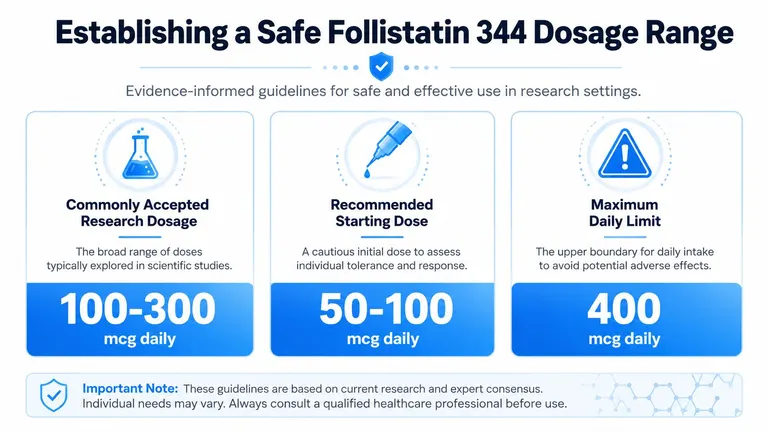
The practical mistake is treating that range like a recommendation to push upward. It is a boundary. Lower-end exposure is usually the right place to start because it gives you a cleaner read on tolerance, injection response, and schedule adherence before you add intensity.
A useful way to structure the range is by function:
| Phase | Practical interpretation |
|---|---|
| Initial tolerance testing | Start at the low end and confirm the protocol can be executed accurately |
| Working range | Stay within the commonly reported subcutaneous band if the response justifies continuing |
| Upper ceiling | Treat the high end as a stop point, not a performance target |
The same review describes a conservative ramp. Starting doses typically begin at 100 mcg twice weekly for the first two weeks, then increase only if tolerance is acceptable. It also describes 250 to 300 mcg three times weekly as the upper boundary used in many research-style protocols.
That distinction matters. A dose can be common online and still be poorly reasoned.
I advise treating escalation as a decision that must be earned by clean execution first. If reconstitution is sloppy, draw volumes vary, or injection days keep drifting, the dose is not ready to increase. Before adjusting anything, verify the concentration math with a final concentration calculation guide and set the actual schedule inside PepFlow so the plan is recorded, repeatable, and harder to misread.
Risk also stops being theoretical once higher exposure enters the picture. The same source associates doses above 300 mcg three times weekly with a higher rate of adverse events, including reported cases of central serous chorioretinopathy, or CSCR. It also summarizes a 2020 case series involving 11 male bodybuilders who developed CSCR after subcutaneous Follistatin-344 use in a higher-dose context.
Once vision-related risk is on the table, aggressive escalation stops looking serious. It looks careless.
Use three rules:
- Start low enough to assess tolerance clearly
- Increase only for a defined protocol reason
- Stop at the ceiling instead of treating it like a goal
That is the trade-off with follistatin 344 dosage. A tighter, more disciplined range may look less exciting on paper, but it reduces preventable errors and gives you a protocol you can execute correctly.
How to Calculate Your Follistatin 344 Dose
A correct dose starts with concentration. Not with “units,” not with a screenshot from a forum, and not with what someone else used in a differently mixed vial.
Start with concentration, not syringe units
When you reconstitute a lyophilized vial, you’re creating a concentration. Your target microgram dose is then pulled from that concentration as a specific liquid volume. If you skip that middle step, you invite misreads.
For a practical refresher on the underlying math, this guide to final concentration calculation is worth reviewing before you mix anything.
The logic is straightforward:
- Know the total peptide amount in the vial
- Know how much diluent you added
- Calculate concentration
- Convert the target mcg dose into mL
- Convert mL into syringe markings only after the volume is known
A simple manual workflow
Use a generic workflow every time, regardless of vial size.
Step 1
Write down the vial strength exactly as labeled.
If the vial contains a total amount of peptide, that total amount is what gets distributed across the liquid you add. The amount in the vial does not tell you the dose by itself.
Step 2
Write down the exact reconstitution volume you added.
If you add more liquid, each draw becomes larger in volume but lower in concentration. If you add less liquid, each draw becomes smaller in volume but more concentrated. Neither choice is automatically better. The point is consistency.
Step 3
Calculate the concentration.
This is the basic relationship:
- Concentration = total peptide in vial ÷ total mL added
Once you know concentration, the rest becomes simple division.
Step 4
Calculate draw volume for your target dose.
- Draw volume = target dose ÷ concentration
That gives you the amount to pull into the syringe.
The safest habit is to record three things together in one place: vial strength, diluent volume, and target dose. If those aren’t written side by side, people start trusting memory, and that’s where dosing errors creep in.
Where digital calculation helps
Manual math is fine when you’re fresh, focused, and doing one vial. It gets less reliable when you’re tired, adjusting dilution, or managing a cycle with several scheduled injections.
That’s where a dedicated calculator removes avoidable mistakes.
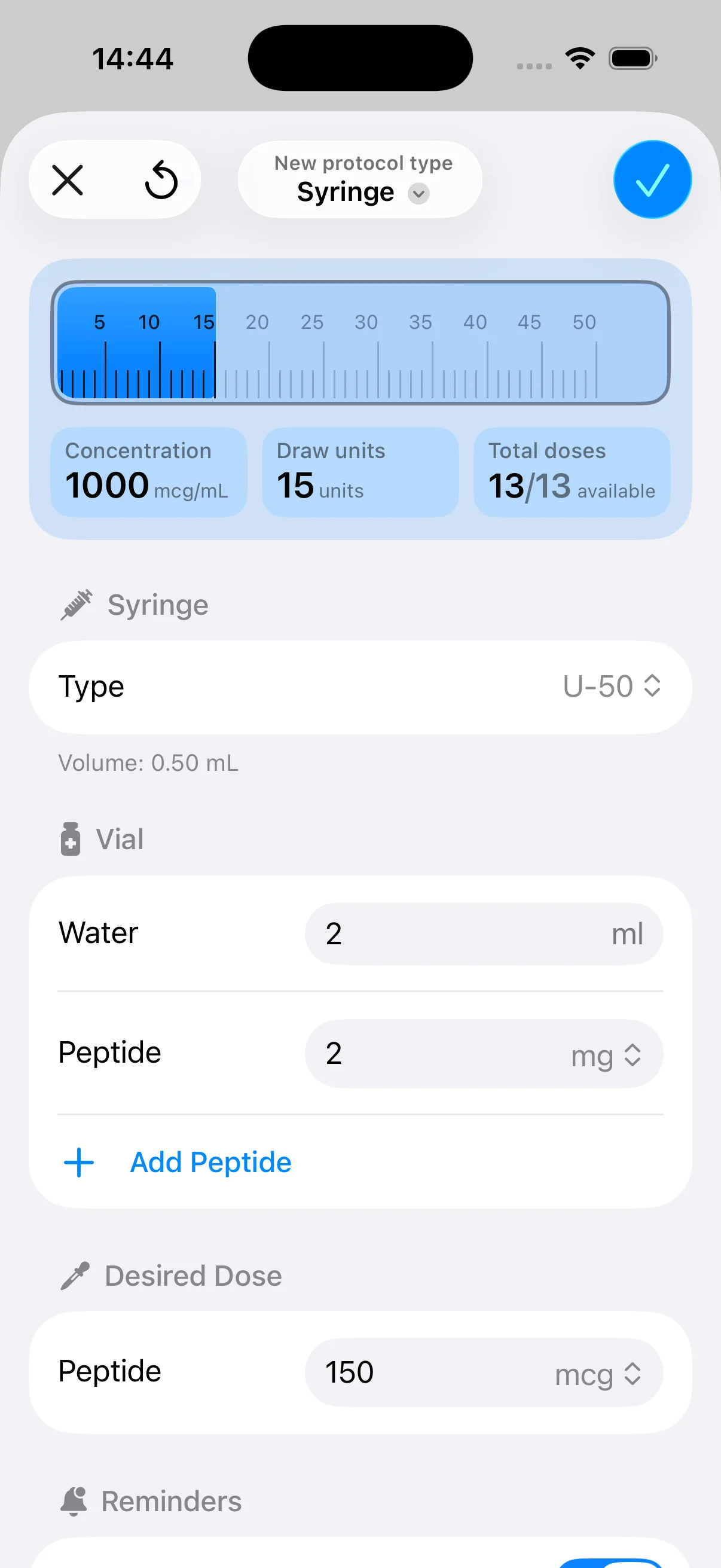
A practical setup flow inside the app looks like this:
- Enter the vial amount: Use the exact total peptide content shown on the vial.
- Enter the reconstitution volume: Match the actual amount of bacteriostatic water you used.
- Set the target dose: Input the intended microgram amount for that injection.
- Read the output: The app converts the target into a usable volume so you’re not doing the conversion in your head.
That’s the primary value. It reduces translation error between abstract dosage and physical draw volume.
A few handling habits that prevent calculation drift
Even with clean math, execution still matters:
- Use one dilution plan per vial: Changing dilution midway through a cycle creates unnecessary confusion.
- Label immediately: Mark the vial with the date and dilution details as soon as it’s reconstituted.
- Recheck before every new cycle: Don’t assume the next vial is mixed the same way as the last one.
- Avoid verbal shortcuts: “Same as last time” is not a protocol.
Most follistatin 344 dosage errors aren’t advanced pharmacology problems. They’re measurement problems.
Structuring Your Dosing Cycle and Frequency
Dose size is only half the decision. Frequency changes the character of the whole protocol.
Daily dosing versus split-week dosing
Current guidance online often blurs two distinct strategies. One pattern recommends 100 mcg daily to saturate binding sites. Another recommends 200 mcg 2 to 3 times weekly, often on a Monday, Wednesday, Friday rhythm, to work around the peptide’s short 3 to 4 hour half-life, as described in this dosing frequency analysis.
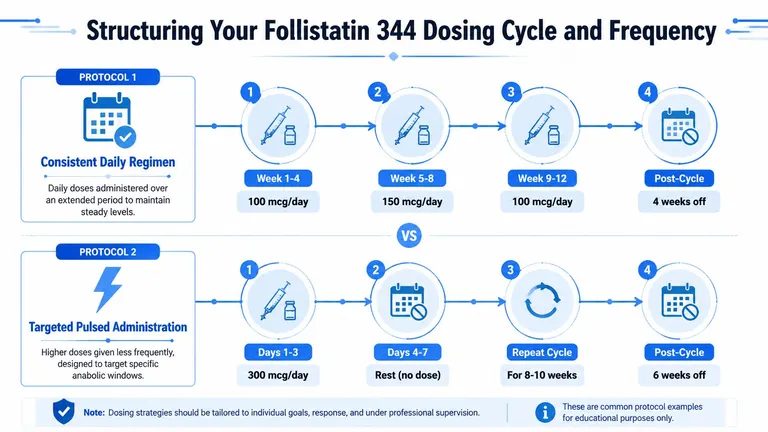
These aren’t interchangeable.
| Strategy | What it tries to do | Main trade-off |
|---|---|---|
| Daily dosing | Favors continuous saturation logic | Increases scheduling burden and cumulative exposure |
| 2 to 3 times weekly | Favors structured pulses with fewer injections | Accepts less frequent exposure in exchange for simpler control |
If someone tells you both are “basically the same,” they’re skipping the reason frequency matters in the first place.
A good schedule should match the reason you chose it. Daily dosing is a saturation strategy. Split-week dosing is an exposure-management strategy.
Short cycles versus traditional cycles
Cycle length is another area where online advice collides. The same source notes an emerging 2025 to 2026 trend toward shorter 10 to 14 day cycles, in contrast to the more traditional 30-day model often repeated elsewhere.
That shift makes sense from a risk-management perspective. Potent compounds often benefit from tighter observation windows. A shorter cycle can make it easier to identify whether the protocol is tolerable before cumulative exposure builds.
Longer cycles may still appear in community practice, but longer isn’t automatically better structured. It can mean more opportunities for drift in measurement, scheduling, and response monitoring.
Sample planning templates
These are planning frameworks, not universal prescriptions.
Conservative observation template
- Opening period: low-end dosing frequency
- Duration: short cycle
- Use case: first exposure, tolerance-focused planning
- Reason it works: limits complexity and gives cleaner feedback
Split-week template
- Schedule: fixed weekday pattern
- Duration: controlled cycle with a defined stop point
- Use case: users who want a repeatable routine without daily burden
- Reason it works: fewer injections usually means fewer calendar errors
Daily micro-schedule template
- Schedule: same time each day
- Duration: shorter total cycle
- Use case: users specifically following saturation logic
- Reason it works: easy to remember, harder to sustain
A complete follistatin 344 dosage calendar also needs a pause built in. Community protocols discussed in published summaries often include a mandatory off period between cycles rather than continuous use. The exact pause you choose should reflect how conservative the cycle was and how closely you monitored it.
The key is simple. The cycle should have a start date, a stop date, and a reason for the chosen frequency. If any of those are missing, it’s not a protocol. It’s improvisation.
Integrating PepFlow for Flawless Execution
The part people underestimate is the gap between a written plan and a plan they adhere to. Most protocol breakdowns don’t happen because the dose was impossible to understand. They happen because the schedule got loose after day three.
Building the protocol inside the app
A clean setup usually starts with the vial details, then moves straight into scheduling.
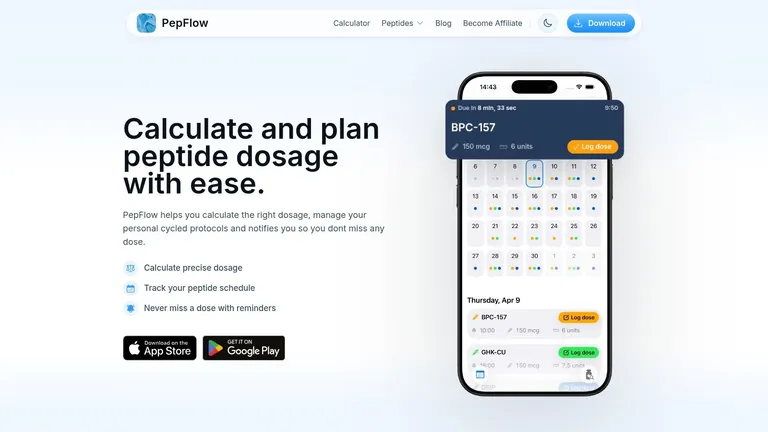
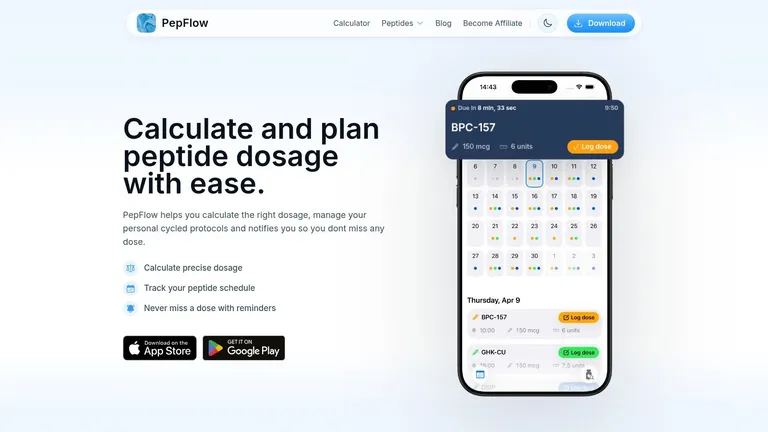
Inside PepFlow, the useful sequence is simple:
- Enter the vial configuration so the dose math stays tied to the actual preparation.
- Build the protocol calendar with the intended start date and dosing frequency.
- Set the cycle length so the stop point is defined from the beginning.
- Enable reminders so the schedule doesn’t rely on memory.
- Log each administration as it happens, not later.
This matters most with split schedules. Monday, Wednesday, Friday sounds easy until one dose shifts a day, the next gets pushed, and the whole pattern becomes guesswork. An app-based planner prevents that slide.
Why adherence usually breaks
People rarely miss because they forgot the peptide exists. They miss because routine friction adds up.
One day they can’t remember whether the vial was mixed at the same concentration as the last one. Another day they’re unsure if a dose was already taken. By the end of the week, the protocol has drifted far enough that the original plan doesn’t mean much.
A structured app fixes the boring parts that cause those failures:
- Reminder timing: prompts the dose when it’s due
- Visible protocol history: shows what was taken and when
- Cycle structure: keeps on-days and off-days separate
- One-tap logging: removes the temptation to “log it later”
The best protocol tool isn’t the one with the most features. It’s the one that makes it harder to make a simple mistake twice.
For follistatin 344 dosage, that’s the primary gain. Less calculator error. Less calendar drift. Fewer accidental changes to a plan that was supposed to stay controlled.
Essential Safety Considerations and Legal Status
A common failure point is not the dose calculation. It is the moment someone treats an experimental peptide like a settled protocol.
Follistatin-344 should be handled as an unapproved research compound in practical terms. There is no established FDA-approved human dosing standard for subcutaneous use, and that alone should change how conservative the plan is. Dose selection, cycle length, and stop criteria need to be defined before the first administration, not improvised once the cycle is underway.
Risk control starts with restraint. Use the lowest planned dose range, keep the cycle short, monitor for unusual responses, and stop the protocol if symptoms fall outside the expected pattern. Visual changes, disproportionate swelling, persistent pain, or systemic symptoms deserve immediate attention rather than dose adjustment.
For a focused review of known concerns and warning signs, read Follistatin 344 side effects.
Legal status matters too. Follistatin-related agents are prohibited in tested sport under anti-doping rules, so any competitive athlete needs to treat use as a disqualifying risk unless cleared otherwise through the governing framework for that sport.
PepFlow is the tool I recommend for execution because safety failures are often process failures. It keeps the concentration, dose history, reminders, and cycle endpoint in one place, which reduces the chance of repeating a math error, drifting off schedule, or extending a protocol past the original plan.