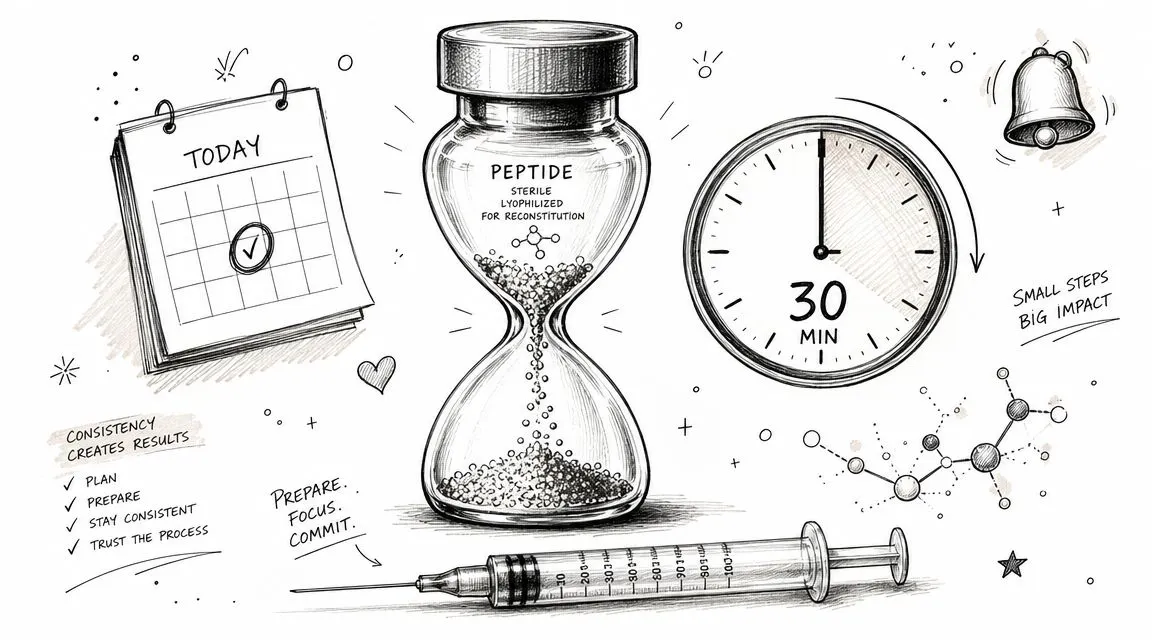
CJC-1295 without DAC has a half-life of about 30 minutes, with some technical summaries placing it in a 30 to 60 minute range and occasionally up to roughly 2 hours depending on formulation and injection site. That short half-life is why protocols commonly use daily dosing or 1 to 3 injections per day, instead of the 1 to 2 times per week schedule more often associated with the DAC version.
Individuals often get stuck on the name. They see “CJC-1295” in two places, assume the dosing logic should be similar, and then wonder why one protocol looks minimal while another looks demanding.
The dividing line isn’t branding. It’s pharmacokinetics. If you understand the CJC 1295 no DAC half life, the dosing pattern stops looking arbitrary and starts looking logical. A short-lived signal has to be scheduled differently from a long-lived one.
Table of Contents
- Why Dosing Frequency Matters for CJC-1295
- Understanding Mod GRF 1-29 The No DAC Peptide
- Half-Life Explained CJC-1295 With and Without DAC
- What Else Affects Peptide Half-Life
- Building a Dosing Schedule Around a Short Half-Life
- Manage Your Schedule with the PepFlow App
Why Dosing Frequency Matters for CJC-1295
Why do some CJC-1295 protocols call for multiple injections in a day while others only mention a couple of doses per week?
Because the schedule follows the half-life. With the no-DAC version, the signal is brief. It doesn’t stay active in the same way the DAC form does, so spacing doses too far apart changes the whole character of the protocol.
That matters more than almost anything else when you’re planning use. If you mismatch the schedule to the peptide’s lifespan, you’re no longer using the compound in the way it was intended to behave.
Practical rule: Short half-life compounds usually demand tighter scheduling discipline than long-acting ones.
A useful way to think about it is this:
- Half-life shapes exposure: A peptide that clears quickly creates a short window of activity.
- Exposure shapes scheduling: Short windows usually mean more frequent administration if you want repeated effects.
- Scheduling shapes adherence: A protocol that looks simple on paper can become messy if it asks for repeated timing every day.
People often focus first on dose amount. That’s understandable, but it’s usually the second question. The first question is, “How long does this version stay around?” Once you answer that, the rest of the protocol starts to make sense.
Understanding Mod GRF 1-29 The No DAC Peptide
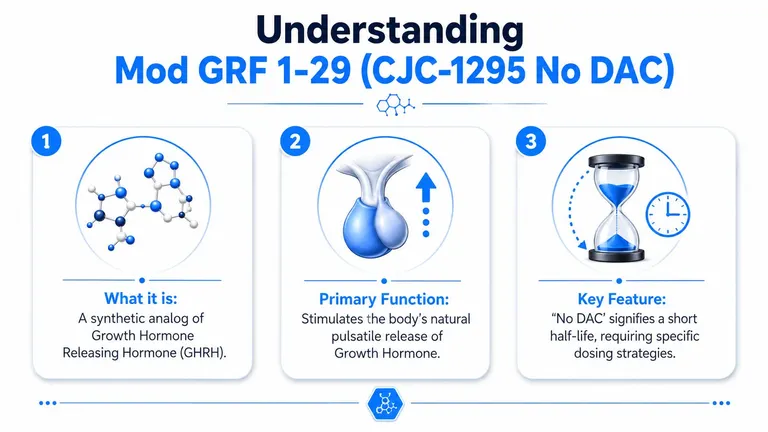
CJC-1295 without DAC is often called Modified GRF 1-29 or Mod GRF 1-29. It belongs to the GHRH analog category, which means it is designed to act like growth hormone releasing hormone and stimulate the body’s own release pattern rather than function as growth hormone itself.
What the peptide is doing
Think of Mod GRF 1-29 like a hand pressing a doorbell, not taping the button down. The goal is a brief signal to the pituitary, followed by clearance. That short action is part of the design.
A simple analogy helps. This version behaves more like a light switch flicked on and off. It creates a pulse. It doesn’t act like a system built to provide a steady background signal for days.
According to a technical comparison of the two forms, CJC-1295 without DAC is a short-acting GHRH analog with an estimated half-life of about 30 to 60 minutes, and some summaries extend that to roughly 2 hours depending on formulation and injection site, which means it produces a brief GH pulse rather than sustained exposure (technical summary on CJC-1295 with and without DAC).
Why readers confuse it with the DAC version
The names are close, so people assume the behavior must be close too. It isn’t.
“No DAC” means there is no albumin-binding extension built into the molecule. In practical terms, that leaves you with a peptide used for a shorter, more pulsatile effect profile. That’s why Mod GRF 1-29 is often discussed as a different tool, even though it shares part of the name with the DAC form.
If you’re choosing the no-DAC version, you’re usually choosing it because you want a short signal, not in spite of it.
That single distinction clears up a lot of protocol confusion.
Half-Life Explained CJC-1295 With and Without DAC
Half-life sounds technical, but the practical meaning is simple. It tells you how quickly a compound falls away after administration. For protocol planning, that affects whether you build around brief pulses or longer exposure.
What half-life means in practice
For the no-DAC version, secondary pharmacology sources consistently place the half-life at about 30 minutes, and that short half-life is why protocols commonly require 1 to 3 injections per day or at least daily dosing, whereas the DAC version is typically dosed only 1 to 2 times per week (comparison of CJC-1295 DAC vs no DAC).
That’s the “so what” most readers care about. A half-life measured in minutes leads to one kind of routine. A half-life measured in days leads to another.
This is also why timing discipline matters more with short-acting compounds. If you miss the intended window, the protocol doesn’t have much built-in cushion.
For people who already think carefully about timing with other compounds, routines, or meals, the same logic applies here. General timing behavior matters in many supplement and peptide routines, which is why practical guides on when to take supplements can be helpful as a broader habit framework.
Why DAC changes everything
The DAC version behaves very differently because the molecule was built for a different exposure pattern. The foundational human pharmacokinetic study published in 2006 found that CJC-1295’s estimated half-life was 5.8 to 8.1 days in healthy adults, and that a single subcutaneous injection increased mean plasma growth hormone 2- to 10-fold for 6 days or more and mean IGF-1 1.5- to 3-fold for 9 to 11 days. After repeated doses, mean IGF-1 levels stayed above baseline for up to 28 days, showing long-duration exposure rather than a short pulse (foundational human pharmacokinetic study on CJC-1295).
If you want a plain-language explanation of that molecular difference, PepFlow’s article on what DAC means in peptides is useful. The short version is that DAC changes how long the peptide remains available in circulation.
A peptide with DAC isn’t just the same compound with a convenience upgrade. It behaves like a different scheduling problem.
CJC-1295 No DAC vs With DAC Comparison
| Attribute | CJC-1295 No DAC (Mod GRF 1-29) | CJC-1295 With DAC |
|---|---|---|
| Half-life | About 30 minutes, with some summaries placing it around 30 to 60 minutes | 5.8 to 8.1 days |
| Exposure pattern | Brief, pulse-like activity | Long-duration exposure |
| Albumin binding | No albumin-binding extension | DAC form creates prolonged exposure profile |
| Typical schedule style | Daily dosing or 1 to 3 injections per day | Often 1 to 2 times per week |
| Protocol mindset | Repeated pulses and precise timing | Fewer administrations and longer carryover |
What Else Affects Peptide Half-Life
The textbook number is helpful, but real use never happens in a vacuum. A short half-life tells you the general behavior. It doesn’t mean every administration feels identical in practice.
Biology changes the real world picture
Different people process compounds differently. Clearance, tissue response, and how quickly the signal fades can vary for biological reasons even when the protocol on paper is identical.
That doesn’t change the big lesson. It just means the “about 30 minutes” rule is best treated as a working pharmacokinetic guide, not a promise of identical real-world behavior every time.
A related practical point is that peptide stability and lifespan can also depend on context, storage, and preparation details. PepFlow’s guide on how long peptides last gives a useful overview of the handling side of that question.
Handling and formulation matter too
Peptides are sensitive materials. The effective life of a preparation can be shaped by reconstitution quality, storage conditions, and how carefully the vial is handled over time.
Keep these factors in mind:
- Formulation differences: Some summaries note that injection site and formulation can affect how the no-DAC version is experienced in practice.
- Storage discipline: Poor storage can reduce stability, which muddies your sense of what the protocol is achieving.
- Consistency of preparation: If concentration calculations or reconstitution steps vary, the schedule may look stable while the effective exposure isn’t.
Clean handling doesn’t make a short-acting peptide long-acting. It just helps the peptide behave the way you expected.
Building a Dosing Schedule Around a Short Half-Life
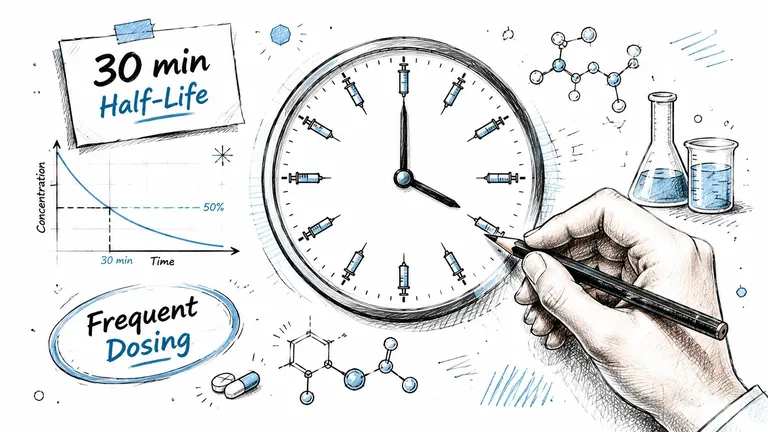
If a peptide clears quickly, the schedule has to do the heavy lifting. That’s why protocol design for Mod GRF 1-29 is really about creating repeated windows instead of expecting one administration to carry the whole day.
Why frequent dosing shows up in protocols
A common mistake is assuming frequent dosing means the peptide is “better.” That’s not the right conclusion. It usually just means the compound is short-acting, so users structure the day around repeated pulses.
In practical terms, people often build no-DAC schedules around moments when they want a distinct, brief signal rather than all-day exposure. That might mean spacing administrations across the day or tying them to recurring routine anchors so doses don’t get missed.
Research-use note: this information is for educational and research discussion only. It isn’t medical advice and shouldn’t replace professional guidance.
A sensible planning framework usually includes:
- Choose the pulse strategy first: Decide whether the protocol is built around one recurring daily pulse or several distinct pulses.
- Use repeatable anchors: Morning routine, training window, or evening routine are easier to follow than vague intentions.
- Protect consistency: A short half-life leaves less room for sloppy timing.
How people usually think about timing
Many users prefer timing that fits the peptide’s pulse-based logic. That often means using it when they want a cleaner signaling window rather than stacking it randomly into a chaotic day.
Two patterns come up often in discussion:
- Empty-stomach timing: People sometimes prefer lower-food windows because they want a clearer pulse-oriented setup.
- Pre-sleep timing: Some build protocols around the evening because it fits a predictable daily rhythm.
The key idea isn’t that one clock time is universally correct. It’s that timing should match the purpose of a short-acting peptide.
A visual walk-through can make that easier to grasp:
Good protocol design starts with the compound’s time profile. It doesn’t start with convenience and work backward.
Manage Your Schedule with the PepFlow App
Once a protocol involves repeated daily timing, the science isn’t the hard part anymore. The hard part is remembering doses, keeping calculations straight, and tracking what happened instead of what you meant to do.
Why tracking becomes the hard part
Short-acting schedules create more points of failure. A missed reminder, a bad unit conversion, or a vague note in your phone can turn a clean protocol into guesswork.
That’s why people often look for external structure. The same reason someone might read about the best app for building habits applies here. Repetition is easier when the system prompts you instead of relying on memory.
What a dosing tool actually helps with
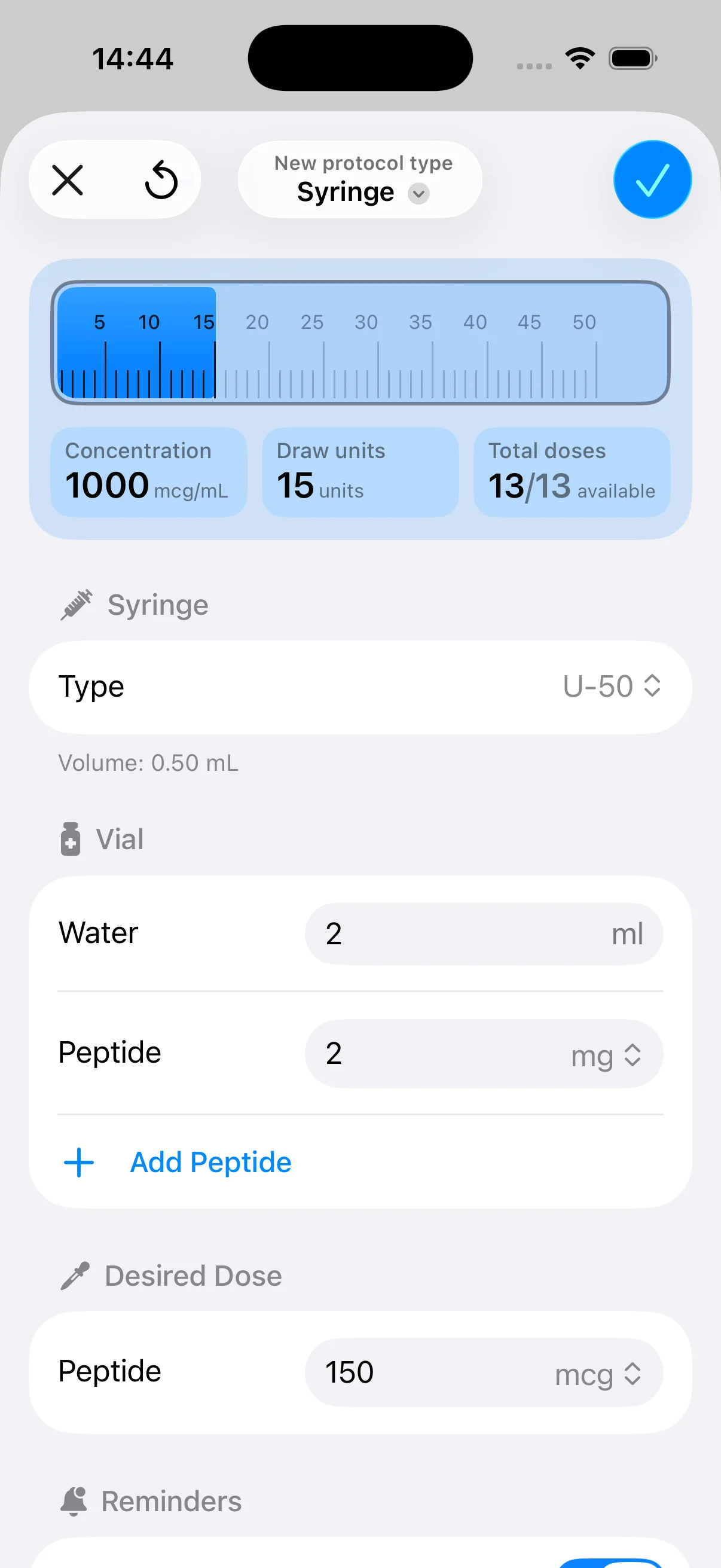
PepFlow is an iOS tool for planning peptide calculations and recurring schedules. It lets users set vial concentration, convert desired amounts into practical unit measurements, build repeated schedules, and log dose history through its peptide calculator and scheduler.
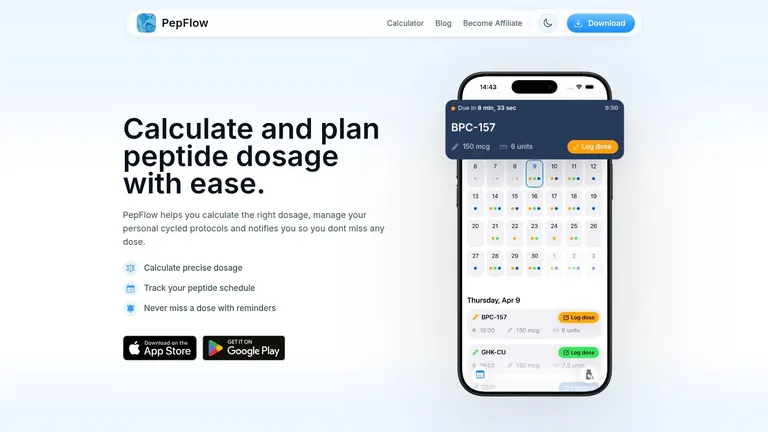
That matters more with no-DAC routines because the protocol isn’t forgiving. You may be dealing with recurring daily entries, timing windows, pause periods, and dose logs over weeks. Manual math and scattered notes tend to break down under that load.
A practical tool helps with things like:
- Dose conversion: Turning a target amount into syringe units based on your vial setup.
- Recurring reminders: Keeping pulse-based schedules from drifting.
- History tracking: Seeing what was logged, not what you assume happened.
Used that way, the app isn’t changing the peptide. It’s helping you execute the protocol you already chose with fewer avoidable errors.
If you’re trying to turn a short half-life into a schedule you can follow, PepFlow can help you calculate doses, organize recurring timing, and keep a clean record of your protocol.