
You searched GLP 2 TRZ, but are you looking at one thing, or two completely different biological ideas that happen to get lumped together?
That confusion matters more than it seems. In fitness and biohacking circles, people often treat anything with “GLP” in the name as part of the same fat-loss or appetite-control bucket. That shortcut breaks down fast. GLP-2 and TRZ, usually shorthand for tirzepatide, don’t do the same job. In one key area, they point in nearly opposite directions: GLP-2 is linked to intestinal lipid absorption, while tirzepatide’s GLP-1-related activity is associated with appetite reduction and slowed gastric emptying.
If you’re trying to think clearly about body composition, digestion, recovery, or metabolic strategy, that distinction isn’t trivia. It changes how you interpret the whole phrase “glp 2 trz.”
Table of Contents
- Untangling GLP-2 and TRZ
- What Is GLP-2 and How Does It Work
- Decoding TRZ What Is Tirzepatide
- Mechanism Showdown GLP-2 vs Tirzepatide
- Potential Applications in Fitness and Wellness
- Safety Profile and Long-Term Considerations
- Planning and Tracking Your Protocol with PepFlow
Untangling GLP-2 and TRZ
The phrase GLP 2 TRZ usually reflects a naming collision, not a single clean concept. One part refers to GLP-2, a gut hormone with a strong intestinal focus. The other part often refers to tirzepatide, a synthetic peptide commonly shortened to TRZ in discussion threads, product listings, and informal protocol talk.
That overlap creates a predictable mistake. People assume GLP-2 sits in the same functional lane as GLP-1-based weight-management drugs, or they assume TRZ is just another version of a generic “GLP peptide.” It isn’t that simple.
A more useful way to think about them is this:
- GLP-2 is mostly about the gut environment, especially intestinal function and nutrient handling.
- Tirzepatide is about metabolic signaling through GIP and GLP-1 receptors.
- They aren’t interchangeable, even if the names sound related.
- Their effects can pull in different directions, especially if you care about appetite, digestion, and lipid absorption.
Main takeaway: If your goal is fat loss, performance nutrition, or gut support, you can’t assume GLP-2 and TRZ belong in the same category just because the acronyms overlap.
For a fitness-focused reader, the biggest trap is thinking all gut peptides are “fat-loss peptides.” Some influence satiety. Some influence nutrient movement through the intestine. Some affect both indirectly. But GLP-2 and tirzepatide start from different receptor biology, which means they shape different outcomes.
That’s why the rest of the discussion has to stay mechanistic. Once you understand what each one does, the phrase “glp 2 trz” becomes much less mysterious, and much less likely to send you toward the wrong assumptions.
What Is GLP-2 and How Does It Work
GLP-2 is a gut-focused signal
GLP-2, short for glucagon-like peptide-2, is best understood as a hormone that supports the intestine’s working environment. If GLP-1 gets most of the public attention because of appetite and glucose control, GLP-2 belongs to a different side of gut physiology.
Think of GLP-2 as a gatekeeper for nutrients. It doesn’t just instruct “eat less” or “burn more.” Instead, it helps shape how the intestinal system handles incoming material. That includes the condition of the intestinal lining, functional support for the gut, and nutrient uptake behavior.
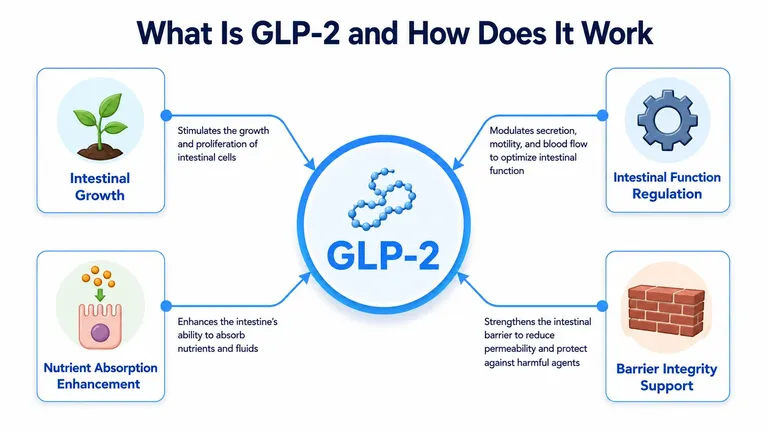
Many readers get tripped up by the “GLP” label, which makes it sound as if GLP-2 should behave like GLP-1. But peer-reviewed discussion highlighted in this review on GLP-2 and intestinal lipid transport points to a key difference: GLP-2 acts as a potent stimulator of intestinal lipid absorption by releasing pre-formed chylomicrons, which is the opposite direction from GLP-1’s suppression of postprandial secretion.
Why lipid handling creates confusion
That detail matters if you care about physique goals, nutrient timing, or “metabolic optimization” language online. A lot of consumer content blurs these hormone families together, and once that happens, people start importing the logic of GLP-1 drugs into conversations about GLP-2.
A simpler way to frame it:
- GLP-2 supports intestinal processing
- GLP-2 is linked to enhanced lipid movement through the gut
- GLP-1 is better known for slowing things down after meals and reducing appetite
- Those are not the same metabolic message
A peptide can belong to the same broader hormone family and still produce a very different practical effect.
For athletes and high-output trainees, that distinction can shape how they think about recovery nutrition. If someone assumes “all GLP peptides reduce nutrient flow,” they may completely misread what GLP-2 is doing. If someone else assumes “all gut peptides help absorb more,” they’ll misread GLP-1-style therapies just as badly.
So when you see GLP 2 TRZ, don’t read it as one smooth category. Read it as a signal to pause and ask a basic question first: Are we talking about intestinal support and lipid absorption, or are we talking about incretin-based metabolic control? That one question clears up most of the confusion.
Decoding TRZ What Is Tirzepatide
TRZ usually means tirzepatide
In most peptide and metabolic-health discussions, TRZ is shorthand for tirzepatide. That’s not a variant of GLP-2. It’s a separate synthetic peptide with a distinct design and a very different receptor profile.
Near the top of the tirzepatide discussion, it helps to see the structure visually.
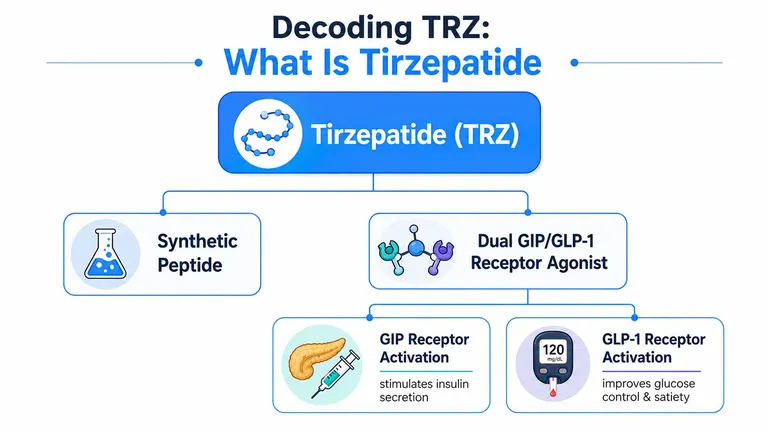
Tirzepatide is often described as a dual agonist, which means it activates two receptor systems, not one. A good mental model is two keys for two different locks. One key engages the GIP receptor. The other engages the GLP-1 receptor. That dual action is central to why tirzepatide gets so much attention in body-composition and metabolic-health conversations.
According to a mechanistic review of tirzepatide’s receptor pharmacology, tirzepatide is an imbalanced dual agonist. It shows full agonism at the GIP receptor while acting as a potent partial agonist at the GLP-1 receptor, with 51% efficacy. The same review reports that tirzepatide is equipotent to native GIP at GIPR with an EC50 of about 22.4 pM, but has a 5-fold lower affinity and about 13-fold weaker potency at GLP-1R than native GLP-1.
For readers who want a more patient-friendly overview, this guide on tirzepatide for weight management gives useful context without requiring you to parse receptor pharmacology line by line. If you want a quick compound reference, PepFlow also keeps a concise tirzepatide profile available.
Why its dual action matters
That “imbalanced” design isn’t random. The same review proposes that this setup may help maximize GIP-mediated weight loss and glycemic control while still producing a tolerable and effective GLP-1 response tied to glucagon suppression and reduced hepatic glucose production.
Here’s the practical translation:
- GIP side: part of the metabolic-control story
- GLP-1 side: part of the appetite, glucose, and gastric-emptying story
- Combined effect: tirzepatide works like a coordinated signal, not a single-pathway switch
A short explainer can help if you want a visual walk-through of the basics.
This is why calling tirzepatide “just another GLP peptide” misses the point. It’s a designed dual-agonist drug, and that design is exactly what separates TRZ from GLP-2.
Mechanism Showdown GLP-2 vs Tirzepatide
GLP-2 vs Tirzepatide At a Glance
| Feature | GLP-2 | Tirzepatide (TRZ) |
|---|---|---|
| Primary target receptors | GLP-2 pathway linked to intestinal function | GIP receptor and GLP-1 receptor |
| Main biological effect | Supports intestinal function and nutrient handling | Alters metabolic signaling tied to glucose control, appetite, and gastric emptying |
| Impact on appetite | Not mainly discussed as an appetite-suppression tool | Commonly associated with reduced food intake through GLP-1-related action |
| Impact on nutrient absorption | Linked to stimulation of intestinal lipid absorption | Not framed as enhancing lipid absorption; its GLP-1-related effects move in a different direction |
| Primary use case | Gut-focused and intestinal-function conversations | Weight management and metabolic disease discussions |
The comparison gets clearer when you stop grouping them by name and start grouping them by job.
GLP-2 acts in a gut-support lane. It’s tied to intestinal function, barrier support, and lipid transport behavior. In practical terms, that makes it relevant to people thinking about nutrient absorption, digestive resilience, and recovery-oriented gut questions.
Tirzepatide acts in a metabolic-regulation lane. Its identity comes from receptor agonism at GIP and GLP-1, which places it in conversations about appetite, glucose handling, body weight, and broader metabolic disease management.
The practical takeaway for fitness-minded readers
For a fitness audience, the most important contrast is the one that usually gets ignored: lipid handling.
If someone hears “GLP” and immediately thinks “less appetite, slower digestion, easier cutting phase,” they may accidentally project tirzepatide logic onto GLP-2. That’s a mistake. The earlier GLP-2 discussion showed why. Its role in stimulating intestinal lipid absorption doesn’t fit the usual social-media summary of GLP-1-style medications.
That difference creates two separate ways of thinking:
-
Gut optimization thinking
- Concerned with intestinal function
- Interested in nutrient uptake
- More likely to ask how the intestine handles incoming fats
-
Body-composition regulation thinking
- Concerned with appetite and intake
- Interested in energy balance and metabolic control
- More likely to ask how to reduce food consumption and improve glycemic handling
If you blur those two frameworks together, your interpretation of “glp 2 trz” becomes directionally wrong.
Another source of confusion is shorthand language in forums and product pages. Readers often see abbreviations and assume they refer to one blended peptide concept. But GLP-2 and tirzepatide are distinct tools with different biological intent. One is not a stronger version of the other. One is not the “next generation” of the other. They don’t sit on a simple upgrade ladder.
For coaches, athletes, and self-experimenters, the cleanest rule is this: match the compound discussion to the physiological target. If the target is intestinal support and absorption, GLP-2 belongs in that conversation. If the target is appetite, glucose regulation, and body-weight reduction, tirzepatide belongs there. Mixing the two usually creates more noise than insight.
Potential Applications in Fitness and Wellness
Where GLP-2 fits conceptually
GLP-2 tends to attract interest from people who think about the gut as a performance variable, not just a digestion variable. That includes readers focused on nutrient tolerance, intestinal resilience, and how well the gut handles feeding under stress from hard training, travel, or restrictive dieting phases.
In that sense, GLP-2 gets attention for reasons that are different from classic fat-loss discussions:
- Gut integrity: People interested in digestive health often look at signals that support the intestinal environment.
- Nutrient handling: If your priority is what happens after food enters the gut, GLP-2 is conceptually more relevant than an appetite-focused drug.
- Recovery support: Some athletes care less about eating less and more about absorbing and tolerating nutrition reliably.
Those are not the same goals as aggressive weight reduction. They sit closer to performance nutrition and GI function.
Where tirzepatide draws attention
Tirzepatide’s appeal is easier to recognize because the outcomes are widely discussed. A review of tirzepatide’s therapeutic mechanism describes concurrent improvements in β-cell function, insulin sensitivity, and glucagon regulation. The same review explains that by mimicking two gut hormones, tirzepatide stimulates first- and second-phase insulin secretion in a glucose-dependent manner while reducing glucagon levels. It also notes that this dual activation leads to delayed gastric emptying, reduced food intake, and significant body weight loss, and that the drug’s long half-life enables once-weekly dosing.
For a fitness-minded reader, the practical appeal often falls into a few buckets:
- Body-composition focus: Reduced food intake can make a deficit easier to sustain for some people.
- Metabolic health focus: Better glucose regulation matters to more than one population.
- Routine simplicity: Once-weekly dosing changes the logistical feel of a protocol compared with compounds that demand more frequent scheduling.
A wider overview of compounds discussed in this space can be useful if you’re comparing mechanisms rather than chasing hype. PepFlow has a readable article on the best peptides for fat loss that helps place tirzepatide in a broader context.
The key question isn’t “Which peptide is better?” It’s “Which physiological outcome are you actually trying to influence?”
That question usually cleans up the conversation fast. Someone focused on intestinal support and nutrient absorption is solving a different problem than someone focused on appetite reduction and weight management. Once you separate the goals, GLP-2 and tirzepatide stop looking like rivals and start looking like compounds discussed for entirely different reasons.
Safety Profile and Long-Term Considerations

Short-term promise and long-term uncertainty
The most responsible way to talk about glp 2 trz is to separate mechanism from certainty. A mechanism can be clear while long-term outcomes remain partly unsettled.
That’s especially relevant for tirzepatide. According to a discussion of gaps in GLP-1 and tirzepatide research and coverage, current literature leans heavily on Phase 3 trial data up to 72 weeks, with reported weight loss ranging from 5% to 20.9%, but still lacks long-range surveillance that fully captures what happens after broader real-world use. The same source notes that even after 20 years of GLP-1 use, “longitudinal effects remain unclear,” and that post-market monitoring through FAERS is important for detecting adverse events that controlled trials may miss.
That should reset the tone of the conversation. Strong short-term efficacy data does not automatically answer long-term safety, long-term sustainability, or post-discontinuation outcomes.
Why non-diabetic use raises extra questions
In medical treatment, risk tolerance often depends on the seriousness of the condition being treated. In physique and performance culture, that balance can shift. People may focus on visible changes, appetite control, or convenience while paying less attention to what remains uncertain over years of use.
A cautious reading suggests a few practical concerns:
- Population mismatch: Data from therapeutic use doesn’t automatically answer questions about chronic use in healthy, non-diabetic people.
- Surveillance gap: Some effects only become visible after widespread market exposure.
- Sustainability questions: Weight change during use and weight maintenance after cessation are not the same problem.
Reality check: Rapid metabolic change can be easier to measure than long-term metabolic stability.
For GLP-2-related discussions, the safety picture also requires restraint. People often borrow the confidence they feel around one peptide class and apply it to another. That’s not good reasoning. Different mechanisms create different unknowns, especially when the intended physiological target is the intestine rather than appetite regulation.
The main point isn’t fear. It’s proportion. If someone is thinking about peptides through a wellness, longevity, or athletic-performance lens, unknown long-term effects should stay in the conversation, not get pushed aside by enthusiasm.
Planning and Tracking Your Protocol with PepFlow
Why tracking matters with peptides
Peptide use gets messy fast when the math lives in notes apps, screenshots, and half-remembered vial calculations. Even people who understand the biology can still make simple planning mistakes. Wrong concentration assumptions, inconsistent schedules, missed doses, and reconstitution confusion tend to come from workflow problems, not from a lack of interest.
A structured system helps most when protocols include:
- Reconstitution steps that need to stay consistent from vial to vial
- Dose calculations in micrograms that must translate into practical unit measurements
- Cycled schedules with pauses, restarts, or different frequency patterns
- Reminders and logs so adherence doesn’t depend on memory
If you need a careful primer before any calculation step, this guidance on peptide reconstitution is a useful technical reference.
Where structured tools help
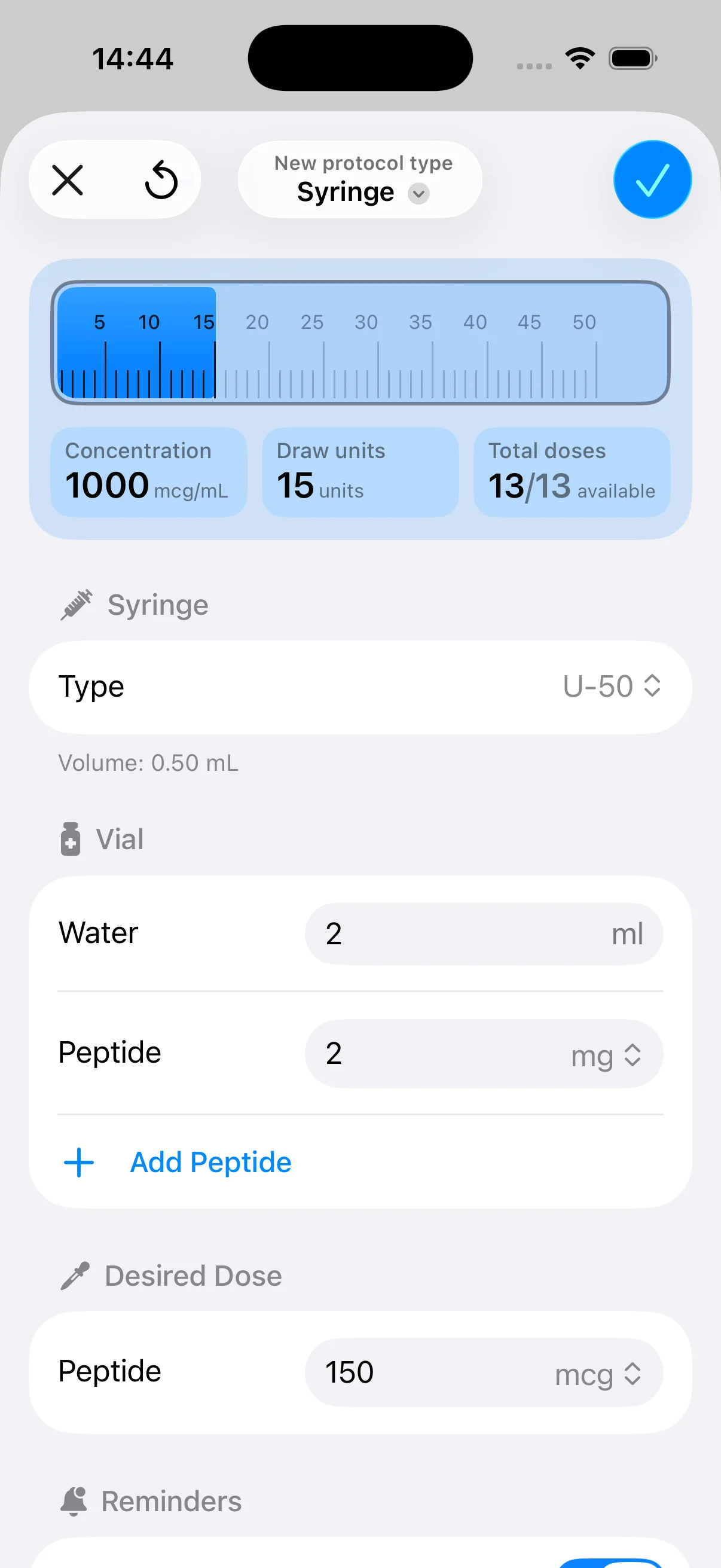
PepFlow is built for the planning side of that problem. It focuses on calculation, scheduling, reminders, and logging rather than medical decision-making.

Instead of doing manual conversions each time, users can rely on PepFlow’s peptide calculator to convert desired amounts into usable measurements based on vial and dilution details. From there, the app can support protocol structure with reminders, live countdowns, history tracking, and simple logging.
That kind of organization doesn’t make a protocol safer by itself. But it does reduce avoidable execution errors. For anyone tracking compounds with different schedules, different concentrations, or different research goals, that’s a meaningful practical advantage.
If you want a cleaner way to manage peptide math, schedules, and reminders without juggling spreadsheets and handwritten notes, try PepFlow. It’s a simple iOS tool for accurate dosing calculations, protocol tracking, and day-to-day adherence.